Madrid rewards a little pre-trip homework, and this page collects the make-or-break basics in one place. The city’s daily rhythm runs later than most first-timers expect, its restaurant customs have a few quirks worth knowing, and small social habits shape how smoothly your days go. None of it is complicated once someone spells it out. What trips people up is arriving without knowing that lunch is a mid-afternoon event, that a cover charge is legal, or that greeting a shopkeeper is expected. This guide answers the practical “what do I actually need to know” questions for Madrid specifically — the madrileño clock, local etiquette, seasonal packing, and weekly closures. The deep verticals — getting around, staying safe, budgeting, choosing a base — each have their own dedicated guide, linked where they belong.
Quick Answer
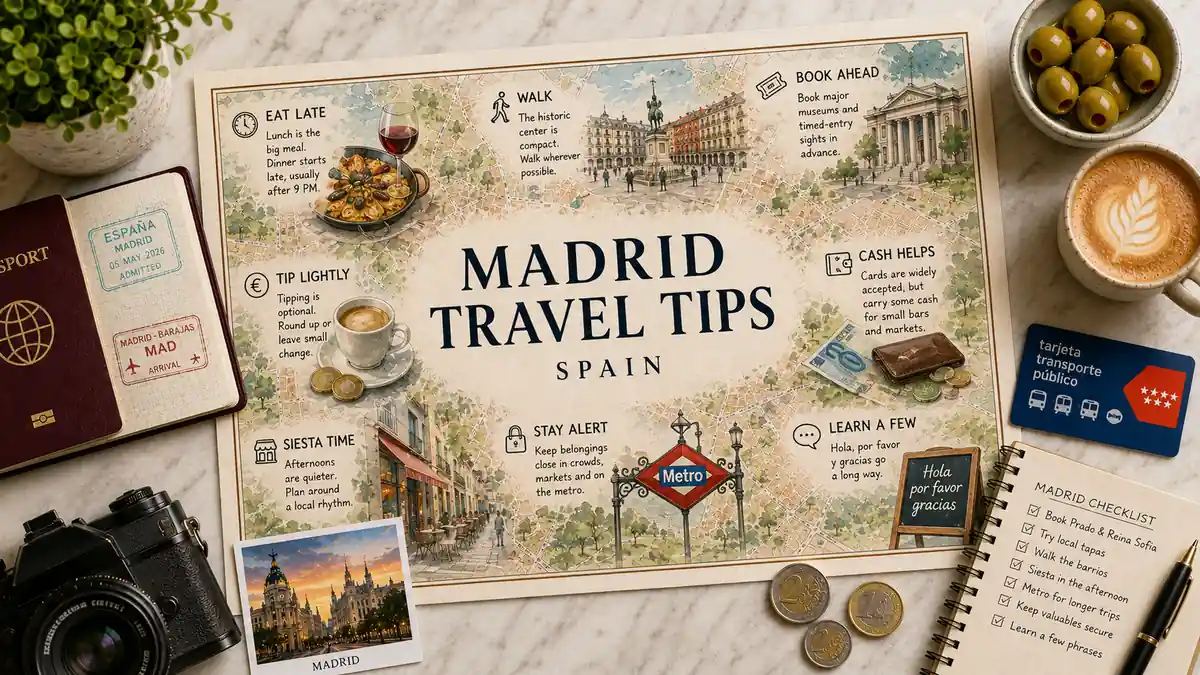
Madrid runs on a later clock: locals eat lunch mid-afternoon and dinner late into the evening. Adjusting to that daily rhythm changes a visit more than any other habit. Eat when locals do, tip lightly by rounding up, carry small coins for cafés, and keep bags in front in busy crowds.
Trust Layer
Tripstou planning guide for travelers resolving one travel decision. Covers the main variable, traveler context, and practical tradeoffs.
Produced with AI assistance and reviewed by Alex Perrut, working in tourism since 2015, for the Tripstou editorial team. See our editorial process for details.
Last factual review: July 21, 2026.
Official sources consulted: Spain.info, Turespaña.
Key Takeaways
- Shift your clock later — locals eat lunch mid-afternoon and dinner late, and adjusting to that rhythm shapes your whole visit.
- Tip lightly by rounding up or leaving small change; no fixed percentage is expected, so carry a few coins.
- A cubierto or bread-and-water charge is legal only when listed on the menu, and you can decline what you did not order.
- Madrid’s tap water is safe and good — ask for agua del grifo to get it free and skip bottled water.
- English gets you by in tourist areas, but greeting staff with hola and gracias opens doors in local spots.
- Pack layers for Madrid’s sharp seasonal swings, and expect quiet shops on Sundays with some museums closed on Mondays.
Table of Contents
What should first-time visitors know before Madrid?
Madrid’s day runs later than most visitors expect, and that one shift shapes everything else. Meals land hours after northern-European or American schedules, tipping stays light, and pickpockets work the busiest tourist streets. Learn those four habits before you land and the city feels effortless from day one.
- Shift your meal times later — lunch mid-afternoon, dinner late in the evening.
- Tip lightly: round up or leave small change, with no fixed percentage expected.
- Keep bags zipped and in front in crowds; the busiest tourist streets are where thieves work.
- Learn two or three Spanish courtesies — they change the tone of every interaction.
A few logistics are worth sorting before you arrive. Getting around is easy once you hold the reloadable Multi Card, and the how-to lives in our Madrid transport guide. Pickpocketing, not violent crime, is the real risk, and it clusters around Sol, Gran Vía, and Callao; our Madrid safety guide covers the specific tricks. If you are landing at Barajas, plan your route into the centre with the Madrid airport transfer guide before you fly.
How do Madrid’s meal times and siesta actually work?
Madrid eats late — lunch in the mid-afternoon and dinner well into the evening. The siesta is more an afternoon lull than a full shutdown; big stores and sights stay open, while some small family shops pause. Shift your own clock a few hours and everything lines up.
When do madrileños eat lunch and dinner?
Madrileños eat lunch in the mid-afternoon and dinner late into the evening. Lunch is the main meal of the day, often a relaxed, multi-course affair, and it is when the value-packed menú del día appears. Dinner starts far later than most visitors are used to, and many neighbourhood kitchens are only warming up in the later evening.
Book dinner for the hour a local would eat, even if you feel hungry earlier — neighbourhood kitchens often do not fire up until well into the evening, and the tourist-strip terraces serving full dinners at six o’clock are the ones to skip.
What is the siesta, and what closes in the afternoon?
The siesta today is more an afternoon lull than a citywide shutdown. In central Madrid, department stores, museums, big-name shops, and restaurants stay open straight through. What you may notice is a quieter mid-afternoon stretch when some small, family-run shops close their shutters for a couple of hours before reopening later. Plan errands around it and you will barely feel it.
| Daily moment | Typical local window | What to expect |
|---|---|---|
| Breakfast (desayuno) | Early morning, kept light | Coffee with a pastry or toast |
| Lunch — the main meal | Roughly mid-afternoon | Largest meal; menú del día shines |
| Afternoon lull | Early-to-mid afternoon | Some small shops pause briefly |
| Dinner (cena) | Late in the evening | Kitchens open late; tourist strips earlier |
| Bars and nightlife | From late evening onward | Terraces and bars stay busy |
How do tipping, bread charges and water work in restaurants?
Tipping in Madrid is light, cover charges are legal only when disclosed, and the tap water is safe. Restaurants here do not expect a fixed percentage; rounding up or leaving small change is plenty. A cubierto or bread charge must appear on the menu and can be declined. Ask for tap water and it arrives free.
Do you tip in Madrid?
Tipping in Madrid is modest and never obligatory. Locals round up the bill or leave a little loose change for good service, and a euro or two per person after a nice meal is generous. Service staff are paid a proper wage, so a tip tops up good service; it does not fund it. Carry small coins — cafés and casual bars are where rounding up is easiest.
What is the cubierto / bread-and-water charge?
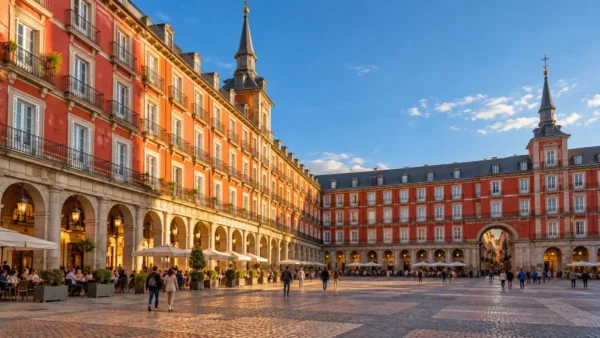
A cubierto is a small per-person cover charge some restaurants apply, and bread brought to the table can carry its own line on the bill. Both are legal only when listed on the menu, and you can decline bread you did not order. The picture menu propped outside a Plaza Mayor terrace is the tell — those tourist-facing spots are the ones most likely to slip a cover onto the bill, while a place chalking up a menú del día rarely bothers.
For the best-value lunch, order the menú del día, a fixed-price multi-course meal locals lean on daily; our Madrid trip cost guide shows how far it stretches a budget.
Can you drink the tap water?
Madrid’s tap water is safe to drink and genuinely good. The city is proud of its mountain-sourced supply, and locals drink it without a second thought. Ask for “agua del grifo” and you will get tap water free, which sidesteps the cost and plastic of bottled water. Refill a bottle before heading out for the day.
Do people in Madrid speak English?
Yes, you can get by in English across tourist-facing Madrid, though a few Spanish courtesies open more doors. Staff at hotels, major restaurants, and top attractions generally speak English well. In neighbourhood bars and local shops, expect less, so lead with a simple “hola” and “gracias”. A little effort in Spanish shifts the whole interaction in your favour.
You do not need to be fluent — a handful of phrases carries you through almost any exchange:
- Hola — hello
- Gracias — thank you
- Por favor — please
- ¿Habla inglés? — Do you speak English?
- La cuenta, por favor — The bill, please
What greeting and social etiquette should you know?
Greet people when you enter a shop or bar, and expect a two-cheek kiss among friends. Madrileños greet on arrival and keep social life late and lively, and none of it feels formal. A handshake suits first meetings; a light cheek kiss suits friends. Follow the room and you fit in fast.
The habits that matter most in Madrid are small and easy to adopt:
- Do say “buenos días” or “hola” when you walk into a shop, bar, or lift.
- Do wait to be seated at restaurants, and keep a relaxed volume even as bars get loud.
- Don’t rush a meal or expect the bill automatically — you ask for it when you are ready.
- Don’t treat late dinners and late nights as unusual; that is simply the local pace.
Much of this overlaps with the rest of the country, so we keep the nationwide customs — broader dining codes, regional sensitivities, wider social norms — in our Spain travel tips guide, and stay Madrid-focused here.
What should you pack for Madrid by season?
Pack for Madrid by season: hot dry summers, cold crisp winters, and mild spring and autumn. Layers matter in every month, because mornings, afternoons, and evenings can swing sharply apart. Whatever the season, Madrid is a walking city, so pack shoes you can cover real distance in. Sun protection matters even outside high summer.
Madrid’s inland, high-altitude position gives it real seasonal swings, so match your bag to when you go:
- Spring: mild days and cool evenings — layers and a light jacket.
- Summer: hot and dry — breathable clothing, a hat, sunscreen, and a water bottle.
- Autumn: comfortable and changeable — layers plus a compact umbrella.
- Winter: cold and crisp — a warm coat, a scarf, and proper footwear.
Staying online for maps and translation is simplest with a local data plan; our best eSIM for Spain guide covers the options before you land.
Get online the moment you land
An eSIM installs before you fly — no SIM swap, no roaming bill, no queue at an airport kiosk. Two options, depending on how you travel:
Holafly — unlimited-data plans, so nothing counts against a
cap. Best for longer stays, remote work, and heavy map and video use.
Code TRIPSTOU applies automatically: 5% off any travel eSIM,
reusable on every order, or 10% off Holafly Plans.
Get a Holafly eSIM →
Airalo — pay for the data you need, across 200+ destinations,
trusted by 20M+ travelers. Best for short trips and light use.
Use code NEWTOAIRALO15 for 15% off your first order:
Get an Airalo eSIM →
Tripstou may earn a commission if you purchase through these links, at no extra cost to you.
What’s closed on Sundays, Mondays and holidays?
Many shops slow down or close on Sundays, and some museums shut on Mondays, but Madrid stays lively. Sunday is the quietest retail day, and a few big museums keep Monday as their closing day. Restaurants, cafés, and major sights largely stay open, so plans rarely fall apart. El Rastro flea market is the big Sunday-morning exception, drawing crowds.
Build your week around the pattern and nothing catches you out:
- Sundays: many shops close or run reduced hours, while El Rastro flea market is the lively exception.
- Mondays: several major museums close, so check before planning a museum-heavy day.
- Public holidays: expect shop closures and quieter streets, though most restaurants keep serving.
- Always open: cafés, bars, major sights, and most restaurants keep the city moving daily.
Frequently Asked Questions
Is Madrid a walkable city?
Yes, Madrid is very walkable, with most major sights clustered in a compact central core. You can stroll between the Prado, Puerta del Sol, the Royal Palace, and Plaza Mayor in well under an hour. Wear comfortable shoes, and save the metro for longer cross-city hops.
What power plug adapter do you need in Spain?
Spain uses the Type C and Type F plugs with a 230-volt supply, the standard across continental Europe. Travelers from the UK, US, and most non-EU countries need a simple travel adapter. US visitors should also check that devices support 230 volts, though phones and laptops usually do.
Is Madrid good for a first-time visitor?
Yes, Madrid is an excellent first-time destination: compact, walkable, and easy to navigate without Spanish. Tourist-facing staff speak English, the metro is straightforward, and world-class museums sit within walking distance of each other. The main adjustment is the late meal schedule, which takes a day or two to settle into.
Do you need cash, or is card widely accepted in Madrid?
Cards are widely accepted in Madrid, including contactless, so you rarely need much cash. Restaurants, shops, taxis, and the metro all take cards, and many places prefer them. Keep a small amount of coins for tipping, café rounds, and the occasional traditional bar or market stall that stays cash-only.
Do shops and restaurants really close in August in Madrid?
Some do, but far fewer than the old cliché suggests. In August, a share of small, family-run shops and traditional restaurants close for a few weeks while owners take holidays. Major sights, museums, chain stores, and tourist-area restaurants stay open, so a summer visit still works comfortably.
Should you carry your passport or just a copy in Madrid?
Carry a copy for daily sightseeing and leave your passport locked in your accommodation. A photo or photocopy covers almost every situation, and it limits your loss if a pickpocket strikes in a crowded area. Keep the original secure, and bring it only when you genuinely need official ID.
Related Guides
- Madrid travel guide — the full overview and starting point for planning your trip.
- Where to stay in Madrid — the best neighbourhoods to base yourself by trip style.
- Madrid in 2 days — how to see the highlights on a short visit.
- Madrid in 3 days — a fuller route for a longer stay.
- Getting around Madrid — the Multi Card, metro, and buses explained.
- Madrid trip cost — what to budget, from meals to museums.
- Is Madrid safe? — pickpocket hotspots and how to avoid the common tricks.
- Spain travel tips — the country-wide customs behind the Madrid specifics.
Did this guide save you time or money? Tripstou is independent and reader-funded — if you'd like to give something back, you can support the site with a crypto contribution of any size.