You have chosen Madrid, and now the real planning question is money: how much to set aside before you lock in trip length, accommodation tier, and how you fill your days. The single decision axis is how much you spend per day and what drives that figure up or down. The honest answer is that travel style decides almost everything — where you sleep and how you eat move the total far more than which sights you see. This guide gives you realistic daily ranges by travel style, a category-by-category breakdown for accommodation, food, and attractions, and sample totals for a weekend and a 3-day stay, so you can size the spend with confidence and route the finer details to the right pages.
Quick Answer
A mid-range Madrid trip costs roughly €100–€180 per person per day. Travel style is the biggest lever: your accommodation tier and eating habits move the total most, with budget trips near €50–€80 and luxury above €250. Most travelers should plan a mid-range daily budget and adjust for season and trip length.
Trust Layer
Tripstou planning guide for travelers resolving one travel decision. Covers the main variable, traveler context, and practical tradeoffs.
Produced with AI assistance and reviewed by Alex Perrut, working in tourism since 2015, for the Tripstou editorial team. See our editorial process for details.
Last factual review: June 24, 2026.
Official sources consulted: travel-europe.europa.eu, european-union.europa.eu.
Key Takeaways
- Plan around €100–€180 per person per day for a mid-range Madrid trip, the realistic anchor most travelers should budget toward.
- Travel style decides the bill more than sightseeing: where you sleep and how you eat move the total most.
- Budget travelers can manage €50–€80 a day while luxury runs €250 upward, bracketing the mid-range band on either side.
- Dropping an accommodation tier saves the most, since lodging is the single largest and most variable line in the budget.
- Trip length scales cost in near-linear steps; a weekend runs €300–€500 and a 3-day stay about €450–€700 per person.
- Madrid is one of Western Europe’s better-value capitals, cheaper than London or Paris thanks to local eating and free museum hours.
Table of Contents
How much does a Madrid trip cost per day?
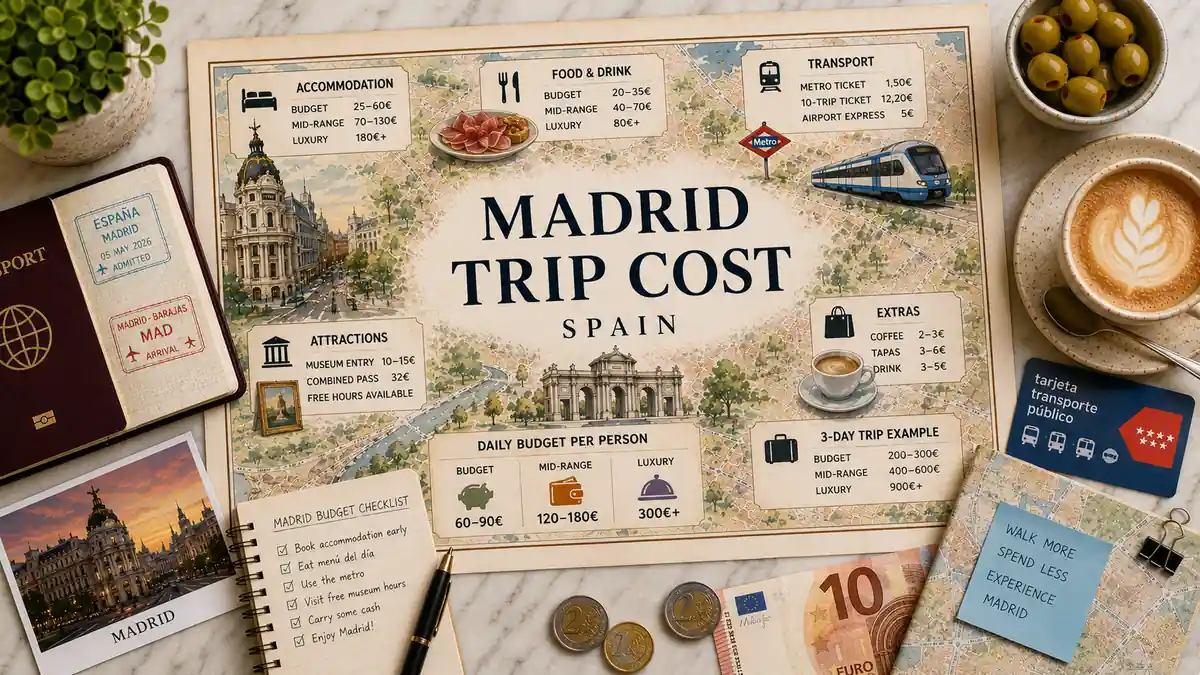
A Madrid trip costs roughly €100–€180 per person per day at a mid-range pace. Travel style is the main driver: budget travelers can manage €50–€80 a day, while luxury trips run €250 or more. Accommodation and food set the floor; sightseeing and transport add comparatively little. Treat these as ranges and verify before booking.
The daily figure is built from a predictable stack: a bed, two or three meals, one or two paid sights, and a small transport allowance. Accommodation is the largest and most variable piece, which is why your tier sets the tone for the entire budget. Food is the second lever, and it swings widely depending on whether you eat tapas and a fixed-price lunch or sit down for dinner with wine every night.
Transport is a small line in Madrid, not a budget driver. The city centre is walkable and the metro is inexpensive, so most travelers fold a few euros a day into the total without much thought. For how fares and passes actually work, see getting around Madrid; for the ride in from the airport, see Madrid airport transport.
The single biggest swing in your daily cost is the tier you choose, not the individual prices you pay. Pick the tier first, then the day-by-day numbers fall into a narrow, plannable band.
Cost by travel style: budget, mid-range, and luxury
Madrid splits into three budget tiers: budget, mid-range, and luxury, each with a distinct daily band. Budget runs roughly €50–€80 a day, mid-range €100–€180, and luxury €250 upward. The tiers differ mainly in behavior — where you sleep, how you eat, and how you move. Match the tier to your habits and the budget plans itself.
The numbers matter less than the lifestyle behind them. A budget traveler sleeps in a dorm or simple double, eats from markets, bakeries, and the menú del día, and walks or uses the metro. A mid-range traveler books a comfortable hotel, mixes casual tapas with a proper sit-down dinner, and pays into a couple of museums without counting every euro. A luxury traveler chooses central design or four- to five-star hotels, dines at restaurants, and adds taxis, tours, and extras freely.
| Travel style | Daily budget (per person) | Where you sleep | How you eat |
|---|---|---|---|
| Budget | roughly €50–€80 a day | hostel dorm or simple double | markets, bakeries, menú del día |
| Mid-range | roughly €100–€180 a day | comfortable central hotel room | tapas plus a sit-down dinner |
| Luxury | roughly €250 a day and up | four- to five-star or design hotel | restaurant dining and extras |
There is no need to chase the lowest tier if it makes you miserable. Identify the style you will actually enjoy, plan that daily band, and let trip length scale the total rather than squeezing every category.
How much does accommodation cost per night in Madrid?
A mid-range Madrid hotel room costs roughly €100–€160 per night for a double. Below that, budget doubles run about €60–€90 and hostel dorm beds €20–€35; above it, luxury rooms start near €250. Accommodation is usually the single largest line in a Madrid budget, so the tier you pick sets the trip total.
Prices move with season and timing more than with any other factor. Peak periods and major events push nightly rates toward the top of each band, while shoulder months and midweek stays pull them down. Booking earlier generally locks in better rates than waiting. Treat every figure here as a range and verify current prices before booking.
This page covers nightly price bands as a budget input only — which area to base yourself in is a separate decision. For neighbourhood tradeoffs and specific picks, see where to stay in Madrid.
Hotels and places to stay
Compare hotels, apartments and stays for your dates in one search.
Search hotels and stays on hotels.com →
Tripstou may earn a commission if you book through this link, at no extra cost to you.
How much does food cost per day in Madrid?
Expect to spend roughly €30–€50 per day on food at a mid-range pace in Madrid. How you eat drives the figure: a menú del día lunch runs about €12–€18, tapas and casual meals keep costs low, and a sit-down dinner with wine pushes higher. Cooking or grabbing market food trims the total further.
Madrid rewards travelers who eat like locals. The fixed-price menú del día — typically a starter, main, drink, and dessert at lunch — is the single best-value meal in the city and the easiest way to keep a daily food budget in check. Casual tapas, bakeries, and markets fill the gaps cheaply, while reserving the bigger spend for one good dinner keeps the average reasonable.
Budget eaters can stay near €15–€25 a day by leaning on markets and fixed-price lunches, while regular restaurant dining pushes the daily figure well above €50. As with all figures here, treat these as ranges that shift with where and how often you eat out.
How much do attractions and museums cost in Madrid?
Major Madrid museums charge roughly €12–€18 for standard adult entry. The big three — the Prado, Reina Sofía, and Thyssen — sit in that band, while smaller sights and the royal palace vary. Budget around €15–€30 a day for sightseeing if you visit one or two paid attractions. Free-entry windows can cut this to almost nothing.
Sightseeing is one of the cheaper lines in a Madrid budget, partly because so much of the city is free to enjoy. The major museums open free entry during set windows, often in the late afternoon or on certain days, which lets careful planners see world-class collections at no cost. Parks like El Retiro, the historic plazas, and simply walking the centre add no charge at all.
Plan one or two paid attractions per day rather than stacking museums, and lean on the free windows where timing allows. Entry prices shift over time, so confirm current rates and free-entry hours before you go and treat the figures here as ranges.
Tours and activities
Book skip-the-line tickets, day trips and local tours with free cancellation on most activities.
You can also browse everything on getyourguide.com.
Tripstou may earn a commission if you book through this link, at no extra cost to you.
Is Madrid expensive for tourists?
Madrid is not expensive by major European capital standards. It typically costs less than London, Paris, or Amsterdam for accommodation, dining, and attractions, while offering world-class museums and food. The city is genuinely affordable for mid-range and budget travelers, with abundant low-cost eating and free cultural windows. Your travel style, not the city, decides the final bill.
The reason Madrid feels affordable is structural. Eating well is cheap thanks to the menú del día and a deep tapas culture, the metro is inexpensive, and many of the city’s best experiences — its plazas, parks, and free museum hours — cost nothing. That keeps the baseline low even when hotel prices climb in peak season.
Where Madrid can get expensive is at the top end: central luxury hotels, fine dining, and prime-season rates rise quickly. But that is a choice, not a requirement. A traveler who books sensibly and eats local will find Madrid one of the better-value capital cities in Western Europe.
How to do Madrid on a budget
The biggest way to cut a Madrid budget is choosing cheaper accommodation. Where you sleep moves the total more than any other choice, so dropping a tier or shifting to a dorm saves the most. After that, free museum hours, the menú del día, public transport, and shoulder-season timing each shave meaningful amounts off the daily spend.
The highest-impact levers, in rough order of savings:
- Drop an accommodation tier — the single largest line, so a dorm or simple double cuts the most from the total.
- Use free museum hours — the major museums waive entry during set windows, turning a paid sightseeing day into a free one.
- Eat the menú del día — a fixed-price lunch is the best-value full meal in the city.
- Walk and use the metro — the centre is compact and public transport is cheap, so skip taxis.
- Travel in shoulder season — quieter months pull nightly rates toward the bottom of their band.
Stack the levers instead of relying on one. Combining cheaper sleeping, fixed-price lunches, and free museum windows can move a trip from mid-range to budget without it feeling like deprivation. For broader money-saving and practical advice, see our Madrid travel tips.
Sample Madrid trip costs: weekend and 3-day budgets
A mid-range weekend in Madrid costs roughly €300–€500 per person, and a 3-day trip about €450–€700. Cost scales mainly with nights booked, since accommodation repeats every night while some sightseeing is one-off. Adding days raises the total in near-linear steps once flights are excluded. Budget travelers land well below these ranges; luxury travelers well above.
These totals exclude flights and assume a mid-range pace: a comfortable hotel, a mix of tapas and one good dinner a day, and one or two paid attractions. A weekend covers two nights, a 3-day trip two to three nights, and a longer five-day stay scales to roughly €750–€1,200 per person on the same basis. Treat all of these as ranges and adjust for season and your own style.
To see how the spend maps onto an actual plan, pair these totals with a 2-day Madrid itinerary or a 3-day Madrid itinerary. If Madrid is one stop on a longer route, fit it into the bigger picture with our Spain travel budget.
The cheapest itinerary design is usually fewer bases, not fewer days. Staying put in Madrid avoids repeat check-ins and transfer costs, so length scales cleanly and predictably.
Frequently Asked Questions
How much spending money do I need for Madrid?
Plan roughly €60–€100 per person per day in spending money for a mid-range Madrid trip, covering food, attractions, and transport once accommodation is booked separately. Budget travelers can manage on €30–€50 a day, while heavy restaurant dining and taxis push the figure well above €100. Adjust for your eating habits.
How much is a typical meal in Madrid?
A typical sit-down meal in Madrid costs roughly €12–€25 per person, depending on the spot. The menú del día — a fixed-price lunch with starter, main, drink, and dessert — runs about €12–€18 and offers the best value. Tapas and casual bites cost less, while dinner with wine runs higher.
What’s the cheapest time of year to visit Madrid?
The cheapest time to visit Madrid is the shoulder seasons — roughly late autumn and winter outside the holidays, plus parts of summer when locals leave. Nightly hotel rates fall toward the bottom of their bands during these quieter months. Avoid major events and peak spring weekends, when accommodation prices climb sharply.
Can you visit Madrid’s museums for free?
Yes, Madrid’s major museums offer free entry during set windows, often in the late afternoon or on certain days. The Prado, Reina Sofía, and Thyssen each waive admission during these periods, letting careful planners see world-class collections at no cost. Parks, plazas, and walking the centre are always free.
How much should I budget for a 5-day Madrid trip?
Budget roughly €750–€1,200 per person for a mid-range 5-day Madrid trip, excluding flights. The figure scales mainly with the four or five nights of accommodation, plus daily food and one or two paid attractions. Budget travelers can do five days for less, while luxury stays run well beyond this range.
Is Madrid mostly cash or card?
Madrid is largely card-friendly, with cards accepted at hotels, restaurants, shops, and the metro. Carry some cash for small tapas bars, markets, tips, and the occasional spot with a card minimum. A mix works best: rely on cards for most spending and keep modest cash on hand for small daily purchases.
Related Guides
- Madrid travel guide — the full city overview and planning hub.
- Where to stay in Madrid — neighbourhood tradeoffs and area picks.
- 3-day Madrid itinerary — how to spend your time and money over a long weekend.
- Getting around Madrid — metro, buses, and fare mechanics.
- Madrid travel tips — practical advice for saving money and avoiding mistakes.
- Spain travel budget — how Madrid fits into a national trip cost.
Did this guide save you time or money? Tripstou is independent and reader-funded — if you'd like to give something back, you can support the site with a crypto contribution of any size.