Vila Nova de Gaia is on your shortlist, and the listing map has stopped making sense. The name covers an entire municipality, most of it ordinary suburb, while the Gaia visitors actually mean is a thin strip of riverfront facing Porto. Two things decide how your week goes, and neither is the hotel. The first is the level you sleep at: Gaia’s riverside exists on two shelves, one at the water and one high above it, each tied to a different deck of the Dom Luís I bridge. The second is how far your address sits from that strip, because a booking site will happily label a bedroom deep inland “Vila Nova de Gaia”. Gaia is its own city on the south bank of the Douro, not a Porto neighbourhood. This page is about choosing the right part of it.
Quick Answer
Stay on the Gaia riverfront near the Dom Luís I bridge; Cais de Gaia is the strongest all-round base. The trade-off is vertical: quay level is flat but you climb to reach most of Porto. Jardim do Morro suits travelers who want the metro, the panorama and Gaia’s busiest pocket.
Trust Layer
Tripstou stay guide for travelers choosing where to base. Covers area atmosphere, budget, convenience, noise, and traveler fit.
Produced with AI assistance and reviewed by Alex Perrut, working in tourism since 2015, for the Tripstou editorial team. See our editorial process for details.
Last factual review: August 30, 2026.
Official sources consulted: Visit Portugal, Turismo de Portugal.
Key Takeaways
- The level you sleep at matters more than the hotel: quay level is flat, the upper deck brings metro and view.
- Cais de Gaia is the strongest all-round base, with lodges, restaurants and the lower bridge deck all on flat ground.
- Jardim do Morro trades quay intimacy for metro Line D, a level walk into upper Porto and heavy sunset crowds.
- If a listing is not walkable to the quay or a bridge deck, it is not the Gaia visitors mean.
- The bridge decks are free and walkable at any hour; the cable car closes in the early evening, earlier in winter.
- Both levels span budget to high-end stays, and the rooms facing Porto sit at the top of every band.
Table of Contents
Vila Nova de Gaia Is Its Own City, Facing Porto Across the Douro
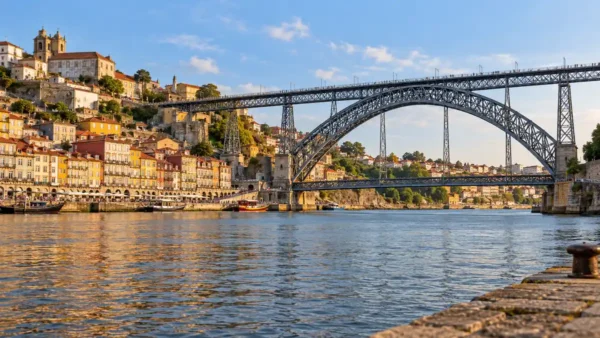
Gaia is a separate city, not a Porto neighbourhood, sitting directly across the Douro from Ribeira. The two banks face each other at close range, joined by the Dom Luís I bridge, whose two pedestrian decks are free to walk at any hour. Porto’s centre starts where the bridge ends.
What the south bank buys you is the postcard in reverse. The port lodges are here — cellars stacked up the hillside, most of them within sight of the water — and so is the view back at Porto’s terraced facades, which is the image everyone photographs and only Gaia guests wake up to. Ribeira has the crowd; Gaia has the angle on it.
Streets away from the quay strip are noticeably calmer at night than the tourist core across the water, since Gaia’s own residential life carries on behind the riverfront. That calm is directional, not absolute: the quay itself fills with diners and river-boat traffic through the evening, and the terrace at the top does the same at sunset.
Everything else about the geography is already settled elsewhere. The river runs west to the Atlantic, the historic centre sits on the north bank, and the city’s monuments cluster uphill from the water — our Porto guide covers that orientation in full. For a base decision, one spatial fact does the work: you are across the river from the sights, and every day begins with a bridge.
Cais de Gaia or Jardim do Morro: Pick Your Level Before Your Hotel
The real choice in Gaia is vertical: sleep at quay level or up at Jardim do Morro. Gaia’s riverfront exists on two shelves, and the one you book decides your daily walk more than the address does. Everything else — atmosphere, price, noise — follows from that level.
The two shelves each pair with a deck of the bridge. Down at the water, Cais de Gaia sits at the same height as the lower deck, which crosses into Ribeira on the flat. Up on the ridge, Jardim do Morro sits at the same height as the upper deck, which crosses into the Sé and Batalha area of upper Porto — also on the flat, but well above the water. The two levels are connected to each other by a hillside of steps, a steep street, or the cable car that runs between them.
That is the mechanic worth internalising before you filter by price: the decks do not connect to each other except by climbing, so booking a level is booking one of the two Portos you can reach without effort. Guests at the quay reach Ribeira and the riverside restaurants flat, and climb for the cathedral, the bookshop, the Clérigos tower and almost every other monument. Guests up top reach the monument belt flat, and descend — then re-ascend — for an evening among the lodges.
If your hesitation is really Gaia against the Porto bank at all, that head-to-head is settled on its own page: Baixa vs Vila Nova de Gaia.
Cais de Gaia and Santa Marinha: Flat at the Water, a Climb to Everything Else
Cais de Gaia is the strongest all-round base in the municipality, and the default choice for a first stay. It runs along the water beneath the lodge hillside, with Santa Marinha as the parish behind and above it. This is the pocket most people picture when they say they are staying in Gaia.
The atmosphere splits cleanly by hour. Daytime belongs to lodge visitors and the tour groups moving between cellars, and the quay itself can feel like a corridor. Evening is the payoff: the strip’s restaurants and wine bars face Porto with the far bank lit up, and the crowd thins to people who are eating instead of passing through. It stays lively without turning into a nightlife district.
Convenience is a story of one flat plane and one wall. Along the water you walk everywhere without gradient — lodges, restaurants, the boat quay — and the lower bridge deck delivers you into Ribeira at the same level. The wall is the hillside: Porto’s monuments sit uphill from Ribeira, so a day of sightseeing means climbing on the far side, and returning to your bed means descending on this one. Travelers with mobility limits or a stroller should book as close to the bridge as possible.
Stock here spans budget guesthouses tucked in the streets behind the quay through mid-range riverfront hotels to a handful of high-end conversions in old lodge buildings. Rooms with a direct view of Porto command the top of whatever band they sit in.
Best for: travelers who want flat evenings among the lodges and accept a climb on sightseeing days.
Jardim do Morro: The View and the Metro, in Gaia’s Busiest Pocket
Jardim do Morro is the base for travelers who put transport and the panorama first. It occupies the ridge at the Gaia end of the upper bridge deck, around the garden that gives it its name. You trade the quay’s intimacy for altitude and connections.
The atmosphere is dominated by the terrace. The garden is the city’s best-known sunset spot, and in peak season it draws a dense, cheerful, buskers-and-beer crowd that spills onto the bridge approach. Off-season and outside the sunset window it empties out fast. The residential streets a block or two behind the garden are calmer at any time of year, which is where the quieter stays are.
Convenience is the reason to be here. Metro Line D stops at Jardim do Morro on the upper deck, linking the ridge to central Porto and onward across the network. Better still, the upper deck is a level walk straight into upper Porto, so the cathedral quarter, Batalha and Baixa arrive without a single stair. The cost is the quay: reaching the lodges and the riverside restaurants means going down the hillside and back up at the end of the night.
Prices here run from budget hostels and apartments on the back streets to mid-range hotels near the metro, with a high-end tier attached to the view itself. The panorama is what the top of the market is selling.
Best for: metro-first travelers who want the panorama and a level walk into Porto’s monument belt.
Hotels and places to stay
Compare hotels, apartments and stays for your dates in one search.
Search hotels and stays on hotels.com →
Tripstou may earn a commission if you book through this link, at no extra cost to you.
How Far from the Quay Is Too Far to Book?
Treat “Vila Nova de Gaia” on a listing as a prompt to open the map, not a location. The visitor’s Gaia is a narrow riverside ribbon and the level immediately above it. Behind that ribbon the municipality turns into ordinary residential suburb that happens to share the name.
The ribbon is genuinely thin — a strip of quay, the lodge hillside above it, and the ridge at the top. Step past that and you are in a working Portuguese city of apartment blocks, supermarkets and school runs, well served for its residents and empty of everything a visitor came for. Listings there are legitimately in Vila Nova de Gaia. They are not in the Gaia anyone means.
Three checks settle almost every doubtful listing:
- Is it on the ribbon? The address should sit on the quay, on the lodge hillside, or on the ridge around Jardim do Morro. Anything further south is inland Gaia.
- Can you walk to the bridge? If reaching either bridge deck needs a bus or a taxi, the location has failed its only real job.
- Can you see the river from the neighbourhood? Not from the window — from the street. The visitor’s Gaia is defined by the water it faces.
An address that fails those checks costs you twice: you inherit an outer-suburb commute and you lose the compensations — the lodges, the view, the evening strip — that made the south bank worth choosing. At that point a room on the Porto side does the same job better.
Other Corners of Gaia: Afurada, the Beaches and the Inland Suburbs
Beyond the riverfront, only a few corners of Gaia make sense for a visitor’s bed. Afurada and the Atlantic beaches have real character, and both cost you proximity to the bridge. The inland districts are residential, and they are where most stray listings actually sit.
Afurada. A working fishing village downriver near the river mouth, with grilled-sardine restaurants, a public washhouse still in use and almost no tourist infrastructure. It is a lovely place to eat and a distant place to sleep — the choice trades daily convenience for atmosphere, which suits repeat visitors far better than first-timers.
Canidelo and the Atlantic beaches. Gaia’s coastline runs south from the river mouth with wide sand, surf schools and a boardwalk. This is a beach base, not a Porto base: you commute into the city instead of stepping into it, so it only earns its place on a summer trip built around the sea.
Mafamude and Oliveira do Douro. Inland residential districts with everyday services, decent bus links and nothing a visitor travelled for. Most of the confusing “Vila Nova de Gaia” listings on booking sites are here, which is precisely why they look cheap.
Can You Walk from Gaia into Porto — and Back at Night?
Yes — both decks of the Dom Luís I bridge are pedestrian, free and open at any hour. The question that matters when you book is which deck your level feeds into. The upper deck serves Jardim do Morro; the lower deck serves the quay.
The crossing itself is never the problem. What varies is the vertical. From Jardim do Morro you walk out onto the upper deck and arrive in upper Porto with no change in height. From Cais de Gaia you cross low into Ribeira, also flat, and then face the hill up to the rest of the city. Changing levels on the Gaia side means the hillside on foot, the Teleférico de Gaia between the quay and the ridge, or — on the Porto side — the Funicular dos Guindais between Ribeira and Batalha.
One ticketing detail is worth knowing before you rely on either: the Andante Tour card is not valid on the Teleférico de Gaia or the Funicular dos Guindais. Both are sold separately from the metro and bus network, so a transport pass does not cover the vertical shortcuts.
The cable car also closes in the early evening, and earlier in winter. That is the mechanic that quietly shapes a Gaia stay: an evening in Porto ends after it has stopped running, so the walk home is the bridge and, from the quay, the hill. The bridge decks are the constant — lit, free and always there. Decide which of those returns you want at midnight, then book the level that gives it to you.
Who Gaia Suits — and Who Should Base Elsewhere in Porto
Gaia is a good base if the lodges, the view and calmer evenings outweigh crossing the river daily. That crossing is the price of the address, and it is paid every day of your trip. Travelers who want the city at their door pay it grudgingly.
For a first visit the level decision matters more than anything else on this page, and the case for and against the south bank in general is laid out in our guide to where to stay in Porto; if this is trip number one, the safer starting point is our first-time base guide. Couples get the best of Gaia — the quay after dark, with Porto lit across the water — and our romantic stays guide weighs the riverfront options. Families are usually better served at quay level, where the ground is flat and the strollers roll, with the alternatives set out for families in Porto. Nightlife-led travelers are on the wrong bank altogether, because Gaia’s evenings end with dinner and the bars are across the river — see Porto for nightlife. Budget travelers will find cheap rooms on both banks, and the honest filter is walkability to the bridge, not the price tag; our budget stays guide applies it across the city. At the top of the market, the south bank has a genuine high-end pocket built around the view, compared against the city’s other luxury options in our luxury guide.
Skip Gaia if your trip is short, monument-heavy and walking-led. A few days spent climbing back and forth over a bridge is a real tax on a first visit, and the view from your window does not repay it.
Frequently Asked Questions
Is Jardim do Morro too touristy to stay in?
The garden itself is Gaia’s busiest spot, and in peak season the sunset crowd is dense and loud. The residential streets a block or two behind it stay calm year-round. Book behind the terrace instead of on it and the pocket works fine as a base.
What time does the Gaia cable car stop running?
The Teleférico de Gaia closes in the early evening, and earlier in winter than in summer. It is not a way home after dinner. The two decks of the Dom Luís I bridge are free and open at any hour, which is what evening returns actually rely on.
Do you have to climb to get to Porto from Gaia?
It depends which climb. From Jardim do Morro the upper deck runs level into upper Porto, so nothing. From the quay you cross flat into Ribeira, then climb on the Porto side to reach the monuments — and the hillside back up to the ridge is a second, separate climb.
Is Afurada worth staying in?
Afurada is worth an evening far more than a week. The fishing village, the grilled sardines and the working washhouse are genuine, but it sits downriver, away from the bridge and the lodges. Repeat visitors with time to spare enjoy it; a first trip loses too much convenience.
Can you stay in Vila Nova de Gaia without a car?
Yes, as long as your address sits on the riverside ribbon or the ridge above it. The bridge decks are walkable, and metro Line D runs from Jardim do Morro. A car only becomes necessary for inland Gaia addresses, which is one more reason to avoid them.
Do you need a room with a view to make Gaia worth it?
No. The famous view back at Porto is public property here — free from the quay, the bridge decks and the garden at Jardim do Morro. A room facing the water sits at the top of whatever price band it belongs to, so treat it as a preference.
Related Guides
- Where to Stay in Porto — the full cross-area comparison and traveler-type breakdown.
- Baixa vs Vila Nova de Gaia — the head-to-head between the two banks.
- Porto Guide — city orientation, layout and how the two banks fit together.
- Best Areas for First-Time Visitors
- Best Areas for Couples
- Best Areas for Families
- Best Areas for Nightlife
- Best Budget Areas in Porto
- Best Luxury Areas in Porto
Did this guide save you time or money? Tripstou is independent and reader-funded — if you'd like to give something back, you can support the site with a crypto contribution of any size.