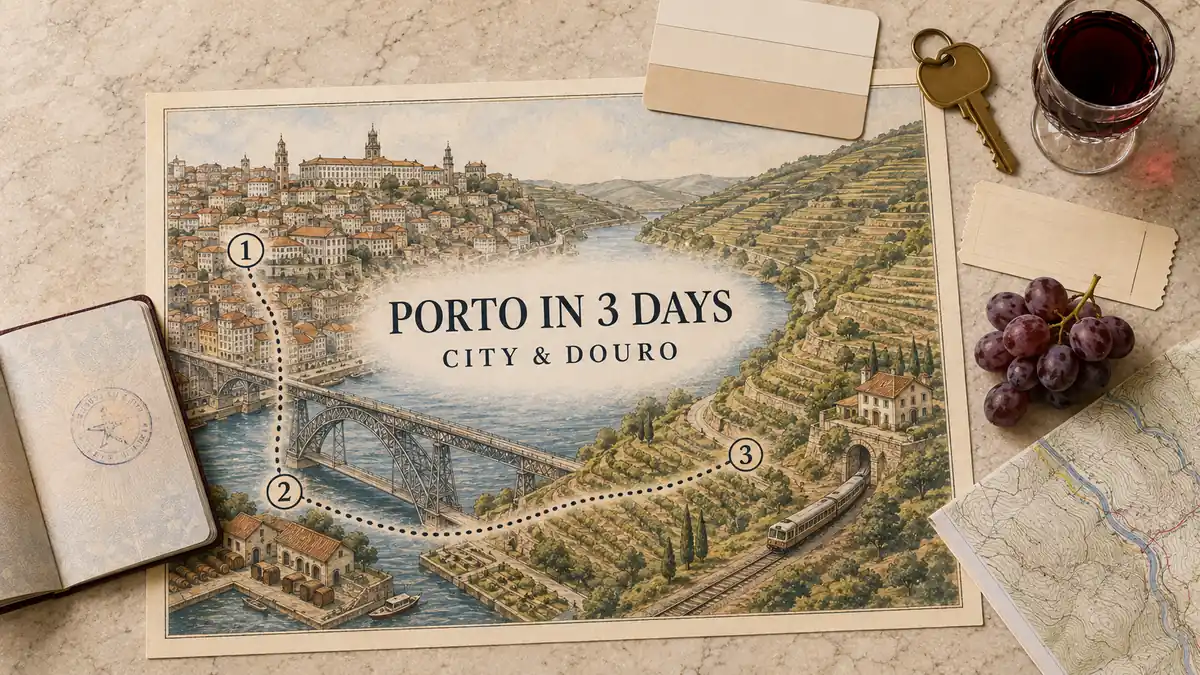
3 days in Porto splits cleanly into 2 city days and 1 day outside the city. Days 1 and 2 cover the whole of walkable Porto — the historic centre on the first day, Vila Nova de Gaia and the port lodges on the second. Day 3 is where the real decision sits, and it is the only decision this itinerary asks you to make.
That decision is the Douro Valley. It is the reason the third day exists on this route, and it is not a free addition: the valley is a full-day commitment with a long journey attached at both ends. This page recommends it anyway, explains what it costs you in hours, and sets out the 3 ways to execute it — a guided tour, the train to Pinhão, or your own car — argued on what each one actually makes possible.
It also names the travelers the valley is wrong for, and what they should do with day 3 instead.
Quick Answer
Spend day 1 in Porto’s historic centre, day 2 in Vila Nova de Gaia, day 3 in the Douro Valley. Day 3 is the real choice: a guided tour reaches several quintas, while the train gives one scenic ride to Pinhão. The route suits first-timers willing to give the valley a full day.
Trust Layer
Tripstou itinerary guide for travelers planning a route. Covers pacing, stop count, stop order, base logic, and trip length.
Produced with AI assistance and reviewed by Alex Perrut, working in tourism since 2015, for the Tripstou editorial team. See our editorial process for details.
Last factual review: August 30, 2026.
Official sources consulted: Visit Portugal, Turismo de Portugal.
Key Takeaways
- Days 1 and 2 cover walkable Porto — the historic centre, then Gaia — leaving day 3 as the only open decision.
- Walk day 1 downhill from Clérigos to Ribeira, so gravity sets the order and the river arrives in the evening.
- The Douro Valley is worth day 3, but it takes the whole day and much of it is travel.
- Choose a guided tour for several quintas, the train for one scenic ride, a car for total freedom.
- Book only two things ahead: the Livraria Lello entry voucher and the Douro day; everything else works on arrival.
- Skip the valley if you travel with small children, need rest, or do not care about wine.
Table of Contents
Porto in 3 Days: The Route at a Glance
Day 1 belongs to the historic centre, day 2 to Gaia, day 3 to the Douro Valley. The order runs outward: the city first, on foot, then the one leg that needs a train or a tour. Leaving the valley until last means a late arrival costs you nothing but the flexible day.
- Day 1: the historic centre — Porto’s downhill core, from Clérigos to the river.
- Day 2: Gaia — the port lodges and the river, reached over the Dom Luís I bridge.
- Day 3: the Douro Valley — the full-day branch, out of the city and back.
The city days are sequence-identical to the shorter version of this trip, and they are deliberately compressed here. If you only have 48 hours, the 2-day Porto itinerary covers the same two days stop by stop, at full depth. This page spends its detail on the third day, because that is the day the shorter route cannot hold.
Broader questions — when to come, how the city is laid out, how many days Porto really needs — sit outside a route page. The Porto travel guide handles those. Everything below assumes the trip is booked and only the running order is open.
Notice what the order protects. Days 1 and 2 have no fixed departure and no timetable; day 3 has both. Putting the valley last means every scheduling risk on the trip lands on the one day you could still drop.
Day 1: The Historic Centre, Top to Bottom
Day 1 runs downhill: Clérigos, Livraria Lello, Avenida dos Aliados, São Bento, the Sé, then Ribeira. Porto’s historic core sits on a hill above the river, so walking top to bottom puts gravity on your side and lands you at the waterfront in the evening, when Ribeira is at its best.
Treat the day as one continuous descent instead of six separate visits. The hilltop cluster — Torre dos Clérigos and Livraria Lello, a couple of minutes apart — takes the morning while your legs are fresh and the streets are quietest. Clérigos is open daily 09:00–19:00 and Lello 09:00–19:30, so an early start on this pair is genuinely available. From there the ground falls away east through Aliados to São Bento, up briefly to the Sé, and down the stepped lanes into Ribeira.
Pace it around lunch on Aliados and you arrive at the river in the late afternoon with nothing left to climb. The whole day is on foot, with no ticket to make except one.
The route only works from a central base. Sleeping in Baixa, around Aliados, or on the edge of Ribeira puts day 1’s first stop within a short walk and day 2’s bridge crossing within another; our guide to where to stay in Porto compares the central areas. If you land in the morning, the transfer decides how much of the descent survives — how long it takes to get from Porto airport to the city centre is what sets your real start time.
Your Lello voucher is valid for 60 minutes from its slot, which makes it the one immovable point in the day. Build the morning around that hour and the rest of the descent absorbs any delay without complaint.
Day 2: Across the River to Gaia and the Port Lodges
Day 2 is built around one crossing: the Dom Luís I bridge into Vila Nova de Gaia. Take the upper deck out, stop at Jardim do Morro on the Gaia side for the view back over Porto, then drop to the waterfront where the port lodges sit.
The geography does the sequencing for you. Jardim do Morro sits at the Gaia end of the bridge’s upper deck, which means the best view of Porto arrives before you have spent anything or booked anything. From the garden you descend to the Gaia quay, where the lodges cluster within a few minutes of each other, and the afternoon becomes a cellar tour and a tasting. Evening is the riverside on whichever bank you want dinner on.
One lodge is the right number for this trip. A second cellar repeats the first, and day 3 gives you the vineyards themselves — the same wine, seen from the other end.
Both the bridge deck and the Ribeira waterfront are crowded and slow-moving, which is exactly the environment pickpockets work; our guide to safety in Porto covers how the city behaves in its busiest corners and after dark.
Day 3: The Douro Valley Deserves the Whole Day
The Douro Valley works as a day trip from Porto, and it is the best use of day 3. The cost is honest: the valley takes the whole day, and much of that day is spent travelling. What you get back is the landscape the wine comes from, terraced above the river.
The valley earns its slot because it completes the story the first 2 days set up. Day 2 puts you in the Gaia cellars where port is aged; day 3 puts you on the slopes where the grapes grow. Seen in that order, the valley is not a scenery detour bolted onto a city trip — it is the last chapter of it, and it reads differently because the cellars came first.
Be clear about the hours. Whichever way you go, the outward and return legs take a substantial share of the day, and what is left in the middle is the valley itself. Travelers who want an unhurried, fully packed day of wine will feel the compression. Travelers who want to see one great landscape and taste in it will not.
The valley is the wrong call for a few people. Anyone travelling with small children, anyone on a trip already short on rest, and anyone who does not care about wine will spend more of the day in transit than in reward.
If the valley isn’t your day: the closer alternatives
- A second, slower city day — Foz, the beaches and the parks, at the pace days 1 and 2 did not allow.
- Braga with Guimarães — two historic cities north of Porto, closer than the valley and doable together.
- Aveiro — the canal town south of Porto, the shortest of these outings and the easiest to cut short.
Each of these is a genuine day, not a consolation prize, and each returns you to Porto with the evening intact.
Tour, Train or Car: How to Do the Douro Day
Take a guided tour if this is your first Douro day and nobody wants to drive. A tour reaches more than one quinta without a designated driver. The train delivers one long scenic ride to Pinhão and a slower, smaller day. A car buys freedom, and costs the driver the tastings.
The guided tour is the default because of what it makes possible, not because it is easy. A full-day format typically visits more than one quinta, and quintas are spread across the valley on roads that eat time. A tour is the only version of this day where every adult can taste and nobody negotiates the return timing.
The train is the option people fall in love with, and it is a genuinely different day. Key Douro line services start at São Bento — some are also callable at Campanhã — and run up the river to Régua, Pinhão and Pocinho. The stretch beyond Régua runs alongside the water with the terraces above you, and it is the reason the line has a reputation. Porto to Pinhão takes roughly 2 to 2.5 hours each way, tickets are inexpensive and sold at cp.pt, and there are only a handful of daily trains. That last point is what shapes the day: you are planning around the timetable, and the return departure sets your deadline in Pinhão. Reaching São Bento is a short walk from anywhere central, and our guide to getting around Porto covers the metro and buses if your base sits further out.
Driving yourself is the freedom option with a specific catch. You choose your own quintas, stop where the view demands it, and leave when you want — but the driver is tasting nothing, in a valley whose entire point is what is in the glass.
| How you go | What it makes possible | The catch | Who it suits |
|---|---|---|---|
| Guided tour | More than one quinta, with everyone tasting | The day’s shape is set by the operator | First-timers and couples who both want to drink |
| Train to Pinhão | One scenic riverside ride, roughly 2 to 2.5 hours each way | Only a handful of daily departures to plan around | Travelers who want the journey itself |
| Your own car | Free choice of quintas, stops and timings | The driver gives up the tastings entirely | Groups with a willing non-drinking driver |
The train and the tour are not two routes to the same day. The train sells you the ride and one place at the end of it; the tour sells you the valley’s spread and hands the driving to someone else. Pick the one whose main pleasure you actually want.
Tours and activities
Book skip-the-line tickets, day trips and local tours with free cancellation on most activities.
You can also browse everything on getyourguide.com.
Tripstou may earn a commission if you book through this link, at no extra cost to you.
What to Book Before You Arrive in Porto
Two things need booking before you arrive: the Livraria Lello entry voucher and the Douro day. The Lello voucher carries a time slot, and Douro tours and train seats both work around a small number of departures. Everything else on this route is walk-up, including the churches and the bridge.
- The Livraria Lello entry voucher — required to enter, valid 60 minutes from its slot, and the fixed point of day 1.
- The Douro day — a tour place, or train seats around the handful of daily departures.
- One port lodge tour — worth locking in peak season, so day 2’s afternoon is not a queue.
Nothing else on this itinerary rewards advance planning. Torre dos Clérigos, São Bento, the Sé, the bridge and Ribeira all work on the day, and holding them loose is what lets the route absorb a late flight or a slow morning. Our Porto travel tips covers the booking habits and first-timer mistakes that cost people time here.
Book the Douro day before the Lello slot, not after. Lello runs from 09:00 to 19:30 with slots all day, so it bends around whatever the valley demands — and the valley bends around nothing. What all of this adds up to in euros is handled in our breakdown of what a Porto trip costs.
How to Adapt This Route with More or Fewer Days
3 days is enough for this route because day 3 is the flexible one. Lose a day and the trip collapses cleanly into the 2-day city version, with nothing rearranged. Gain a day and the valley stops being a commute. The city core never changes shape; only the Douro leg does.
- Cut first, at 2 days: day 3 goes whole. Days 1 and 2 stand alone as a complete Porto trip.
- Add first, at 4 days: a night in the valley, so the Douro is slept in instead of commuted.
- Add second, at 4 days: a slower fourth city day — Foz, the beaches, the museums days 1 and 2 skipped.
What does not fit in 3 days is worth stating plainly. A wider circuit of day trips does not fit, because this route already spends its one free day on the valley. Valley overnights do not fit either — that is the 4-day version. Neither does a museum-led approach to the city, since days 1 and 2 are built to move.
The fourth day is where the trip changes character, not just length. Sleeping in the valley removes the return journey that shapes every version of day 3, and it is the only upgrade on this route that buys back hours instead of adding stops.
Frequently Asked Questions
Is the Douro Valley worth it from Porto?
Yes, for most travelers on a 3-day trip. The valley is the landscape port comes from, and a Gaia cellar tour does not substitute for seeing the terraces. The cost is real: the whole day goes to it, much of that in transit. Skip it only if the wine holds no interest.
What should you do on day 3 if not the Douro Valley?
Pick by pace. A slower second city day — Foz, the beaches, the parks — suits groups already tired from days 1 and 2. Braga with Guimarães suits travelers who want history over wine. Aveiro suits anyone who wants an outing they can cut short and return from early.
Can you walk everywhere in this Porto itinerary?
Almost. Days 1 and 2 are entirely on foot, including the Dom Luís I bridge crossing into Gaia, provided you sleep centrally. Day 3 is the exception: the Douro Valley needs a train, a tour coach or a car. Steep hills, not distance, are what tire people here.
Can you do the Douro Valley on day 1 instead of day 3?
You can, but the route works better with the valley last. Days 1 and 2 have no timetable, so putting the fixed-departure day at the end keeps every scheduling risk on the day you could still drop. The Gaia cellars also read better before the vineyards, not after.
Do you need a car for the Douro Valley?
No. A guided tour or the train to Pinhão both work without driving, and a tour is the only version where every adult can taste. A car buys freedom to choose quintas and stop for views, at the price of one person staying dry all day.
Related Guides
With the 3-day route settled, these guides cover the decisions around it:
- Porto travel guide — orientation, timing and how many days the city needs.
- 2 days in Porto itinerary — the same city days, at full stop-by-stop depth.
- Where to stay in Porto — the central areas that keep days 1 and 2 on foot.
- Getting around Porto — the metro, buses and reaching São Bento.
- Porto trip cost — what 3 days in the city and the valley adds up to.
- Porto travel tips — the habits and bookings worth sorting before day 1.
Did this guide save you time or money? Tripstou is independent and reader-funded — if you'd like to give something back, you can support the site with a crypto contribution of any size.