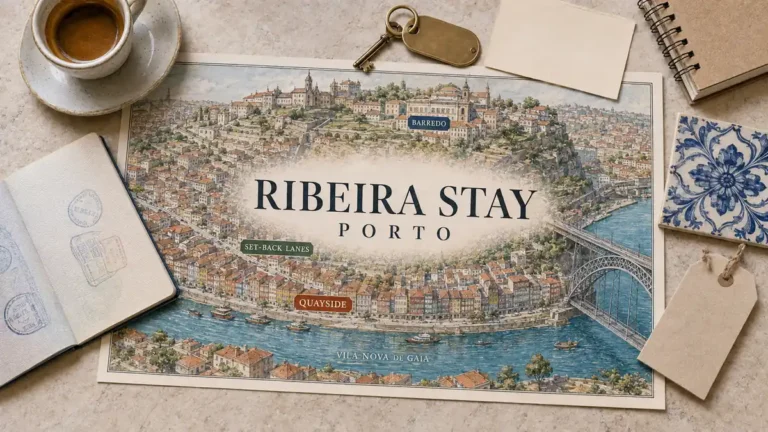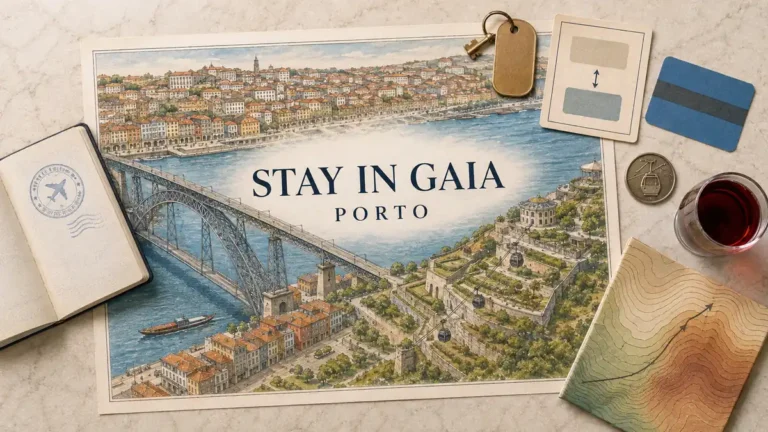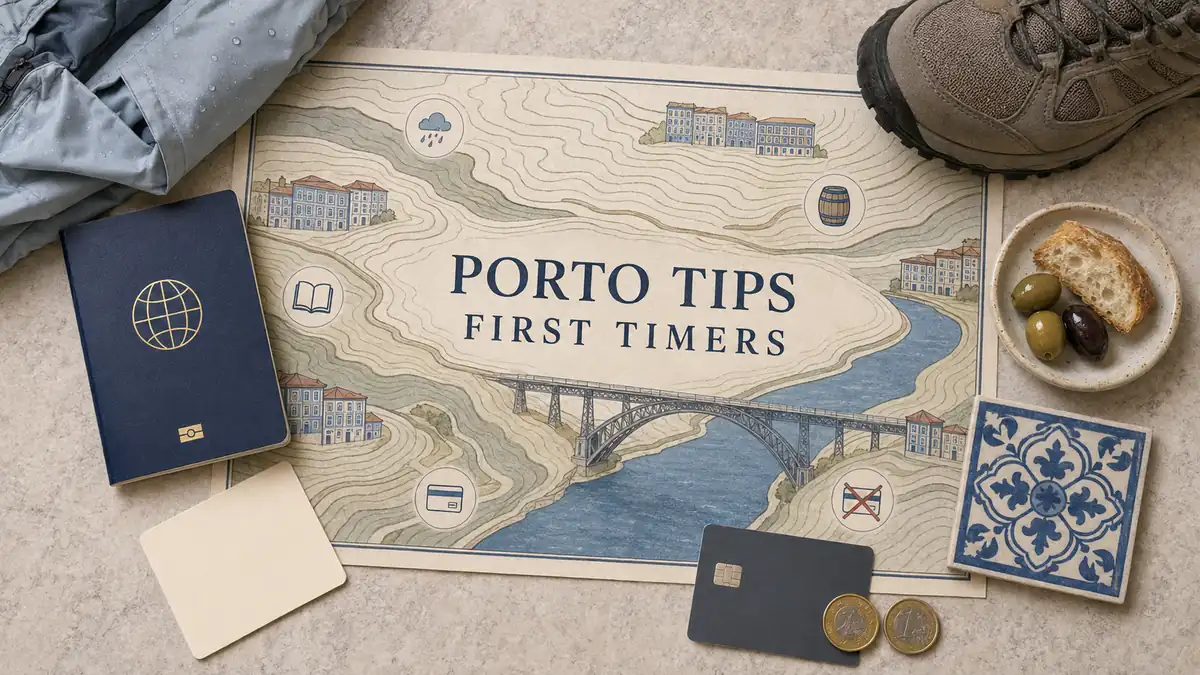
Your Porto trip is booked. What is left is the short list of calls that work differently here than they do in the rest of Portugal, and getting them wrong costs either an hour in a queue or a few euros you did not need to spend. Porto is small enough to walk and steep enough to punish a badly planned day, its restaurants run on a convention most visitors misread as a scam, and two of its most-wanted attractions are the only things in the city that genuinely sell out.
There is one more problem, and it is the reason this page exists. The most repeated piece of Porto advice on the internet — buy the Porto Card — is currently wrong, for a reason almost no ranking page has caught up with. That gets resolved first, before anything else.
Quick Answer
Book Livraria Lello and the Gaia cellar tours ahead, and dress for steep, wet cobbles. How sight-heavy your plan is decides what needs a slot and whether any pass logic applies. Skip the Porto Card question entirely — it is off sale — and carry a card plus a small cash float.
Trust Layer
Tripstou planning guide for travelers resolving one travel decision. Covers the main variable, traveler context, and practical tradeoffs.
Produced with AI assistance and reviewed by Alex Perrut, working in tourism since 2015, for the Tripstou editorial team. See our editorial process for details.
Last factual review: August 30, 2026.
Official sources consulted: Visit Portugal, Turismo de Portugal.
Key Takeaways
- The Porto Card is off sale for restructuring, so no current trip needs a pass decision at all.
- Only Livraria Lello and the big-name Gaia cellar tours genuinely sell out; book those two and improvise everything else.
- Porto’s distances are short but its gradients are not; grippy shoes and altitude-grouped days matter more than any transport choice.
- Carry a card for almost everything and a small cash float for tascas, market stalls and counter coffees.
- The couvert is priced on the menu and refusable; tipping is a discretionary round-up, never an owed percentage.
- If the card returns, price it only against admissions you would pay for anyway and ignore the discounts.
Table of Contents
Is the Porto Card Worth Buying Right Now?
You cannot buy the Porto Card right now. The official Visit Porto & North store withdrew it from sale at the beginning of July for a product restructuring process, and it remained off sale at our last factual review. So the worth-it question is really a question about what to do if it returns.
That status is the whole answer for anyone travelling soon. No official channel is selling the card, and the tourist offices are pointing visitors to individual tickets instead. Nothing in Porto requires it — every museum, cellar and cruise it touched sells its own admission at the door or online.
What the card actually did is worth understanding, because it explains who should care about a relaunch. It gave free entry to a small set of municipal museums, then attached partial discounts to a long tail of monuments, port cellars, river cruises and guided tours. It suited one traveler well: someone doing dense, museum-heavy sightseeing across consecutive days. It never suited the trip most people actually take in Porto — two days of eating, walking, viewpoints and one cellar visit. Those visitors were the ones buying it because a blog told them to, and losing money on it.
The last version on official sale was the walker-only card. Before withdrawal, the official ladder ran €7.50 for 24 hours, €12 for 48 hours, €16 for 72 hours and €18 for 96 hours. Those are the final official prices before the card left sale, not prices you can pay today.
Why Does Every Site Quote a Different Porto Card Price?
Because most sites are still pricing a version of the card that was discontinued before the suspension. The Porto Card once came in two forms: a walker-only card and a transport-inclusive bundle that folded Andante travel into the price. The bundle was retired first. The walker-only card carried on alone, at the cheaper ladder above, until it too came off sale.
The numbers still circulating — figures shaped around €13 a day, or roughly €32 to €33 for a three- or four-day pass — are the old transport-inclusive bundle, quoted by resellers and copied between blogs long after the product stopped existing. That is why no two pages agree. They are not describing the same card, and neither card is currently purchasable.
The practical consequence is simple: transport was already unbundled long before any of this. Andante is a separate purchase whichever way the card returns, so no pass decision changes how you pay for metro and buses — that sits entirely with getting around Porto.
The Decision Rule If the Card Comes Back
If the card relaunches, price it against the paid entries you would genuinely make — nothing else. Write down the museums and monuments you would pay to enter even without a pass, add up their individual admissions, and compare. If the card costs less, buy it. If it is close, do not.
Two corrections make that rule reliable. Ignore the discount long tail entirely: percentage-off deals on cruises, cellars and tours are the part of any city card that looks generous and almost never gets used, because they only pay out on things you were already committed to buying. And keep transport out of the maths, since Andante is a separate cost regardless of what the new card includes.
Porto’s paid-museum list is short, which is why the card’s arithmetic collapses faster here than it does in a big-museum capital. A pass earns its keep where there are twenty things to enter. In Porto there are a handful, and most first trips enter two or three.
What Do You Actually Need to Book Ahead in Porto?
Only two things in Porto genuinely sell out: Livraria Lello entry slots and the big-name Gaia cellar tours. Everything else — viewpoints, churches, markets, most restaurants — can be decided on the morning of. Booking those two ahead removes the only real queue risk in a Porto trip.
The failure mode is always the same. Someone walks up to Lello mid-morning in high season, finds the queue folded around the block, and either burns an hour or skips it and resents the day. The correction is not spending more money. It is holding a timed slot and building the rest of the morning around it.
Cellar tours fail differently. The famous houses in Vila Nova de Gaia run tours in fixed language slots with capped group sizes, so the English tour you want at the hour you want is the thing that disappears, not the cellar itself. Turn up without a booking and you take whatever is left, which is often a later slot in a different house.
Lello is a timing constraint on your whole day, not just a ticket purchase — it fixes where you have to be at a specific hour in the densest part of the centre, so book it first and build outward from it. Everything else in Porto flexes; that slot does not.
- Book ahead: Livraria Lello entry, guided tours at the well-known Gaia port houses, any dinner you genuinely care about on a weekend.
- Decide on the day: viewpoints and gardens, the Clérigos and Carmo churches, São Bento station, Mercado do Bolhão, river crossings, smaller or lesser-known cellars, lunch anywhere.
Where those two anchors land in your trip is a sequencing problem, and it changes with how long you have — the 2-day Porto itinerary puts them on different days from the 3-day Porto itinerary, which has room to keep Gaia and the centre apart.
Do You Need to Book Livraria Lello in Advance?
Yes, if you want to enter without queuing. Lello sells timed entry and the popular slots go before the day itself in busy months. Booking ahead is the difference between a fifteen-minute visit you planned and an hour of standing in a street queue for the same bookshop.
Do Port Wine Cellar Tours Sell Out?
The big-name houses do, in the language and time slot you want. Group sizes are capped and English tours are the first to fill, especially in the afternoon. Smaller and less-famous cellars in Gaia are far more likely to take walk-ins, and are frequently the better visit anyway.
Tours and activities
Book skip-the-line tickets, day trips and local tours with free cancellation on most activities.
You can also browse everything on getyourguide.com.
Tripstou may earn a commission if you book through this link, at no extra cost to you.
How Hilly Is Porto, Really?
Porto is a compact city with serious hills. Walking distances are short — the riverside, the centre and the main viewpoints sit close together — but the gradients between them are steep enough to reshape a day. Footwear and pacing matter here more than any transport decision.
The city is built on a cliff above the Douro, so the map lies to you. Two points four hundred metres apart can be separated by a long staircase or a switchback climb, and the return leg from the riverside to the upper town is the one that catches people out at the end of a long day. Plan descents late and climbs early.
Then there is the surface. Porto’s pavements are largely calçada — small polished stone setts — and wet calçada on a slope is genuinely slippery, not mildly so. Rain arrives often outside high summer, and it comes with wind off the Atlantic that makes umbrellas close to useless near the river.
The altitude of your bed matters more than the distance from it. A room three streets further out but level with the upper town beats a closer one at the bottom of a river-cliff stairway, because you pay that stairway twice a day for your entire stay. That is a real filter to apply when choosing where to stay in Porto.
What to Pack for Porto’s Rain, Wind and Cobbles
- Grippy, broken-in shoes with a real sole. Smooth soles and wet calçada do not mix, and this is the one packing decision that changes your day.
- A hooded waterproof jacket over an umbrella. The wind off the river defeats umbrellas; a hood does not.
- Layers, not weight. Porto swings between sun and cold damp within a single afternoon, riverside to upper town.
- Leave the wheeled-suitcase-on-cobbles fantasy behind. If you can carry it up a flight of stairs, pack it; if not, repack.
Cash or Card in Porto?
Cards work almost everywhere in Porto, but a small cash float still earns its place. Contactless is standard in restaurants, shops, taxis and ticket machines. Cash covers the gaps: a tiny tasca, a market stall, a bica at a neighbourhood counter, a tip left on the table.
The float should stay small. Carrying a large amount of euros around a city where cards are accepted this widely creates a risk without buying you anything, and cash-only holdouts in Porto are mostly cheap by definition — a coffee, a pastry, a couple of stalls at Bolhão. Top up from a bank ATM as you go instead of arriving loaded.
One habit is worth building before you land: always choose to be charged in euros when a card terminal offers you your home currency. That offer is dynamic currency conversion, and it quietly moves the exchange rate against you on every transaction. What any of it actually adds up to across a trip belongs to what Porto costs.
How Do the Couvert and Tipping Work in Porto?
The bread, olives and cheese placed on your table are not free and not compulsory. That is the couvert: it must be priced on the menu, and waving it away is normal. Tipping is separate and discretionary — Portugal has no service-charge convention.
The couvert gets called a scam more often than anything else in Portuguese dining, and it is not one. The items are brought unprompted because that is the service convention, the prices are printed on the menu before you order, and untouched plates go back off the bill. What people are actually objecting to is being charged for something they assumed was a gift.
Declining is straightforward and nobody takes offence. A simple “não, obrigado” as the plate lands, or leaving it untouched and saying so when the bill is made up, ends it. If you eat one olive, you have bought the couvert — that is the only rule worth remembering.
Tipping runs on the same logic of discretion. Restaurant staff in Portugal are not paid on the assumption of tips, so nothing is owed and nothing is expected as a percentage. Rounding up the bill or leaving small change is the ordinary local gesture; a modest tip on a genuinely good meal is welcome and never demanded. Both conventions apply nationwide, not just here — they sit alongside the rest of the country’s habits in our Portugal travel tips.
What Is the Couvert — and Can You Refuse It?
The couvert is the bread, butter, olives or cheese brought to your table at the start of a meal, and yes, you can refuse it. It is charged per item and must appear priced on the menu. Send it back untouched and it comes off the bill without argument.
Do You Tip in Porto?
Tipping in Porto is discretionary and modest. There is no service-charge convention in Portugal and no expected percentage. Most people round the bill up or leave small change after an ordinary meal, and leave a little more after a good one. Leaving nothing is not treated as an insult.
Do They Speak English in Porto?
Yes — English is widely spoken across Porto’s tourist core. Hotels, restaurants, museums and ticket desks will switch to English without being asked, and younger staff are usually fluent. The catch is social, not practical: opening in Portuguese changes the temperature of the exchange.
Portugal has high English proficiency and Porto is a tourist city, so you will not get stuck. Step outside the centre — a neighbourhood bakery, a market stall, an older taxi driver — and it thins out, but rarely to the point of a real problem.
The courtesy phrases are worth learning anyway, and not for comprehension. Opening in Portuguese signals you are treating the city as a place people live rather than a backdrop, and the response you get is measurably warmer. Four phrases carry almost all of it:
- Bom dia / boa tarde — good morning / good afternoon, said on entering anywhere
- Por favor — please
- Obrigado (men) / obrigada (women) — thank you, and it agrees with your gender, not theirs
- A conta, por favor — the bill, please
For live translation, offline maps and everything else that needs data the moment you land, sorting connectivity before departure is simpler than hunting a SIM at the airport — see our guide to the best eSIM for Portugal.
First-Timer Mistakes That Cost Time or Money in Porto
Most Porto mistakes come from planning it like a flat city. The costly ones are predictable: overpacking the day against the hills, defaulting to riverfront dining, arriving at Lello at peak with no slot, and treating stale Porto Card advice as current. Each has a cheap correction.
Building the day off a flat map. Six sights that look adjacent can involve four climbs. Group your day by altitude instead of by distance — do the upper town together, then drop to the river, and do not plan to bounce between the two.
Eating on the Ribeira waterfront by default. The riverfront terraces charge a view premium and the food rarely justifies it. Walking two or three streets back from the water, in either Porto or Gaia, changes both the price and the cooking.
Turning up at Lello without a slot. This is the one queue in Porto that regularly eats an hour. Book it, and anchor the morning around it.
Buying advice about the Porto Card. Pages still recommending it — and quoting prices for it — are describing a product you cannot buy. If you have read a “buy the card first” tip elsewhere, that tip is out of date.
Arriving at the airport with no plan for the last ten kilometres. OPO connects to the city directly and cheaply, and knowing which option you want before you land beats improvising at arrivals — the calls are laid out in our guide to getting from Porto airport to the city.
Over-planning the trip length and the month. How many days Porto deserves and which season suits you are decisions this page deliberately does not make; they belong in the wider Porto guide.
On safety, Porto is a comfortable city to walk and the only real caution is ordinary tourist-crowd pickpocketing, covered properly in our page on whether Porto is safe.
Frequently Asked Questions
Is Porto walkable?
Yes — Porto’s centre is genuinely walkable, and most visitors cover it almost entirely on foot. The historic core, the riverside and Gaia across the bridge sit within a compact area. The limit is not distance but gradient: budget more time and more energy per kilometre than a flat city.
Is Porto manageable with mobility issues or a pushchair?
It is difficult in the historic centre and easier elsewhere. Steep gradients, long staircases and polished cobbles make the old core hard work on wheels or with reduced mobility. The riverside promenade, Gaia’s waterfront and the flatter modern districts are the practical exceptions worth building a day around.
Is Vila Nova de Gaia part of Porto?
No — Gaia is a separate municipality on the south bank of the Douro, facing Porto across the river. In practice it functions as part of the same visit: the port cellars sit there, and the bridges are a short walk. Administratively separate, practically inseparable.
What can you use instead of the Porto Card while it is off sale?
Individual tickets, bought at the door or online. With the card off sale, every museum, monument, port cellar and river cruise in Porto still sells its own admission directly, and the tourist offices point visitors that way. Nothing in the city is gated behind the pass.
Is the couvert charged everywhere in Portugal or only in Porto?
It is a national convention, not a Porto habit. Restaurants across Portugal bring bread, olives or cheese unprompted, price the items on the menu, and remove untouched plates from the bill. The same declining phrase works in Lisbon, the Algarve and the Douro exactly as it does here.
Do you need to book restaurants in Porto in advance?
Rarely. Lunch and most weekday dinners take walk-ins without trouble, and wandering until something looks right is a reasonable plan. The exception is a weekend evening at a place you have specifically chosen — those fill, and a reservation is the difference between eating there and eating nearby.
Related Guides
- Porto guide — orientation, how many days, and which month suits your trip.
- Getting around Porto — Andante, metro, buses and the funicular explained.
- Porto airport to the city — every route from OPO into the centre.
- Where to stay in Porto — area by area, including which ones spare you the hills.
- Porto trip cost — what a few days here actually adds up to.
- 2-day Porto itinerary — the tight version, with Lello and Gaia already placed.
- 3-day Porto itinerary — room to slow down and add the river.
- Portugal travel tips — the national conventions behind the local ones.
Did this guide save you time or money? Tripstou is independent and reader-funded — if you'd like to give something back, you can support the site with a crypto contribution of any size.