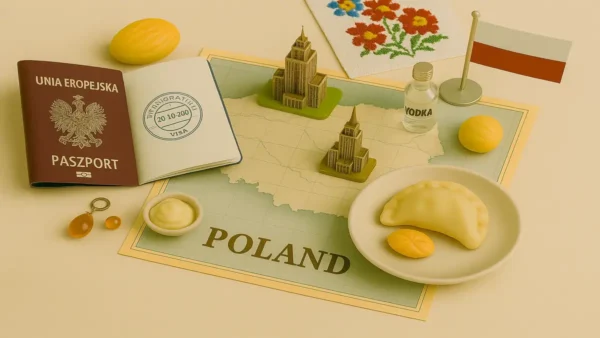

Most visitors do not need a visa for Poland. EU, EEA and Swiss citizens enter on a passport or national ID card. Holders of US, UK, Canadian, Australian, New Zealand, Japanese, Brazilian and Mexican passports, and every other nationality on the Polish Ministry of Foreign Affairs visa-free list, get 90 days in any 180 across the Schengen area on the passport alone. Travelers from India, mainland China, the Philippines and South Africa need a Schengen visa before they travel. Which list your passport sits on decides everything else.
Poland is an EU and Schengen state, so its rules are the Schengen rules, applied by the Polish Border Guard. Every reader lands in one of three groups: free movement, visa-free for short stays, or visa first. Non-EU arrivals at an external Polish border are registered under the EES, with fingerprints and a photo in place of a passport stamp.
How We Checked These Rules
This page settles whether your passport gets you into Poland, for how long, and where EES and ETIAS stand; it is not a trip planner, an application manual or a permit guide.
Produced with AI assistance; Alex Perrut, working in tourism since 2015, checked these rules for the Tripstou editorial team under our editorial process.
Official sources consulted: Travel to Europe (EU), Polish Foreign Ministry, Polish Interior Ministry, Interior Ministry EES notice, UK Foreign Office.
Visa-free, Schengen visa or national visa: where your passport puts you
The Polish Ministry of Foreign Affairs visa-free list puts every passport in one of three places. US, UK, Canadian, Australian, New Zealand, Japanese, Brazilian and Mexican passports are visa-exempt for short stays. Indian, mainland Chinese, Philippine and South African passports need a Schengen visa first. EU, EEA and Swiss citizens need only an ID card.
| Passport group | What you need | Maximum stay | Read next on this page |
|---|---|---|---|
| EU, EEA or Swiss citizen | Valid passport or national ID card | Not subject to the 90/180 limit | Passport test |
| Visa-exempt passport (US, UK, Canada, Australia and others on the list) | Valid passport, no visa | 90 days in any 180 across Schengen | Stay limit |
| Visa-required passport (India, mainland China, Philippines, South Africa and others) | Schengen (C) visa obtained before travel | The days and dates printed on the visa | Applying for a visa |
| Residence permit or long-stay visa from another Schengen state | That permit or visa plus your passport, no Schengen visa | Short visits under the 90/180 rule | Stay limit |
A few passports sit on the edge of the list. Taiwan passports qualify for the exemption only when they carry the holder’s ID number. Hong Kong SAR and Macao SAR passports are listed as visa-exempt.
The exemption covers visits, never jobs. A visa-free stay does not allow you to work in Poland, even for a few days.
Visa-free status has one practical upside: as a non-EU visitor you can also claim a tax-free shopping refund in Poland on eligible purchases. If your passport is in the visa-required row, skip ahead to the application section below.
How long can you stay in Poland, and does time in Germany count?
Visa-exempt visitors may stay up to 90 days in any rolling 180-day period across the Schengen area as a whole, not per country. Time in Germany counts. A week in Berlin before you cross into Poland has already spent seven of your 90 days.
The window rolls. On any day of your trip, look back 180 days and add up every day you spent anywhere in Schengen; that total must stay at 90 or below. Picture a traveler who spends 60 days touring Schengen, goes home, and returns two months later. Those 60 earlier days still sit inside the 180-day look-back, so only 30 days remain until the first ones age out.
- Counts: the day you enter and the day you leave, each as a full day.
- Counts: every day in any other Schengen state, before or after Poland.
- Does not count: days spent on a residence permit or long-stay visa.
Leaving Schengen for a weekend in the UK or Ukraine does not wipe the slate. Only time does. Citizens of seven Latin American countries can ask for an extension, covered in the FAQ below.
The passport test the Polish Border Guard applies
Your passport must stay valid for at least three months after the day you plan to leave the Schengen area, and it must have been issued within the previous ten years. The ten-year rule is the one that catches people.
Passports with a long validity, or ones that were extended, can pass the three-month test and still fail on issue date. Check the issue date printed on the data page, not only the expiry. Officers of Straż Graniczna, the Polish Border Guard, apply both tests at the booth.
EU, EEA and Swiss citizens can travel on a valid national ID card instead. Whatever document you carry, it is checked every time you cross an external border, and it can be checked at internal ones too.
What is the EES at the Polish border, and do you need ETIAS yet?
The Entry/Exit System registers non-EU travelers biometrically at the border and is fully operational across the Schengen area. ETIAS is a pre-travel authorisation for visa-exempt nationals that is not yet in operation; the European Union will announce the start date several months before launch. Status: the EU Entry/Exit System has been fully operational at all Polish border crossings since 10 April 2026, and ETIAS is not yet in operation.
EES: fingerprints and a photo instead of a stamp
EES runs at all 71 Polish road, rail, air and sea border crossings. At your first entry, the officer takes your fingerprints and a facial image and links them to your passport. No stamp goes in. The record is kept for three years, so later trips through the booth are faster.
The system covers third-country nationals only; EU, EEA and Swiss citizens are not registered. Children aged 11 and under give no fingerprints. Long-term residents of a Schengen state are exempt. There is nothing to apply for in advance, and declining to give biometrics can lead to entry being refused.
ETIAS: not yet, and nobody can sell you one
No one can issue an ETIAS today, so any website taking money for one is not official. Once the scheme operates, it will apply to travelers from 59 visa-exempt countries heading to 30 European countries, with applications made on the official EU website for a small online fee. An approved authorisation will be valid for up to three years or until the passport expires, whichever comes first.
Arriving from Germany or from Ukraine: which Polish borders actually check you
Crossing by land from Germany, Czechia, Slovakia or Lithuania means crossing an internal Schengen border, with no routine passport control. Arriving from Ukraine, Belarus or Russia’s Kaliningrad region, or on a flight from outside Schengen, means a full border check and EES registration.
- Internal land border (Germany, Czechia, Slovakia, Lithuania): applies to anyone already inside Schengen. Expect no booth, but temporary checks can be reintroduced, so keep your passport on you.
- External land border (Ukraine, Belarus, Kaliningrad): applies to every road or rail arrival from the east. Expect a full document check and, for non-EU travelers, EES registration.
- Air from outside Schengen: applies to long-haul and UK flights. Your first Schengen airport is where the passport check and EES registration happen.
For most non-EU arrivals, that first airport is Warsaw Chopin or Kraków. Warsaw Chopin is the main EES registration point for flights from outside Schengen; once through, two days in Warsaw shows how to use the city. Kraków’s airport handles the same checks for travelers starting in the south, and the first trip to Kraków guide picks up from there.
The eastern land border is an external Schengen border with full checks on every crossing. Some crossings into Belarus can close at short notice, and parts of the area near the Ukraine and Belarus borders are restricted zones closed to visitors. Plan an eastern overland route with a fallback crossing.
A flight into Berlin followed by a train to Poland means your EES registration happens in Germany, and the Polish side has no booth at all. Carry the passport anyway: a spot check on that train is legal.
How much money do you need to show at the Polish border?
The Polish Border Guard can ask any non-EU visitor to show proof of funds, a return or onward ticket and the purpose of the stay. The official amounts are set in zloty and start at PLN 300 for a stay of up to four days.
| Situation | Amount | How it is counted |
|---|---|---|
| Stay of up to 4 days | PLN 300 | Total for the stay |
| Stay longer than 4 days | PLN 75 | Per day |
| Prepaid package stay | PLN 20, minimum PLN 100 | Per day |
| No return ticket, arriving from a neighbouring country | PLN 200 | Extra, on top of the above |
| No return ticket, arriving from another EU state | PLN 500 | Extra, on top of the above |
| No return ticket, arriving from a non-EU state | PLN 2,500 | Extra, on top of the above |
Proof can be cash, a payment card with an available balance, or booking confirmations for accommodation and transport. Officers may also ask visa-exempt visitors about travel insurance; carrying a policy is wise, and the FAQ covers when it is mandatory.
Visa-required passports apply through the Polish consulate, up to six months ahead
A visa-required traveler applies at the Polish consulate, or the visa centre it uses (VFS in many countries), in the country where they live, up to six months before travel. A decision normally takes about 15 calendar days and can run longer, so apply before booking non-refundable travel.
- Confirm that Poland is your main destination: the country of your longest stay, or of first entry when stays are equal.
- Book an appointment with the Polish consulate or its visa centre in your country of residence.
- Prepare the file: passport, photo, application form, itinerary, accommodation, proof of funds and travel medical insurance.
- Attend in person, give biometrics and pay the fee.
- Wait for the decision, normally about 15 calendar days.
The main-destination rule decides which consulate takes the file. A trip of three nights in Kraków and five in Prague goes to the Czech consulate, even if you land in Poland.
The fee is set EU-wide, paid when you apply and not refunded if the visa is refused. Travel medical insurance is mandatory for every applicant. Once issued, the C visa covers all Schengen states.
Refusals usually come down to a missing document, an unclear purpose or insufficient funds. A forged document, an entry on the Schengen alert list, or a threat to public health or security also lead to refusal.
Schengen C visa or national D visa: which one does your Poland trip need?
A tourist, business or family visit of up to 90 days needs a Schengen C visa, or nothing at all on a visa-exempt passport. Any stay over 90 days, any work and any study needs a Polish national D visa or a residence permit, handled by the consulate abroad and, inside Poland, by the Office for Foreigners (UdSC).
On a C visa, check the entries field. “1” allows a single entry: leave Schengen once, even for a day trip to Ukraine, and the visa is spent. “MULT” lets you leave and come back as often as you like within its validity and day count.
The D visa is a different route with its own procedure, set by the consulate and the Office for Foreigners. A short visit stays on the C visa or visa-free path; a move, a job or a degree starts with a national visa application. For everything else about a short trip, the closing link below takes you to the wider planner.
The Short Version for Poland
- EU, EEA and Swiss citizens need only an ID card; US, UK, Canadian and other visa-exempt passports need no visa for short stays; Indian, mainland Chinese, Philippine and South African passports need a Schengen visa before travel.
- The 90-day allowance runs over any rolling 180 days across the whole Schengen area, so a week in Germany before Poland already counts against it.
- Your passport must stay valid three months past your planned exit from Schengen and have been issued within the last ten years, so check the issue date as well as the expiry.
- Non-EU visitors give fingerprints and a photo under the EES at their first Schengen border, while ETIAS is not yet in operation and no website can sell you one.
- A stay over 90 days, or any work or study, needs a Polish national D visa or a residence permit instead of a Schengen visa.
Poland Entry Questions, Answered Short
Can you extend a visa-free stay in Poland?
Only if you hold a passport from Argentina, Brazil, Chile, Honduras, Costa Rica, Nicaragua or Uruguay. Those citizens can ask for up to 90 more days in justified cases, applying in person before their last legal day; everyone else must leave Schengen when the 90 days run out. A Schengen visa can be extended only for force majeure, humanitarian or important personal reasons.
Can you enter Poland on a Schengen visa issued by another country?
Yes. A valid Schengen visa from any member state covers Poland too, as long as you respect its entries and its day count. The visa should still come from the country of your main stay, so a trip spent mostly in Poland is applied for at the Polish consulate.
Do you need travel insurance to enter Poland?
Only if you need a Schengen visa: travel medical insurance is mandatory for every visa applicant. Visa-exempt visitors are not required to hold a policy, but the Border Guard can ask about cover, so carrying one is the safer choice.
What happens if you overstay in Poland?
You risk a fine, removal from Poland and an entry ban. Because EES records every entry and exit, the system detects an overstay automatically, so a few extra days do not go unnoticed.
Keep Planning Poland
- Poland travel guide: the broad trip planner once your entry is settled.
Did this guide save you time or money? Tripstou is independent and reader-funded — if you'd like to give something back, you can support the site with a crypto contribution of any size.