Chania asks three transport questions, and most of the trip follows from how you answer them. Do you need a rental car, or does the bus network already cover what you want to do? Which bus network — because there are two, run by different operators from different stations, dividing the map between them. And how do you get into town from Souda, the port where the ferry from Piraeus lands, which for many visitors is the first journey of the trip. This guide resolves all three, then adds where tickets are bought, where cars can and cannot go, and the point at which the famous beach day trips stop working on public transport. Tradeoffs are given by trip type, because the honest answer for two nights in the Old Town is not the answer for a week built around western Crete.
Quick Answer
Most visitors get around Chania on foot, using blue city buses and taxis for the beaches and Souda port. KTEL coaches reach Elafonisi and Kissamos, so the headline day trips do not require a car. Rent one only for a stay built around several western-Crete excursions, and park on the Old Town perimeter.
Trust Layer
Tripstou transport guide for travelers deciding how to make a specific journey. Covers realistic options, tradeoffs by traveler type and luggage, passes, and arrival cases.
Produced with AI assistance and reviewed by Alex Perrut, working in tourism since 2015, for the Tripstou editorial team. See our editorial process for details.
Last factual review: September 4, 2026.
Official sources consulted: Visit Greece, Greek Ministry of Tourism.
Key Takeaways
- Walking covers the entire Old Town; you only need a bus or taxi once you leave the historic core.
- Rent a car only when several western-Crete excursions drive the plan, and expect to park on the Old Town perimeter.
- Chania runs two unrelated bus networks — blue urban buses and KTEL coaches — from two separate stations with separate tickets.
- Arriving at Souda port, take the city bus with light luggage in daylight and the pier taxi rank otherwise.
- Elafonisi is reachable by seasonal KTEL coach, but Balos needs a coach to Kissamos plus an excursion boat.
- Chania sells no travel pass; buy each urban ticket at the Plateia 1866 kiosk, which costs less than boarding unticketed.
Table of Contents
Your Options for Getting Around Chania
Chania runs on five modes — walking, blue city buses, KTEL coaches, taxis and rental cars. Walking covers the Old Town, blue buses handle nearby beaches and Souda port, KTEL coaches reach the wider prefecture, and taxis fill the gaps. A rental car earns its keep only on excursion-heavy stays.
Each mode has a job here, and they overlap far less than they do in a big city. The ladder below is the realistic set:
- Walking — suits anyone staying in or beside the Old Town, which is where most visitors sleep. Defining tradeoff: it covers the historic core completely and nothing past its edges.
- Blue city bus — suits trips to nearby beaches, the newer parts of town and the run out to Souda port. Defining tradeoff: it is the cheapest way to move, but it stops where the urban network stops.
- KTEL coach — suits travelers heading to Elafonisi, Kissamos, Omalos or another Cretan city. Defining tradeoff: it reaches the whole prefecture on a fixed timetable you plan your day around.
- Taxi — suits port arrivals, late returns and anyone moving luggage across town. Defining tradeoff: a ride costs several times a bus ticket, though the distances involved are short.
- Rental car — suits stays built around several western-Crete excursions or off-route beaches. Defining tradeoff: complete freedom outside town, and no access at all inside the Old Town.
Scooters and quads are rented widely here and work for short coastal hops, but with luggage or Cretan mountain roads in the plan they are a weak substitute for a car.
| Mode | Best for | Reach | Main limitation |
|---|---|---|---|
| Walking | Everything inside the Old Town, morning to night | The historic core, end to end | Nothing beyond the edge of the centre |
| Blue city bus | Nearby beaches and the Souda port run | Chania town, its suburbs and the port | Stops where the urban network ends |
| KTEL coach | Day trips out into western Crete | The prefecture and other Cretan cities | Fixed timetable, one return window |
| Taxi | Arrivals, late returns and heavy luggage | Anywhere, door to door outside the core | Costs several times any bus fare |
| Rental car | Excursion-heavy stays and off-route beaches | The whole island, on your own schedule | Cannot enter or park in the Old Town |
Most visitors end up combining three of these: feet inside the Old Town, a blue bus or taxi for the port and the near beaches, and a KTEL coach for one or two bigger days out. If you are still deciding what those days out should be, the wider Chania guide handles the orientation this page deliberately leaves out.
When a Taxi Is the Right Call
Taxis earn their fare on arrivals, late returns and luggage days. A cross-town ride in Chania is short, so a taxi is rarely a big expense and often the difference between a smooth arrival and a complicated one. Where they make least sense is ordinary daytime movement inside a town this compact — you will usually walk it faster than you can find the rank.
Agree the fare or confirm the meter is running before you set off, particularly on port and airport runs. Broader local practicalities of this kind sit in our Chania travel tips.
Do You Need a Car in Chania?
No for a short stay based in or near the Old Town; yes once western Crete excursions dominate the plan. A central base puts the harbour, the market and the bus hub within walking distance. A car only starts paying once your days run past the reach of the coaches.
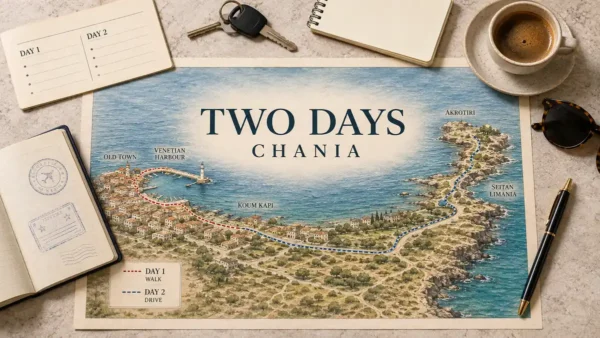
A short central stay is the clearest no-car case. If you are here for two or three nights and sleeping near the harbour, the car spends its life in a perimeter car park while you walk everywhere that matters. Our 2 days in Chania plan shows how completely a short stay fits inside walking distance and one or two bus rides.
A beach-focused week sits on the fence. Blue city buses reach the closer stretches of coast and KTEL coaches cover the famous ones, so the week is possible without a car — it just runs on someone else’s schedule, with a departure window in the morning and a fixed return in the afternoon.
An excursion-heavy week flips the verdict. Once the plan has several inland villages, gorges or beaches that no coach serves directly, the bus network starts costing you whole mornings, and a rental repays itself in recovered time. Families with beach gear, buggies and small children reach that point sooner, because loading a coach with equipment twice a day wears thin fast.
The car question here is really a question about how many mornings you are willing to hand to a coach timetable. Two or fewer, and the buses win outright.
Daily rental rates on Crete are moderate by European standards and climb in high summer, which makes the parking liability the more important half of the decision: your car cannot enter the Old Town, so you will always park on the perimeter and walk in. Where you sleep changes this calculation more than anything else you control — a central room removes most of the transport need before it appears, and our guide to where to stay in Chania sets out what each base costs you in movement.
How Do You Get From Souda Port Into Chania?
From Souda port you take the city bus into central Chania or a taxi from the rank at the pier. Souda sits roughly 6.5–7 km southeast of town and handles the ferry from Piraeus. The bus is the cheap default; the taxi wins on luggage, groups and awkward hours.
- City bus from the port — suits solo travelers and couples with light luggage arriving in daylight. Defining tradeoff: it costs a fraction of the taxi, and it drops you in the centre, not at your door.
- Taxi from the pier rank — suits families, groups, heavy bags and anyone landing before the town is properly awake. Defining tradeoff: several times the bus fare, split between however many of you are travelling.
Arrival timing does most of the deciding. The overnight boat from Piraeus reaches Souda early, when you are tired, carrying everything you brought, and facing a walk into a pedestrian zone at the other end. A rank of taxis waits at the pier for exactly this reason. Two people with cabin bags will be fine on the bus; four people with suitcases will not enjoy it.
The return leg deserves more planning than the arrival. Getting yourself out to Souda in the evening for a night sailing is the journey travelers most often underestimate, and it is worth settling how you will make it on the day you arrive, not the afternoon you leave.
Chania’s airport is the other arrival case, roughly 15 km out on the Akrotiri peninsula and served by both bus and taxi — the full route detail lives in our Chania airport to town guide. If Chania is one stop in a longer sea route, onward sailings to other islands are planned in our Greek island hopping guide.
Train and bus tickets
Compare routes, schedules and prices across rail and bus operators in one search, with mobile tickets on your phone.
New to Omio? Code NEW10 takes 10% off your first booking — or APPNEW10 if you book inside the Omio app. Both apply to bookings up to €80.
Search routes and compare prices on Omio →
Tripstou may earn a commission if you book through this link, at no extra cost to you.
The Old Town Is Walkable and Closed to Cars
The Old Town is a compact pedestrian zone you cross on foot end to end; cars stay outside. Walking is the default here because no vehicle can drive or park inside the core. Anyone with a rental leaves it on the perimeter and walks in through one of the lanes.
Compactness is what makes this work. The distance from one side of the historic centre to the other is a short walk, the harbour anchors your bearings, and the lanes in between are too narrow for traffic anyway. Nobody needs a vehicle inside it.
Drivers therefore adopt the same pattern regardless of where they are staying: park on the perimeter, walk in with what you need for the day. The car parks ringing the Old Town are a mix of free and paid, and the free ones fill first. In high summer, arriving early is the whole strategy — by mid-morning the perimeter is full and you will be circling. Confirm what each car park charges when you arrive, since arrangements vary from one to the next.
The practical consequence for accommodation is worth naming: if your room is inside the pedestrian zone, no taxi and no rental car reaches its door. You will walk the last stretch with your luggage in every scenario, which is why light packing pays off in Chania more than in most Greek towns.
City Buses and KTEL Coaches Are Two Separate Networks
Chania has two bus systems: blue urban buses for the town and coast, KTEL coaches for everywhere further. The blue network covers central Chania, nearby beaches and Souda port. KTEL runs from its own station to the wider prefecture and other Cretan cities. Different stations, different tickets.
Confusing them is the classic Chania transport mistake, so it helps to hold the split clearly:
- Blue urban buses — the town network, hubbed at Plateia 1866 on the edge of the Old Town. They reach the suburbs, the closer beaches along the coast and Souda port. This is the network you use for everyday movement and for ferry arrivals.
- KTEL coaches — the regional operator, working out of its own separate bus station. These are the long-distance vehicles that cross the prefecture to Kissamos, Omalos and the western beaches, and they also connect Chania to the other Cretan cities along the north coast.
The division is geographic and clean. Anything inside the built-up area and its immediate coast is blue-bus territory; anything that requires leaving greater Chania is KTEL. Neither network sells you a ticket the other accepts, and neither departs from the other’s station.
One consequence catches people out repeatedly: a blue city bus will never take you to a headline western beach, no matter how long you wait at Plateia 1866. Those routes are KTEL routes, and they start somewhere else.
How Do You Buy Bus Tickets in Chania?
Urban bus tickets come from the kiosk at Plateia 1866; KTEL tickets from the separate KTEL station. The blue buses use Plateia 1866 as their hub, a short walk from the Old Town. Buying at the kiosk before boarding costs less than buying from the driver. KTEL fares are paid at that station’s ticket desk.
- Plateia 1866 — the blue-bus hub, walkable from the Old Town, with a ticket kiosk beside the stands. This is where urban journeys and the Souda port run begin.
- The KTEL station — a separate building for regional coaches, with its own ticket desk. Buy here for Elafonisi, Kissamos, Omalos and journeys to other Cretan cities.
- Kiosk beats on-board — buying before you board is cheaper than paying the driver. The difference per ride is small, but it applies every time.
- Keep the ticket — hold on to it for the whole journey and validate it on board if the bus has a machine.
- The one mistake — turning up at the wrong station, or waiting at Plateia 1866 for a bus to a western beach that only KTEL runs. Check which network serves your destination before you set out.
Individual fares on both networks are low, and a stay’s worth of them adds up to less than most visitors expect — what that means for a whole trip budget is broken down in our Chania trip cost guide. Chania sells no travel pass, so there is no break-even to calculate: every ride is bought on its own.
Can You Reach Elafonisi and Balos by Bus?
Elafonisi has a seasonal KTEL coach; Balos does not — you ride KTEL to Kissamos and take the boat. Both trips are doable without a car, on the coach operator’s schedule instead of your own. That fixed departure-and-return window is where a no-car plan starts to strain.
- Elafonisi — a direct KTEL coach runs from Chania in the warmer months. The route exists, the connection is single-leg, and the constraint is the timetable: one outward departure window in the morning, one return in the afternoon.
- Balos — no bus reaches the beach itself. You take a KTEL coach to Kissamos port and board an excursion boat from there, which makes it two connections and a full-day commitment.
Both services are seasonal, and the schedules change through the year, so check the current timetable with the operator before you build a day around either. Outside the summer months the picture thins considerably.
What a fixed timetable actually costs you is flexibility at both ends of the day. You leave when the coach leaves and return when it returns, which means no early start to beat the crowds and no lingering for the light. A car buys back exactly those two hours — and on a single excursion, that is rarely worth the rental. Across four or five, it is.
Balos is where the no-car plan gets expensive instead of impossible: coach to Kissamos, then the boat, is two paid legs and an entire day committed to one beach.
How these excursions fit alongside the town itself, and how many of them a stay can absorb, is sequenced in our 3 days in Chania plan.
Frequently Asked Questions
Can you reach Samaria Gorge by bus from Chania?
Yes. KTEL runs an early coach from Chania to Omalos and the Xyloskalo trailhead; walkers descend the gorge and exit at Agia Roumeli, returning by south-coast ferry and a connecting coach. The service is seasonal and revised through the year, so confirm the current timetable with the operator first.
Where do you park if your hotel is inside Chania Old Town?
On the perimeter, then walk in — no car reaches a door inside the pedestrian zone. Ask your accommodation which nearby lot it recommends, since the ring of car parks mixes free and paid spaces and the free ones fill first. In high summer, arriving early is the only reliable strategy.
Can you drive into Chania Old Town?
No. The historic core is a pedestrian zone with controlled entry points, so a rental car cannot drive through it or stop inside it. Deliveries and residents’ vehicles are the exceptions, not visitors. Treat the edge of the zone as the end of the road and continue on foot.
How much does a taxi cost in Chania?
Less than most visitors expect for town journeys, and several times a bus fare. Chania is compact, so a cross-town hop is a short, modest ride, while the runs out to Souda port or the airport cost noticeably more. Confirm the meter is on, or agree the fare beforehand.
Are Chania buses reliable, and do they run in winter?
The blue urban buses are the dependable half — they serve residents as well as visitors, so they keep running through winter. KTEL’s beach and gorge routes are the seasonal ones, thinning out or stopping entirely outside summer. A winter stay works in town but limits day trips without a car.
How do you get back to Souda port for a night ferry?
By city bus from the centre or by taxi from a town rank, and the taxi is worth arranging ahead for a late sailing. The bus follows the same route you would take inward. Decide which one you are using on the day you arrive, not the afternoon you leave.
Related Guides
- Chania guide — the full planner for the town and the wider trip.
- Chania airport to town — the arrival leg this page leaves out.
- Where to stay in Chania — how each base changes what you need to move around.
- 3 days in Chania — where day trips and a rental start making sense.
- Chania trip cost — what transport, stays and food add up to across a stay.
- Chania travel tips — the practical habits worth adopting before you arrive.
Did this guide save you time or money? Tripstou is independent and reader-funded — if you'd like to give something back, you can support the site with a crypto contribution of any size.