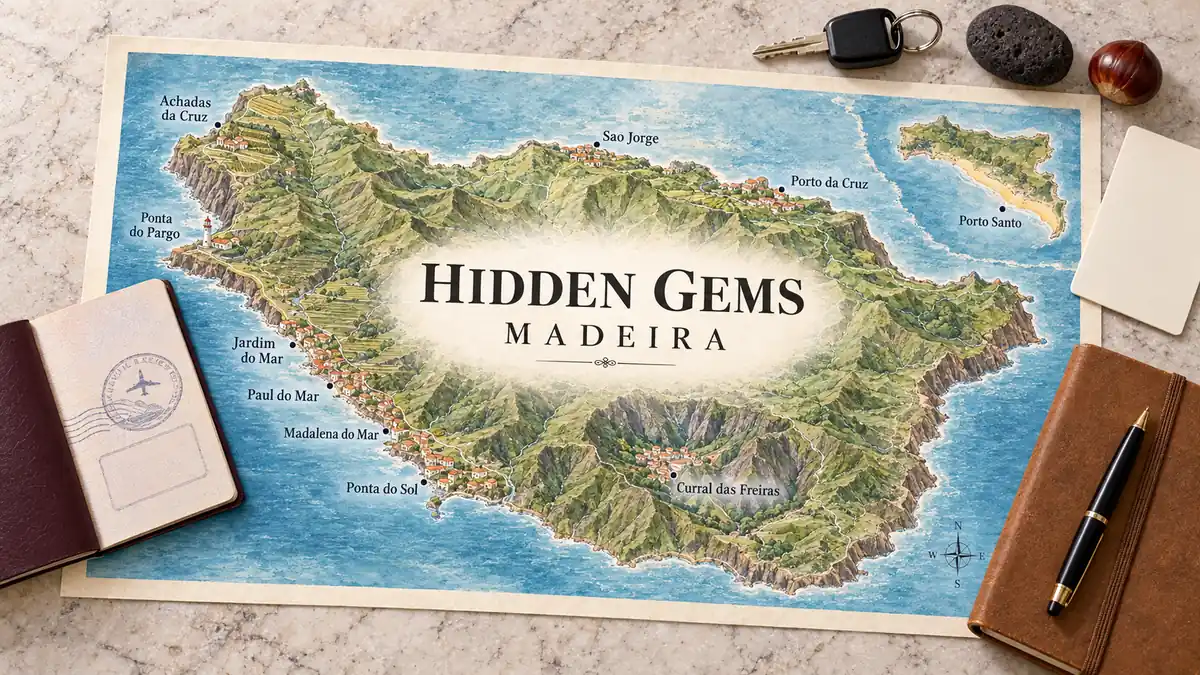
Every list of hidden gems in Madeira gives you the same set: a viewpoint, one beach, one road. Most of those are photo stops, not places you can spend an afternoon in. This page is narrower. Madeira’s quiet side is its lived-in villages, and it has a geography — the south-west coast beneath the cliffs, the north coast and the far west, one valley folded into the mountains, and a second island offshore. Not every entry here is equally hidden, and the page says so: each pick carries an honest label. The tradeoff is worth naming up front. Most of these places sit off the main road and are far easier with a car, and quiet means fewer places to eat and fewer buses. Ten picks follow, grouped into two coast sets plus two that stand alone, each closing on a one-line test of who it suits, then a selector by coast and trip type.
Quick Answer
Madeira’s real hidden gems are its lived-in villages, led by Jardim do Mar, São Jorge and Ponta do Pargo. Coast and access decide which fit: the south-west villages are the easiest quiet stops; the north and far west are least visited and need a car. Porto Santo, a separate island, earns its own day.
Trust Layer
Tripstou selection guide for travelers choosing between multiple places. Covers selection criteria, traveler fit, and trip value.
Produced with AI assistance and reviewed by Alex Perrut, working in tourism since 2015, for the Tripstou editorial team. See our editorial process for details.
Last factual review: September 11, 2026.
Official sources consulted: Visit Portugal, Turismo de Portugal, Madeira Islands Tourism Board, Porto Santo Line.
Key Takeaways
- Jardim do Mar and Paul do Mar are the easiest genuinely quiet stops, close enough to bolt onto a south-coast day.
- Pick São Jorge for emptiness, Ponta do Pargo for the island’s edge, Ponta do Sol for sun and a centre.
- A car decides how much of this list you reach; without one the whole north and far west drops out.
- Quiet costs services, so plan lunch around the livelier village in each pair and keep the empty one for the afternoon.
- Curral das Freiras is the one pick reachable from Funchal without a coast drive — go down, not just up.
- Two picks hinge on a service that can stop — the Achadas da Cruz cable car and the Porto Santo crossing.
Table of Contents
What counts as a hidden gem on Madeira?
A hidden gem on Madeira is a village you can spend time in that the coach circuit skips. Not a viewpoint, not a beach, not a scenic road. Those places sit on the south-west coast, along the north and far west, in one mountain valley, and on the island next door.
The recycled lists fail that definition in three ways. Viewpoints and beaches are spots you photograph, not destinations you spend an afternoon in. Funchal’s old-town streets and street art belong to a city page. And the famous circuit is many things, but hidden is not one of them.
On an island this small, hidden is mostly a function of driving time from Funchal, not of obscurity. Every place on this page is signposted, mapped and easy to find. What keeps them quiet is that almost nobody bothers.
Every pick here carries one of four honest labels:
- Genuinely off the circuit: São Jorge, Ponta do Pargo, Madalena do Mar, Jardim do Mar.
- Quiet but discovered: Paul do Mar, Porto da Cruz, Achadas da Cruz, Ponta do Sol.
- Famous viewpoint, overlooked village: Curral das Freiras.
- A whole island most people skip: Porto Santo.
What these places share is that they are still working. Paul do Mar is a fishing village. The fajã below Achadas da Cruz is farmed by the people who live above it. Curral das Freiras sells the chestnuts that grow in its own valley. That is a far more useful test than any claim about where locals go.
Hidden has a price, and it is the same price everywhere on this page: a car for most of it, fewer places to eat, and dinner earlier than you would like. The list suits second-time visitors, drivers and anyone bored of the headline island. If this is a first trip and you want the sights everyone comes for, stay with the well-known circuit, which sits collectively on our guide to things to do in Madeira. And if Madeira is still competing with the mainland’s famous names for your week, settle that first on the best places to visit in Portugal.
The south-west coast has Madeira’s easiest quiet villages
Jardim do Mar, Paul do Mar, Ponta do Sol and Madalena do Mar are the south coast’s quiet villages. A south-coast day reaches all four without a long drive. They sort into two pairs: Jardim do Mar or Paul do Mar in the far south-west, Ponta do Sol or Madalena do Mar nearer the middle.
Each pair splits on one question. Take Jardim do Mar if quiet is the point, Paul do Mar if you want surf, food and an evening; take Ponta do Sol if you want a centre, Madalena do Mar if you want nobody there. A coastal path links the first two. All four sit along one coast road, so a pair is an easy afternoon — but this is Madeira’s busy coast, and quiet here means quiet by island standards, not empty.
Jardim do Mar
Jardim do Mar is a clifftop village on the south-west coast whose core is pedestrianised, and that one detail is why it stays quiet. Cars stop at the edge; everything past that point is lanes. Nothing arrives by accident and nothing passes through. It is the quietest of the four picks on this coast. Label: genuinely off the circuit.
What separates it from Paul do Mar, its neighbour at sea level, is that nothing happens here — and that is the entire proposition. It has fewer bars and restaurants than Paul do Mar and no through-traffic. A coastal path links the two villages. The catch: you leave the car and walk in.
Pick this if: you want the quietest village on the south-west coast and are happy to leave the car at the edge.
Paul do Mar
Paul do Mar is the larger, livelier neighbour directly below Jardim do Mar, at sea level instead of on the cliff. It is a working fishing village and a surf spot, with more bars and restaurants than Jardim do Mar — the only one of this pair where an evening exists. Label: quiet but discovered.
The surf crowd found it first, which is what makes it different from every other pick on this page: it already has a small scene of its own. That brings company, and on the south-west coast company is the thing you came here to escape. Come for lunch and the difference is obvious.
Pick this if: you want the same coast with surf, somewhere to eat and an evening, and accept sharing it.
Ponta do Sol
Ponta do Sol is officially described as the sunniest village on the island, and it is the easiest of these four to stop in without a plan. A compact centre sits squeezed between cliffs and ocean, with a pebble beach at the bottom of it. There is somewhere to walk to and somewhere to sit. Label: quiet but discovered.
Having a real centre is also what made it the most discovered of the four. That is a fair trade for a first visit. But it is a stop, not a day: the centre is small, and once you have walked it you have seen it.
Pick this if: you want sun, a pebble beach and a small centre on an easy south-coast stop.
Madalena do Mar
Madalena do Mar is a long stony beach with cliffs behind it and almost nothing on it. The atmosphere is the draw: this is the emptiest place on the south coast and the one with the least to do. A sunken ship offshore serves as a dive site. Label: genuinely off the circuit.
No other south-coast pick offers so little, and that is precisely who it suits. There is no centre to speak of and no reason to stay past the light. Nothing about the place asks anything of you. The catch is the obvious one: bring what you need, because there is nothing else there.
Pick this if: you want a long empty beach with nobody on it and nothing else to do.
The north and far west are the least visited parts of Madeira
Ponta do Pargo, Achadas da Cruz, São Jorge and Porto da Cruz are the island’s least visited corners. They sit furthest from Funchal and off the fast road, which is exactly why they stayed quiet. Yes, the north coast is worth a full day — and it needs one, not a detour.
The south stays busy because Funchal, the airport and the fast road are all on it. The north and the far west get greyer skies and a slower drive. West to east, the four run: Ponta do Pargo, Achadas da Cruz, São Jorge, Porto da Cruz, with Porto Moniz just north of Achadas da Cruz. That grey sky is the price of the quiet, and it is a fair one. Porto Moniz itself belongs to the well-known circuit covered in things to do in Madeira.
Ponta do Pargo
Ponta do Pargo is the westernmost point of Madeira, and the reason to come is that the island simply stops here. A lighthouse viewpoint sits on a cliff roughly 290 m above the sea, with a small lighthouse museum beside it. It is a parish, not an attraction: farmland, a scatter of houses, then the edge. Label: genuinely off the circuit.
Every other pick here is somewhere you arrive at; this is somewhere the island runs out. Most visitors photograph the cliff from the road and drive on, which is the mistake — the place rewards staying a while. The catch is distance: it is a long way from everything else on this page.
Pick this if: you want the island’s western edge as a place to stay a while, not a photo stop on the way round.
Achadas da Cruz
Achadas da Cruz is a clifftop village with a cable car that drops to a fajã of smallholdings by the sea. The fajã is farmed by the people who live above it, so the cable car is a piece of working infrastructure and not a ride built for visitors. Two trails also reach it on foot. Label: quiet but discovered.
This is the only pick where the destination is below you and worked instead of visited. Is it worth it? Yes if the fajã is the reason and no if the descent is. The catch: this is a small mechanical service, and it does stop for maintenance and faults, so check before you commit the drive.
Pick this if: you want to see a working fajã and will check the cable car is running before you drive out.
São Jorge
São Jorge is a quiet north-coast parish whose interest is what the island used to make. Ruins of old sugar mills stand in the parish, one of them keeping a preserved pebble portico, and a centuries-old watermill at Achadinha has been restored. There is a baroque parish church, and levada paths run through the countryside around it. Label: genuinely off the circuit.
It is the emptiest pick on the page, and the only one built around sugar and milling instead of a beach or a view. Nothing here is staged. The catch is that there is no headline sight to point at and very little going on after dark, so treat it as a morning.
Pick this if: you want the emptiest parish on the north coast — a church, mill ruins, quiet paths and no crowd at all.
Porto da Cruz
Porto da Cruz is a north-east coast village with a sugar-cane distillery in it, a dark-sand surf beach, and the Penha de Águia massif rising alongside. The distillery is the draw: a working producer, not a museum piece, and it sits in the village itself. The massif gives the village its backdrop. Label: quiet but discovered.
It is the closest of these four to the east side of the island, and the one that turns up on every commodity list — quiet by north-coast standards, not undiscovered. What sets it apart is the combination: a cane village under a massif, with surf in front. The catch is company at weekends.
Pick this if: you want the north-east’s surf beach and distillery under the Penha de Águia without driving the whole north coast.
Is Curral das Freiras worth going down into?
Yes — Curral das Freiras is worth going down into. The village in its bowl of mountains is a different place from the viewpoint everyone photographs it from. It is also the only pick on this page you can reach from Funchal without driving the coast.
The village sits deep in a bowl of mountains and was historically a refuge, because it cannot be seen from the sea. Above it, the Eira do Serrado viewpoint at 1,095 m is where almost every coach stops — and where almost every trip ends. The viewpoint is famous; the village is overlooked.
Going down changes the subject. This is the only inland pick, the only one whose reason to stop is what the place grows — chestnuts and cherry liqueur — and the only one where hidden means below the crowd. Buying chestnuts in the valley they come from is not the same visit as reading about them at a railing.
It suits a half-day out of Funchal. It does not suit anyone who only wanted the view, because that reader has already had it. The catch is the shape of a valley: one road in, one road out.
Pick this if: you want to go down into the valley everyone photographs from above and buy the chestnuts where they grow.
Tours and activities
Book skip-the-line tickets, day trips and local tours with free cancellation on most activities.
You can also browse everything on getyourguide.com.
Tripstou may earn a commission if you book through this link, at no extra cost to you.
Is Porto Santo worth a day trip from Madeira?
Porto Santo is worth it if a long sandy beach is what Madeira is missing for you. It is a separate island, reached by ferry from Funchal or a short flight. A day works; a night works better, because the island’s pace is the point.
Porto Santo lies roughly 71 km from Madeira. Its town is Vila Baleira, where the house associated with Columbus is now a museum. The draw is one long sandy beach, which Madeira does not have — the main island’s coast is stone and pebble. If sand is not what you are missing, the crossing buys you nothing. Most visitors never cross, which is the honest label: a whole island most people skip.
It is the only pick that is another destination, and the only one that costs a crossing. A ferry runs from Funchal and there are short flights, but sailings and crossing time vary, so check the operator. For how a second island reshapes a trip, see our Madeira travel guide.
It suits beach time, a slower pace and a return visit. Skip it on a short first trip that needs its days for the main island.
Pick this if: you want a sandy beach and a slower island, and will give it a whole day or a night.
Train and bus tickets
Compare routes, schedules and prices across rail and bus operators in one search, with mobile tickets on your phone.
New to Omio? Code NEW10 takes 10% off your first booking — or APPNEW10 if you book inside the Omio app. Both apply to bookings up to €80.
Search routes and compare prices on Omio →
Tripstou may earn a commission if you book through this link, at no extra cost to you.
Which quiet corner of Madeira fits your trip?
Choose by coast first, then by how much of the day you have. The south-west pair fits a first trip with one spare afternoon. The north and far west need a car and a full day, Curral das Freiras fills a half-day from Funchal, and Porto Santo takes a day or a night of its own.
| Where | Picks | How hidden it really is | Who it suits |
|---|---|---|---|
| Far south-west coast | Jardim do Mar and Paul do Mar | One genuinely off the circuit, one already discovered | A spare afternoon from a south-coast base |
| Mid south coast | Ponta do Sol and Madalena do Mar | A discovered centre beside an empty stony beach | Travelers wanting sun without a long drive |
| The far west | Ponta do Pargo and Achadas da Cruz | The island’s edge, and a fajã few people reach | Drivers giving the west end a full day |
| The north coast | São Jorge and Porto da Cruz | The emptiest parish and the north’s best-known village | Anyone bored of the famous circuit |
| The mountain interior | Curral das Freiras | Famous viewpoint above, overlooked village below | A half-day from Funchal without a coast drive |
| The other island | Porto Santo | A whole island most visitors never cross to | Beach time and a slower return visit |
A car decides how many of these you can reach. Most sit off the main road, and without one you are choosing between the south-coast picks and Curral das Freiras, and accepting fewer of them. That is not a small cut. It removes the whole north and far west, which is where this page’s quietest picks are.
Quieter also means fewer services, and the fix is the same in every pair. Fewer places to eat, fewer buses, and dinner harder to find late. Plan lunch around the livelier village of each pair — Paul do Mar over Jardim do Mar, Ponta do Sol over Madalena do Mar — and the quiet one becomes your afternoon.
One drive links each group: the south-west four along one coast road, the north and far west four west to east. Curral das Freiras stands alone. Porto Santo is not a drive at all.
For how the coasts relate and what shape a Madeira trip takes, start with the Madeira travel guide. If the quiet side is the point of the whole trip and not only of one afternoon, the mainland has far more of it — see our hidden gems on mainland Portugal.
Frequently Asked Questions
What is the sunniest village in Madeira?
Ponta do Sol, which the island’s tourism board describes as its sunniest village. It sits on the south coast, a compact centre squeezed between cliffs and ocean, with a pebble beach below it. Label it quiet but discovered: an easy stop on a south-coast day, not a destination in itself.
What is São Jorge in Madeira known for?
São Jorge is known for Madeira’s sugar and milling past. Mill ruins stand in the parish, one keeping a preserved pebble portico, and a watermill at Achadinha has been restored. A baroque parish church and levada paths complete it. Nothing here is a headline sight, which is why it stays empty.
Can you visit the westernmost point of Madeira?
Yes. Ponta do Pargo is Madeira’s westernmost point, and its lighthouse viewpoint sits on a cliff roughly 290 m above the sea, with a small lighthouse museum beside it. It is a working parish, not an attraction, and it is a long drive from the rest of the island.
Is Madalena do Mar worth visiting?
Yes, if an empty stony beach under cliffs is what you want, and no if you need somewhere to sit. There is very little there beyond the beach, and a sunken ship offshore serves as a dive site. Pair it with Ponta do Sol, which supplies the centre it lacks.
How many days do you need for the quiet side of Madeira?
You do not need extra days — you need to decide how many groups you attempt. One outing realistically covers one group, not two: a south-west pair, or the north and far west with a car, or Curral das Freiras. Porto Santo is the exception and wants a day or a night to itself.
What is a fajã in Madeira?
A fajã is a flat shelf of land at the foot of a sea cliff. The one below Achadas da Cruz is a patchwork of smallholdings, farmed by the people who live on the clifftop above and reached by cable car or on foot by two trails. It is worked land, not a viewpoint.
Related Guides
- Madeira travel guide — orientation, how the coasts relate and the shape of a trip.
- Things to do in Madeira — the well-known circuit this page deliberately leaves out.
- Best places to visit in Portugal — the famous names, for deciding where Madeira fits.
- Hidden gems in Portugal — the mainland’s quiet villages and regions.
Did this guide save you time or money? Tripstou is independent and reader-funded — if you'd like to give something back, you can support the site with a crypto contribution of any size.