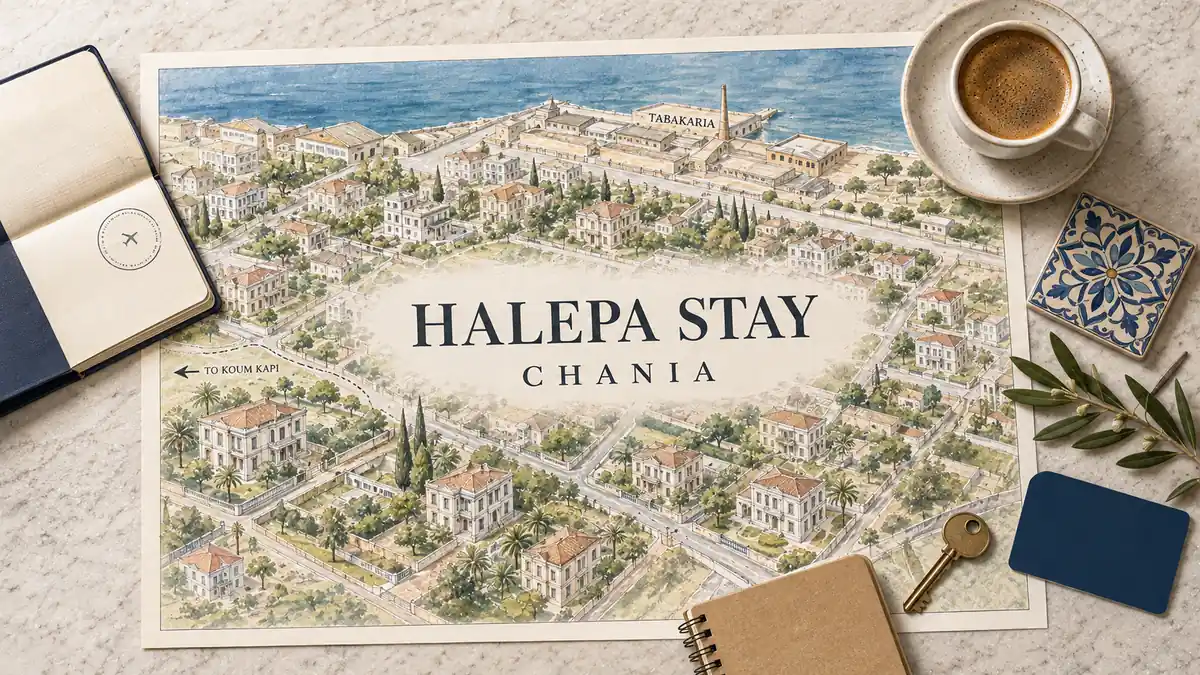
Halepa is two things in Chania, and the search results mix them freely: a residential neighbourhood on the city’s eastern hillside, and the Halepa Hotel, one property that took the district’s name. This page is about the neighbourhood. Halepa sits east of the centre, a quarter of preserved neoclassical mansions running downhill to the sea, and it poses one question to anyone booking a Chania trip — base here, or base closer to the harbour? The honest answer is a trade. Halepa buys you quiet streets, period architecture and space to spread out in an apartment-style stay. It costs you a walk or a bus ride every time you want dinner, a much thinner list of places to book, and a hill on the way home. What follows is what that trade actually feels like, and who it suits.
Quick Answer
Halepa is Chania’s quiet neoclassical quarter east of the centre, a good base if calm outranks convenience. The trade: quiet streets and period mansions against a hilly 20–45-minute walk or a bus 11 ride to the Old Town, plus few hotels and thin dining. Stay here for character and sleep; base nearer the Old Town for doorstep evenings.
Trust Layer
Tripstou stay guide for travelers choosing where to base. Covers area atmosphere, budget, convenience, noise, and traveler fit.
Produced with AI assistance and reviewed by Alex Perrut, working in tourism since 2015, for the Tripstou editorial team. See our editorial process for details.
Last factual review: September 7, 2026.
Official sources consulted: Visit Greece, Greek Ministry of Tourism.
Key Takeaways
- Halepa is a residential neighbourhood on Chania’s eastern hillside; the hotel that shares its name is one property inside it.
- Reaching the Old Town takes a 20–45-minute walk, depending on your street, or a short ride on bus 11.
- Expect guesthouses, private houses and apartment rentals here; conventional hotels are scarce, so book early and plan for self check-in.
- The core trade: quiet streets, period architecture and more space, paid for by walking out to dinner and climbing home.
- Light sleepers, repeat visitors and apartment bookers fit Halepa; first-timers and anyone wanting a reception desk should base elsewhere.
- The common mistake is booking Halepa expecting harbour atmosphere and arriving to find a quiet residential hillside instead.
Table of Contents
Is the Halepa Hotel the Same as the Halepa Neighbourhood?
No: Halepa is a residential neighbourhood on Chania’s eastern hillside, and the Halepa Hotel is one property inside it. The district is a preserved quarter of neoclassical mansions sloping down to the sea. This page judges it as a place to base, not as a property to book.
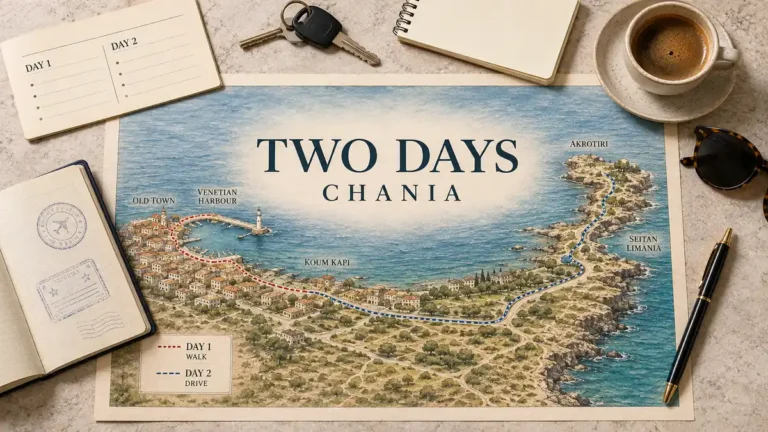
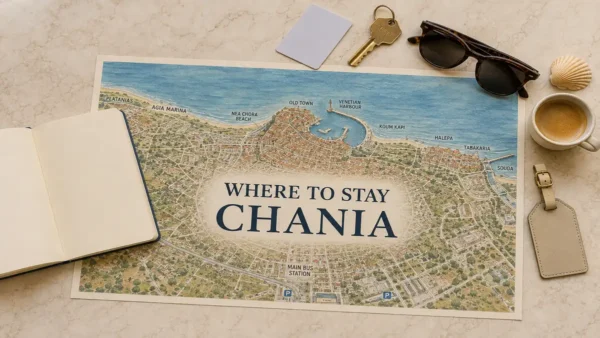
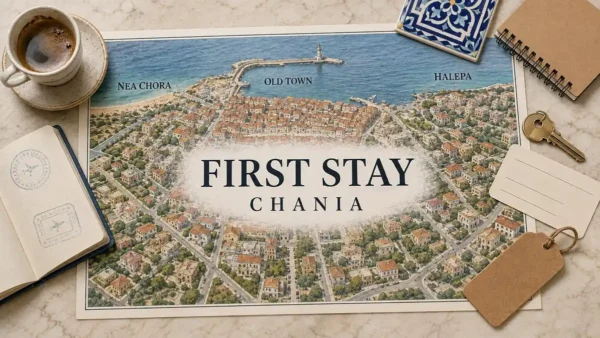
Halepa sits east of central Chania, uphill from the shoreline, with Tabakaria as its coastal edge and Koum Kapi and the Old Town strung out to the west along the water. That geography is the whole decision in one line. You are staying above and outside the tourist centre, close enough to reach it on foot, far enough that nothing from it reaches you at night.
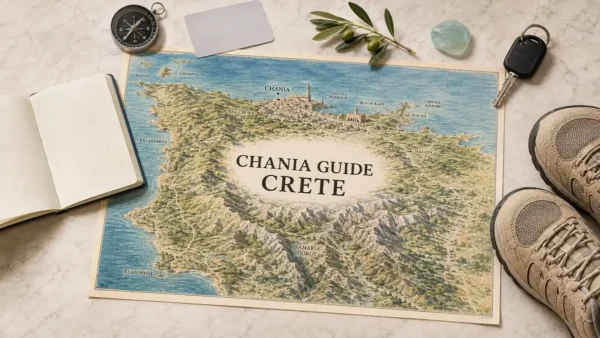
Orientation matters more here than in a compact centre, because the district covers a slope and your street decides your day. If you are still assembling the rest of the trip around this choice, the Chania guide covers the city itself.
Halepa Is Quiet Because It Was Built as a Mansion Quarter
Halepa is quiet, low-rise and short on hotels because it was built as Chania’s aristocratic and diplomatic quarter. Its mansions are protected, so the district never grew a hotel strip or a nightlife core. What survives is a residential hillside with period façades and very little commercial noise.
The mansions exist because foreign consulates and the Old French School clustered here when Halepa was the city’s diplomatic address, which is why the streets are wide, the plots deep and the buildings low. The House of Eleftherios Venizelos stands among them and operates as a museum, so the district’s best-known address is a quiet one that empties by evening.
Down at the water, Tabakaria was the tanners’ quarter and is now partly converted, giving Halepa a seafront edge that feels open and industrial while the hill above it stays domestic and closed. Every section below is downstream of that history: what you can book, where you walk to eat, and how well you sleep.
How Far Is Halepa from the Old Town, on Foot and by Bus?
Halepa is a 20–45-minute walk from the Old Town, depending on where in the district you stay. The spread is real: the lower western streets are close, the upper and eastern ones are not, and the return leg is uphill. Bus 11 is what makes the base workable day to day.
The range comes from where you land inside Halepa. The lower, western streets towards Koum Kapi put the Old Town at the short end; the higher and more easterly addresses add the rest, and the climb arrives at the end of the night, when you least want it.
- On foot — the default in daylight, and pleasant along the water for anyone who likes walking. Trade-off: the hill on the way back, which is the half travelers underestimate.
- Bus 11 — the connection that makes Halepa workable as a base, a short ride of roughly 5–10 minutes into the centre. Best for the end of a long day or the middle of an August afternoon.
- Taxi — the late-night fallback when the walk home has stopped sounding appealing.
Choose your street before you choose your stay. The gap between Halepa’s lower western edge and its top lanes is the gap between strolling to dinner and planning your evening around a bus.
Expect Guesthouses and Apartments in Halepa, Not a Hotel Strip
Halepa’s stays are mostly guesthouses, private houses and apartment rentals, with very few conventional hotels. Book it the way you would book an apartment: expect self check-in, a key code and no reception desk. That suits some travelers and quietly frustrates others.
The inventory follows the architecture. Restored houses and divided mansions leave no room for a hotel strip, so what reaches the market is rooms and flats inside buildings that were homes first. In practice that means kitchens you will actually use for breakfast, more space per night than a hotel room, and nobody at a desk when your flight lands late.
It also means a thinner list. The well-run places in a small district go early in high season, and there is no block of hotels behind them to absorb the overflow, so book earlier here than you would for the centre. If you want a reception, a designed interior and someone to call at midnight, boutique hotels in Chania is the better starting point.
Hotels and places to stay
Compare hotels, apartments and stays for your dates in one search.
Search hotels and stays on hotels.com →
Tripstou may earn a commission if you book through this link, at no extra cost to you.
Halepa Nights Are Quiet, and Dinner Usually Means a Walk
Halepa is genuinely quiet after dark, and most evenings you will walk out of it to eat. The streets are residential, with no bar strip and no harbour crowd. Dining inside the district is thin, so dinner usually means Koum Kapi, Tabakaria or the Old Town.
For a light sleeper this is the whole point. Rooms here face gardens and quiet lanes, not a taverna terrace that runs until two, and in a city where the centre trades sleep for atmosphere that is a genuine advantage. Inside Halepa itself you will find a handful of local places and daytime cafés — enough for a coffee, a bakery run or an unplanned lunch, not enough to carry a week of dinners.
So most evenings involve a decision and a walk: down to the Koum Kapi seafront, along to Tabakaria, or on into the Old Town, with the climb waiting on the way back. Quiet is not a side effect of this district — it is the product, and if the midnight walk home through empty streets sounds like a chore instead of a pleasure, Halepa is the wrong base for you. The Old Town puts the evening outside your door and charges for it in noise and crowds; if you are still weighing the two, the Old Town vs Halepa comparison settles it.
Do You Need a Car If You Stay in Halepa?
No: bus 11 and the walk cover Chania itself, and a car earns its keep only for day trips. Halepa’s streets are residential and low-traffic, so driving in and out is straightforward. Whether you need a vehicle depends entirely on how much of western Crete you plan to see.
Hire one if the trip is built around leaving the city — the beaches, gorges and mountain villages inland and along the coast are where a car pays for itself, and Halepa’s position on the eastern edge means you can drive out without threading the centre. Skip it for a Chania-only stay, and skip it on a first visit that will be spent mostly inside the Old Town, where you would be paying daily for something parked and unused.
Do not book Halepa for the driving. Book it for the quiet, and treat the car as a separate decision about the rest of Crete — a district this residential makes a vehicle less awkward than the pedestrian core does, but that is a consolation, never a reason.
Should You Stay in Halepa?
Stay in Halepa if quiet streets, period character and an apartment-style stay matter more than the harbour outside your door. Look elsewhere if you want a reception desk, dinner downstairs, or a base that never asks you to climb. For most travelers the walk and bus 11 decide it.
Best for: light sleepers and repeat visitors who want a restored-mansion quarter and are happy to walk or take bus 11 to dinner.
Stay here if:
- You sleep badly with noise and want a street that goes silent after dark.
- You are booking an apartment-style stay and want space, a kitchen and a residential setting.
- You have seen the Old Town before and do not need it outside the door.
- You like walking, and a hill at the end of the evening does not put you off.
Look elsewhere if:
- You want the harbour, the tavernas and the evening crowd a minute from your room.
- You need a hotel with a reception, housekeeping and someone to handle luggage.
- Mobility is limited, or you are arriving with heavy bags and small children.
- Your stay is two or three nights and you want zero transit inside the city.
First-timers usually do better nearer the centre, so weigh Halepa against where first-timers should stay in Chania before committing, while couples who want privacy over buzz are the district’s natural fit and can compare alternatives in where couples should stay in Chania. Families gain space here and lose convenience, a trade where families should stay in Chania weighs properly, and anyone whose trip revolves around late nights should read where to stay in Chania for nightlife and base elsewhere. Budget travelers will find self-catering useful but the stock thin, so check where to stay in Chania on a budget, and travelers who want full-service luxury should start from where to stay in Chania for luxury.
For the full set of Chania districts side by side, where to stay in Chania is the guide this page sits under.
Frequently Asked Questions
What is Tabakaria in Chania?
Tabakaria is the coastal strip of Halepa, named for the tanneries that once worked on its shore. The old tannery buildings stand right at the water’s edge and are partly converted today, giving Halepa a seafront that feels open and industrial beside the quiet residential hill above it.
Is there a beach near Halepa?
Not inside the district. Halepa’s own shoreline is the Tabakaria waterfront, a former tannery frontage, not a stretch of sand. The town’s main beach sits west of the centre, so a beach day from Halepa means crossing the city by bus, taxi or a long walk.
Is Halepa hilly or walkable?
Both. Halepa is built on a slope running down to the sea, so its streets are perfectly walkable but rarely flat, and the gradient is what people notice. Anyone with limited mobility, a pushchair or heavy luggage should weigh that carefully; the climb comes at the end of the evening.
Where is the Venizelos House in Chania?
The House of Eleftherios Venizelos stands in Halepa, among the neoclassical mansions on the district’s hillside, and it operates as a museum devoted to the statesman and modern Greek political history. It is the best-known address in the neighbourhood and one reason visitors walk east from the centre.
What was the Pact of Halepa?
The Pact of Halepa was an agreement signed in the district in 1878, giving Crete a degree of self-government under Ottoman rule. It is why the neighbourhood carries weight in Greek history, and why the consulates and grand houses that still shape its streets were built here at all.
Related Guides
- Where to stay in Chania — every Chania area compared in one place.
- Old Town vs Halepa — the head-to-head, if you are still weighing the two.
- Where first-timers should stay in Chania — the default base for a first visit.
- Where couples should stay in Chania — quiet, romantic and central options compared.
- Boutique hotels in Chania — design-led places to stay across the city.
- Chania guide — planning the rest of the Chania trip.
Did this guide save you time or money? Tripstou is independent and reader-funded — if you'd like to give something back, you can support the site with a crypto contribution of any size.