You have already chosen Chania. The only question left is how much caution the trip actually needs — and the honest answer is: not much for crime, more for roads, sea and heat. Chania is a small, walkable city where the Old Town and the Venetian Harbour stay busy late and violent crime against visitors is rare. That does not make it risk-free. It makes the risks different from the ones most safety pages lead with. This guide works through what genuinely deserves your attention: night walking, petty theft in its two real settings, driving on Crete’s roads, the money-friction patterns that pass for scams here, how the city reads for solo women, the sea and the summer heat, and whether travel insurance is worth buying for this particular trip.
Quick Answer
Chania is one of the safer cities a tourist can visit in Greece, with very low violent crime. The genuine risks are practical ones: Crete’s mountain roads, the sea, summer heat, and unclear bills on tourist strips. Drive conservatively and never leave valuables unattended on the sand — those two habits prevent most trip-ruining problems.
Trust Layer
Tripstou safety guide for travelers deciding how safe a destination is and what precautions actually matter. Covers real risk levels, common scams, situational awareness, and protection choices.
Produced with AI assistance and reviewed by Alex Perrut, working in tourism since 2015, for the Tripstou editorial team. See our editorial process for details.
Last factual review: September 4, 2026.
Official sources consulted: Visit Greece, Greek Ministry of Tourism.
Key Takeaways
- Violent crime against tourists in Chania is rare, and the pedestrianised Old Town stays busy and walkable well after midnight.
- Driving on Crete’s narrow mountain roads is the trip’s real hazard — judge those routes by terrain, not by distance.
- Petty theft has two settings only: packed harbour crowds in high season and bags left unattended on the sand.
- Chania’s scams are price friction — agree taxi fares, order from printed menus, and photograph the rental car at pickup.
- Summer heat reshapes a Chania day more than crime does; front-load walking into the morning and the evening.
- Travel insurance earns its cost on a driving trip; a short car-free town stay makes the case much weaker.
Table of Contents
Is Chania Safe for Tourists?
Violent crime against tourists in Chania is rare, and the city stays relaxed even in peak season. What deserves your attention sits elsewhere: Crete’s roads, the open sea, midsummer heat, and the occasional inflated bill. The compact, pedestrianised core keeps most day-to-day friction low.
The verdict holds for structural reasons, not luck. Chania’s centre is small enough to cross on foot, and the Venetian core is almost entirely closed to vehicles — the lanes carry pedestrians, not traffic. Tourism here is largely family-run: the tavernas, guesthouses and shops on the harbour are worked by people who live in the same streets, which raises the social cost of preying on visitors. The picture is consistent across sources, and it is consistent with how the city feels on the ground.
The useful reframe is to stop asking whether Chania is dangerous and start asking what actually deserves attention. Risk here is situational, not geographic. There is no street you cross into and become a target; there are moments — a wet mountain hairpin, a windy afternoon at an unwatched cove, a bag left on a towel — where your choices matter more than your location. That distinction runs through the whole page. For wider orientation before you arrive, the Chania travel guide covers what the city is and how it fits into a Crete trip.
Traveler type changes very little of the verdict. First-timers, families and older travelers can relax about crime almost completely. Drivers and swimmers are the two groups who should read the rest of this page properly. If you are not renting a car and not swimming off a remote beach, Chania’s risk profile sits close to that of a quiet European provincial town.
Are There Areas to Avoid in Chania?
No — Chania has no no-go areas. The neighbourhoods travelers ask about differ in crowd density and in how lively they are after dark, not in danger. Naming them is useful for context, not for avoidance.
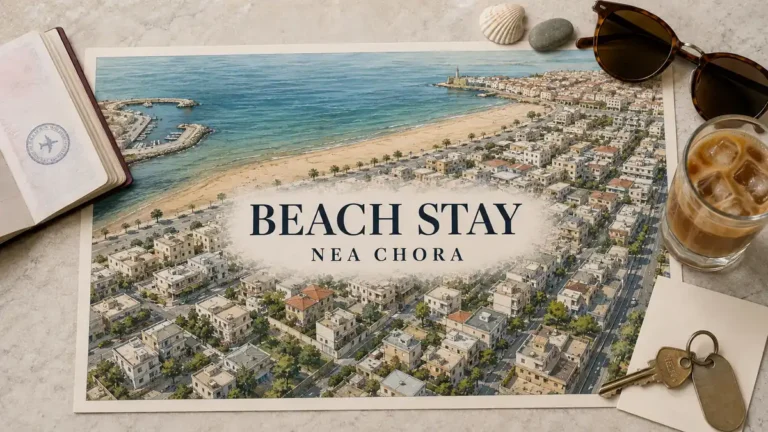
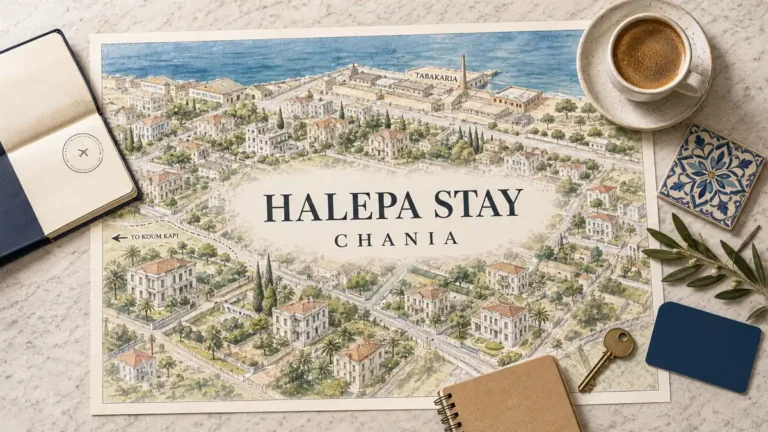
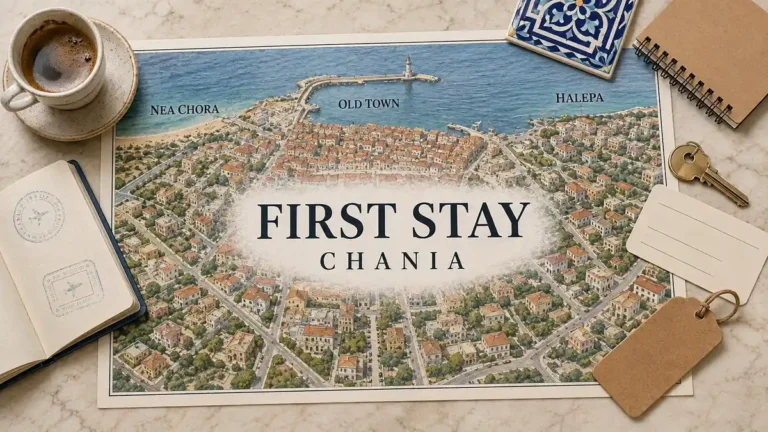
The Venetian Harbour and the Old Town lanes are the crowd zones. In peak summer the waterfront and the market streets compress to shoulder-to-shoulder in the evening, and that density is the one setting where pickpocketing is realistic. Splantzia, the old Jewish Quarter side of the centre, is quieter and more residential in feel, with the same pedestrian character. Nea Chora is the town beach neighbourhood — busy by day, calmer at night. Halepa is residential and largely uphill, with quiet, dimly lit stretches that feel empty late but are not threatening.
Treat unlit residential streets as a comfort question, not a crime question. If a late walk home through a silent Halepa street would make you uneasy, that is a reason to choose a base in or beside the pedestrianised centre — a decision resolved properly in the guide to where to stay in Chania, which weighs areas as places to sleep rather than as risk labels.
Is Chania Safe at Night?
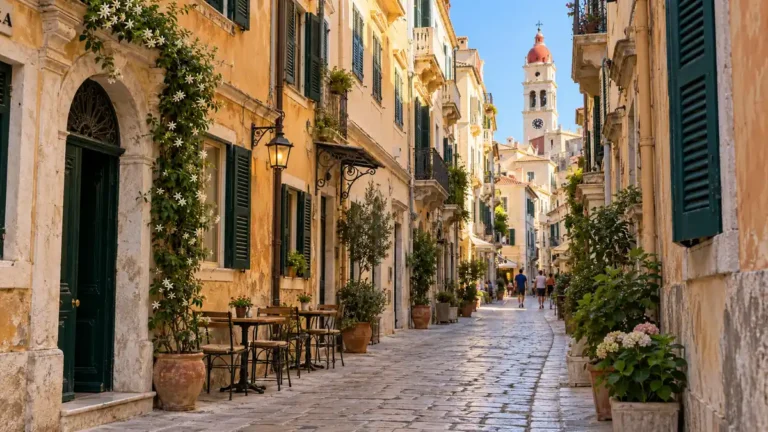
Chania’s Old Town and Venetian Harbour are safe to walk at night, largely because they never empty. Diners, families and bar crowds keep the lanes busy and lit until late, and the pedestrianised core removes traffic from the equation. The friction at night is noise and drink, not crime.
Crowd is the mechanism. A street with people on it at midnight is a street where opportunistic behaviour is observed, and Chania’s centre stays populated well past dinner because Greek evenings simply run late. Because vehicles cannot enter the Venetian core, you also lose the single most common night-time injury risk in most cities: being hit by a car while distracted or tired. Walking the harbour at 1am is a pleasant thing to do here, and it is normal.
The real night-time issues are ordinary nightlife issues. Bar strips get loud and drunk in high season, drinks cost more than they do two streets inland, and arguments over bills happen when the table has been drinking. Keep an eye on your own group and on your own tab. The walk back is the other variable: once you leave the busy lanes for a quiet residential street, the question becomes lighting and orientation, so know your route before you set off instead of working it out on a phone screen in the dark.
A taxi late at night is a pricing-clarity question first and a safety question second. Confirm the fare or the meter before the car moves, and the ride is unremarkable. Solo walkers, late diners and bar-goers all get the same advice here, which is itself part of the verdict.
Pickpockets and Beach Theft: Where Petty Crime Actually Happens
Petty theft in Chania concentrates in two places: packed harbour crowds in high season and unattended beach bags. Neither needs special gear to avoid. Keeping a bag in front of you through the market lanes and never leaving a phone on the sand removes almost all of the exposure.
The harbour and the market lanes matter only when they are full. In peak summer the waterfront promenade and the narrow shopping streets around the market become slow-moving crowds where bodies touch constantly, and that is the environment a pickpocket needs. Outside those hours and outside high season, the same streets are quiet enough that the risk effectively disappears. Café tables are the other soft spot — a phone on the outer edge of a table beside a busy walkway is the easiest thing in the city to take.
Beach theft works on a different mechanism, and Nea Chora, as the town beach everyone can walk to, is where it matters most. Beach theft in Chania peaks in the one minute everyone walks into the water together — the thief is not watching your bag, they are watching the group leave it.
- Carry a bag across your front, zipped, in harbour and market crowds.
- Keep phones and wallets off table edges at outdoor cafés.
- Take to the beach only what you could stand to lose in a swim.
- Leave one person with the bags, or swim in shifts.
- Put passports and spare cards in the accommodation safe, not in the day bag.
These are behaviours, not purchases. Anti-theft backpacks and money belts solve a problem Chania does not really have; attention in two specific settings solves the one it does.
Is Driving in Crete Safe for Tourists?
Driving is the real hazard of a Chania trip, not crime. Crete’s roads run from a fast north-coast motorway to narrow mountain lanes with hairpins, no barriers and the occasional goat. Both are manageable at a slow, defensive pace. Nervous drivers can skip the wheel entirely and still see plenty.
The two road worlds demand different things from you. The north-coast route linking Chania eastwards is a proper high-speed road, and the main adjustment is local overtaking culture: slower drivers routinely pull onto the hard shoulder to let faster traffic pass, and overtaking happens with less margin than many visitors are used to. Hold your line, do not be rushed, and let people go. Inland and toward the south coast, the roads narrow into unguarded mountain sections with blind hairpins, loose gravel on the surface and livestock that treats tarmac as pasture. Drive those at a fraction of the speed the map implies.
The mountain road that looks like a shortcut usually turns out to be the slowest and most demanding hour of a Cretan day, so judge those routes by terrain instead of by distance. Two practical rental points follow from this. Photograph and video the car from every angle at pickup, including the roof and the underside of the bumpers. And check whether your rental cover excludes unpaved roads — this varies by operator, and the contract is the only place the answer lives.
Parking is the easy part to get wrong. The Old Town is pedestrianised and cars cannot enter it, so plan to park on the outskirts of the centre and walk in. If driving in an unfamiliar country already makes you tense, base yourself in town and day-trip by bus or organised tour instead — the guide to getting around Chania without a car covers the options in detail.
Common Scams in Chania
Chania has few true scams; what travelers actually meet is price friction. Unclear taxi fares, inflated or “special menu” bills on the harbour strip, and disputed damage at rental return account for nearly all of it. Each one is defeated by agreeing or checking before money changes hands.
The pattern is worth naming because it changes your defence. Nobody is running an elaborate confidence trick on the Chania waterfront. What happens is that a price stays vague until after you have consumed the service, and vagueness reliably resolves in the seller’s favour. Remove the vagueness up front and the problem stops existing.
- Unclear taxi pricing. Where: ranks, the port, the airport, and late-night pickups near the bar strips. Recognise it: the driver deflects on price or leaves the meter off. Do: agree the fare or confirm the meter is running before the car moves.
- Inflated or “special menu” bills. Where: the harbour front and the busiest tourist lanes, especially where someone is standing outside inviting you in. Recognise it: a verbal offer, an unpriced daily special, or a bill with more lines than you ordered. Do: order from the printed, priced menu and read the bill line by line before paying.
- Rental damage disputes at return. Where: car and scooter returns, particularly rushed airport or port drop-offs. Recognise it: a scratch that “was not there” and no documentation to argue with. Do: photograph and video the vehicle at pickup and keep the signed checkout sheet until the deposit is released.
- Beach lounger and harbour tout offers. Where: the busy town beach and the waterfront. Recognise it: a sunbed or a boat trip presented as free or nominal, priced properly only afterwards. Do: ask the price and what it includes before you sit down or step aboard.
Price friction in Chania clusters where you did not choose the venue — a taxi you flagged in a hurry, a table a tout waved you toward. Anywhere you picked deliberately, the bill is usually fair. Knowing what a Chania trip costs makes an inflated bill obvious in the moment, and the national picture of Greek scam patterns sits on the Greece safety guide.
Chania Is Safe for Solo Female Travelers, With Small Caveats
Chania is a comfortable city for solo female travelers, with low street harassment and a busy, lit centre. Evenings in the Old Town belong to families and couples as much as to bar crowds. The caveats are the same ones every visitor faces late: the bar strip and the quiet walk home.
The reasons are the city’s own. Chania is small, its tourism economy is family-run, and the centre is crowded and pedestrian well past dinner, so a woman eating or walking alone attracts no particular attention. Solo travelers consistently describe it as low-hassle, and that reputation matches the city’s structure rather than depending on luck.
Two caveats are worth planning around. Late in the night the bar strip gets drunk, and drunk crowds anywhere produce unwanted attention. And the walk from the busy lanes to a quiet residential street is the one stretch where you are genuinely alone. Staying inside or beside the pedestrianised core after dark solves both at once, because it shortens that walk to nothing. Share your location with someone when you go out late, and agree a taxi fare before getting in. For the broader practical side of a Chania trip beyond safety, see the practical Chania tips.
Sea and Summer Heat: The Risks That Shape a Chania Trip
Chania’s beaches are safe to swim when you respect the flags, the wind and your own limits. The heat is the bigger daily factor: in high summer the middle of the afternoon flattens sightseeing plans. Shift walking and Old Town wandering to the morning and evening, and the day works.
The sea’s variable is wind more than water. Chania sits on Crete’s north coast, and on windy days the same beaches that were glassy yesterday develop chop and pull that tire swimmers quickly. Town beaches are busy and supervised in season; remote coves are neither, which is where confidence outruns ability. Respect posted flags and any signed swimming restriction — bathing water quality is officially monitored, and where a restriction is posted it exists for a reason.
The wind decides which Chania beach works on a given day more than the temperature does; a sheltered stretch can be calm while the exposed north-facing sand is unswimmable. Check before you commit the day to one spot.
Heat is the risk that quietly reshapes itineraries. In high summer the early afternoon is genuinely draining, and the visitors who struggle most are young children, older travelers and anyone attempting a gorge hike late in the day.
- Front-load sightseeing and walking into the morning; keep the harbour and the Old Town lanes for the evening.
- Carry water and refill it; shade in the Old Town lanes is better than on the open waterfront.
- Swim where there is supervision and where other people are already in the water.
- Start any hike early and turn back on a time, not on a destination.
Building the day around that rhythm is a planning move, not a precaution. The 2-day Chania itinerary and the 3-day Chania itinerary both show how the heat pattern shapes a workable day plan.
Do You Need Travel Insurance for Chania?
Travel insurance is worth it for Chania mainly because the real risks are medical, not criminal. A hire-car scrape on a mountain road, a swimming mishap or a heat-related hospital visit cost far more than a stolen beach bag. A short, car-free town stay needs it less.
Line up the scenarios and the pattern is obvious. A road accident in a rental on a narrow inland road is the expensive one, combining vehicle liability with medical treatment. A hospital visit for heat exhaustion, a bad fall on a gorge trail, or a swimming incident all sit in the same category. Weather-disrupted ferries and flights are a smaller but real cost, since Crete’s sea links are wind-sensitive. Theft cover matters least here, which is a fair summary of the whole page.
The insurance question in Chania is really a car question. If you are signing a rental contract, buy the cover and read what it excludes. If you are staying in town on foot for a few nights, the case is much weaker — and EU travelers carrying a European health card already have a baseline of public healthcare access, though it is not a substitute for full cover on a driving trip. The trade-off is straightforward: a modest fixed cost against an unlikely but large one.
Two act-now facts close this out. For any emergency in Greece, dial 112 — it works from any phone and connects to all emergency services. Keep your rental contract and pickup photos somewhere you can reach them fast, because they are what settles a dispute. That is the whole of the local emergency content; the national picture — emergency structure, tourist police, laws and country-wide scam patterns — lives on the Greece safety guide.
Travel medical insurance
SafetyWing Nomad Insurance provides travel medical coverage designed for travelers and digital nomads, with flexible Monthly and Annual plans.
Check Nomad Insurance coverage and current pricing →
New Nomad Insurance Essential members can get 8 weeks of electronic theft coverage free with reward code TRIPSTOU8.
Apply the reward before creating your SafetyWing account by looking for the pink camera icon on the Nomad Insurance page.
Tripstou may earn a commission if you purchase through this link, at no extra cost to you.
Frequently Asked Questions
Can you drink the tap water in Chania?
Yes, tap water in Chania town is chlorinated and regularly tested, and drinking it or brushing your teeth with it is normal. Many residents still buy bottled because the coastal supply is hard and tastes noticeably mineral. If the taste bothers you, a filter bottle solves it cheaply.
Is Chania safe for families with young children?
Yes, Chania suits families well, and crime is not the issue parents should plan around. Heat, sea conditions and the crowded evening lanes of the Old Town matter far more. Base yourself inside the walkable centre, keep afternoons shaded, and swim where other people already are.
Is Chania safe for LGBTQ travelers?
Chania is a relaxed tourist city where LGBTQ travelers generally report little hassle, particularly in the Old Town and around the harbour, where visitors of every kind are unremarkable. The surrounding villages are more conservative and traditional, so public displays draw more attention there than they do in town.
Are there earthquakes or wildfires in Crete?
Crete sits in a seismically active region, so small tremors are a normal background fact, not a trip risk, and the dry summer hills carry genuine wildfire potential. Neither should change your plans. Follow any instruction from local authorities or your accommodation, and dial 112 in an emergency.
Is Chania safer than the rest of Greece?
Chania is calmer than Athens for petty crime and broadly comparable to other Cretan and island towns, where small, tourism-dependent communities keep street crime low. The meaningful difference is not crime at all: Crete’s mountain roads and exposed coastline give it risks a city-only trip never meets.
Related Guides
- Chania travel guide — the full orientation to the city and how it fits a Crete trip.
- Where to stay in Chania — choosing an area as a base, with the trade-offs of each.
- Getting around Chania — buses, taxis, the airport and the port, with and without a car.
- Chania trip cost — what things actually cost, so an inflated bill stands out.
- Practical Chania tips — the non-safety things worth knowing before you arrive.
- 2-day Chania itinerary — a short stay built around the day’s rhythm.
- 3-day Chania itinerary — adding a day trip without overloading the plan.
- Greece safety guide — emergency structure, national scam patterns and country-wide context.
Did this guide save you time or money? Tripstou is independent and reader-funded — if you'd like to give something back, you can support the site with a crypto contribution of any size.