Sizing a realistic budget is the first hurdle of planning an Italy trip, and most sites either dodge the number or bury it in per-city detail. This guide resolves the headline question: what an Italy trip actually costs, per person and overall, before you commit. You will get a daily spend range by travel style, total cost by trip length for a week, ten days, or two weeks, a breakdown of what drives the number, how the season moves it, and the highest-leverage ways to spend less. The figures stay national and use ranges, since real costs shift with your style, timing, and region. Treat the numbers as planning ranges to verify before booking, not fixed quotes.
Quick Answer
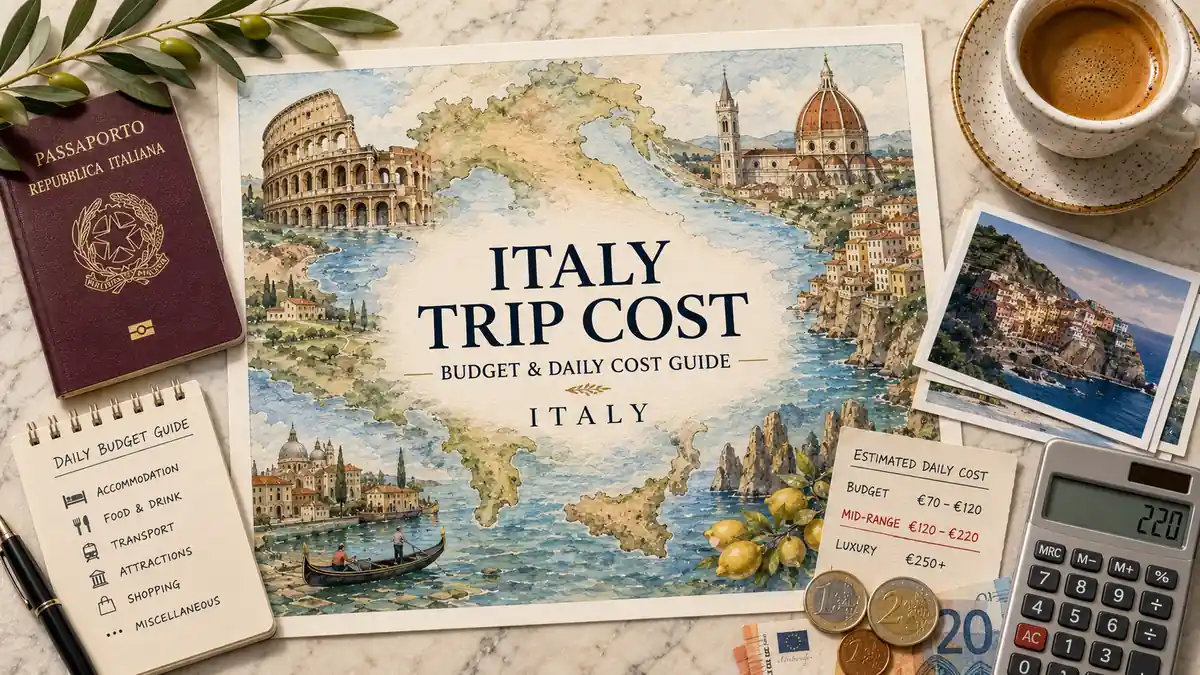
A typical mid-range Italy trip costs roughly €120–€220 per person per day, excluding international flights. Travel style and season move that number most: budget travelers spend less, luxury far more, and summer runs highest. Most visitors fit the mid-range band, and shoulder-season travel trims the total without gutting the experience.
Trust Layer
Tripstou planning guide for travelers resolving one travel decision. Covers the main variable, traveler context, and practical tradeoffs.
Produced with AI assistance and reviewed by Alex Perrut, working in tourism since 2015, for the Tripstou editorial team. See our editorial process for details.
Last factual review: September 21, 2026.
Official sources consulted: Italia.it, ENIT, Uffizi Galleries.
Key Takeaways
- A mid-range Italy trip runs roughly €120–€220 per person per day, with travel style and season moving the figure most.
- Accommodation and international flights dominate the budget, so where you sleep and when you fly drive the total far more than meals.
- A week costs about €1,200–€2,500 per person, ten days €1,700–€3,500, and two weeks €2,300–€4,800, flights included.
- Traveling in shoulder season instead of summer is the single biggest lever, often cutting flights and hotels 20–40%.
- Italy is moderately priced for Western Europe; smart choices on timing and base can swing the same itinerary by a third.
- Couples save per person because accommodation, the largest line, splits two ways, lowering the daily figure for two travelers.
Table of Contents
Is Italy expensive to visit?
Italy is moderately priced for Western Europe: cheaper than Switzerland or Scandinavia, pricier than much of the Balkans. What you pay depends far more on travel style, season, and region than on the country itself. A careful traveler eats and sleeps well here without a luxury budget.
The country rarely forces a high spend. Some of its best experiences, like wandering historic centers, hilltop villages, and free churches, cost nothing, and a sit-down lunch of pasta and house wine remains affordable in most towns. Where Italy gets expensive is concentrated and predictable: peak-summer coastal stays, marquee cities in high season, and anything labeled “near the main square.” Tourist or city tax applies in most Italian cities, charged per person per night and usually small. Prices you see already include VAT, so the displayed figure is what you pay.
Reality check: Italy is only as expensive as your choices about timing and base. The same itinerary can swing by a third depending on when you go and where you sleep, which is why the verdict is “moderate, and largely in your control.” For how cost fits into the wider picture of planning the country, see our Italy travel guide.
How much money do you need per day in Italy?
Most travelers need roughly €100–€250 per person per day in Italy, accommodation included. That range covers a comfortable mid-range trip: a decent room, two restaurant meals, local transport, and a paid sight or two. Budget travelers can dip lower; anyone chasing luxury climbs well past the top.
The daily figure is driven first by your bed and second by how you eat. A backpacker in dorms cooking some meals can hold the day near the bottom of the range, while a couple in three-star hotels eating out twice sits comfortably in the middle. Add a guided tour, a fine dinner, or a peak-season city and the day climbs fast. Card payment is widely accepted, though small cafés and rural spots still favor cash, so carry some for the day. For on-the-ground money habits like tipping and payment norms, see our Italy travel tips.
Budget, mid-range, and luxury: Italy by travel style
Italy splits cleanly into three daily-budget tiers: budget, mid-range, and luxury. Each tier mostly reflects where you sleep and how you eat. Budget means hostels and street food; mid-range means three-star hotels and trattorias; luxury means boutique stays and tasting menus. The table below sizes each per person per day.
The jump between tiers is rarely linear. Moving from budget to mid-range buys real comfort, a private room, restaurant meals, the occasional taxi, for a modest step up. The leap from mid-range to luxury buys polish more than necessity: four- and five-star addresses, private transfers, and reservations at the hardest tables. Most travelers get the best value at the mid-range tier, where the experience already feels generous.
Per person per day, accommodation and food included; international flights excluded. Treat as planning ranges and verify before booking.
| Travel style | Daily spend per person | Where you sleep | How you eat |
|---|---|---|---|
| Budget | About €60–€110 per day | Hostel dorms and guesthouses | Street food and self-catering |
| Mid-range | About €120–€220 per day | Three-star hotels and B&Bs | Trattorias and casual restaurants |
| Luxury | From €300 per day upward | Boutique and four-star hotels | Fine dining and tasting menus |
Rule of thumb: comfort is cheap in Italy, but prestige is not. The smartest spenders buy the mid-range room and put the saved money toward experiences, not a more expensive pillow.
Italy cost breakdown by category
Accommodation and flights dominate an Italy budget, followed by food, then activities and local transport. For most trips, where you sleep is the single largest controllable cost, while international airfare is the largest fixed one. Food sits comfortably in the middle; sightseeing and getting around cost the least.
Understanding the hierarchy tells you where effort pays off. Trimming a few euros off lunch barely moves the total, but choosing a slightly cheaper neighborhood or shoulder-season rate reshapes the whole trip. Intercity travel by train is efficient and reasonably priced when booked ahead, and city transport runs on cheap single tickets or day passes. Museum and attraction tickets are modest individually but add up across a packed itinerary.
| Category | Typical cost | Notes |
|---|---|---|
| Accommodation | Largest controllable line | Mid-range doubles roughly €80–€200 a night |
| Flights | Largest fixed line from afar | Long-haul fares swing widely by season |
| Food | Middle of the budget | Restaurant meals roughly €15–€35 per person |
| Activities | Smaller, additive line | Museum tickets often around €10–€30 each |
| Local transport | Smallest daily line | City tickets a few euros; trains booked early |
City choice shifts these numbers. Northern hubs and headline tourist cities run higher, while the south generally runs lower for the same comfort. For city-level detail, see our cost guides for Rome, Florence, Venice, Milan, Bologna, and lower-cost Naples.
Hotels and places to stay
Compare hotels, apartments and stays for your dates in one search.
Search hotels and stays on hotels.com →
Tripstou may earn a commission if you book through this link, at no extra cost to you.
How much does a 7, 10, or 14-day trip to Italy cost?
A week in Italy costs roughly €1,200–€2,500 per person; ten days run about €1,700–€3,500, and two weeks €2,300–€4,800, flights included. These are mid-range totals per traveler. Couples sharing a room lower the per-person figure, since accommodation, the biggest line, splits two ways.
Totals scale less than the day count suggests, because flights are a one-time cost spread across more days, dropping the daily average on longer trips. Pace also matters: fewer bases means fewer paid transfers and check-ins, so a slower route is usually the cheaper one for the same length. These ranges cover spend, not the actual route or sequencing. To turn a budget into a real plan, see our itineraries for 7 days, 10 days, and 14 days.
When is Italy cheapest? Cost by season
Italy is cheapest in the shoulder and off-season: roughly November to March, plus late autumn and early spring. Flights and hotels drop most in this window, often 20–40% below summer peaks. Summer and the winter holidays cost the most, when demand for the coast and cities surges.
The swing is concentrated in the two largest budget lines, airfare and accommodation, which is why timing is the single most powerful cost lever. Shoulder months, broadly April to early June and September to October, are the sweet spot: prices ease off the peak while the weather and daylight stay good for sightseeing. Deep winter is cheapest of all outside the holiday weeks, with the tradeoff of shorter days, some coastal closures, and colder northern cities.
Rule: shifting a summer trip into the shoulder season can save more than any amount of penny-pinching on meals or sights once you are there.
How to save money on a trip to Italy
The biggest savings come from timing and accommodation, not from skipping sights. Traveling in shoulder season and choosing where you sleep carefully can cut a trip’s cost by a third. Smaller levers, eating local, walking, and booking trains early, add up without diminishing the experience.
Stack the high-leverage moves first, then layer the small ones:
- Travel in shoulder season. The single biggest lever, cutting flights and hotels together.
- Sleep one neighborhood out. Staying just off the main square or square sights drops nightly rates sharply.
- Book trains and flights early. Advance intercity rail fares are a fraction of walk-up prices.
- Eat where locals eat. A standing espresso, market lunch, and house wine cost a fraction of tourist-strip menus.
- Walk and use day passes. Italian historic centers are compact and best seen on foot.
- Travel slower with fewer bases. Each move adds transfers and check-ins; staying put saves money and time.
Packing well saves money too, since replacing forgotten layers, adapters, or comfortable shoes at destination prices adds up fast. Our Italy packing list covers what to bring so you do not buy it twice.
Train and bus tickets
Compare routes, schedules and prices across rail and bus operators in one search, with mobile tickets on your phone.
New to Omio? Code NEW10 takes 10% off your first booking — or APPNEW10 if you book inside the Omio app. Both apply to bookings up to €80.
Search routes and compare prices on Omio →
Tripstou may earn a commission if you book through this link, at no extra cost to you.
Frequently Asked Questions
How much does an Italy vacation cost for a couple?
A couple should budget roughly €240–€440 per day for a mid-range Italy trip, since the two share one room — the biggest cost. Over a week that totals about €2,400–€5,000 including flights. Sharing accommodation lowers each person’s daily figure compared with traveling solo.
How much does a flight to Italy cost from the US?
Round-trip flights from the US to Italy typically run about $600–$1,200 in economy, depending on season, departure city, and how far ahead you book. Summer and holidays sit at the top; shoulder months and early booking land near the bottom. Direct routes cost more than connections.
How much cash should you bring to Italy?
Bring roughly €40–€80 in cash per person per day for small purchases, since cards are accepted almost everywhere else. Espresso bars, markets, small trattorias, and rural spots often prefer cash, while hotels, restaurants, and shops take cards. Withdraw euros from ATMs in Italy rather than exchanging money at home.
What is the cheapest region of Italy to visit?
Southern Italy is generally the cheapest region, including areas like Puglia, Calabria, Sicily, and Campania outside the Amalfi Coast. Accommodation, meals, and everyday costs run noticeably lower than in the north or in headline cities like Venice and Florence. The far south offers the best value for comfort.
How much is the tourist tax in Italy?
Italy’s tourist tax is a small per-person, per-night charge that varies by city and hotel category, usually only a few euros each night. It is often capped at a set number of nights and typically paid at check-out, separate from your room rate. Children are frequently exempt.
How much should you budget for food per day in Italy?
Budget roughly €30–€60 per person per day for food in Italy on a mid-range trip. That covers a coffee and pastry breakfast, a casual lunch, and a sit-down dinner with house wine. Cooking some meals or eating at markets pushes it lower; fine dining pushes it well higher.
Related Guides
- Italy Travel Guide — the full country planner and how this budget fits the bigger picture.
- Italy 7-Day Itinerary — turn a one-week budget into an actual route.
- Italy 10-Day Itinerary — pacing and route for a ten-day trip.
- Rome Trip Cost — city-level numbers for the capital.
- Italy Travel Tips — payment, tipping, and on-the-ground money habits.
- Italy Packing List — pack smart and avoid buying at destination prices.
Did this guide save you time or money? Tripstou is independent and reader-funded — if you'd like to give something back, you can support the site with a crypto contribution of any size.