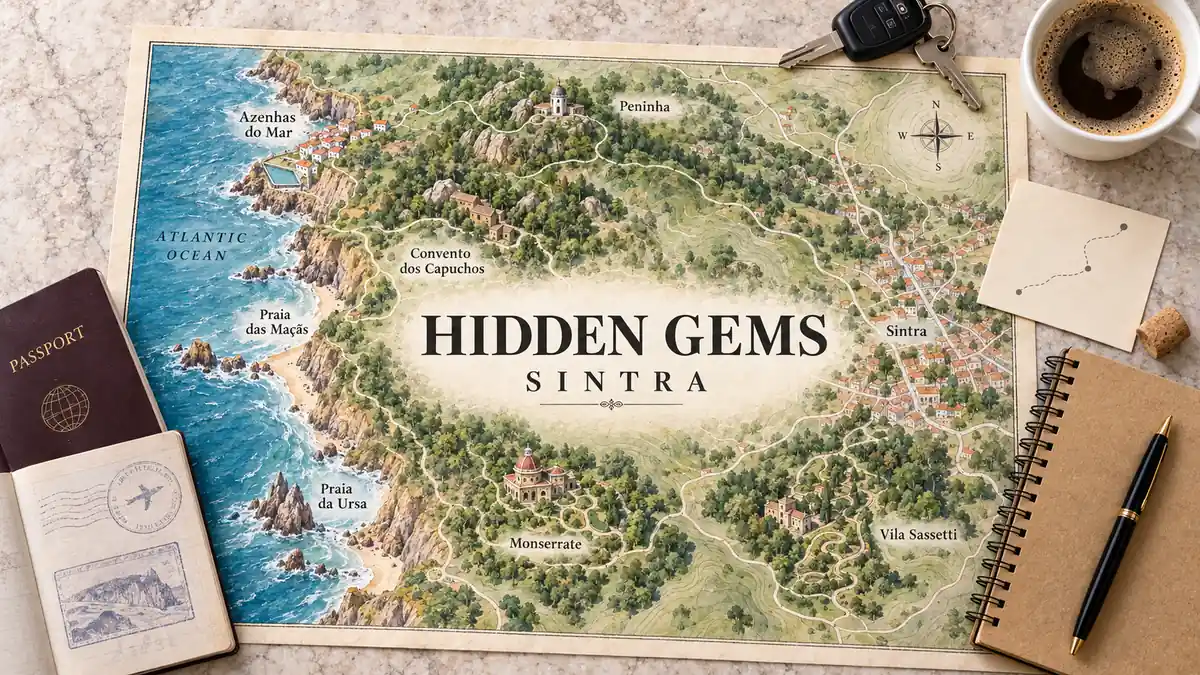
The palaces are booked, or already behind you, and the question is what to do with the hours that are left. Most lists answer it with fifteen names and no filter — the same set every time, with no way to tell which places are genuinely quiet and no word on whether you can reach them without a car. This page does two things instead. It applies a test for “hidden” that rejects four names those lists keep, including one of the most photographed spots in the municipality. And it gives every surviving pick a car / no-car verdict, because in Sintra that is the constraint that decides your afternoon. Seven places pass. Four sit on the Serra side, within reach of the historic centre. Three sit on the coast, where the quiet is real and the access is the price you pay for it.
Quick Answer
Monserrate, Convento dos Capuchos and Azenhas do Mar are Sintra’s three strongest hidden gems. The real split is car versus no car: the Serra-side picks stay within reach of the historic centre — the coast does not. Add one or two Serra places to a palace day; give the coast its own half-day.
Trust Layer
Tripstou selection guide for travelers choosing between multiple places. Covers selection criteria, traveler fit, and trip value.
Produced with AI assistance and reviewed by Alex Perrut, working in tourism since 2015, for the Tripstou editorial team. See our editorial process for details.
Last factual review: September 12, 2026.
Official sources consulted: Visit Portugal, Turismo de Portugal, Parques de Sintra.
Key Takeaways
- Monserrate is the strongest overall pick: palace-scale rooms and gardens with none of the queueing that defines the headline sites.
- Without a car, build on the Serra side — Vila Sassetti costs nothing, starts in town and needs no timetable at all.
- With a car, the coast opens up: Praia da Ursa is the emptiest sand in the municipality and the hardest earned.
- Treat the coast as its own half-day; bolting Azenhas do Mar onto a palace day produces a rushed hour and a long wait.
- Cabo da Roca, Biester Palace, Pena and Quinta da Regaleira fail the test — famous, ticketed or on the coach circuit.
- Every quiet place here is paid for in distance or gradient — Sintra has no undiscovered site near the station.
Table of Contents
What counts as a hidden gem in Sintra?
Seven places in Sintra pass a simple test: no coach groups, no tour-bus stop, quiet at midday in high season. They are Palácio de Monserrate, Convento dos Capuchos, the Peninha sanctuary, the Vila Sassetti path, Azenhas do Mar, Praia da Ursa and Praia das Maçãs.
The test has four criteria, and a place has to clear all of them:
- It sits outside the tourist-bus loop that shuttles visitors between the historic centre and the hilltop palaces.
- No coach groups turn over there — the crowd, when there is one, arrives in ones and twos.
- It stays quiet at midday in high season, not only at opening time.
- It sits inside the Sintra municipality, so it can realistically join a Sintra day.
Ranked by how quiet they stay, Praia da Ursa and Peninha are the emptiest of the seven — both ask for an approach most visitors will never make. Convento dos Capuchos comes next, then Azenhas do Mar outside summer weekends. Monserrate is the busiest of the seven and still nothing like the palace cluster; Vila Sassetti and Praia das Maçãs sit in the middle. Quiet in Sintra is bought with distance or gradient and almost nothing else — the municipality has no secret site five minutes from the station.
None of this argues against the headline palaces. They earn their queues, and the questions of which one to choose, how long to stay and when the crowds thin belong in our Sintra travel guide. This page also sorts places, not experiences: tours, tastings and bookable activities live with the things to do in Sintra guide.
Cabo da Roca and Biester Palace don’t make the cut
Cabo da Roca, Biester Palace, Pena and Quinta da Regaleira are not hidden gems, whatever the lists say. Each one is either a fixed stop on the standard tour circuit or an actively marketed ticketed attraction, which is the opposite of what this page is filtering for.
- Cabo da Roca — a fixed stop on the standard Sintra and Cascais tour circuit, with coaches arriving through the day.
- Biester Palace — ticketed and actively marketed since it opened to the public; a marketing budget and hidden status cannot coexist.
- Pena Palace — the most-visited monument in the municipality, and the thing the other seven are quietly hiding from.
- Quinta da Regaleira — Sintra’s second headline site and its most photographed well. Being underground does not make it undiscovered.
None of that makes them poor places to spend an afternoon. It makes them famous, and Portugal’s famous destinations are ranked in our guide to the best places to visit in Portugal.
The Serra side: four quiet places above the palaces
The Serra side is where Sintra’s hidden gems stay reachable without a car. Monserrate, Convento dos Capuchos, the Peninha sanctuary and the Vila Sassetti path all sit above or beside the historic centre, and each one asks for legs or a ticket instead of a bus timetable.
These four share one access reality, and that is what makes them a group: none of them depends on a service you cannot easily check. Two ask for a ticket, two ask only for effort. Distance from Sintra station predicts quiet on the Serra side far more reliably than fame does — Capuchos sits at the far end of that line, and it shows.
Palácio de Monserrate
Monserrate is the one hidden gem in Sintra that delivers palace-scale spectacle without the queue. The interior is a Moorish, Indian and Gothic fantasy of carved plaster and filigree arches, and the gardens around it are a serious botanical collection laid out across a valley.
What separates it from the other picks here is scale: this is a full monument visit with an interior, where the rest of the Serra side offers viewpoints and footpaths. It stays quiet for one reason — it sits roughly 4 km from the historic centre, outside the palace cluster, so the tour circuit skips it. Adult admission is currently €12, with the park open 09:00–19:00 and the palace 09:30–18:00; treat both as figures to confirm before you travel. A roof restoration means scaffolding and a temporary covering over part of the monument, which costs you the exterior photograph and not the interior.
Pick this if: you want a palace-scale interior you can walk through at your own pace with no queue.
Convento dos Capuchos
The Convent of the Capuchos is the anti-Pena: a tiny friary of cork-lined cells cut straight into the rock and the forest. Monks lived here in spaces barely large enough to lie down, and the whole building is deliberately, almost aggressively austere.
That austerity is its distinction on this page. Every other Serra pick trades in scale or in view; Capuchos trades in restraint, and it is the only one that changes how you read the palaces afterwards. It stays quiet because it sits at the far western end of the Serra, well beyond the palace cluster, and because it is small enough that a coach group simply would not fit inside it. Adult admission is currently €11, with the site open 09:00–17:30 — again, worth confirming before you set out.
Pick this if: you want the exact opposite of Pena and can give the approach an unhurried afternoon.
Peninha sanctuary
Peninha is the best viewpoint in the Serra de Sintra, and the one place on this shortlist where the reward is entirely the horizon. A small sanctuary and chapel sit on an exposed rock summit, with the Atlantic on one side and the whole ridge falling away on the other.
Its distinction is that it costs nothing and is gated by weather instead of by a ticket. On a clear day the view runs from the coastline to the plain; in the cloud the Serra generates almost daily, there is nothing to see at all. It stays quiet because it has no ticketed draw and sits high on the ridge, reached by a climb that deters casual visitors. There is no shelter and no facilities up there. Check the sky before you commit.
Pick this if: you want the widest view in the Serra and can reach the ridge by car or on foot.
Vila Sassetti path
The Vila Sassetti path is the only hidden gem in Sintra that is free, needs no transport and starts in the historic centre. It is a public footpath winding up through a landscaped estate, linking the town directly to the Moorish Castle on foot.
What makes it distinct is that it replaces a journey most people pay for. Visitors queue for the bus up to the castles and ride straight past the gate, while the path delivers them to the same place through gardens, terraces and rock-cut steps. It stays quiet for exactly that reason — nobody is told about it at the station. The trade-off is honest: it climbs the whole way, with no cafés, no guaranteed shade and no facilities on the route.
Pick this if: you want the pick that costs nothing, needs no transport at all, and starts where you are already standing.
Tours and activities
Book skip-the-line tickets, day trips and local tours with free cancellation on most activities.
You can also browse everything on getyourguide.com.
Tripstou may earn a commission if you book through this link, at no extra cost to you.
The coast side: Sintra’s emptier half
Sintra’s coast is emptier than its palaces because reaching it takes effort. Azenhas do Mar, Praia da Ursa and Praia das Maçãs sit on the Atlantic edge of the same municipality, and each one is quiet for the same reason: a car, an infrequent bus or a seasonal tram stands between you and it.
The access barrier is the amenity here. Remove it and these three would look like any other stretch of Lisbon-adjacent coast; with it in place, a weekday afternoon out here can feel close to private. The coast is also where this page’s factual caution bites hardest — bus routes, tram seasons and trailheads all shift, so treat every access note below as something to confirm before you build a day on it.
Azenhas do Mar
Azenhas do Mar is a white village stacked down a cliff face, and it is the strongest coast-side pick because it rewards staying still. Houses cascade toward a natural sea pool cut into the rock at the base of the cliff, refilled by the Atlantic itself.
Its distinction here is that it is a village you inhabit for an hour, where every other pick on this page is somewhere you arrive at, look at and leave. You reach it from Sintra station on a Carris Metropolitana coastal bus or by car; services on this stretch are infrequent, so check before you commit to a return. It also sits about 1.5 km north of Praia das Maçãs, which means the tram terminus and the village pair up on foot for anyone without a car.
Pick this if: you want a village to sit in and a coastline to watch, more than another monument to tick off.
Praia da Ursa
Praia da Ursa is the wildest beach in the Sintra municipality and the hardest of these seven to reach. Sea stacks rise straight out of the sand beneath cliffs that carry no road, no café and no lifeguard.
What sets it apart is that the difficulty is the whole point and the whole risk at once. The descent from the clifftop is steep, unmarked and exposed, with loose ground in places and nothing to hold on to; it is a scramble, not a stroll, and it suits neither children nor anyone unsteady on their feet nor wet weather. Getting down is the easy half. Realistically you need a car to the trailhead, and you should not start the descent late in the day.
Pick this if: you are sure-footed, travelling with a car, and want the emptiest sand in the municipality.
Praia das Maçãs and the historic tram
Praia das Maçãs is the coast pick you can reach without driving, and the historic tram from Sintra is half the reason to go. The line runs roughly 12 km from town down to the sea, through Colares and the vineyard country behind the coast.
What makes it distinct is that the journey outranks the destination. The beach is a decent, workaday resort beach with a river mouth at one end; the wooden tram rattling down a single track built for a different era is the part people remember. The trade-off is built into that. The tram is seasonal, and its operating season and timetable have to be checked before you plan a day around it — if it is not running, the beach alone will not repay the trip.
Pick this if: you want the coast without a car and you are in Sintra while the tram is running.
Can you reach Sintra’s hidden gems without a car?
Without a car you can reach the Serra-side gems; the coast is harder. Monserrate and Vila Sassetti work straight from the historic centre, Peninha and Capuchos demand real effort, and on the coast only Praia das Maçãs has a dependable car-free route in season.
The grid below sets the whole shortlist against that constraint. Where a car-free route is not dependable, the cell says so plainly instead of naming a service you might find cancelled.
| Place | Side of Sintra | Car needed? | Ticketed or free | Half-day or add-on |
|---|---|---|---|---|
| Palácio de Monserrate | Serra side, west of the historic centre | No — reachable without a car | Ticketed monument with gardens | Fits as a palace-day add-on |
| Convento dos Capuchos | Serra side, far western end | Car or taxi recommended | Ticketed monument, small site | Half-day once travel is counted |
| Peninha sanctuary | Serra side, high on the ridge | Car, or a long uphill walk | Free to reach and to visit | Half-day unless you drive up |
| Vila Sassetti path | Serra side, from the historic centre | No — the walk starts in town | Free public footpath | Easy add-on to a palace day |
| Azenhas do Mar | Coast side, north of Praia das Maçãs | Bus or car; services are infrequent | Free village and sea pool | Half-day built around the coast |
| Praia da Ursa | Coast side, below a clifftop trailhead | Car or taxi recommended | Free, with a difficult descent | Half-day, and weather permitting |
| Praia das Maçãs | Coast side, at the tram terminus | No — historic tram during its season | Free beach; a tram fare applies | Half-day built around the coast |
A car buys you the coast, and nothing else on this page. Without one, build the day on the Serra: Monserrate and Vila Sassetti are the two picks that never depend on a timetable, and Praia das Maçãs is the one coastal exception, valid only while the tram is running. Everything else on the coast column is a taxi fare waiting to happen.
Train and bus tickets
Compare routes, schedules and prices across rail and bus operators in one search, with mobile tickets on your phone.
New to Omio? Code NEW10 takes 10% off your first booking — or APPNEW10 if you book inside the Omio app. Both apply to bookings up to €80.
Search routes and compare prices on Omio →
Tripstou may earn a commission if you book through this link, at no extra cost to you.
Serra or coast: which additions fit your Sintra day?
Two Serra-side additions fit a day built around one palace; the coast needs its own half-day. Vila Sassetti plus Monserrate is the realistic pair, because one is a walk you are already making and the other sits a short ride away. Anything coastal breaks the day.
Three patterns cover almost every version of this decision:
- One palace plus one Serra pick. Fits day-trippers with a fixed return train and anyone who wants lunch to be unhurried. Vila Sassetti is the natural choice, since it doubles as the way up or the way down. Trade-off: you see one hidden gem, and it is the free one.
- One palace plus two Serra picks. Fits early starters and anyone staying overnight in Sintra or nearby. Vila Sassetti on foot, then Monserrate, is the pairing that holds together; Capuchos and Peninha sit too far west to bolt on. Trade-off: the day becomes a walking day, and the palace gets the shorter visit.
- A coast half-day on its own. Fits second visits, anyone with a car, and anyone who has already done the palaces. Azenhas do Mar with Praia das Maçãs is the strongest pairing, because the two link on foot. Trade-off: with no car you are tied to an infrequent bus or a seasonal tram.
The mistake worth avoiding is treating the coast as an add-on. Every version of that plan ends the same way — a rushed hour at Azenhas and a long wait for the way back.
Which palace to choose, how many days Sintra deserves and when the crowds thin are all decisions for our Sintra travel guide, and this page deliberately leaves them there. If the Sintra shortlist has you wondering what the same filter turns up elsewhere in the country, the country-scale version lives in our guide to hidden gems in Portugal.
Frequently Asked Questions
Is Cabo da Roca overrated?
No — Cabo da Roca earns its reputation as mainland Europe’s westernmost point, with genuinely dramatic cliffs. It simply is not hidden, which is why it sits outside this shortlist. Go if you have a car and the time, and expect company at every viewpoint.
Is Biester Palace a hidden gem?
No, and the reason is profile, not quality. Biester is sold as a paid attraction on Sintra’s main visitor circuit, so it draws exactly the crowd this shortlist is built to avoid. Treat it as one more ticketed palace interior, and keep it separate from the quiet picks here.
Is the Chalet of the Countess of Edla included with the Pena ticket?
Yes. The Chalet and Garden of the Countess of Edla are covered by the Park of Pena ticket, so no separate admission is needed. It still feels quiet because most visitors climb straight to the palace and never walk out into the wider park to find it.
Which is quieter, Praia da Adraga or Praia Grande?
Praia da Adraga is the quieter of the two. It is a compact cove closed in by cliffs, and the setting itself caps how many people fit on the sand. Praia Grande is broad, open and popular with surfers, and livelier for it. Neither made this shortlist; both draw a summer crowd.
Do you need to book Sintra’s quieter monuments in advance?
Booking ahead is not compulsory at Monserrate, the Convent of the Capuchos or the Chalet of the Countess of Edla. Tickets bought online do carry a date reservation you commit to at checkout, so buying at the gate keeps an unplanned afternoon flexible. Confirm conditions on the official Parques de Sintra site.
Can you pair Monserrate with the Convent of the Capuchos in one afternoon?
Only with a car. Both sit west of the historic centre, Capuchos considerably further, and there is no car-free connection between the two you can depend on. Drivers pair them comfortably in one afternoon; without a car the combination becomes two taxi fares and rarely repays the cost.
Related Guides
- Sintra travel guide — which palace to choose, how long to stay, and how to time a visit around the crowds.
- Things to do in Sintra — the experience side of the same destination, including tours, tastings and bookable activities.
- Hidden gems in Portugal — the same famous-versus-quiet filter applied to underrated towns and regions across the country.
- Best places to visit in Portugal — the famous destinations, ranked, for the parts of the trip that are meant to be busy.
Did this guide save you time or money? Tripstou is independent and reader-funded — if you'd like to give something back, you can support the site with a crypto contribution of any size.