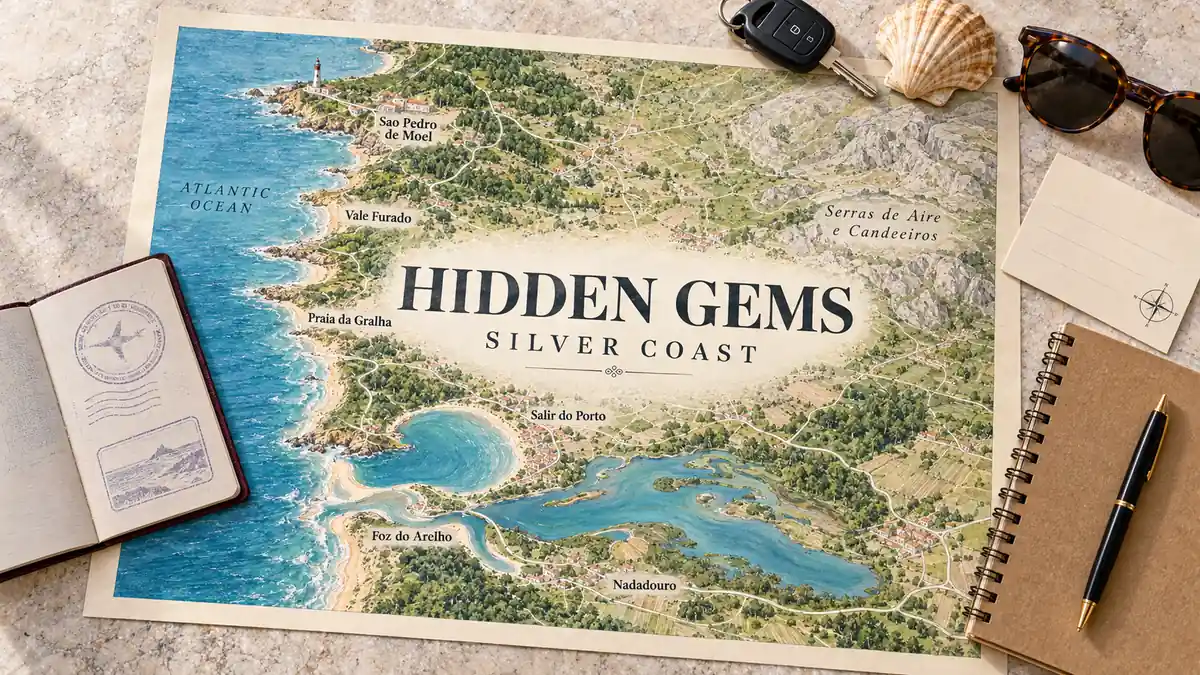
Every “hidden gems on the Silver Coast” page you have read so far answered with Óbidos, Nazaré and Peniche. Those are the three best-known names on this coast, which makes them the opposite of hidden. This page names the places those lists leave out: small villages inside the pine forest north of Nazaré, the cluster of settlements around the Óbidos lagoon, beaches in Alcobaça and Peniche municipalities that appear in Portuguese regional press and almost nowhere in English, and one limestone range inland. For each one you get what it is, why it stayed off the lists, and how you actually reach it. That last part is the honest catch. Most of these places stayed quiet because they are awkward to get to — a turning you would miss, a track instead of a road, parking for a dozen cars. A car is part of the deal here, and a few picks also ask you to walk the last stretch.
Quick Answer
The Silver Coast’s real hidden gems are São Pedro de Moel, the Óbidos lagoon villages and Alcobaça’s walk-in beaches. They stay quiet because they are awkward to reach: nearly all need a car, some a walk in from parking. Pick a village for a quiet base, a walk-in beach for a half-day detour.
Trust Layer
Tripstou selection guide for travelers choosing between multiple places. Covers selection criteria, traveler fit, and trip value.
Produced with AI assistance and reviewed by Alex Perrut, working in tourism since 2015, for the Tripstou editorial team. See our editorial process for details.
Last factual review: September 12, 2026.
Official sources consulted: Visit Portugal, Turismo de Portugal.
Key Takeaways
- São Pedro de Moel is the strongest quiet base here: a village inside the pine forest, not a beach with a car park.
- Óbidos, Nazaré, Peniche and São Martinho are good towns but fail the hidden test — every list already opens with them.
- Vale Furado and Praia da Gralha reward the walk in: bring everything, expect nothing, and have the sand largely to yourself.
- The Serras de Aire e Candeeiros is the one pick where the Atlantic plays no part — a whole day of limestone country.
- A car is the price of entry — awkward access is exactly why these places stayed quiet in the first place.
- Quiet here is seasonal: parking at the hardest-access beaches fills on summer afternoons, so treat emptiness as likely, never promised.
Table of Contents
Óbidos, Nazaré, Peniche and São Martinho are not hidden gems
Óbidos, Nazaré, Peniche and São Martinho do Porto are good places and not hidden. They are the four best-known towns on this coast, and every Silver Coast list opens with them. A place that headlines the standard itinerary cannot also be the secret. Worth visiting, yes. Hidden, no.
The recycling has a mechanical cause. English-language pages about this stretch are written for readers who have never heard of it, so they lead with whatever is recognisable, then print the word “secret” above it. Add Alcobaça town, Batalha, Tomar, Aveiro and Figueira da Foz and you have the standard eight, repeated page after page. Those names deserve a trip and they belong on a shortlist of the best places to visit in Portugal, where a reader is genuinely choosing between destinations.
This page applies a harder test. A pick qualifies when it is absent from the English-language lists, awkward enough to reach that mass tourism passed it over, overshadowed by a famous neighbour, or named mainly in Portuguese regional press and forums. Those four conditions usually travel together, which is why so much of what follows is villages you have to look up and beaches you park short of.
What there is to do in and around the famous four — the waves, the island crossing, the monastery detours — is a separate question, answered in things to do on the Silver Coast. This page stays on places.
A quick test before you trust any list on this subject: if Óbidos appears in the first three entries, you are reading a best-of page wearing a hidden-gems title.
The Pine-Forest Coast North of Nazaré: São Pedro de Moel and Alcobaça’s Quiet Beaches
The forested coast between Nazaré and São Pedro de Moel holds the Silver Coast’s quietest string of beaches. A single road runs north through the pines and drops to one small beach after another, ending at a village almost no English list mentions. Nothing here was built for visitors.
Quiet on this stretch is mostly a function of the last hundred metres. The beaches you can park on top of fill first, and the ones with a slope or a track between the car and the sand stay empty on the same August afternoon. Choose by how far you are willing to walk, and the crowd question answers itself.
Is São Pedro de Moel worth visiting?
São Pedro de Moel is worth visiting, and it is the strongest quiet base on this part of the coast. It is a small village of a few hundred people set inside the Pinhal de Leiria, with the Penedo da Saudade lighthouse standing above it and Praia Velha and Praia da Concha close by. What makes it distinct among the picks on this page is that it is a village first and a beach second — the other stops on this road are beaches with a car park attached.
- Where it is: inside the pine forest, roughly 19–20 km north of Nazaré and about 20 km from Leiria.
- How you reach it: paved road by car through the forest; do not count on public transport to get you here or away again.
Pick this if: you want a base you can walk end to end, with the ocean on one side and forest on the other.
Paredes da Vitória, Polvoeira, Mina and Água de Madeiros: the beaches along the forest road
These four beaches are strung along the forested coastal road that runs north from Nazaré toward São Pedro de Moel. They stayed quiet because the road was never a resort strip: each beach is a turning off it, a small parking area and a way down to the sand, with nothing built up behind it. They work best taken as a set. Drive north, look at each one, stop at whichever suits the wind that day — that flexibility is what none of the famous beaches on this coast can offer you.
- Where they are: along the coastal road north of Nazaré, in the order Paredes da Vitória, Polvoeira, Mina, Água de Madeiros, toward São Pedro de Moel.
- What to expect: small parking areas that fill on summer afternoons, and seasonal facilities at best — many beaches on this coast have no lifeguard cover outside the summer season.
Pick this if: you want a half-day where the plan is to stop at whichever beach looks best from the road.
Vale Furado and Praia da Gralha: Alcobaça’s walk-in beaches
Vale Furado and Praia da Gralha are the two hardest-earned beaches in Alcobaça municipality, and that is exactly why they appear in Portuguese regional press and nowhere in English. Vale Furado is difficult to reach, with parking that fills in summer. Gralha is effectively wild — dirt-road access, unmanned, nothing waiting for you at the bottom. The emptiness is the product here. Both ask more of you than any other pick on this page, and both pay it back on an August weekend when the famous beaches are full.
- Where they are: both in Alcobaça municipality, reached by minor roads off the coastal route.
- What to expect: track surfaces and parking capacity that shift with the season and the weather — check on the day, never assume.
Pick this if: you will carry everything you need down to the sand and expect nothing at all waiting there.
Praia do Salgado and Salir do Porto: The Quiet Edges of Nazaré and São Martinho
Praia do Salgado and Salir do Porto sit beside Nazaré and São Martinho do Porto and stay quiet. Each famous town has a neighbour the crowds never cross into — a beach you park short of on Nazaré’s side, a residential village on São Martinho’s. The gap is small and the difference is not.
Praia do Salgado: park short and walk in
Praia do Salgado is a broad open beach in Nazaré municipality that visitors reach by parking short and walking in. Parking is limited, which is the whole explanation for its emptiness: a beach that cannot absorb cars cannot absorb crowds, however close it sits to a famous town. Scale is what separates it from the other picks here. This is no hidden cove — it is a long stretch of Atlantic sand near one of Portugal’s best-known beaches, and on the same day one is shoulder to shoulder and the other is not.
- Where it is: Nazaré municipality, on the coast outside the town itself.
- How you reach it: by car, then on foot from wherever you find space — expect the walk-in, especially in summer.
Pick this if: you want a big open beach on Nazaré’s doorstep and do not mind parking short and walking the rest.
Salir do Porto: the residential side of São Martinho’s bay
Salir do Porto is the quiet residential neighbour of São Martinho do Porto, on the far side of the same bay. It is a village where people live year-round, which is precisely why it never became a name: no promenade, no resort frontage, no reason for a coach to stop. It is the only pick on this page that gives you a sleepy base with a full resort town’s services minutes away, and that combination is worth more than it sounds when you are travelling with people who want different things from a day.
- Where it is: on the bay beside São Martinho do Porto, the quiet residential side of it.
- How you reach it: paved road by car; the practical assumption is that you drive to anything beyond the village.
Pick this if: you want to sleep somewhere residential and quiet with a resort town’s restaurants a short drive away.
On this coast the quiet option is rarely further away. It is often the same bay or the same stretch of sand, approached from the side with no promenade on it.
The Óbidos Lagoon Villages: Foz do Arelho, Nadadouro and the Ocean-Side Beaches
No cluster on the Silver Coast is overlooked as consistently as the villages around the Óbidos lagoon. One of Portugal’s largest coastal lagoons sits below the walled town, and the settlements on its shore carry none of its traffic: a village at the mouth, two across the water, and two ocean beaches no Óbidos list mentions.
The lagoon is the reason this cluster stayed off the lists. Visitors come to Óbidos for the walls, and the walls are inland. Very few drive the extra stretch west to discover that the same municipality has a coastline, a lagoon and beaches with no queue at the gate.
Foz do Arelho: the village at the lagoon mouth
Foz do Arelho sits exactly where the Óbidos lagoon meets the Atlantic, and that position is its entire case. On one side you have flat, sheltered lagoon water; on the other, open ocean with everything the Atlantic brings. No other pick on this page puts two completely different bodies of water within a few minutes of each other. It is also the most established of the villages here, which cuts both ways: you will find services, and you will not have the place to yourself in August.
- Where it is: at the mouth of the Óbidos lagoon, west of Óbidos town.
- How you reach it: paved road by car; the easiest arrival of the picks on this page.
Pick this if: you want a base where flat lagoon water and open Atlantic sit minutes apart.
Nadadouro and Casal da Lapinha: the view across the lagoon
Nadadouro and Casal da Lapinha are lagoon-side villages that look across the water toward Foz do Arelho, and the view is the reason to stop. They sit on the lagoon’s shore, away from the ocean entirely, which is why no beach list has ever had a reason to name them. What they give you is the lagoon seen whole — water, birds, the far shore — instead of the mouth’s activity. Neither sustains a trip alone. Both improve a drive around the lagoon considerably.
- Where they are: on the lagoon’s shore, facing across the water toward Foz do Arelho.
- How you reach them: by car on the minor roads that circle the lagoon; there is no practical alternative.
Pick this if: you are circling the lagoon by car and want a short stop where the view is the whole point.
Praia do Bom Sucesso and Praia do Rei Cortiço: Óbidos’s beaches nobody lists
Praia do Bom Sucesso and Praia do Rei Cortiço are ocean beaches inside Óbidos municipality that sit outside every list written about Óbidos. That is the anomaly worth knowing: the town’s name carries enormous recognition and none of it reaches its own coastline. Both appear in Portuguese-language coverage of the region’s lesser-known beaches and effectively nowhere in English. They are the cluster’s proof that a famous name attaches to a walled centre, never to the whole municipality drawn around it.
- Where they are: on the ocean coast of Óbidos municipality, away from the walled town.
- What to expect: confirm access and parking locally before committing a day to either, and plan for the same limited-services pattern as the rest of this coast.
Pick this if: you are staying near the lagoon and want ocean sand that carries none of the town’s name recognition.
Peniche to Torres Vedras: Four Beaches the Lists Miss
Praia da Almagreira, Portinho da Areia Norte, Porto das Barcas and Praia Azul are the southern coast’s unlisted beaches. Two sit in Peniche municipality, one at Atalaia in Lourinhã, one in Torres Vedras. All four get real local use and almost no English-language coverage, which is an unusual combination this close to Lisbon.
Proximity to the capital usually destroys a beach’s obscurity. Here it works the other way: day-trip traffic concentrates on the handful of names people already know, and the beaches a few turnings away stay local precisely because a famous alternative nearby is soaking up the arrivals.
Praia da Almagreira and Portinho da Areia Norte: Peniche’s quiet beaches
Praia da Almagreira and Portinho da Areia Norte are the two beaches in Peniche municipality that the area’s own visitors walk past. Almagreira sits at Ferrel, on a coast whose reputation was built by neighbouring places with much louder names. Portinho da Areia Norte is small and unmanned, which keeps it a local beach in practice. What distinguishes the pair is how close they are to a busy, well-known stretch of coast while carrying none of its weekend numbers. You are not driving into the hinterland to find them.
- Where they are: Almagreira at Ferrel in Peniche municipality; Portinho da Areia Norte on the Peniche coast.
- What to expect: small scale and limited or absent services; lifeguard cover here is seasonal at best and never something to count on.
Pick this if: you are passing through Peniche and want the coast without the harbour town’s crowds.
Porto das Barcas and Praia Azul: Lourinhã and Torres Vedras
Porto das Barcas and Praia Azul are the southernmost picks on this page and the first genuinely quiet coast you meet coming up from Lisbon. Porto das Barcas sits at Atalaia in Lourinhã municipality; Praia Azul belongs to Torres Vedras. Both are named in Portuguese coverage of the Oeste’s lesser-known beaches and neither appears in the English-language Silver Coast canon, despite sitting on the stretch most Lisbon-based travelers drive straight through on the way north to the famous towns.
- Where they are: Porto das Barcas at Atalaia, Lourinhã municipality; Praia Azul, Torres Vedras municipality.
- What to expect: confirm parking and facilities locally, and plan for the small-scale, limited-services pattern that runs along this whole coast.
Pick this if: you are coming up from Lisbon and want the first genuinely quiet coast on the drive.
Inland Detours: Alfeizerão and the Serras de Aire e Candeeiros
Alfeizerão and the Serras de Aire e Candeeiros are the inland detours worth making from the Silver Coast. One is a parish behind São Martinho known across Portugal for a cake; the other is a limestone range spanning six municipalities. Both do the same job — they trade Atlantic wind for a landscape that looks nothing like the coast.
Going inland here is no wet-weather consolation. It is the one direction where the wind stops, and on a shoreline this exposed that matters far more than it would on a sheltered coast.
Alfeizerão: the pão de ló parish behind São Martinho
Alfeizerão is a parish of Alcobaça municipality sitting inland behind São Martinho do Porto, and it is known throughout Portugal for its pão de ló. The cake is its identity, the way a fishing village is defined by its boats — nothing needs organising around it to understand the place. Its other distinction is geographic: the flat ground it sits on was historically the Pederneira lagoon, which explains a landscape that makes no sense until someone tells you the water used to reach this far inland.
- Where it is: Alcobaça municipality, inland behind São Martinho do Porto.
- How you reach it: by car on the inland roads between the coast and Alcobaça.
Pick this if: you want twenty minutes of somewhere ordinary and Portuguese between two beach days.
Parque Natural das Serras de Aire e Candeeiros: the limestone range
The Parque Natural das Serras de Aire e Candeeiros is the region’s inland counterweight: roughly 39,000 hectares of limestone country spanning Alcobaça, Porto de Mós, Alcanena, Santarém, Torres Novas and Ourém. It has carried protected status for decades. Scale is what makes it different from every other pick here — a landscape you drive into for a whole day, dry stone walls and bare rock above, a set of show caves below, and the only entry on this page where the Atlantic plays no part at all.
- Where it is: inland from the coast, across six municipalities behind Alcobaça and Porto de Mós.
- How you reach it: by car; the park is a driving landscape with villages and viewpoints spread across it.
Pick this if: the wind has beaten you and you want a day inland where the landscape changes completely.
If the overlooked-places approach works for you beyond this region, the same job at national scope is covered in hidden gems in Portugal.
Do you need a car for the Silver Coast’s hidden gems?
You need a car for almost every place on this page. Car dependency is the reason these places stayed quiet, and it is the trade-off you accept to have them to yourself. The village picks are the only ones where you might manage a day or two without driving.
The access pattern is consistent across the picks. Villages sit on paved roads and are straightforward to reach. Beaches range from a turning with a small car park to a dirt track and a walk in from wherever you find space, and parking at the hardest ones fills on summer days. Do not count on reaching the beaches by bus. Public-transport reachability is not something this page can confirm for these villages, and building a trip on that assumption is how people end up stranded.
“No lifeguard, no services” has a practical translation. Bring water, food and shade, expect no toilets and no beach bar, and treat the sea as unsupervised. Many beaches on this coast have no lifeguard cover outside the summer season, and no beach here should be assumed supervised — the position can change from one season to the next.
The Atlantic itself is the quiet coast’s real explanation: cold, exposed and windy for much of the year, which is why this shoreline never filled up the way the south did.
| Place | What it is | Why it stays quiet | How you reach it |
|---|---|---|---|
| São Pedro de Moel | Small forest village with a lighthouse above it | Absent from English lists, small and self-contained | Paved road by car; park in the village |
| Foz do Arelho | Village at the mouth of the Óbidos lagoon | Overshadowed by the walled town inland | Paved road by car; easiest arrival of the picks |
| Salir do Porto | Residential village on São Martinho do Porto’s bay | Its famous neighbour absorbs the visitors | Paved road by car; short drive to the resort town |
| Praia do Salgado | Broad open beach in Nazaré municipality | Limited parking keeps visitor numbers naturally low | Park short of the beach and walk in |
| Vale Furado | Small Atlantic beach in Alcobaça municipality | Difficult access has always kept numbers down | By car; parking fills on summer days |
| Praia da Gralha | Effectively wild beach in Alcobaça municipality | Dirt-road access and no services on site | Car to the track, then walk in |
Treat the car as part of your beach kit here. At the unmanned picks it is your shade, your storage and the only place to change, which makes where you park a bigger decision than it ever is on a serviced beach.
Getting around the region, when to go and where to base yourself are resolved in the Silver Coast guide, which covers the logistics this page deliberately leaves out.
Tours and activities
Book skip-the-line tickets, day trips and local tours with free cancellation on most activities.
You can also browse everything on getyourguide.com.
Tripstou may earn a commission if you book through this link, at no extra cost to you.
Frequently Asked Questions
Are the Silver Coast’s hidden gems still quiet in August?
Mostly yes, but not uniformly. The lagoon-side villages, the inland picks and the beaches you walk into hold their quiet best in August. Parking at the hard-access beaches fills on summer afternoons, and Foz do Arelho is the pick least likely to feel empty. Treat quiet as likely, never guaranteed.
Which Silver Coast beaches have no lifeguard?
Praia da Gralha and Portinho da Areia Norte are the two unmanned picks on this page, with no lifeguard service on site. The wider pattern matters more than any single name: many beaches along this coast carry no cover outside the summer season, so check locally before you swim.
Which Silver Coast hidden gems are closest to Lisbon?
Praia Azul in Torres Vedras and Porto das Barcas at Atalaia, in Lourinhã, are the southernmost picks and therefore the closest to Lisbon. The two Peniche beaches, Praia da Almagreira and Portinho da Areia Norte, come next. Everything north of them adds driving time you should plan for.
Is Foz do Arelho or Salir do Porto better for a quiet stay?
Salir do Porto is quieter; Foz do Arelho is more useful. Salir is residential, with São Martinho do Porto’s services a short drive away and almost nothing happening in the village itself. Foz do Arelho puts lagoon and ocean minutes apart but keeps a summer crowd. Choose by how much quiet you want.
What is the difference between the Silver Coast and the Oeste?
They are two labels for overlapping ground, not two different places. Silver Coast, Costa de Prata in Portuguese, is the tourism name used in English for this stretch of Atlantic shoreline. Oeste is the Portuguese regional name you meet locally and in Portuguese-language sources covering the same beaches.
What is the Pinhal de Leiria?
The Pinhal de Leiria is the pine forest that covers the coast north of Nazaré, with São Pedro de Moel sitting inside it. It is what gives this stretch its character: a forest road instead of a resort strip, and small beaches reached by turnings off it.
Related Guides
- Silver Coast guide — getting around, when to go and where to stay across the region.
- Things to do on the Silver Coast — the waves, islands and monasteries around the famous towns.
- Best places to visit in Portugal — where Óbidos, Nazaré and the other famous names belong.
- Hidden gems in Portugal — the same overlooked-places job at national scope.
Did this guide save you time or money? Tripstou is independent and reader-funded — if you'd like to give something back, you can support the site with a crypto contribution of any size.