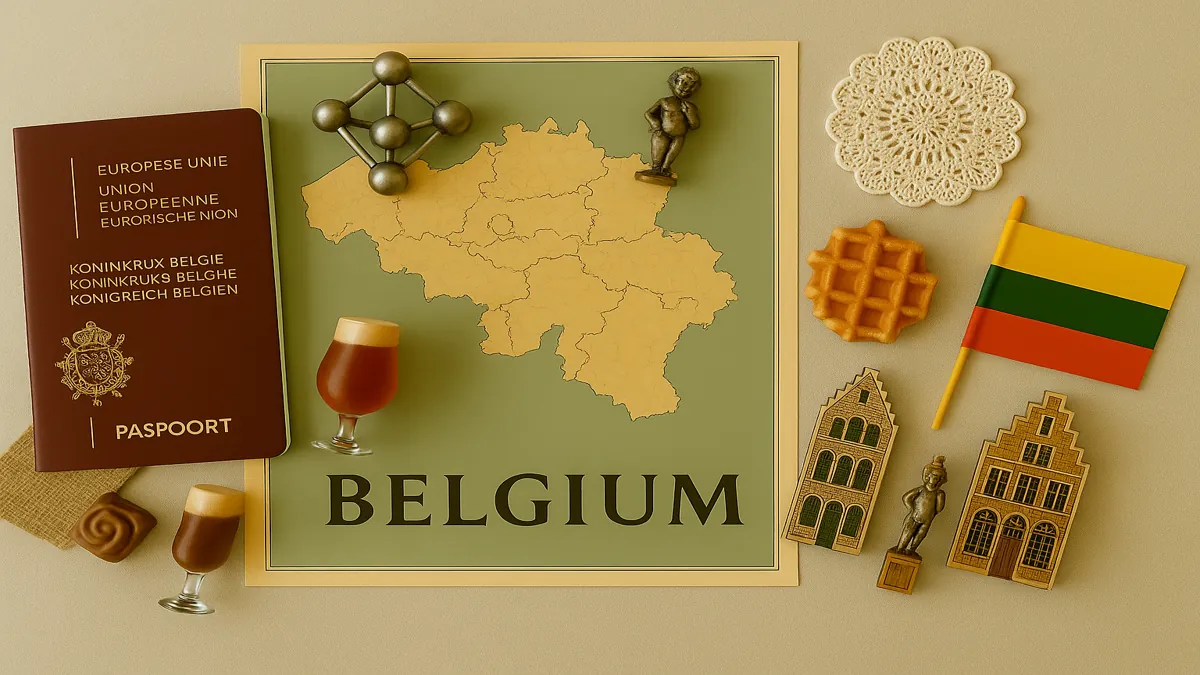
Belgium is small, rail-linked and split between three languages, and that shape decides almost every first-trip choice. Bruges, Ghent and Antwerp all sit within about an hour of Brussels by train, so you can see a lot without long travel days. The hard part is choosing well. This guide resolves the decisions a first-timer actually faces: where to base yourself, how many days to give the country, when to go, how the trains work, and what differs from home, from Sunday closures to the coins you still need. It assumes no prior knowledge of Belgium. It stays at country level: city detail, day-by-day routes and food depth live in the guides linked along the way.
Quick Answer
Plan a first Belgium trip around one central base (Brussels or Ghent) and reach the other cities by train. Trip length decides how many cities fit: Brussels plus one in a weekend, all four main cities and a Wallonia extra in about a week. Go in spring or early autumn, and buy train tickets before boarding.
Trust Layer
Tripstou country guide for travelers planning a trip across a whole country. Covers route direction, trip length, season, budget, bases, and transport tradeoffs.
Produced with AI assistance and reviewed by Alex Perrut, working in tourism since 2015, for the Tripstou editorial team. See our editorial process for details.
Last factual review: September 29, 2026.
Official sources consulted: Belgian Federal Government portal, Belgian Foreign Affairs, SNCB Belgian Railways.
Key Takeaways
- One central base covers most first trips: Ghent for atmosphere, Brussels for connections, with the other main cities reached as day trips by train.
- Domestic Belgian trains no longer sell tickets on board, so buy through the SNCB app, website, a station machine or a ticket office first.
- Trip length sets how many cities fit: two to three days buys Brussels plus one, and four to five covers all four main cities.
- Bruges earns an overnight only if its quiet evenings matter to you; otherwise a day trip from Ghent saves the priciest room of the trip.
- Shoulder months beat summer for a first trip, because Bruges is packed from mid-morning in peak season and rooms cost the most then.
- Greet in Dutch or French before switching to English, carry a few coins for toilets, and expect small-town shops to close on Sundays.
Table of Contents
Is Belgium Worth Visiting for a First Trip?
Belgium is worth it for travelers who want several distinct cities without long travel days. The main cities sit close together on one rail network, and each rewards a short stay with art, architecture and food. The trade-off is scale: the cities feel similar in size, so Belgium suits a dense trip of days, not weeks.
It suits first-time visitors to Europe especially well. English is widely understood in the cities, trains run frequently, and distances are short enough that a wrong call costs an hour instead of a day. Travelers drawn to Flemish painting, medieval squares, Art Nouveau streets, beer culture and serious chocolate get the most from it.
Beach, mountain and road-trip travelers get less. The coast is short, and the Ardennes are gentle forested hills, pleasant but rarely the reason to fly in. Nobody needs a car for the cities.
A first trip here can take in a capital, two Flemish old towns and a port city while unpacking only once, which a larger country only manages with hotel moves. Which places earn a spot, and in what order, is ranked in our guide to the best places to visit in Belgium.
How Belgium Is Laid Out: Flanders, Wallonia and Brussels
Belgium splits into Dutch-speaking Flanders in the north, French-speaking Wallonia in the south, and bilingual Brussels in between. The split matters on the ground. It decides which greeting to use, which name a town carries on signs, and which language appears first on a station board, even within a short train ride.
German is the third official language, spoken in a small area in the east. Brussels is a region of its own and officially bilingual in French and Dutch.
Many towns carry two names. Antwerpen is Anvers in French, Gent is Gand, Brugge is Bruges, Leuven is Louvain, and Mons is Bergen in Dutch. Station boards and ticket apps may use either form depending on the region. Learn both names for every stop on your route.
Brussels
Brussels is the capital and the country’s transport hub, with EU-institution energy, grand squares and a lived-in, slightly rough edge. Its anchor draws are the Grand-Place and the museum quarter, and trains leave it for every other city. Best for: first arrival and day trips in every direction. Our Brussels guide covers arrival and neighbourhoods.
Bruges
Bruges keeps a remarkably preserved medieval core of canals, brick gables and a skyline set by its belfry. Day visitors fill the centre from mid-morning; evenings are quiet and far more atmospheric. Best for: an overnight stay after the day crowds leave. The Bruges guide covers where to stay and how to time a visit.
Ghent
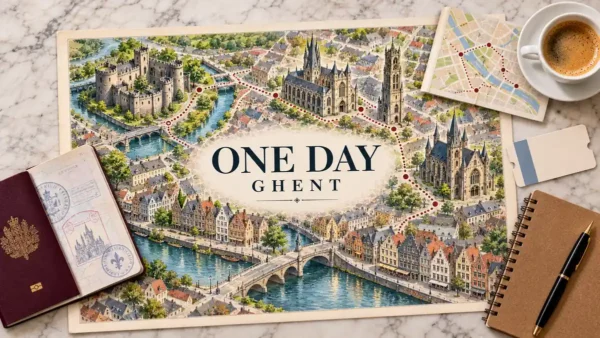
Ghent is a working university city whose medieval centre still feels lived-in. Its anchor draws are the canal-side Graslei and the Ghent Altarpiece in St Bavo’s Cathedral. It stays lively at night and draws noticeably thinner crowds than Bruges. Best for: a base that feels lived-in. A plan for one day in Ghent shows how to use it well.
Antwerp
Antwerp is the port and fashion city, bigger and more modern in tone than its Flemish neighbours. Its anchor draws are the grand Centraal station, the Rubens heritage and a strong design and shopping scene. Best for: a second base with a modern edge. Our route for two days in Antwerp lays out a full visit.
Wallonia works as a slower extra: Namur and Dinant on the Meuse, with the forested Ardennes beyond. Leuven and Mechelen are compact Flemish towns that fit an easy half-day from Brussels or Antwerp. Both sit in context in our ranking of Belgium’s top places to visit.
Tours and activities
Book skip-the-line tickets, day trips and local tours with free cancellation on most activities.
You can also browse everything on getyourguide.com.
Tripstou may earn a commission if you book through this link, at no extra cost to you.
Where to Base Yourself: Brussels, Ghent or Bruges
One central base works for most first trips. Ghent and Brussels both make every other city an easy day trip. A single base covers up to about five days. Choose Ghent for atmosphere, Brussels for connections, and Bruges only when evenings there matter more than convenience.
Add a second base once the trip reaches about a week, or when Bruges nights or Antwerp are priorities. Splitting a short trip mostly buys packing time. A common two-base shape pairs Ghent or Brussels with a final night or two in Bruges, or adds Antwerp for the northern half of the trip.
| Base | Character | Suits | Trade-off | Time from Brussels |
|---|---|---|---|---|
| Brussels | Capital energy, big museums, mixed-looking streets | Travelers who want maximum connections and choice | Less charming as a base than Ghent | The hub for every day trip |
| Ghent | Lively student city with a medieval core | Travelers wanting atmosphere without Bruges-level crowds | Some Wallonia trips need a change in Brussels | About half an hour by train |
| Bruges | Preserved medieval town, quiet after dark | Travelers who value evenings over convenience | Pricier overnight stays and heavy day crowds | About an hour by train |
| Antwerp | Port and fashion city with a modern tone | Travelers adding a second base on longer trips | Further from Bruges and the Wallonia routes | Under an hour by train |
A Bruges overnight buys the evening, and nothing else about it is convenient. The town empties once the day visitors leave. That quiet is the view a day trip never gets, and it is the only reason to pay the premium.
How Many Days You Need in Belgium
Two to three days buys Brussels plus one city, four to five the main four, and a week adds Wallonia. The rail network is dense enough that each extra day adds a whole city. Most first-timers land in the four-to-five-day range, which shows the country’s contrasts without repeating itself.
- 2–3 days: Brussels plus Bruges or Ghent, as a day trip or a single overnight. Fits weekend visitors and travelers adding Belgium to a wider Europe route.
- 4–5 days: Brussels, Ghent, Bruges and Antwerp from one or two bases. Fits most first trips and anyone who wants the full range of Belgian cities.
- About a week: the main four plus an Ardennes stay or Namur and Dinant. Fits slower travelers, walkers and anyone who dislikes a train hop every day.
Past a week, the Flemish cities start to blur together. Add a neighbouring country before adding more Belgian towns. For the order that works on the ground, follow our day-by-day Belgium route.
When to Go to Belgium
Late spring and early autumn give the best balance of weather and crowds for Belgian cities. Days are long enough for full sightseeing, and Bruges stays manageable outside summer weekends. Summer brings the most reliable warmth with the heaviest crowds, while winter trades daylight for Christmas markets in the main cities.
- Peak (June–August): long days and busy terraces, but Bruges is packed from mid-morning and rooms are at their dearest. Suits travelers tied to school holidays.
- Shoulder (March–May and September–October): mild, changeable weather and thinner crowds. Suits most first trips.
- Winter (November–February): short, grey days, lifted by Christmas markets in the main cities. Suits travelers building a trip around the markets.
The market season, city by city, is covered in our guide to Belgium’s Christmas markets. Rain is possible in any month. No season is a dry one, and packing for it is covered in the practicalities below.
In Bruges the day of the week matters almost as much as the month: a midweek day in July is often calmer than a Saturday in May.
How to Get Around Belgium by Train
Trains reach every main city from Brussels within about an hour, and you buy tickets before boarding. Domestic trains no longer sell tickets on board. Ghent is about half an hour from Brussels, Antwerp under an hour and Bruges about an hour, so trains beat driving for every city trip.
Buy your ticket through one of these before reaching the platform:
- SNCB app: suits travelers with a smartphone and data. It is the fastest option and the easiest place to find discounted weekend and multi-journey tickets.
- SNCB website: suits planners booking from home. Tickets can be saved or printed ahead of the trip.
- Station ticket machine: suits walk-up journeys. It needs a working card and can have queues at busy times.
- Ticket office: suits complex questions. Smaller stations may not have a staffed counter.
Brussels has several mainline stations: Brussels-Midi (Zuid), Brussels-Central and Brussels-Nord (Noord). Midi is the international hub. Many domestic trains call at all three, so pick the one closest to your hotel.
Brussels Airport has direct trains to the city and beyond, and airport journeys carry a supplement on top of the normal fare. Charleroi, the low-cost airport, is linked to Brussels by coach. Arrival options are laid out in our Brussels travel tips.
Belgian cities are bike-friendly, with marked lanes through most centres. Cyclists ride fast. As a pedestrian, keep out of the bike lanes.
With nothing sold on board, the SNCB app becomes the ticket office you carry: install it before the first train, not on the platform.
Do you need a car in Belgium?
You do not need a car for Belgian cities. Parking is scarce and expensive, old centres restrict traffic, and trains cover every urban route faster. A car earns its place only in the Ardennes or rural Wallonia, where villages, trails and castles sit off the rail lines. Rent one for those days only, once the city leg of the trip is done.
What Belgium Costs by Spend Style
Belgium sits mid-range for western Europe, with short train hops keeping transport costs low. Accommodation drives most of the budget, and Bruges overnight stays carry the main premium. Travelers who base in Ghent or Brussels and day-trip by train keep costs predictable; peak-season Bruges nights push them up fast.
- Budget: hostels and simple B&Bs, frites stands, bakery lunches and weekday lunch menus, with day trips by train from one base. Belgium is kind here on transport and walkable centres. It punishes budget travelers who insist on sleeping in Bruges in summer.
- Mid-range: comfortable hotels or guesthouses, a sit-down bistro dinner most nights and a beer café stop, with trains between cities. Lunch menus are the kind surprise. Brussels hotels on weekdays are the punishing one, when business travel fills rooms and lifts rates.
- High-end: design hotels and canal-side boutique stays, tasting menus and chocolatier visits, with first-class train seats. Fine dining is a genuine draw at this level. The premium bites hardest in Bruges on peak weekends.
For budget travelers, Bruges works best as a day trip from Ghent: one short train ride replaces the most expensive room of the trip.
First-Trip Practicalities in Belgium: Language, Money, Sundays and Safety
Belgium is easy for first-timers once you know the language split, the coin habit and the Sunday rhythm. Greet people in the local language first, pay by card but carry a few coins, expect Sunday closures outside tourist centres, and watch your bag at busy stations. Little else will surprise you.
Language and greetings
- Dutch is spoken in Flanders, French in Wallonia and German in a small eastern area; Brussels is officially bilingual.
- English is widely understood in the cities and tourist areas, less so in small Wallonia towns.
- Open with a simple “Goedendag” in Flanders or “Bonjour” in Wallonia and Brussels before switching to English.
Money and payments
- Belgium uses the euro, and contactless card payment is widely accepted.
- Carry some coins: public toilets often cost a small coin, and some lockers still take cash.
- Service is generally included; rounding up or leaving a small tip for good service is appreciated, not required.
Opening hours and Sundays
- Shops in smaller towns are often closed on Sundays; tourist centres stay more open.
- Shops and kitchens close earlier than in southern Europe, so plan dinner at a northern European hour.
- Museum closing days vary, so check before building a day around one.
Safety
- Belgium is generally safe for visitors, including in the evening in city centres.
- Pickpocketing is the main risk, concentrated at busy stations and crowded squares.
- Keep bags closed and in front on platforms and trams, and keep phones off café tables in busy areas.
Weather and packing
- Rain is possible in any month, summer included.
- Pack layers and a light waterproof; an umbrella alone struggles in the wind.
- Bring comfortable shoes with grip, because old centres are cobbled and slippery when wet.
Entry rules
- Belgium is part of the EU and the Schengen area.
- Check the entry rules that apply to your passport before booking.
- Short stays are capped at 90 days in any rolling 180-day period across the Schengen area as a whole, not per country.
Travel medical insurance
SafetyWing Nomad Insurance provides travel medical coverage designed for travelers and digital nomads, with flexible Monthly and Annual plans.
Check Nomad Insurance coverage and current pricing →
New Nomad Insurance Essential members can get 8 weeks of electronic theft coverage free with reward code TRIPSTOU8.
Apply the reward before creating your SafetyWing account by looking for the pink camera icon on the Nomad Insurance page.
Tripstou may earn a commission if you purchase through this link, at no extra cost to you.
What to Eat and Drink in Belgium, in Short
Belgium’s food is built around frites, beer, chocolate and waffles, and each is taken more seriously than visitors expect. Frites are a meal in their own right, served in a cone with sauce. Beer arrives in the brewery’s own glass, and many Belgian beers are much stronger than a standard lager.
Eat frites from a stand, ask which local breweries are on tap, and buy chocolate from a chocolatier instead of a souvenir shop. The dishes, beers and regional specialities worth planning around are covered in our Belgium food guide.
Frequently Asked Questions
Can you buy train tickets on board in Belgium?
No. Domestic Belgian trains no longer sell tickets on board, so every journey needs a ticket bought before you step on. The SNCB app is the quickest option if you have mobile data. Without data, use a station ticket machine or a staffed ticket office, or buy on the SNCB website and save the ticket before leaving.
Do you tip in Belgium?
Tipping in Belgium is optional. Service is generally included in restaurant and café bills, so no fixed percentage is expected on top. Rounding up or leaving a small tip for good service is appreciated, not required. Travelers used to adding a set percentage at home can drop that habit here without seeming rude.
Is Belgium safe for tourists?
Yes. Belgium is generally safe for tourists, including city centres in the evening. Pickpocketing is the main risk, and it concentrates at busy railway stations, on crowded platforms and trams, and in packed central squares. Keep bags zipped and in front, keep phones off café tables, and stay most alert during arrivals and departures with luggage.
Is Belgium a good place to start a European trip?
Yes. Belgium is compact, easy to cross by train, and English is widely understood in the cities, so first-time visitors to Europe find their feet quickly. Brussels-Midi is the country’s international rail hub, with direct trains towards Paris, London, Amsterdam and Germany, which makes Brussels a practical first stop before a wider route.
Is English spoken in Belgium?
Yes, English is widely understood in Belgian cities and tourist areas, so a first trip works without Dutch or French. It is less common in small Wallonia towns, where a few words of French help. Opening with a local greeting — “Goedendag” in Flanders, “Bonjour” in Wallonia and Brussels — before switching to English is appreciated everywhere.
Are there discounted train tickets in Belgium?
Yes. SNCB sells discounted weekend tickets and multi-journey tickets alongside single fares, and the SNCB app is the easiest place to compare them. They pay off most for travelers making several day trips from one base, where short hops add up across a trip. Check the app before each purchase: the right ticket depends on your number of journeys.
Related Guides
- Best places to visit in Belgium: which cities and towns to prioritise on a first trip, ranked.
- Belgium itinerary: day-by-day routes for trips of different lengths.
- Brussels guide: arrival, airport links and neighbourhoods in the capital.
- Bruges guide: where to stay and how to time a visit around the crowds.
- One day in Ghent: a full day in the city that makes the best central base.
- Two days in Antwerp: a two-day plan for the port and fashion city.
- Belgium food guide: frites, beer, chocolate and the regional dishes worth seeking out.
- Belgium’s Christmas markets: the winter market season across the main cities.
Did this guide save you time or money? Tripstou is independent and reader-funded — if you'd like to give something back, you can support the site with a crypto contribution of any size.