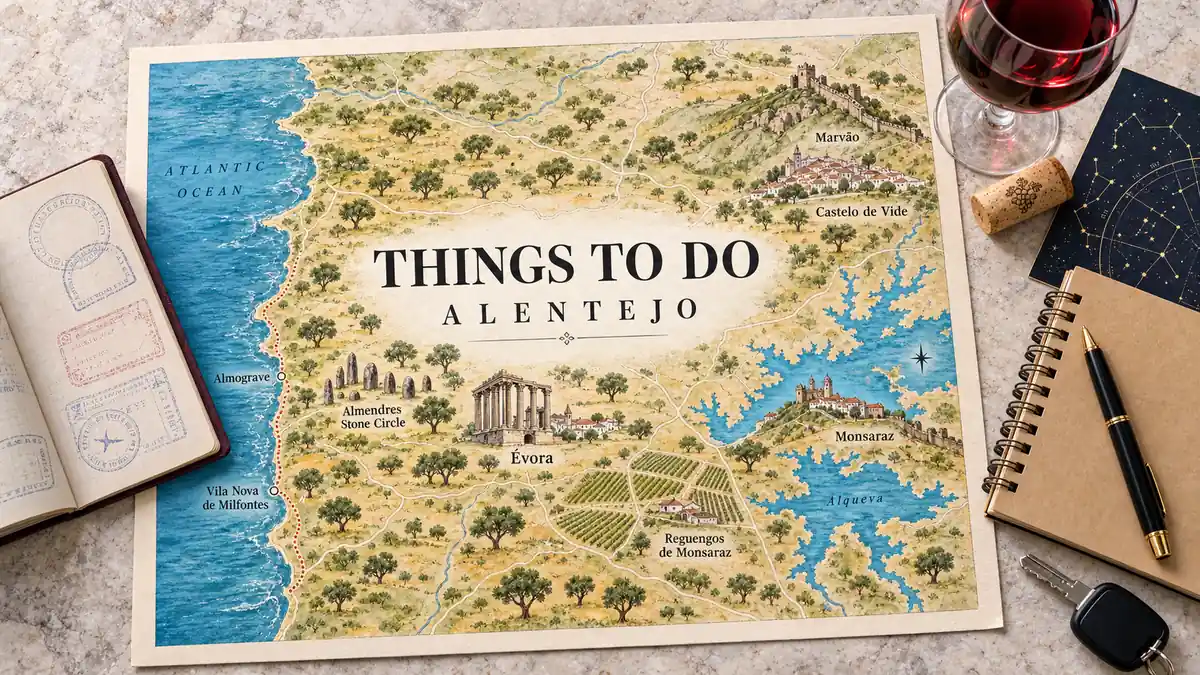
The Alentejo is famous for being empty, which raises the obvious worry: is there enough here to fill your days? There is, if you accept that slowness is the product and book two things before you arrive. This page judges nine experiences: a night under a certified dark sky, an estate tasting, food as an activity, Évora’s Roman core and Chapel of Bones, a megalithic circle, a walled village above a lake, two hilltop fortress towns, cork-oak country and a day on the coast. Each gets a verdict, the traveler it suits and the tradeoff that decides it. Then three rules: which experiences have to be booked in advance, which ones combine inside one day, and what to pick if you only have one or two. It is a big region, and that shapes everything here — but which base, how many nights and how to get around belong to the Alentejo guide, not to this page.
Quick Answer
The Alentejo is worth it for slow experiences: dark-sky stargazing, wine estate tastings, Évora’s historic core and a coastal walk. It suits travelers with two or more unhurried days; a rushed pass through disappoints. Book the stargazing session and any estate tasting before you arrive; everything else you can walk into.
Trust Layer
Tripstou attraction guide for travelers deciding whether an experience is worth doing and how to do it well. Covers value, booking versions, timing, access, and traveler fit.
Produced with AI assistance and reviewed by Alex Perrut, working in tourism since 2015, for the Tripstou editorial team. See our editorial process for details.
Last factual review: September 11, 2026.
Official sources consulted: Visit Portugal, Turismo de Portugal, Dark Sky Alqueva, Igreja de São Francisco.
Key Takeaways
- The Alentejo rewards travelers who give it unhurried days; a half-day dash through it convinces people there is nothing here.
- Only two experiences must be booked before you arrive: the Dark Sky stargazing session and any wine estate tasting.
- Évora’s walled centre is the strongest walk-in day, dense enough to carry a visitor who plans nothing in advance.
- Interior experiences cluster and combine easily, but the coast sits apart and needs a whole day of its own.
- Arriving unbooked at Cumeada or a wine estate ends the plan, because the region keeps almost no walk-in fallbacks.
- With a single day, pair Évora’s centre with one estate tasting and leave the coast for a longer trip.
Table of Contents
What is the Alentejo known for, and is it worth visiting?
The Alentejo is worth visiting for travelers who want space, slowness and a night sky, not a checklist. It is known for wine, cork forests, Évora’s Roman and medieval core, certified dark skies and an undeveloped coast. Skip it if you need a new sight every hour.
The region’s best experiences reward unhurried time, which is exactly why speed-running it fails. A tasting that runs long, a village you sit in until the light goes, a session that only starts once the sky is properly dark — none of these compress. Travelers who arrive with a half-day and a list leave convinced there was nothing to do.
The common mistake here is adding a fourth experience to a day that already had three.
Skip the Alentejo if your appetite is urban and your trip is short. There is no headline monument to tick off, no nightlife worth a detour, and the distances between things are real.
Everything structural belongs elsewhere. How the region divides, which town to base in, how many nights it deserves, whether you need a car and when to come are all answered in our Alentejo travel guide. This page only resolves what you actually do once you are here.
Stargazing, wine tastings and food are the Alentejo’s signature experiences
The Alentejo’s signature experiences are a night at the Dark Sky observatory, an estate tasting and eating as an activity. All three reward time over efficiency, and two of them close to anyone who did not book. They are why the region earns a night instead of a detour.
Two of the three need a reservation, and that is the practical difference between the Alentejo and regions where you improvise. If you are still comparing regions, these three sit alongside the country’s other signature experiences in our guide to things to do in Portugal.
Stargazing at the Dark Sky Alqueva observatory
A booked session at the Cumeada observatory is the best night you can have in the Alentejo. The Alqueva area is a certified Dark Sky Reserve and Starlight Tourism Destination covering roughly 10,000 square kilometres across ten municipalities, which is why the sky here looks different from a dark field anywhere else.
Worth it for: anyone spending a night near Monsaraz or Reguengos de Monsaraz who will reserve a place in advance.
Sessions run Tuesday to Saturday and require prior booking; Portuguese and English sessions alternate, so check which language you are joining. They begin after full darkness, which pushes them late in summer.
The tradeoff is that you do not control the night. Moon phase and cloud decide what you see, and the observatory cannot conjure a clear sky for you. There is no walk-in version: turn up unbooked at Cumeada and there is nothing to do but drive back.
A wine estate visit and tasting
A tasting on an Alentejo wine estate is the region’s easiest half-day to love. Estates cluster in the countryside around Reguengos de Monsaraz and Estremoz, and the wine route runs across 26 municipalities, so almost any interior base has one within reach.
Worth it for: travelers who want one long, seated experience instead of a morning of short stops.
Tastings and cellar visits on the route are by appointment. That is the rule, not a formality — estates are working farms with small teams, and an unannounced arrival usually gets a polite no. Reserve before you leave home, or at least the day before.
Two tradeoffs decide it. A proper visit eats half a day, so it does not slot between two other things. And someone has to drive: on an estate visit there is no bus to fall back on, which usually means one person tastes and spits while the rest do not.
Food as an activity: markets, tastings and a cooking class
Eating in the Alentejo works better as an activity than as a refuelling stop. Three formats carry it: a morning at a town market, a producer tasting of bread, cheese, olive oil or wine, and a cooking class that turns lunch into the afternoon’s plan.
Worth it for: travelers who want to cook the region’s food, not only order it.
The market morning asks nothing of you in advance; go early, when producers still have stock. A tasting is the middle option, often attached to an estate visit. A class is the committed one: it is booked in advance and it fixes your afternoon.
Commitment is the tradeoff. Book a class and the day is built around it, which is fine on a two-day stay and wasteful on a one-day pass. Which dishes define the region is a different question; this page cares about the format.
Tours and activities
Book skip-the-line tickets, day trips and local tours with free cancellation on most activities.
You can also browse everything on getyourguide.com.
Tripstou may earn a commission if you book through this link, at no extra cost to you.
History You Can Walk Through: Évora, the Megaliths and Monsaraz
Évora’s Roman temple and Chapel of Bones, the Almendres Cromlech and Monsaraz are the historic experiences worth a day. They sit in the same interior sweep, so one day holds them comfortably. None of the three needs advance booking, which makes this the page’s safest section for travelers who decide late.
Treat all three as experiences, not as candidate bases. Which Alentejo towns deserve a stay of their own sits in our guide to the best places to visit in Portugal.
Walking Évora’s Roman temple and Chapel of Bones
Évora’s walled centre is the strongest walk-in experience in the Alentejo. The historic centre is UNESCO-listed, and the Roman temple at its top is a 1st-century open-air monument you meet on the street, with no queue and no ticket desk between you and it.
Worth it for: first-time visitors who want one dense, walkable historic core in a very spread-out region.
The Chapel of Bones sits inside the Igreja de São Francisco, a short walk downhill. The church itself is free to enter; the chapel and the museum areas are covered by one combined ticket bought on the spot. It opens daily through the year with a small number of holiday closures and shorter hours in winter.
The tradeoff catches people out. The chapel is small, quick and often crowded, and travelers who build the day around it feel short-changed. The centre around it — the temple, the walls, the lanes between them — is the actual experience.
Standing inside the Almendres Cromlech
The Almendres Cromlech rewards the detour for anyone who likes prehistory without a building around it. The stone circle stands in open cork-oak country outside Évora, and you walk among the stones instead of viewing them from behind a rope.
Worth it for: early risers and late finishers who want the megaliths when the light is low and nobody else is there.
It is an open-air site with no gate, no guide and no visitor centre. That is its appeal and its problem: there is nothing on site to tell you what you are looking at, so read about the alignment before you go, or the stones will look like scattered rocks.
Bring water and shade — there is neither out there — and go at the ends of the day. Midday flattens the stones and the heat makes the walk unpleasant. This is the one historic experience on the page that depends entirely on when you arrive.
Climbing to Monsaraz above the Alqueva lake
Monsaraz is the Alentejo’s best evening walk. The village sits inside its walls on a hilltop, and the lake below is the reason to climb: from the ramparts the Alqueva spreads out under a sky that has no towns in it to spoil the dark.
Worth it for: anyone with a stargazing session booked that night and an evening to fill first.
That pairing is the point. The village empties as the day-trippers leave, the light on the water goes gold and then goes, and the observatory session starts once it is fully dark. One evening carries both.
The tradeoffs are size and timing. Monsaraz is tiny and fills by midday, so the middle of the day is the worst version of it. And the lake is scenery more than activity: there is a beach on it near the village for a swim, but you look at the Alqueva far more than you use it.
Hilltop towns, cork country and the coast are the Alentejo’s slow-day experiences
Marvão and Castelo de Vide, the cork-oak countryside and the Costa Vicentina each reward a full unhurried day. None of them takes a booking. What decides them is weather: wind on the coast, heat in the interior, and light everywhere. These are the experiences you choose on the morning, after looking outside.
One caveat covers all three: the interior is punishing in high summer, and the open sections of this page — the cromlech, the walls at Marvão, cork country — get unpleasant in the middle of a hot day.
Walking the walls at Marvão and Castelo de Vide
Marvão and Castelo de Vide work as a single day’s walking. Marvão is a fortified village on a granite ridge whose walls you walk for the view over the border country; Castelo de Vide, below it, adds a castle, a medieval Jewish quarter and a gentler set of lanes.
Worth it for: walkers who want height, ramparts and cool air after days on flat plains.
The verb here is walk. Both towns are small enough to cover on foot and steep enough that you feel it, and the reward is the wall circuit at Marvão, where the drop on either side does the work. Go for the ridge, the air and the silence.
The tradeoff is cost in days. These two sit in the far north of the region, well away from the Évora and Alqueva cluster, so they claim a day of their own and do not combine with the lake or the observatory.
Cork-oak countryside on foot or by estate visit
Cork country is the Alentejo’s default landscape, and it becomes an experience only when someone explains it. The montado — spaced cork oaks over grazing land, worked for centuries — is what you drive through all day without noticing, until you see a stripped trunk up close and understand the cycle.
Worth it for: curious travelers who like working landscapes and want to understand what they have been driving past.
Two versions exist. Walking or cycling a farm track through the montado needs no arrangement and gives you the scale. A visit to a working estate gives you the explanation: how a tree is stripped, why the bark grows back, what the marks on the trunks mean.
Subtlety is the problem here. Without the explanation it is scenery you have already seen from the car, and a visit only pays if the harvest cycle is part of it. This is the experience to drop first when the days get tight.
A coastal day on the Rota Vicentina or a swim-and-seafood day at Milfontes or Almograve
The Alentejo coast is a different holiday from the interior, and it deserves a day on its own terms. Two formats work: a stretch of the Rota Vicentina — the Fishermen’s Trail along the cliffs, or the inland Historical Way — or a swim-and-seafood day based at Vila Nova de Milfontes or Almograve.
Worth it for: travelers who want Atlantic cliffs and cold water after the dry interior.
You do not need to walk the whole trail. Pick one signposted stretch out and back from a village, and check the official Rota Vicentina site for trail conditions before you set off. The beach version asks even less: a morning swim, lunch, an afternoon on the sand.
Against that, the coast is its own trip. It sits away from everything else on this page, the Atlantic here is cold and often windy even in summer, and a day at Milfontes is not something you bolt onto an Évora morning.
Which Alentejo experiences do you need to book in advance?
Two Alentejo experiences must be booked before you arrive: the Dark Sky stargazing session and any wine estate tasting. A cooking class is the third. Évora’s Chapel of Bones is ticketed but you buy on arrival. Everything else on this page — the cromlech, Monsaraz, the hilltop towns, cork country, the coast — is simply open.
- Appointment only — stargazing, estate tastings, a cooking class. Suits travelers who know their dates and want the region’s two best experiences. Tradeoff: you commit an evening or an afternoon weeks ahead, and the stargazing commitment is to a sky nobody can forecast that far out.
- Ticketed, walk in — the Chapel of Bones in Évora. Suits anyone building a flexible day around the walled centre. Tradeoff: no reservation protects you from the queue at peak hours, so go early or late in the day.
- Open and unbooked — the Almendres Cromlech, Monsaraz, Marvão and Castelo de Vide, cork country, the coast. Suits weather-watchers and late deciders. Tradeoff: nothing is guaranteed to be pleasant, because heat, wind and cloud decide these and nobody is holding a place for you.
Booking status, not price, is what separates these six experiences.
| Experience | Book ahead or walk in | What happens if you skip the rule | Best fit |
|---|---|---|---|
| Dark Sky stargazing at Cumeada | Book ahead; prior booking is mandatory | You arrive to a closed gate and drive back | Travelers sleeping near the lake for a night |
| Wine estate visit and tasting | Book ahead; visits run by appointment | An unannounced arrival is usually turned away | Slower travelers giving it half a day |
| Cooking class | Book ahead, ideally before you travel | Nothing available at short notice out here | Food-led travelers staying two days or more |
| Chapel of Bones, Évora | Walk in and buy the combined ticket there | You queue at the busiest part of the day | First-timers building a day around Évora |
| Almendres Cromlech | Walk in; open-air site with no gate | Midday light and heat spoil the visit | Early risers and late-afternoon visitors |
| Coastal walk or beach day | Walk in; decide it on the morning | Wind or swell ruins an inflexible plan | Travelers giving the coast a whole day |
The booking is the itinerary here. Fix the observatory night first and the rest of the days arrange themselves around it, because every other Alentejo experience is flexible enough to move.
Turning up and seeing what happens fails here in a way it does not in Lisbon or the Algarve. In a city an unbooked evening still produces a restaurant, a viewpoint, a bar. At Cumeada it produces a locked gate and a drive home in the dark. The region has fewer fallbacks than anywhere else in Portugal, and the two experiences worth the trip are the two that will not improvise with you.
Interior experiences combine easily; the coast needs its own day
The interior experiences pair naturally into clusters; the coast pairs with nothing and needs a day of its own. Three clusters do most of the work: Évora’s centre with the Almendres Cromlech and an estate tasting; Monsaraz with the Alqueva lake and the stargazing session; Marvão with Castelo de Vide.
The clusters work because they share ground and split the clock cleanly. Évora’s core is a morning; the cromlech belongs to an early or late hour; an estate tasting fills the long middle of the day. The Monsaraz cluster is an afternoon and an evening, with the walled village before dark and the observatory after it — which is why that pairing is the one to build a night around.
Marvão and Castelo de Vide stand apart, together. They belong to the northern edge of the region and combine with each other and with nothing else here.
The coast breaks every cluster. Milfontes and Almograve face the Atlantic, the interior sights do not, and trying to hold both in one day means seeing neither properly.
Which cluster to do in what order, and how many nights the region deserves, is a planning question — that one belongs to our guide to planning the Alentejo.
What should you do in the Alentejo with only one or two days?
With one day, take Évora’s centre plus one estate tasting; with two, add Monsaraz and a booked stargazing night. That order follows density and the evening slot: Évora packs the most into the least walking, and the stargazing only exists after dark. The coast waits for a third day.
- One day: Évora’s walled centre in the morning and a booked estate tasting after it. This buys the region’s densest sight and its most characteristic experience in a single loop. Fits travelers passing through with a car and no night in the region.
- Two days: add Monsaraz late on the second afternoon and the stargazing session that night. This buys the one thing you cannot get anywhere else in Portugal. Fits travelers willing to sleep in the region and book ahead.
Both tiers assume you booked. Whether the Alentejo works as a day trip from Lisbon, and how many nights it really deserves, belongs to the Alentejo guide; slotting it into a longer route across the country is what our Portugal itinerary is for.
Frequently Asked Questions
Do you need to book Alqueva stargazing in advance?
Yes. Prior booking is mandatory at the Cumeada observatory, and sessions run Tuesday to Saturday only, so there is no walk-in option. Reserve a night early in your stay instead of your last one, because cloud can spoil a session and a spare evening gives you a second chance.
Do you need an appointment to visit Alentejo wineries?
Yes. Wine-route estates list tastings and cellar visits by appointment, so an unannounced arrival is usually turned away. Book directly with the estate, and pick one close to where you are staying: the route runs across many municipalities, and a distant estate eats the day twice over.
Do you need a ticket for the Chapel of Bones in Évora?
Yes, for the chapel itself. Entry to the Igreja de São Francisco is free, while the Chapel of Bones and the museum rooms sit behind one combined ticket sold at the door. It covers the chapter room, the sacred art collection and the terrace, so it buys more than the bones.
Can you take a cooking class in Évora?
Yes. Évora is the easiest place in the Alentejo to find a cooking class, and it is a booked half-day, not a drop-in workshop. It suits travelers who want the region’s cooking explained while they do it, which no restaurant meal delivers. Reserve before you travel.
Are there river beaches in the Alentejo for swimming?
Yes. The best known sits on the Alqueva lake below Monsaraz, a calm freshwater swim that pairs naturally with an evening in the walled village. It is a warm-weather add-on, not a destination in itself, and it works best as a break in a hot interior day.
Can you hear Cante Alentejano in the Alentejo?
Sometimes, and it cannot be scheduled like a concert. Cante Alentejano is the region’s unaccompanied group singing, and travelers meet it at local festivals and in taverns where a group happens to be gathered. Ask locally once you arrive; it is not something to build a trip around.
Related Guides
- Alentejo Travel Guide — where to base yourself, how many nights the region needs and how to get around it.
- Best Places to Visit in Portugal — the towns and regions that deserve a stay of their own.
- Things to Do in Portugal — the national set of experiences, from fado nights to levadas.
- Portugal Itinerary — how to fit the Alentejo into a wider route around the country.
Did this guide save you time or money? Tripstou is independent and reader-funded — if you'd like to give something back, you can support the site with a crypto contribution of any size.