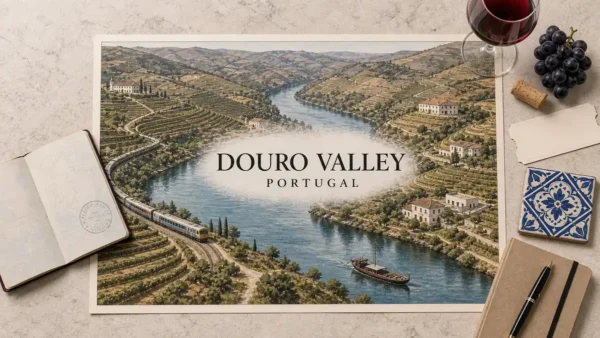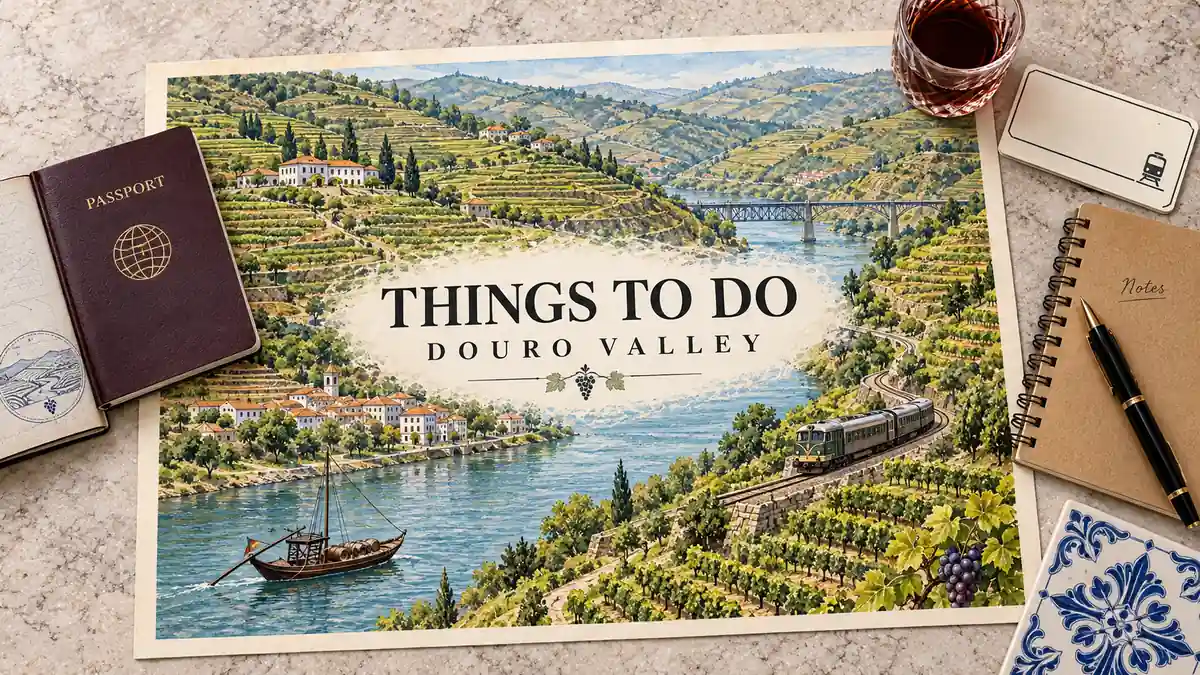
You have a day in the Douro Valley, or a night or two, and more options than hours. Most first-timers try to fit too much in. Everything looks close on the map, but on the ground the roads wind along steep slopes and every stop takes longer than planned.
The set here runs from a quinta tasting and the river to the train, the viewpoints, the terraces on foot, the harvest and one museum. Each of the eight experiences gets a verdict, the traveler it suits and the version worth booking: big estate or family producer, short rabelo or full-day cruise, everyday train or seasonal historic train, guided tour or your own plan. The page does not rank villages or sort out access, bases and days; the Douro Valley’s main guide covers those.
Quick Answer
The core Douro day is one quinta tasting, a short rabelo cruise from Pinhão or Régua, and one miradouro (viewpoint). The real choice is a guided day tour from Porto or self-guided by train; tastings need a reservation either way. One-day first-timers take the tour; overnight stayers go by train and add a terrace walk.
Trust Layer
Tripstou attraction guide for travelers deciding whether an experience is worth doing and how to do it well. Covers value, booking versions, timing, access, and traveler fit.
Produced with AI assistance and reviewed by Alex Perrut, working in tourism since 2015, for the Tripstou editorial team. See our editorial process for details.
Last factual review: September 11, 2026.
Official sources consulted: Visit Portugal, Turismo de Portugal, CP Douro Historical Train, CP MiraDouro.
Key Takeaways
- A core Douro day is one quinta tasting, a short rabelo cruise and one viewpoint; everything beyond that needs a night in the valley.
- Pick a short rabelo cruise from Pinhão or Régua over the full-day Porto cruise unless the river itself is meant to fill the day.
- Ride the MiraDouro or a regular train east of Régua, and treat the seasonal historic train as an extra only when your dates fit.
- A guided day tour from Porto suits one-day first-timers; overnight stayers do better self-guided by train, choosing their own quinta.
- Whoever drives cannot taste, which is the real reason to book a tour or a private driver when everyone in the group wants the wine.
- Reserve the quinta tasting before anything else, and buy historic-train tickets through CP before you travel, since peak dates sell out.
Table of Contents
A quinta tasting is the Douro experience to build your day around
One quinta tasting, done slowly, is the Douro experience everything else is arranged around. The terraces exist to grow these grapes, and a cellar visit explains the landscape better than any viewpoint. One estate done properly beats two rushed. The honest case for skipping it is a non-drinking party, who should take the museum and a viewpoint instead.
Worth it for: every first visit — this is the experience the region exists for.
The Douro is the oldest demarcated wine region and a UNESCO World Heritage cultural landscape, so the terraces you drive past are the product in your glass. A visit usually pairs the vines or the cellar with a tasting of the estate’s wines and Port. The real decision is which kind of estate to book.
- A big-name estate along the river: suits first-timers and day-tour travelers who want the full cellar-and-terrace show. Tradeoff: busier and more scripted, and the first to book out in season.
- A small family producer up a side valley: suits overnight stayers and second-timers who want the owner pouring. Tradeoff: you need your own transport or a driver, plus a reservation made directly.
Then count your quintas. One per day is right. Two is the maximum. Three is the classic Douro over-booking, because each visit runs long and the roads between estates are slow.
Choose the quinta by its view. An estate whose terraces fall to the river gives you the tasting and a viewpoint in one stop, which leaves more of the day for the rabelo. Either way, reserve ahead; the booking rules are gathered in the logistics section below.
Tours and activities
Book skip-the-line tickets, day trips and local tours with free cancellation on most activities.
You can also browse everything on getyourguide.com.
Tripstou may earn a commission if you book through this link, at no extra cost to you.
Is a Douro river cruise from Porto worth it?
A full-day Douro cruise from Porto is worth it only when the river itself is the day. For most visitors, an hour or two on a rabelo from Pinhão or Régua shows the best terraces from the water. It also leaves time for the quinta tasting and a viewpoint, which the full-day cruise does not.
Worth it for: seeing the terraces from the water without giving up the tasting.
The rabelo is the version to book. These boats are replicas of the cargo vessels that once carried the valley’s wine downriver, and the short trips keep to the vineyard stretch.
- Short rabelo cruise from Pinhão or Régua: suits anyone on a one-day visit, or on a tour with a tasting already booked. Tradeoff: an hour or two on the water covers the vineyard stretch only.
- Full-day cruise from Porto: suits travelers who want the river locks, a meal on board and no driving. Tradeoff: most of a day on the water plus the return leg leaves little or no time ashore, so the valley stays a view, not a visit.
The pairing settles it. A rabelo, a tasting and a viewpoint fit into one day; the full-day cruise replaces that day. The steepest terraces crowd the river around Régua and Pinhão, so a cruise from Porto spends much of its time reaching the stretch where a rabelo simply begins.
Riding the Linha do Douro: Regular Train vs the Seasonal Historic Train
The river stretch east of Régua is the train ride worth taking; the Porto leg is the commute. From Régua the Linha do Douro hugs the water through Pinhão and Tua to Pocinho, where the line ends. The everyday MiraDouro and regional trains cover it both ways; the seasonal historic train is a short, festive extra between Régua and Tua.
The MiraDouro and regular trains are the everyday way to ride the line
The MiraDouro and the regular regional trains are the simplest way to turn the Douro line into a day out.
Worth it for: anyone without a car who wants the ride east of Régua to count as an experience.
CP’s MiraDouro uses vintage carriages with opening panoramic windows, hauled by a diesel locomotive, and runs in both directions between Porto São Bento and Régua, Pinhão and Pocinho, where the line ends. The payoff starts at Régua, where the vineyard terraces close in on both banks. Break the ride at Pinhão, whose station is decorated with azulejo panels of the Douro and its wine life. The catch is control: the timetable dictates the day.
The seasonal historic train from Régua to Tua is a treat, not a necessity
The historic train is a charming, touristy extra, worth it if your dates fit and never worth building the trip around.
Worth it for: rail fans and anyone already in the valley on a running day.
CP runs it between Régua and Tua, stopping at Pinhão, roughly from early summer to mid-autumn and mainly at weekends. The draw is the atmosphere: vintage carriages, music on board and a welcome glass of Port. The steam engine has been replaced by a vintage diesel in recent seasons, so come for the ride and the party. Tickets are sold through CP; buy them before you travel. Rigidity is the cost: it runs on set days only, so your plans bend to its calendar.
Train and bus tickets
Compare routes, schedules and prices across rail and bus operators in one search, with mobile tickets on your phone.
New to Omio? Code NEW10 takes 10% off your first booking — or APPNEW10 if you book inside the Omio app. Both apply to bookings up to €80.
Search routes and compare prices on Omio →
Tripstou may earn a commission if you book through this link, at no extra cost to you.
What is there to do in the Douro Valley besides wine?
The viewpoints, the terrace walks and the museum in Régua fill a Douro day with no glass in hand. Add the river cruise and the train ride covered above, and a non-drinker never needs to enter a cellar. Each of the three suits a different condition: a clear day, a mild season or a rainy afternoon.
The miradouros and the N222 river road are the free half-day
The miradouros and the N222 river road give you the Douro’s big views for the cost of fuel.
Worth it for: drivers and photographers who want the landscape without a booking.
Aim for two viewpoints: São Leonardo de Galafura, high above the river near Régua, and Casal de Loivos, looking down on the bend at Pinhão. Go early or late, when low light picks out the terrace lines. The N222 between Régua and Pinhão is the drive. The tradeoff is pace. The roads wind and climb slowly, and whoever drives cannot taste, which is the case for the tour or driver below. For what else deserves a stay on a wider trip, see the best places to visit in Portugal.
Walking the vineyard terraces works in spring and autumn
A walk through the vineyard terraces is the Douro’s best active experience, and spring and autumn are when it works.
Worth it for: walkers visiting in spring or autumn who want to be inside the vineyards, not looking at them.
The walking follows the old paths between the terraces and the tracks along the river. Spring brings green vines and mild air. Autumn brings changing leaf colour and, around the harvest, the valley at work. Summer heat on the exposed slopes limits walking to the early morning. Expect real effort: the terraces are steep and shade is scarce, so carry plenty of water and start early. Some quintas also offer walks through their own vineyards, which pairs the walk with the tasting.
Museu do Douro in Régua is the non-drinker’s and rainy-day pick
Museu do Douro is worth a short visit as the one indoor experience on this list.
Worth it for: non-drinkers and rainy-day travelers who want the region’s story.
The museum sits on the riverfront in Peso da Régua, inside the restored Casa da Companhia Velha, and covers the history and culture of the demarcated region. That context sharpens everything else: the terraces, the quintas and the river trade read differently once you know how the region was built. It also pairs neatly with the train, since Régua is a station on the line. The verdict depends on the weather. On a wet or very hot day it earns its place. On a single sunny day, skip it and spend the hours outdoors.
Harvest season turns a tasting into a working visit
In harvest season, some quintas let you tread grapes instead of just tasting the result. From roughly September into early October, harvest visits turn a tasting into a few hours of taking part. It is the best version of the Douro for travelers who can fix their dates, and also the busiest.
Worth it for: travelers who can fix their dates and want to work the harvest, not just watch it.
The visit is hands-on. Depending on the estate, it can mean picking on the terraces, treading grapes barefoot in a lagar (the traditional stone tank) and seeing the working cellar at full stretch. It must be booked ahead, because harvest visits are offered by some quintas in season only.
The tradeoff is crowds. Harvest is when the valley is busiest and demand is heaviest, so tastings, rooms and tours all fill earlier. A harvest visit also takes the tasting’s slot in the day. It is still one quinta, so a rabelo and a viewpoint remain the whole plan around it.
Should you take a guided day tour from Porto or go self-guided?
Take the guided tour on a single day from Porto; go self-guided by train if you stay over. The tour suits a first-timer with no wish to drive. The train suits overnight stayers who want to pick their own quinta. A private driver is the middle path for couples and small groups who want wine without the wheel.
- Guided day tour from Porto: suits first-timers with one day and nobody willing to drive, with the tastings and a short cruise arranged for you. Tradeoff: fixed stops at group pace, and the quinta is chosen for you.
- Self-guided by train plus local activities: suits overnight stayers, budget travelers and anyone who wants to choose the quinta. Tradeoff: the timetable runs the day, getting from station to quinta can mean a walk or a taxi, and every reservation is yours to make.
- Private driver for the day: suits couples and small groups who want two quintas and a viewpoint without anyone abstaining. Tradeoff: it is the costliest of the three and needs booking ahead.
The drink-driving logic decides most of this. Tastings plus winding roads mean the driver drinks nothing, and that is the real reason the tour and the private driver exist. A mixed group with one non-drinker is the exception. They can drive themselves and keep full control of the day.
How to reach the valley, where to base yourself and how many days to give it are covered in our Douro Valley travel guide.
Booking the Douro: What to Reserve Ahead and the Mistakes to Avoid
Book the quinta tasting and the historic train ahead; then plan fewer stops than you think you can fit. Most quintas require a reservation, especially in the busy months from roughly spring to autumn. Historic-train tickets are sold through CP. The classic mistake is stacking stops that look close on the map and are not.
- Quinta tastings: reserve directly with the estate or through your tour. Most estates require a booking; a walk-in welcome is luck, and a reservation is the plan.
- Historic train: seasonal and mainly at weekends, with tickets through CP. Peak dates sell out, so buy before you travel.
- Regular train: check the return timetable before committing to a quinta far from a station.
- Driving: whoever drives does not taste. The N222 is slow and winding, and so are the side roads up to the estates.
- Stacking: one quinta, one river stretch and one viewpoint make a full day. Distances are longer than the map suggests.
Fix the tasting first and fit the rest around it. The appointment is the one part of a Douro day that will not move; a rabelo from Pinhão or Régua is far easier to slot in afterwards.
For when to go, where to stay and how long to spend in the valley, see our Douro Valley guide.
How to Choose: Two or Three Douro Experiences by Traveler Type
One day buys a tasting, a rabelo cruise and a viewpoint; everything else needs a night in the valley. With a night or two, add the terrace walk and the train. Non-drinkers swap the tasting for the museum and the viewpoints. Harvest-season visitors book the treading first and fit the rest around it.
| Traveler type | Core two or three | Skip or swap | Booking note |
|---|---|---|---|
| First-timer on a day tour from Porto | Tasting, short rabelo cruise and one viewpoint | Skip the historic train and the museum | Choose a tour that includes both tasting and cruise |
| Overnight stayer going by train | Small-producer tasting, the train ride east of Régua, a terrace walk | Swap the full-day cruise for a short rabelo | Reserve the quinta and check the return train |
| Non-drinker or mixed group | Museu do Douro, the miradouros and a rabelo cruise | Skip the quinta, or book one for the drinkers | A sober driver makes the N222 an easy option |
| Walker or photographer | Terrace walk, viewpoints at dawn or dusk, the train ride | Skip the full-day cruise from Porto | Walk in spring or autumn and start early |
| Harvest-season visitor | Grape treading, one viewpoint, a short rabelo cruise | Skip a second quinta on the treading day | Book the harvest visit before anything else |
Pair experiences that sit close together — a tasting and a rabelo from the same riverside station — and the day stays unhurried. To fit the Douro into a wider route, see our Portugal itinerary. If the valley is one stop among several regions, weigh these eight against the national list of things to do in Portugal.
Frequently Asked Questions
Does the Douro historic train still run on steam?
No. The steam engine has been replaced by a vintage diesel in recent seasons, and CP runs the historic train that way between Régua and Tua. The draw is unchanged: a vintage train, music on board and a welcome glass of Port. Book it for the atmosphere and the riverside ride, not for the locomotive.
What are the azulejo tiles at Pinhão station?
Pinhão station is decorated with azulejo panels (Portugal’s traditional painted tiles) that depict the Douro landscape and its wine life. The station sits on the regular line, so seeing them costs only a break in your train ride. They reward a few minutes before a rabelo cruise from Pinhão, but they are no reason to book the historic train.
Can you go kayaking on the Douro River?
Yes. Kayaking is offered on the Douro River in season, and it puts active travelers on the water under their own power. Treat it as a bonus for a spare afternoon, not a core pick. A short rabelo cruise shows the terraces from the water with far less effort and fits more easily around a quinta tasting.
What can you do in the Douro Valley with kids?
The best Douro activities for kids are a short rabelo cruise, the train ride and the miradouros. In harvest season, treading grapes at a quinta that offers it is the standout. Quinta visits vary in how well they suit children, so ask the estate when you book.
Are multi-day Douro river cruises worth it?
Multi-day Douro river cruises are worth it when you want the cruise to be the whole holiday. They suit travelers happy to watch much of the valley from the deck. For most visitors, one day built on a quinta tasting, a short rabelo cruise and a viewpoint shows more of the Douro up close.
Can you combine a Douro train ride and a river cruise in one day?
Yes. Take the train to Pinhão, where short rabelo cruises leave from the riverside, then add a quinta tasting within reach of the station. Many guided day tours from Porto package the boat, the train and a tasting together. Going self-guided, check the return train before you fix the tasting time.
Related Guides
- Douro Valley Travel Guide — how to get there, where to base yourself, how many days to spend and when to go.
- Things to Do in Portugal — the national set of experiences beyond the Douro.
- Best Places to Visit in Portugal — the towns and regions that deserve a stay of their own.
- Portugal Itinerary — how to fit the Douro into a wider route around the country.
Did this guide save you time or money? Tripstou is independent and reader-funded — if you'd like to give something back, you can support the site with a crypto contribution of any size.