Lagos sits on Portugal’s Algarve coast, at the western end of the country’s cliff-and-cove shoreline. Two days already fill it: the sea caves at Ponta da Piedade, the cove beaches under the cliffs, the old town inside its walls. So a three-day trip is not a question of what else Lagos has. It is a question of what the third day should be, and most guides refuse to answer it — they hand you a menu of day trips and let you sort it out.
This page picks a side. Day three goes west, by bus, to Sagres and Cabo de São Vicente, the southwestern tip of mainland Europe. No rental car is required for any of the three days. One rule decides whether the plan holds: the connection out to the cape does not run at weekends or public holidays, which is why the day has to land Monday to Friday.
Quick Answer
Three days in Lagos, Portugal, covers the town, its cliffs and beaches plus one full day trip. Spend day three going west by bus to Sagres and Cabo de São Vicente, on a weekday, because the cape connection does not run at weekends. No car is needed; families can swap in a slow local day.
Trust Layer
Tripstou itinerary guide for travelers planning a route. Covers pacing, stop count, stop order, base logic, and trip length.
Produced with AI assistance and reviewed by Alex Perrut, working in tourism since 2015, for the Tripstou editorial team. See our editorial process for details.
Last factual review: September 7, 2026.
Official sources consulted: Visit Portugal, Turismo de Portugal.
Key Takeaways
- Three days covers Lagos itself plus one full day trip; it is not enough to tour the wider Algarve.
- Days one and two stay unchanged from the two-day plan; the third day is additive, not a reshuffle.
- Commit day three to Sagres and Cabo de São Vicente, reached from Lagos bus terminal on VAMUS line 47.
- The onward bus to the cape does not run at weekends or public holidays, so schedule day three midweek.
- The whole trip works without a rental car; the cape at a weekend is the one place that breaks.
- Families, weekend arrivals and rest-day travelers should swap in the slow day at Praia da Luz and Burgau.
Table of Contents
Is three days enough for Lagos?
Yes, three days is enough for Lagos itself plus one full day trip, but not for the wider Algarve. Two days empty the town’s must-dos: the cliffs at Ponta da Piedade, the cove beaches, the old town. The third day buys one committed excursion, not a second town.
Three days is not enough for anyone trying to see the Algarve from a single base. Lagos to Albufeira, Carvoeiro or Faro and back eats the same day the west coast does, and each one delivers a car park, a strip of coast and a return journey. Pick one direction and go properly.
The reason three days works so cleanly here is that Lagos is small enough to walk and dense enough to fill two days without transport. That is unusual on this coast. Most Algarve bases need a car by day two; Lagos needs one only if you insist on collecting towns.
City framing, weather patterns and the question of when to visit belong to the wider Lagos guide, which covers the season you should be booking rather than the route you follow once you arrive.
The 3-Day Lagos Route at a Glance
Two days cover Lagos on foot and by boat; the third goes west by bus. Days one and two stay exactly as they are in the two-day plan — the cliffs, the cove beaches, the old town. Day three is additive: a full excursion bolted on, not a reshuffle of what already works.
- Day 1: Ponta da Piedade by water, then the old town — the Lagos core
- Day 2: Praia Dona Ana and Praia do Camilo on foot — the cove beaches
- Day 3: Sagres and Cabo de São Vicente — the full day west (weekday)
Day one belongs to the water. A boat trip through the grottoes at Ponta da Piedade shows the rock formations from the only angle that does them justice, and the rest of the day drops back into the old town’s walls, squares and marina-side walk. Short trips often run around €20, with longer circuits and kayak tours costing more; treat that as a range and confirm before you pay.
Day two is walking. Praia Dona Ana and Praia do Camilo sit within easy reach of town along the clifftop, and the day fills itself with swimming, the walk between coves and an afternoon that does not need planning. The step-by-step version — timings, the stair descents, boat against kayak — lives in the two-day Lagos itinerary.
Three days still means one base. Stay in or near the old town for all three nights and you walk to dinner, to the beaches and to the bus terminal; the trade-offs between neighbourhoods are set out in where to stay in Lagos.
What to sort in advance, and what to leave alone:
- Book ahead: the grotto boat trip on day one, especially in high season.
- Turn up: the bus west, the fort at Sagres, and every beach on this route.
Tours and activities
Book skip-the-line tickets, day trips and local tours with free cancellation on most activities.
You can also browse everything on getyourguide.com.
Tripstou may earn a commission if you book through this link, at no extra cost to you.
Full day west or slow local day: which day three should you choose?
The full day west to Sagres and Cabo de São Vicente is the day three worth committing to. It works on one condition: go on a weekday, by bus. Families with small children, weekend arrivals without a car and anyone who wants day three to be a rest should take the slow local day instead.
The west day earns the commitment because it changes the shape of the trip. Days one and two are the same coast at different angles — cliffs, coves, warm water. Sagres is a different landscape: flat, wind-scoured, treeless, with the Atlantic on three sides. The contrast is the point.
| Decision point | Full day west | Slow local day |
|---|---|---|
| Transport used | VAMUS line 47, plus the onward cape bus | Local bus west, then walking |
| Time commitment | A full day, morning out to late return | Half a day, easy to stretch or cut short |
| Works at a weekend without a car? | Sagres yes, the cape no | Yes, on any day of the week |
| Best for | First-timers wanting the end-of-Europe headland | Families, rest days, shoulder-season weather |
| Skip it if | You arrive Friday night for a weekend | Days one and two already gave you beach time |
Which days of your stay fall Monday to Friday decides this fork before your preferences do. A Saturday-to-Monday trip has no weekday day three that reaches the cape, so the fork resolves itself and the slow day wins by default.
Benagil is not a third option on this route. It lies east of Lagos, it is the anchor of a different trip built around a different base, and reaching it turns day three into a tour-booking exercise with a fixed departure and a fixed return. The west day needs one bus and a decision.
Day 3 West: Sagres and Cabo de São Vicente Hour by Hour
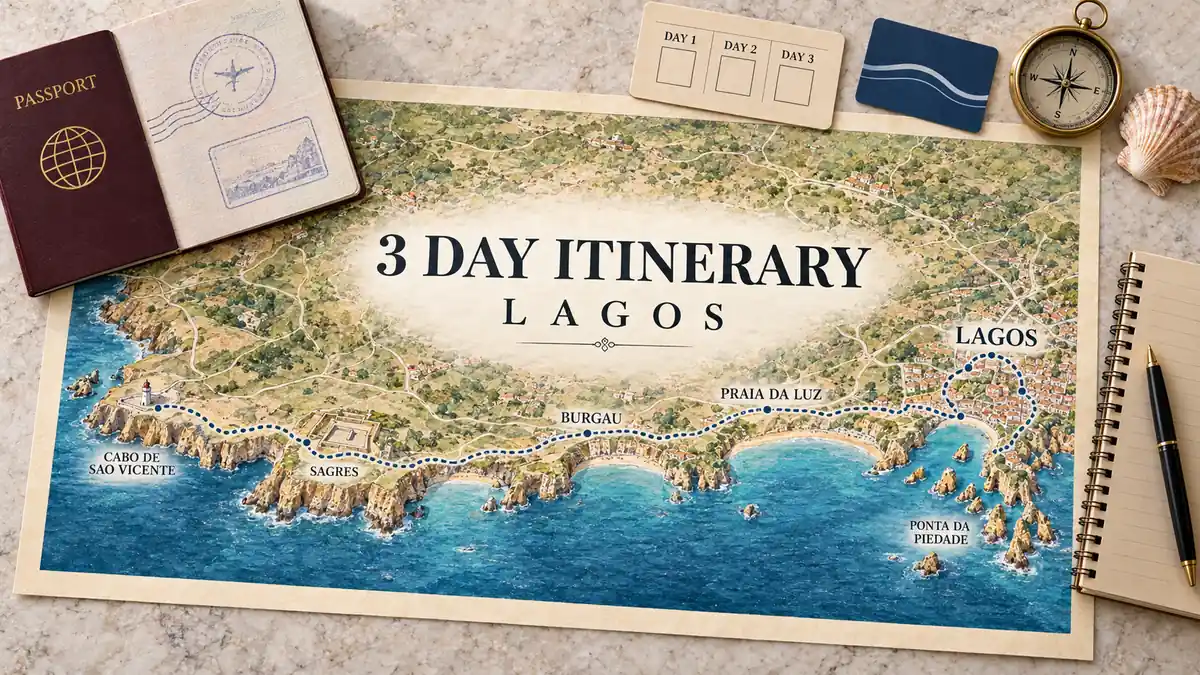
Day three is a bus ride west, the fortress at Sagres, then the cape at mainland Europe’s southwestern tip. It earns a whole day because the cape sits roughly 7 km beyond the Sagres bus stop — far enough that reaching it has to be planned in the morning, not improvised after lunch.
Morning: Lagos bus terminal to Sagres
The day starts at the Lagos bus terminal on Avenida dos Descobrimentos, a short walk from the old town. VAMUS line 47 runs west to Sagres, roughly 30–35 km away, and the ride takes anywhere from under an hour to a little over it depending on whether you catch an express or a stopping service. Fares sit in a small single-digit euro band per leg.
Sort the onward cape leg here, at the terminal, before you board. Ask about the connection from Sagres to Cabo de São Vicente and about the last return to Lagos, and write both down. Travelers who discover the cape connection on arrival in Sagres have already lost the option.
Sagres: the fortress and the headland
Sagres opens with the Fortaleza de Sagres, the walled headland fort that gives the town its shape. Entry sits in a low single-digit euro band, and what you buy is less a building than a walk: a flat, wind-blown promontory with cliffs falling away on either side and the Atlantic filling the horizon.
The town itself is the lunch stop and nothing more ambitious. It is small, low-rise and built around the beach and the harbour, and an hour there is enough before the onward bus. Keep the stop short. The cape is the part of the day that cannot be rescheduled.
Cabo de São Vicente: the cape itself
Cabo de São Vicente is the southwestern tip of mainland Europe, and the onward bus from Sagres is the only way there without a car. The cape lies roughly 7 km from the Sagres stop — not a walk you fold into a day trip, and not a distance to attempt in the afternoon wind.
What the cape delivers is the end of the continent: a lighthouse on a cliff edge, open ocean in every direction the land does not block, and the sense that the road genuinely stops. It holds an hour comfortably, more if the light is good and the wind is not.
Late afternoon: back to Lagos before the last bus
Treat the return as fixed. Check the last departure back to Lagos when you are at the terminal in the morning, then plan the cape and the fort backwards from it, leaving a margin rather than shaving it. Services thin out sharply late in the day and there is no walkable fallback from Sagres.
Back in Lagos, the evening is deliberately unplanned: dinner in the old town, a walk down to the marina, an early night after a long day of wind. Day three is the trip’s longest day. It should not also carry the trip’s biggest dinner plans.
Can you get from Lagos to Sagres and the cape without a car?
Yes to Sagres on any day, by VAMUS line 47; yes to the cape only on a weekday. The onward connection from Sagres to Cabo de São Vicente does not run at weekends or public holidays, and the cape lies roughly 7 km from the Sagres stop — too far to walk inside a day trip.
The whole three-day route holds without a rental car. Day one is a boat trip and a walk around the old town. Day two is a clifftop path to two beaches. Day three is one bus line out and the same line back. Nothing in the plan asks for a car park, a fuel stop or an Algarve motorway.
It breaks in exactly one place: the cape at a weekend or on a public holiday. That is the single point of failure in an otherwise car-free trip, and it is the detail most three-day Lagos itineraries leave out entirely.
Line 47 gets you to Sagres easily; it is the short second leg that decides whether the day works, and that is the one nobody checks. Anchoring your weekday around the cape, not around the fort, is what keeps day three intact.
Keep the figures loose. Fares on line 47 sit in a small single-digit euro band per leg, and the ride runs roughly 40–65 minutes depending on the service. Departures are far fewer at weekends and vary by season, so confirm at the terminal instead of trusting a number you read somewhere. The full picture of what a trip here costs, including transport and boat trips, is in what a Lagos trip costs.
Weekend arrivals have two workable options. Swap day three for the slow local day west of Lagos, which runs on any day of the week, or take line 47 to Sagres anyway and accept the fort and the headland without the cape. The second still gives you the landscape change; it just stops short of the continent’s edge.
Train and bus tickets
Compare routes, schedules and prices across rail and bus operators in one search, with mobile tickets on your phone.
New to Omio? Code NEW10 takes 10% off your first booking — or APPNEW10 if you book inside the Omio app. Both apply to bookings up to €80.
Search routes and compare prices on Omio →
Tripstou may earn a commission if you book through this link, at no extra cost to you.
Day 3 Slow: Praia da Luz, Burgau and the Coast Path
The slow day is a local bus west to Praia da Luz, a coastal walk and a beach afternoon. Burgau is the optional second stop. It suits families with small children, weekend arrivals without a car, and anyone who wants the third day to feel like a rest, not an expedition.
Start at Praia da Luz. It is served by local bus from Lagos, it has a proper beach with a village behind it, and the coastal walking route between Luz and Porto de Mós gives the day a shape that a beach alone would not. Walk one direction, swim at the end, and let the afternoon go where it goes.
Burgau is the second stop if energy and the local bus allow. It is smaller and steeper than Luz, tucked into a gap in the cliffs, and it works better as an add-on than as the day’s centre of gravity. Skip it without regret if the walk has already done its job.
This day also holds up better in shoulder-season weather than the cape day does. Sagres is exposed and the wind there is a genuine variable; the coast west of Lagos is sheltered by comparison, and a grey morning costs you far less of the experience.
When the Weather, the Sea or the Bus Kills the Plan
If the cape bus is not running, do Sagres alone or switch to the slow day. If the sea is rough, move the boat trip to another morning and swap the days around. The three-day plan absorbs one failure without losing anything, because only day three depends on a fixed connection.
The common failures and their one-line swaps:
- Missed the morning bus west: take the slow day instead and move Sagres to tomorrow if you still have a weekday left.
- Weekend or public holiday discovered late: go to Sagres for the fort and the headland, drop the cape, and stop treating it as a loss.
- Rough sea cancels the grotto boat: swap day one and day two, and try the boat again on the calmer morning.
- Rain: keep the old town, the marina and the covered parts of the day; push the cliffs and beaches later in the trip.
- Strong wind at Sagres: shorten the headland walk, keep the cape, and add the time back in Lagos that evening.
Building slack into day one is what makes the swaps painless. The boat trip is the only booked element on the route, so a three-day stay has two spare mornings to move it into. Everything else turns up and works.
Weather habits, terminal etiquette and the small on-the-ground details that stop a swap becoming a scramble are covered in the Lagos travel tips.
How to Adapt This Route with More or Fewer Days
With two days, drop day three entirely — days one and two stand on their own. With four, add the slow local day the fork rejected. The Lagos core is fixed and non-negotiable; the west day is the first thing that flexes, in either direction.
What gets cut first when time shrinks:
- The cape leg goes first. Sagres without Cabo de São Vicente is still a real half-day and needs no onward connection.
- Then the whole west day. Two days in Lagos is a complete trip, not a truncated one — the full version is the two-day version of this route.
- Never the boat trip. Ponta da Piedade from the water is the thing you came for.
What gets added first when time grows:
- Day four is the slow day. Praia da Luz, the coast path and Burgau, at a pace the west day does not allow.
- Day five is more Lagos, not more Algarve. The beaches you skipped, a second swim at Camilo, a longer walk on the cliffs.
A fifth day is not an invitation to start touring the Algarve. Adding Albufeira, Carvoeiro or the eastern caves turns this into a multi-base route with different transport logic, and that is a different trip and a different page. Keep one base, keep one excursion.
Frequently Asked Questions
How long is the bus ride from Lagos to Sagres?
Allow roughly 40–65 minutes each way, depending on whether you catch an express or a stopping service on VAMUS line 47. Add the short onward leg to Cabo de São Vicente and the return, and the bus, not the sightseeing, sets the shape of day three.
Can you visit Benagil Cave from Lagos in three days?
You can, but it does not fit this route. Benagil lies east of Lagos and is a tour product, from around €36 for roughly two hours, plus the travel each way. Day three then becomes a booking with a fixed departure, and the west day disappears.
Do you need to book the Sagres day trip in advance?
No. Line 47 and the Fortaleza de Sagres are turn-up-and-go, and no ticket needs buying ahead. The only element worth reserving on the whole three-day route is the day-one grotto boat, in high season. Guided Sagres tours exist, but they buy you a fixed return, nothing more.
What is the best month for a three-day trip to Lagos?
Late spring and early autumn suit this route best: the coastal walking is comfortable, the beaches are usable and the cape is less punishing than in high summer wind or winter rain. Midsummer gives the warmest sea and the most reliable conditions for boat trips, at the cost of crowds and heat.
How many nights do you need in Lagos for a three-day itinerary?
Three nights, in one place. Days one and two run from a base in or near the old town, and day three leaves and returns from the same bus terminal, so nothing is gained by moving. A fourth night only helps if you arrive late and lose an evening.
Should you spend day three on another Lagos beach instead?
You can, but it repeats day two. The point of day three is a change of landscape, and another cove gives you the same cliffs from a different towel. If you want a slow day, Praia da Luz at least adds a coastal walk and a new stretch of coast.
Related Guides
- Lagos guide — city framing, when to visit and how the destination fits the wider Algarve.
- Two days in Lagos — the day-by-day detail behind days one and two of this route.
- Where to stay in Lagos — which area to base in for a walkable three-night trip.
- Lagos trip cost — what transport, boat trips and a few days on this coast add up to.
- Lagos travel tips — practicalities, beach conditions and the habits that make the route run smoothly.
Did this guide save you time or money? Tripstou is independent and reader-funded — if you'd like to give something back, you can support the site with a crypto contribution of any size.