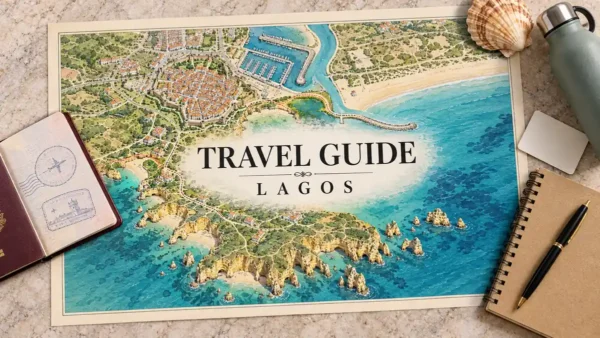
Lagos sits on the western Algarve coast in southern Portugal, and two days there is a sequencing problem more than a shortlist problem. The stops are few and close together. What decides whether the 48 hours work is the order you put them in, because one element — the water tour at Ponta da Piedade — is weather-dependent and time-slotted, and nothing else is. Get that wrong and you burn a morning on a cancelled boat with no slack left to retry it. This itinerary commits to one order: the coast from the water on Day 1 morning, the old town from late afternoon, the cove beaches on foot on Day 2. It resolves the boat-versus-kayak decision, shows that every leg works on foot from an old-town base, and gives you a fallback for the day the sea says no.
Quick Answer
Two days is enough for Lagos itself: water at Ponta da Piedade, cove beaches on foot, old town evenings. The only real choice is boat or kayak on the Day 1 morning, which sets your cost band and how many caves you enter. Everything else is walked from an old-town base. It covers Lagos, not the wider Algarve.
Trust Layer
Tripstou itinerary guide for travelers planning a route. Covers pacing, stop count, stop order, base logic, and trip length.
Produced with AI assistance and reviewed by Alex Perrut, working in tourism since 2015, for the Tripstou editorial team. See our editorial process for details.
Last factual review: September 7, 2026.
Official sources consulted: Visit Portugal, Turismo de Portugal.
Key Takeaways
- Two days covers Lagos itself — the coast, the cove beaches and the old town — but not the wider Algarve.
- Run the water tour on Day 1 morning so Day 2 morning stays free as a weather retry slot.
- Boat or kayak is the only real decision: the kayak costs more, reaches more caves and demands paddling.
- No car is needed: the marina and both cove beaches are walkable from a base in the old town.
- Praia do Camilo means roughly 200 steps down and back up; Praia Dona Ana has far fewer.
- If the sea cancels your tour, swap the two days instead of writing off the coast entirely.
Table of Contents
Two Days Is Enough for Lagos, Not for the Algarve
Two days is enough for Lagos itself, and not enough for anything beyond it. The town’s whole itinerary — the marina, the old town, the cove beaches, the cliffs at Ponta da Piedade — sits within a walk of the historic centre. The wider Algarve does not, and trying to reach it eats the trip.
In practice, “enough” here means four blocks: one morning on the water, one morning on the cove beaches, and two evenings inside the old town. That fills 48 hours without a single rushed transfer. Nothing is skipped and nothing is doubled back on.
The plan assumes a specific traveler: car-free, based in or on the edge of the old town, happy to walk uphill and down stairs. If that is you, two days is generous rather than tight. If you arrive late on day one or leave early on day two, the water morning is the block that survives and the second beach is the one that goes.
What a third day buys is distance, not depth: Sagres, Cabo de São Vicente and the Benagil stretch of coast all sit outside walking range, and each needs most of a day — that is the trade-off covered in our 3 days in Lagos itinerary. For when to visit, how the town is laid out and the broader city context this page deliberately skips, start with the Lagos guide.
The line between a comfortable two days and a frantic one in Lagos is drawn at the town boundary, not at the clock. Stay inside it and the schedule looks after itself.
How to Split Two Days in Lagos: The Route at a Glance
Do the water on Day 1 morning, the old town that afternoon, the cove beaches on Day 2. The order is not arbitrary. The sea is usually calmest early, tours run most reliably then, and putting the water first leaves Day 2 morning free as a retry slot.
The route, one line per leg:
- Day 1: morning — Ponta da Piedade by boat or kayak, the coast from the water.
- Day 1: afternoon and evening — Forte da Ponta da Bandeira and the old town (walls, church, marina).
- Day 2: morning — Praia Dona Ana and Praia do Camilo on foot, the coves from above and below.
- Day 2: afternoon and evening — beach time, then back into the old town.
Reverse it and you lose your safety margin. A traveler who spends Day 1 on the beaches and books the water for Day 2 morning has one shot at the sea; if the swell picks up overnight, the coast from sea level is gone and there is no second morning to move it to. Running the same plan forward costs nothing when the weather cooperates and saves the trip when it does not.
The pairing of blocks also matters. Water in the morning and old town in the late afternoon means you are on the coast when the sea is calm and inside the walls when the light and the temperature are kinder. Both evenings need no transport, no tickets and no plan, which is why they carry the flex.
The morning slot is the only part of these 48 hours you cannot move at will. Build everything else around it, and both days hold.
Can You Do Two Days in Lagos Without a Car?
No car is needed for two days in Lagos if you base in or near the old town. Every leg of this itinerary starts on foot. The marina sits a short walk from the centre, the cove beaches are a walk out of town along the cliffs, and nothing in the plan requires parking.
That makes the base the only real logistical decision on the trip. Sleeping in the old town or on its immediate edge means every morning begins by walking out of your door, which is the whole reason this itinerary needs no wheels; our page on where to stay in Lagos covers the areas and the trade-offs between them.
The walk times quoted later assume that base. A base out by the beaches does not break the plan, it reverses it: you walk into town for the marina and the old town, and roll out of bed onto the sand. Either works. What does not work is a base far enough out that both legs become a drive, at which point you have bought a car for a town you could have walked.
The real cost of going car-free is not distance but gradient. Lagos is compact, but the routes out to the coves climb, and the beaches themselves are reached by stairs. That trade-off is handled on Day 2, where it actually bites.
Hotels and places to stay
Compare hotels, apartments and stays for your dates in one search.
Search hotels and stays on hotels.com →
Tripstou may earn a commission if you book through this link, at no extra cost to you.
Day 1 in Lagos: Ponta da Piedade by Water, Then the Old Town
Day 1 starts on the water at Ponta da Piedade and ends inside the old town walls. You leave from Lagos Marina in the morning, come back for the fort and the historic core once the light softens, and spend the evening on foot. The water comes first because it is the one leg the weather can cancel.
Morning: Ponta da Piedade from Lagos Marina
The morning begins with a walk of about ten minutes from the old town to Lagos Marina, where the grotto boats and kayak tours leave. This is the only time-slotted element of the whole trip, which is why it takes the first and calmest block of the itinerary.
Its job is to show you the Ponta da Piedade headland from sea level — the stacks, the arches and the grottoes cut into the base of the cliffs, none of which read the same from the clifftop above. The grottoes are the anchor moment. In the June to September peak, book the morning slot ahead instead of turning up and hoping; outside those months walk-up is far more realistic.
Which craft you take changes the morning substantially, and that decision gets its own section below.
Afternoon: Forte da Ponta da Bandeira and the Old Town Walls
Back on land, the afternoon is the historic core, starting at Forte da Ponta da Bandeira on the waterfront. The fort sits between the marina and the town, so you arrive at it simply by walking back from where the boat dropped you.
From there the route runs inland through the old town: the Castelo dos Governadores and the Porta de São Gonçalo in the town walls, then the Igreja de Santo António. Three stops is the right cap for the block. Their role in the itinerary is to give the day a second register — enclosed, shaded, historic — after a morning of open water and glare. The onward move is the same as every other move on this trip: on foot, and short.
Evening: The Old Town on Foot
The evening needs nothing booked and nothing arranged. The old town’s lanes are pedestrian and tightly packed, the marina waterfront is a few minutes away, and the whole block is a matter of walking until you stop. Keeping the first evening unstructured is deliberate: it is the buffer that absorbs a boat that ran late or a morning that ran long. It is also the one block of Day 1 you can shorten without losing anything.
Tours and activities
Book skip-the-line tickets, day trips and local tours with free cancellation on most activities.
You can also browse everything on getyourguide.com.
Tripstou may earn a commission if you book through this link, at no extra cost to you.
Boat or Kayak at Ponta da Piedade?
Take the kayak for cave access in calm seas; take the grotto boat for the cliffs with no effort. Both leave from Lagos Marina and both show you the same stretch of coast. The kayak sits in a higher cost band, asks for a half-morning and some paddling; the short grotto boat is cheaper, quicker and dry.
| Decision point | Grotto boat | Kayak tour |
|---|---|---|
| Cost band | The lower of the two price bands | A clear step up from the boat |
| Cave access | Enters the larger grottoes when the sea allows | Reaches more caves in calm seas and low swell |
| Physical effort | None beyond getting on and off the boat | Continuous paddling for most of the session |
| Time it takes | Short, a slice of the morning only | A half-morning once briefing and return are counted |
| Booking | Walk-up at the marina is often realistic | Book ahead in the June to September peak |
Cave access is a condition, not a promise. Both craft depend on tide and sea state, and on a swell day the smaller openings are closed to everyone regardless of what you booked. Kayaks get further into the narrow gaps only when the water is genuinely calm.
Traveler fit settles most of these cases quickly. Families with small children, non-swimmers, anyone with a shoulder or back that objects to an hour of paddling, and anyone who wants to walk into the old town that afternoon in dry clothes should take the boat. Confident swimmers who want the coast at arm’s length, and who do not mind the afternoon starting a little later, should take the kayak. For what each option does to the wider budget, see what two days in Lagos cost.
The kayak only earns its premium on a flat-calm morning. In any real swell it delivers the same cliff view as the boat — just wetter, slower and more expensive.
Day 2 in Lagos: Praia Dona Ana and Praia do Camilo on Foot
Day 2 is the cove beaches on foot: Dona Ana first, then Camilo, then back to town. Dona Ana comes first because it is nearer and has fewer stairs, so the harder descent at Camilo lands when you are already out on the cliffs. Beach time fills the afternoon, and the walk back closes the day.
Getting from the Old Town to Dona Ana and Camilo on Foot
You start where Day 1 ended, in the old town, and walk south-west out of the centre. Praia Dona Ana is roughly 15 to 20 minutes away; Praia do Camilo is roughly 25 to 30 minutes, uphill in places. Treat both as ranges and add time in the heat.
The two beaches sit roughly ten minutes apart, which is what makes the pairing work: you are not choosing between them, you are walking from one to the other along the clifftop. If your legs are still willing after Camilo, the same clifftop path continues out towards the Ponta da Piedade headland you saw from the water the day before. That continuation is optional and easy to abandon halfway — the onward move from any point on it is simply to turn round and walk back into town.
The Stairs: Camilo’s Roughly 200 Steps and Dona Ana’s Shorter Climb
Praia do Camilo is reached by a long wooden staircase, widely cited as roughly 200 steps down to the sand. Dona Ana also has stairs, but noticeably fewer. Every step you go down you come back up, in full sun, at the end of a beach morning.
That is the whole mobility calculation for this itinerary. Travelers with luggage, small children, a pushchair, or limited mobility should treat Dona Ana as the one-beach version of Day 2 and skip Camilo’s descent entirely — the clifftop viewpoint above Camilo gives you the postcard without the staircase. Everyone else should do Camilo early in the morning block, before the heat and before the stairs fill up.
Afternoon and Evening: Beach Time, Then Back to Town
The afternoon is unstructured beach time at whichever cove you preferred, and the walk back into the old town is the day’s last move. Leave enough energy for the return climb — it is uphill from both beaches. Timing that climb for late afternoon keeps it out of the worst of the heat, which is the only real cost of walking back. Whichever cove you end on, the route is the one you already walked, in reverse. The second evening runs like the first: on foot, in the old town, with nothing booked.
How to Adapt When the Sea Is Rough or a Tour Is Cancelled
If the boat or kayak is cancelled, swap the two days instead of dropping the coast. Do the cove beaches on foot on Day 1 and retry the water on Day 2 morning. If both mornings are unusable, the old town, the fort and the clifftop walk absorb the time, and the water is the only thing you lose.
When time or weather shrinks the plan, cut in this order:
- The water tour, first. Move it to the other morning before you cancel it. It is the only leg with a fixed slot, so it is the only leg that needs the swap.
- Camilo’s descent, second. Do Dona Ana alone and view Camilo from the clifftop above. This saves the stairs in both directions and most of the beach block’s walking.
- The clifftop continuation towards Ponta da Piedade, third. It is the one purely optional stretch on the page, and turning back early costs you nothing structural.
Rain is the easiest failure to absorb. The town walls, the church, the fort and the marina are all short stops close together, so a wet afternoon becomes a slower version of Day 1’s second block instead of a lost one. For the on-the-ground habits that make a bad-weather day in town easier, see our Lagos travel tips.
If instead your time grows, the extra day buys distance rather than a rearrangement — Sagres or the Benagil coast, both covered in the Lagos 3-day itinerary.
Almost nothing on this itinerary is weatherproof except the water tour, and that single leg is the one you can move. Two mornings is the whole reason the plan survives a bad forecast.
Frequently Asked Questions
Do you need to book Lagos boat tours in advance?
In the June to September peak, yes — book the morning slot ahead, because the calm early departures fill first. Outside those months, turning up at Lagos Marina on the day is usually realistic. Booking ahead also protects the Day 1 sequence that this whole itinerary depends on.
How much is a Ponta da Piedade boat tour?
A short grotto boat around Ponta da Piedade sits in the low-to-mid twenties of euros per person. A guided kayak tour is a clear step up, typically half as much again. The boat is the cheaper way to see the cliffs from sea level; full budgeting lives on our Lagos trip cost page.
Is Lagos walkable?
Yes — everything in this itinerary connects on foot from an old-town base. The catch is gradient, not distance: the routes out to the cove beaches climb, the beaches themselves are reached by stairs, and the return climb from either beach comes at the end of a beach morning.
What is the best time of day for a kayak tour in Lagos?
Morning, for three reasons: the sea is usually at its calmest, the light on the cliffs is kinder, and cancellations are less likely than later in the day. A morning slot also leaves the rest of Day 1 free for the fort and the old town once you are dry.
Can you do this Lagos itinerary with kids or limited mobility?
Yes, with two substitutions. Take the grotto boat instead of the kayak, since it asks nothing physical beyond boarding, and treat Praia Dona Ana as the single beach on Day 2, viewing Praia do Camilo from the clifftop above and skipping its long staircase entirely.
Does this two-day Lagos itinerary work outside summer?
Mostly, yes. The old town, the fort, the clifftop paths and both cove beaches work year-round, and they are quieter and cooler without the peak crowds. The variable is the water: grotto and kayak tours run on sea state, so out of season you may get the coast from above only.
Related Guides
- Lagos guide — the full city picture: when to visit, how the town is laid out, and what to expect on arrival.
- Where to stay in Lagos — which areas keep this itinerary on foot, and what each base costs you in walking.
- Lagos 3-day itinerary — what a third day buys: Sagres, Cabo de São Vicente and the coast east of town.
- Lagos trip cost — what two days in Lagos actually cost, including the boat and kayak options.
- Lagos travel tips — practical on-the-ground advice for the days you spend walking the town and the cliffs.
Did this guide save you time or money? Tripstou is independent and reader-funded — if you'd like to give something back, you can support the site with a crypto contribution of any size.