You have already chosen Santorini. The trip is short, it is expensive, and the questions left are execution questions: when to be where, what to carry, what not to do. Those are the ones that decide whether the days feel spacious or spent queueing.
Santorini runs on a handful of rules that are not obvious from the outside. Crowds arrive and drain on a cycle set by cruise tendering and day-trip boats. The island has no freshwater of its own. Small businesses still lean on cash. The famous villages are built on stepped cliff paths, not pavements. And the blue domes everyone photographs are working churches surrounded by other people’s homes.
Everything below is island-specific. General Greek habits — greetings, meal times, national customs — belong elsewhere, and this page points you there once instead of repeating them.
Quick Answer
Timing and positioning matter more on Santorini than anything else you control; move against the crowd cycle, not with it. Cruise tendering and day-trippers fill Oia mid-morning and again before sunset. See Oia early or in the afternoon lull, take sunset from Imerovigli or Fira, carry cash, and skip the tap water.
Trust Layer
Tripstou planning guide for travelers resolving one travel decision. Covers the main variable, traveler context, and practical tradeoffs.
Produced with AI assistance and reviewed by Alex Perrut, working in tourism since 2015, for the Tripstou editorial team. See our editorial process for details.
Last factual review: September 3, 2026.
Official sources consulted: Visit Greece, Greek Ministry of Tourism.
Key Takeaways
- Santorini’s crowds follow a cruise-tendering cycle: Oia fills mid-morning and again before sunset, and empties in the mid-afternoon lull.
- Imerovigli and Fira face the same caldera sunset as Oia, with far more room to stand and watch.
- The island has no natural freshwater and runs on desalination, so drink bottled water and keep showers short.
- Carry euros and coins: buses, beach loungers, kiosks and tips rarely accept cards, and ATMs thin out beyond Fira and Oia.
- Closed shoes handle the stepped caldera paths, covered shoulders open the churches, and the blue domes are photographed only from public paths.
- In peak season, book anything with a caldera view ahead — sunset tables, transfers and boat trips sell out first.
Table of Contents
What do first-time visitors get wrong in Santorini?
Most first-time mistakes on Santorini are timing mistakes, not planning mistakes. Visitors arrive expecting a beach island, reach Oia at the same hour as everyone else, assume every till takes cards, and stack too many villages into one day on slow, winding roads.
Each of those has a fixable cause, and each is resolved further down this page:
- Treating Santorini as a beach holiday. The island’s draw is a volcanic cliff rim, and the beaches sit on the opposite, low side — so a day planned around swimming means a long transfer away from everything you came to see.
- Visiting Oia on the same clock as the day-trippers. The village has a predictable fill-and-empty rhythm, and arriving during the fill turns a short walkway into a queue.
- Assuming cards work everywhere. Buses, kiosks and small tavernas frequently want euros, and a cashless traveler ends up hunting for an ATM at the worst moment.
- Drinking the tap water. The island desalinates and imports what it uses; bottled water is the local default, not a tourist upgrade.
- Wearing the wrong shoes. The caldera paths are stepped, uneven and slick in places, which is why flip-flops and heels are the most visible first-timer error.
- Turning up at churches in beachwear. Covered shoulders and non-minimal shorts are expected inside churches and monasteries, and there is no cover-up on offer at the door.
- Over-scheduling. Santorini is compact but slow: three villages, a beach and a boat trip in one day is a plan that mostly happens in transit.
Orientation — what the island contains, which corners are worth your hours — sits with the parent Santorini travel guide, not here. And the norms that apply everywhere in the country, from tipping culture to how Greek meal times run, are covered in our Greece travel tips. This page stays with what Santorini does differently.
How do you avoid the crowds in Santorini?
Santorini’s crowds move on a predictable daily cycle, so you avoid them by timing, not by skipping places. Cruise tendering and day-trip boats concentrate visitors in Oia and Fira for a few hours, then release them. Position yourself outside those windows and the same villages feel entirely different.
When do cruise ships arrive in Santorini?
Cruise ships anchor in the caldera and tender their passengers ashore through the morning, which is what creates the daily surge. Because everyone comes in by small boat and then rides up the cliff, arrivals stack instead of trickling in. Oia and Fira fill from mid-morning, thin out in the mid-afternoon as tenders start collecting people back, then rebuild in the run-up to sunset when the land-based visitors take over. A daily cap on cruise passengers applies to the island; it flattens the worst days without removing the surge — the shape of the cycle is unchanged, only its ceiling.
What is the best time of day to visit Oia?
Early morning is the best time to visit Oia, with the mid-afternoon lull as the strong second choice. Early means empty lanes, soft light and cool stone underfoot before the tenders land. The lull works because the day-trippers are heading back to their ships while the sunset crowd has not yet formed, though you pay for it in heat. Evening only makes sense if Oia’s sunset itself is the goal, and that is a separate trade-off.
The practical moves are all about where you place yourself during the surge:
- Do Oia at opening hours. The photogenic lanes are narrow, so being ahead of the fill is worth more here than at any other spot on the island.
- Or take Oia in the mid-afternoon dip, accepting strong sun in exchange for space on the footpaths.
- Flip Fira and Oia against the flow. When Oia is packed, Fira’s back lanes away from the cable-car top are noticeably calmer, and the reverse holds later.
- Spend the surge off the caldera. The beaches on the island’s eastern and southern side and the inland villages absorb almost none of the cruise flow — treat them as a timing tool, not a sightseeing detour.
- Do not plan a village-to-village hop during the surge. The roads and buses that link the caldera villages are at their slowest exactly when everyone is moving.
The lull between the tender departure and the sunset build is the most underused hour on Santorini: the villages quietly empty while most visitors are back at a hotel pool. Which vehicle you use to exploit it — bus, taxi, transfer, rental — is a separate decision, and we work through it in our guide to getting around Santorini.
Where can you watch the sunset in Santorini without the crowds?
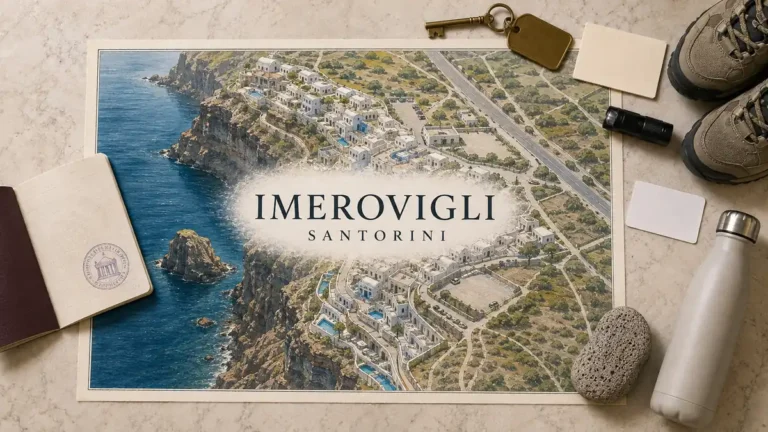
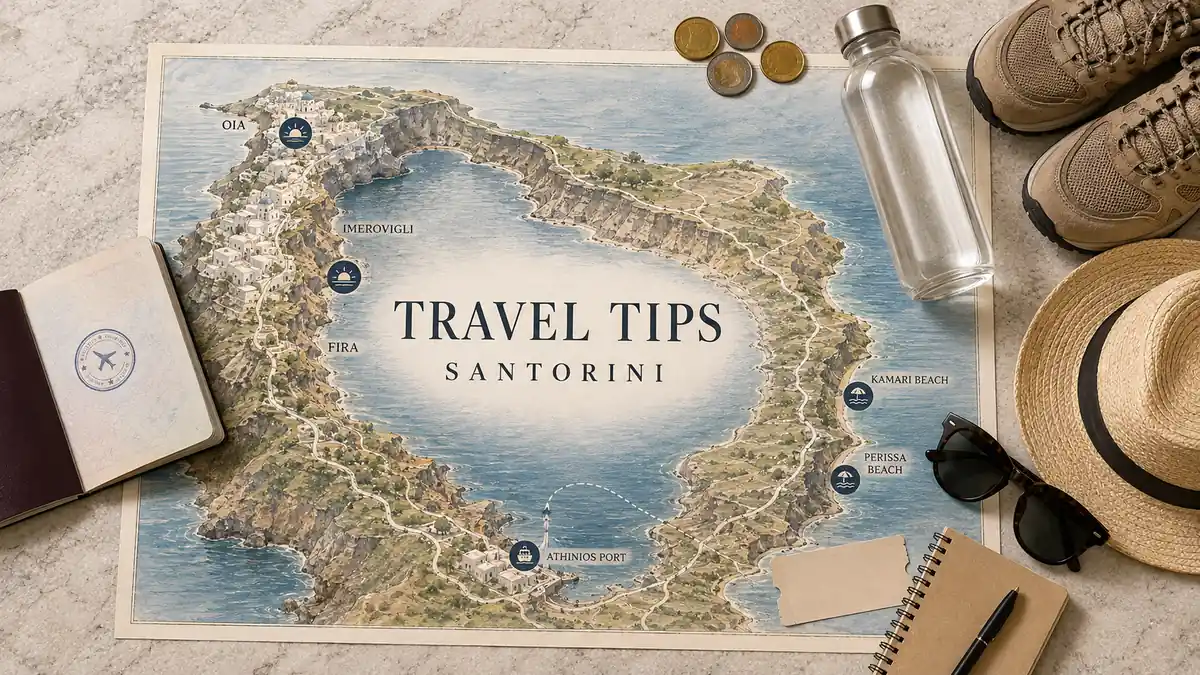
Imerovigli and Fira give you the same caldera sunset as Oia without the crush. All three sit on the same west-facing cliff and watch the sun drop behind one volcanic rim. Oia’s advantage is its specific postcard foreground; the cost is the most crowded hour on the island.
So the choice is honest and narrow. If you want the castle-ruin silhouette and the tiered white village in your frame, that view exists only in Oia and you accept the conditions attached to it. If what you want is the caldera, the light and somewhere to actually stand, Imerovigli and Fira deliver it with a fraction of the pressure. Imerovigli sits highest of the three and looks straight down the caldera; Fira spreads its crowd over a much longer stretch of cliff, so it dilutes.
- Imerovigli for the calmest version of the same view, reached along the cliff path.
- Fira if you want the sunset with somewhere to eat and drink immediately afterwards, without a transfer.
- The Fira–Imerovigli–Oia footpath at sunset hour, which puts you between villages and away from the fixed viewing points entirely.
- If Oia is non-negotiable, arrive well before the build, expect to stand for a long time, and then stay put for a while after the sun goes instead of joining the exit.
- Adjust for the season. Sunset falls late in high summer and appreciably earlier in the shoulder months, which changes when your evening actually starts.
Oia’s sunset costs you the exit as much as the view: the same handful of narrow footpaths that fed thousands of people in have to drain them all out again, so waiting out the first push moves you faster than joining it. If sunset access every single evening is what you are buying the trip for, it stops being a timing question and becomes a base question — which village to sleep in is worked out in where to stay in Santorini.
Can you drink the tap water in Santorini?
Tap water in Santorini is not recommended for drinking. The island has no natural freshwater supply and runs on desalinated and shipped-in water, which serves washing and cleaning but is not what people here drink. Hotels, tavernas and residents use bottled water, and so should you.
Day to day, this costs you very little:
- Buy bottled water in large sizes from mini-markets and decant into a smaller bottle for the day, because buying small bottles one at a time on the caldera edge is the expensive way to stay hydrated.
- Use the water your hotel supplies for refills — most properties provide it precisely because guests cannot use the tap.
- Expect showers to feel slightly saline and your skin to feel different afterwards; that is the desalinated supply, not the plumbing.
- Keep showers short. Water is a genuinely scarce resource on this island, and long showers are noticed.
Do you need cash in Santorini, or are cards accepted?
Carry cash on Santorini. Cards work in most hotels, larger restaurants and shops, but local buses, small tavernas, beach loungers, kiosks and tips still run on euros and coins. A small-island economy with seasonal businesses and patchy terminals leaves more cash-only moments than a mainland city does.
The logic is structural. Many businesses here open for a season and close again, terminals depend on connections that drop when the island is full, and the smallest operators never installed one. Greece uses the euro, so there is no currency step to plan — only a supply step. ATMs cluster in Fira and Oia and thin out quickly beyond them, which means the time to withdraw is when you pass one, not when you need one.
- Local buses — fares are collected on board and cash is the reliable option.
- Small tavernas and bakeries, especially inland and away from the caldera rim.
- Beach loungers and umbrellas, which are usually settled directly with an attendant.
- Kiosks, church donation boxes and small market stalls.
- Tips, which are almost always left in cash even when the bill is paid by card.
Coins matter more here than notes do. Bus fares, donation boxes and lounger fees are the transactions that stall, and none of them are set up to break a large note. What all of this adds up to across a trip — accommodation, food, transport, activities — is a separate calculation, and we break it down in our guide to Santorini trip cost.
Do you tip in Santorini, and how much?
Tipping in Santorini is customary but not obligatory, and nothing goes wrong if you simply round up. Rounding the bill up, or leaving around ten percent for good service, sits comfortably within the norm; tourist-heavy caldera restaurants tend to see a little more.
What should you wear in Santorini?
Wear closed shoes with grip for the caldera steps, cover your shoulders for churches, and plan for full sun. Those three constraints decide almost everything you actually need; the rest is personal taste. Fira, Firostefani, Imerovigli and Oia are built on stepped, uneven cliff paths, and shade is scarce.
The terrain is the part people underestimate. Moving between caldera villages means hundreds of steps of varying height, cobbles polished smooth by decades of foot traffic, and stretches with a drop on one side. Flip-flops slide on the polished sections and heels catch in the gaps — which is why you see both being carried, not worn, by the end of an evening.
- Closed shoes with a real sole for any day that includes the cliff path or a village walk. Sandals are fine for a flat beach day.
- Shoulders covered and shorts not too short for churches and monasteries, which are still active places of worship and not photo stops.
- A hat and light long sleeves, because the island is essentially treeless and the whitewash reflects sun back at you from below.
- A cover-up you can pull on quickly, so a swim does not rule out the church or the taverna afterwards.
- Something warmer for the evening — the caldera edge catches wind that the villages do not.
Heat and footing are the everyday hazards on foot here, and they are matters of conduct, not danger warnings. The fuller risk picture, including ATV and quad rental — which is where visitors most often get hurt — belongs to our Santorini safety guide.
Can you take photos on the blue domes in Santorini?
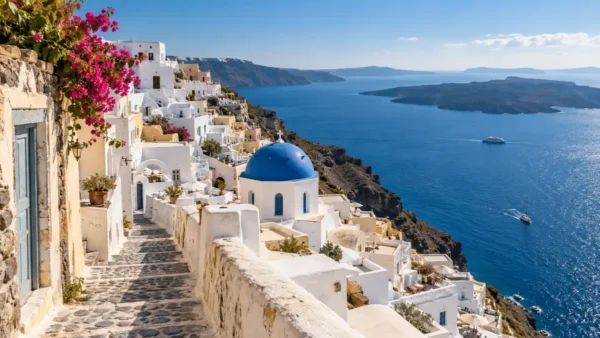
Photograph the blue domes from the public paths, and never climb onto a dome, roof or private terrace. The domes are church roofs, and the whitewashed terraces framing them belong to homes and hotels. The famous angles are all reachable from walkways that anyone may use.
The etiquette here has a reason behind it. People live directly beneath the most photographed roofline in the Aegean, and the response to years of visitors stepping onto private terraces has been locked gates, low walls and hand-painted signs across Oia and Imerovigli. The churches themselves are in use. Treat both as what they are and the whole question resolves itself.
- Shoot from the public footpaths. The Oia walkways and the Fira–Imerovigli path give you the recognisable compositions without stepping onto anyone’s property.
- Go early. Morning light is the best light on white and blue, and it doubles as the emptiest hour.
- Ask before entering a hotel terrace, even one that looks open — most belong to guests who paid for the view.
- Respect closed gates and signs instead of reading them as a challenge; they exist because of what came before you.
- Church interiors and drones follow the same logic — quiet, permission first, and no assumption of access.
This is the only sight on Santorini where the viewing platform is somebody’s bedroom roof. That one fact explains every restriction you will meet around the domes.
Do you need to book restaurants in Santorini in advance?
Book sunset-view restaurants ahead in peak season; in shoulder months and away from the caldera edge, walk-ins usually work. The same split applies to airport and port transfers, caldera boat trips, and cliffside rooms. Demand concentrates on a narrow strip of the island, so that strip sells out first.
The dividing line is view, not quality. A table with the caldera in front of it at the right hour is a scarce, fixed-quantity thing in high season, while an excellent taverna two streets inland or in a village off the rim will usually seat you. Apply the same test to everything else you are tempted to reserve.
- Book ahead in peak season: sunset-view and caldera-edge restaurants, airport and port transfers, the popular caldera and volcano boat trips, and caldera-view accommodation.
- Usually walk-in: inland and village tavernas, beach restaurants, bakeries and cafés, and most casual daytime eating anywhere on the island.
- In the shoulder months, the book-ahead list shrinks to transfers and the most sought-after sunset tables.
- Keep one day’s reservations in one place. A lunch in the south and a sunset table in the north is a day built around a road.
Every booking you make in a different village is also a transfer you have to survive in the heat, which is why two fixed points a day is the honest ceiling on this island. How many days that adds up to, and in what order, is the itinerary question: we sequence it in our 2-day Santorini itinerary and, for a slower version with a boat trip and a beach day, the 3-day Santorini itinerary. One practical note: restaurants, transfer drivers and boat operators here confirm and reschedule over messaging apps, so arrive with data already working — the options are compared in our guide to the best eSIM for Greece.
Tours and activities
Book skip-the-line tickets, day trips and local tours with free cancellation on most activities.
You can also browse everything on getyourguide.com.
Tripstou may earn a commission if you book through this link, at no extra cost to you.
Frequently Asked Questions
How many days do you need in Santorini?
Two to three nights suits most first-time visitors. That is enough for the caldera villages, one sunset, and a boat trip or beach day without spending the trip in transit. Add a night if you want a slower pace or a day away from the rim.
Can you flush toilet paper in Santorini?
Generally no. Bins beside the toilet are standard across Santorini, and signs in bathrooms will tell you when paper must go in the bin instead of the bowl. The island’s narrow pipes and strained water system are the reason, and the habit applies in hotels too.
Can you brush your teeth with the tap water in Santorini?
Yes, brushing your teeth with the tap water is generally fine. The advisory on Santorini is about drinking, not contact — the desalinated supply is used for washing, showering and cleaning throughout the island. If you prefer, use the bottled water your hotel provides.
Is the donkey ride in Santorini ethical?
Welfare concerns make it a ride worth declining. The donkeys work the steep stepped path between Fira and the old port, carrying loads up a hot climb through the day, and the practice is widely criticised. The cable car and walking the same steps are the alternatives.
Do people speak English in Santorini?
Yes. English is widely spoken in tourist-facing businesses on Santorini — hotels, restaurants, shops, tour operators and taxi drivers — so you can plan a trip without any Greek. A few words still land well: kalimera, efharisto and parakalo cost nothing and change how an exchange feels.
What should you not wear in the Santorini hot springs?
Avoid light or white swimwear. The caldera hot springs run sulphur-rich water that stains pale fabric a rusty orange, and the marks often do not wash out. Wear a dark swimsuit you do not mind discolouring, and rinse it as soon as you can.
Related Guides
- Santorini travel guide — the island overview: what to see, how the villages differ, and how to shape a first visit.
- Where to stay in Santorini — which village suits which traveler, and what you gain or lose on the caldera edge.
- 3-day Santorini itinerary — a paced plan that fits the crowd cycle instead of fighting it.
- Santorini trip cost — what a trip actually costs, broken down by travel style.
- Getting around Santorini — buses, taxis, transfers and rentals compared for a small island with slow roads.
- Santorini safety guide — the real risks, including ATV rental, cliff paths and sun exposure.
Did this guide save you time or money? Tripstou is independent and reader-funded — if you'd like to give something back, you can support the site with a crypto contribution of any size.