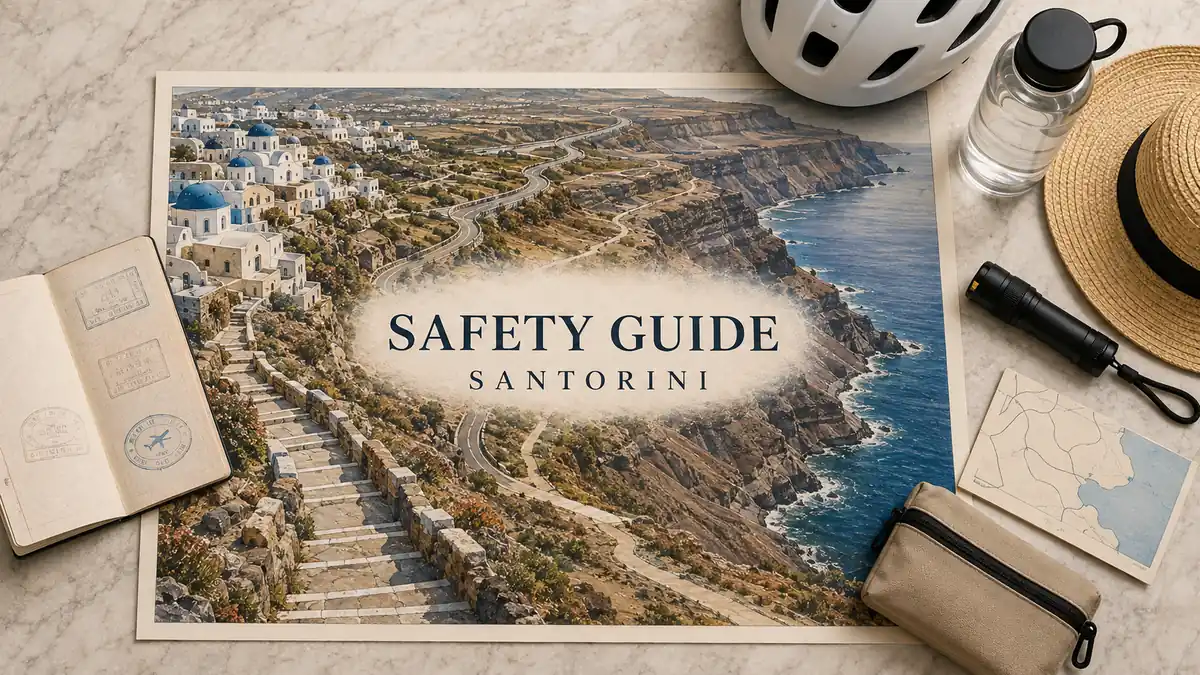
Is Santorini safe? Yes — and the honest version of that answer is more useful than the reassurance. Crime against visitors on this island is rare, and the sunset crowds in Oia are not where the danger sits. What actually sends travelers to the island’s clinic is a rented quad on a cliff road with no shoulder, a slip on a polished stone stair in a caldera village, and a midday walk along an exposed rim path in high summer. Those three things account for the overwhelming majority of ruined trips here, and all three are avoidable with decisions you make before you arrive. This guide gives the calibrated verdict first, then works through the island’s real risks in the order they actually hurt people — vehicles, falls, heat, and only then theft. It also resolves the quad question, the insurance question, and the short list of precautions that change outcomes.
Quick Answer
Santorini is a safe island for visitors, and crime against tourists is rare. The real risks are rented quads on narrow cliff roads, steep and slippery caldera stairs, and summer heat on exposed paths. Skip the quad unless you are licensed and experienced, wear real shoes in the villages, and walk the rim path early.
Trust Layer
Tripstou safety guide for travelers deciding how safe a destination is and what precautions actually matter. Covers real risk levels, common scams, situational awareness, and protection choices.
Produced with AI assistance and reviewed by Alex Perrut, working in tourism since 2015, for the Tripstou editorial team. See our editorial process for details.
Last factual review: September 3, 2026.
Official sources consulted: Visit Greece, Greek Ministry of Tourism.
Key Takeaways
- Santorini is genuinely safe for visitors; crime is rare, and the real hazards are vehicles, falls and heat.
- Renting a quad is the riskiest thing most visitors do here; skip it unless you are licensed and experienced.
- Caldera villages are hazardous by design: wear shoes with grip, keep off unfenced edges, and carry a torch after dark.
- Walk the Fira to Oia rim path early or late; it is almost entirely unshaded and brutal at midday.
- Theft is opportunistic and crowd-shaped: sunset viewpoints, packed buses and port queues are where bags get opened.
- Check that your policy covers quad riding, because serious injuries here mean a medical transfer to Crete or Athens.
Table of Contents
Is Santorini Safe for Tourists?
Santorini is safe for tourists, and crime against visitors is rare. What sends people to the island’s clinic is almost never theft or assault. It is a rented vehicle on a cliff road, a fall on a stepped village path, or too much sun on an exposed walk.
Safety here varies by situation, not by neighbourhood. There is no part of Santorini a visitor should avoid, and any page ranking its villages by danger is inventing a risk that does not exist. What changes your exposure is what you are doing: riding a rented quad down to a beach, descending unlit steps at midnight, or standing on the rim at two in the afternoon in August.
The island’s geography explains almost all of it. Caldera villages are built vertically into a cliff face, so movement means stairs — narrow, worn smooth, often without a handrail and sometimes with a long drop on one side. The connecting roads are two-lane, wind-blown and shoulderless, shared by buses, delivery vans, rental cars and thousands of holiday riders on machines they have never used before. The volcanic terrain is bare, so there is no shade where you most want it. Those are the three risk engines. None of them is a crime problem.
If you want the national picture — advisory context, the Greek scam landscape, the mainland cities — that belongs on our guide to whether Greece is safe, which covers the country-wide patterns this page deliberately leaves out. For broad orientation on the island itself, start with the Santorini travel guide.
What Is the Most Common Way People Get Hurt in Santorini?
The most common way visitors get hurt in Santorini is a road accident on a rented quad or scooter. Falls on stairs and caldera paths come next, then heat illness on exposed walks in summer. Crime is a distant last on that list.
That order is the useful part of this page, and it is the order the rest of the article follows:
- Rented quads, ATVs and scooters — inexperienced riders on narrow cliff roads. The most serious injuries on the island.
- Falls on stairs, paths and terraces — the caldera villages, especially in the dark, in wind, or in the wrong shoes.
- Heat — the exposed rim path and unshaded archaeological and beach sites in high summer.
- Petty theft and thin scams — opportunistic, crowd-based, and rare enough to sit last.
Is It Safe to Rent a Quad or ATV in Santorini?
Renting a quad is the riskiest thing most visitors do in Santorini. It is legal, heavily marketed and genuinely popular, and it accounts for the island’s most serious visitor injuries. The decision turns on three things: your licence, your real experience on similar vehicles, and the roads you plan to ride.
The problem is the road, not the machine. Santorini’s main routes are narrow, frequently walled, exposed to strong wind and often surfaced with loose gravel at the edges. Coaches and delivery trucks take the bends wide. There is rarely a shoulder to escape onto. A quad is stable at walking pace and unforgiving on a cambered corner, and its low profile makes it hard for a driver coming the other way to see.
The legal position is clear even when the rental desk is casual about it. A Category B car licence is legally required to rent a quad or ATV in Greece, and a licence issued outside the EU, UK, US or Australia must be accompanied by an International Driving Permit. Helmets are mandatory by law. Operators commonly add their own conditions on top, including how long you have held the licence, and the rules in this area are being tightened — confirm current requirements directly with the operator before you book.
Before you ride, settle four things:
- Licence — Category B, plus an International Driving Permit if it was issued outside the EU, UK, US or Australia.
- Helmet — mandatory by law, and one that actually fits you, not whichever one is handed over by default.
- Cover — check that your travel policy includes quad and ATV riding before you sign anything (see the insurance section below).
- Operator confirmation — ask what documents and conditions they currently require, since the rules are moving.
Honest self-selection matters more than any checklist. Rent if you hold the right licence, have genuine road experience on a similar machine, and plan short daytime hops. Do not rent if this would be your first time on one, if there is any chance you will drink, or if you are counting on riding back after dark. Most quad injuries here happen on the short hop, not the long ride — the run between village and beach is where riders relax, and it is the stretch with the tightest bends and the heaviest bus traffic.
If the answer is no, the island is entirely navigable without one. Our guide to getting around Santorini covers the buses, transfers and taxi reality so you can plan the trip on other modes.
Are Santorini’s Cliff Paths and Stairs Dangerous?
Santorini’s caldera paths and stairs are the island’s main fall hazard, especially after dark. The villages are hazardous by design: stepped lanes, low walls, unfenced terraces and stone polished smooth by decades of foot traffic. Footwear, attention and timing manage that hazard far better than avoiding the villages.
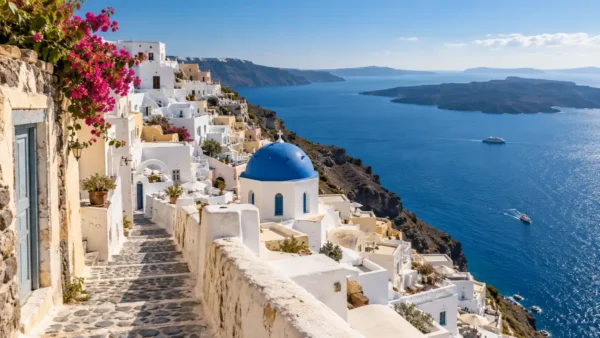
“Hazardous by design” is literal here. Fira, Imerovigli and Oia were built on a cliff edge long before anyone thought about tourist volumes, so the walkways are narrow, the steps are irregular in height, and the boundary between a public lane and a hundred-metre drop is often a knee-high whitewashed wall. Rooftops double as terraces and terraces double as photo spots. Marble and worn stone become slick in rain and stay slippery for a while afterwards.
Crowding compounds it. At sunset the lanes funnel, people stop dead to take photographs, and the person behind steps sideways to get past. The stepped path down to the old port carries donkey and mule traffic, which makes the surface uneven and the footing unpredictable. The dangerous moment in the caldera villages is almost always the photo — people step backwards onto a low wall or an unrailed terrace edge to fit the view in frame.
The precautions are short and they work:
- Proper shoes with grip. Sandals and smooth soles are how most stair falls start.
- Do not stand on walls, ledges or unfenced terrace edges for photographs.
- Take extra care when the stone is wet and when the wind is up on exposed sections.
- Carry a phone torch after dark. Village lighting is atmospheric, which is another way of saying dim.
Where you base yourself changes how many of these stairs you climb every day, purely as a matter of logistics: a caldera-edge room means a stepped approach with luggage, and a flatter inland or beach base means almost none.
Is the Fira to Oia Hike Safe in Summer Heat?
The Fira to Oia walk is safe in summer if you time it and carry water. The rim path is exposed for almost its entire length, with next to no shade, so midday in July and August is where heat exhaustion happens. Start early or late.
Treat it as a hot-weather walk, not a stroll between two villages. Set off soon after sunrise or in the last hours of daylight, carry more water than feels necessary, wear a hat and real shoes, and turn back if you are struggling — the path passes settlements along the way, so bailing out is easy and pushing on is the mistake. The surface alternates between road, dirt and loose volcanic rock, and it climbs and drops more than the flat caldera view suggests. Broader preparation, from packing to timing your days, sits in our Santorini travel tips.
Is Santorini Safe at Night?
Santorini is safe at night. The villages stay calm after dark, and walking through Fira or Oia in the evening is unremarkable. The consequential risk is the way home: unlit stepped paths, connecting roads with no pavement, and transport that thins out late. Plan the return before you go out.
Three things change after dark on this island. Stairs you handled easily in daylight become genuinely tricky under low lighting, especially downhill and especially after wine. Roads between villages have no pavement, so a walk back along one puts you in a traffic lane on a blind bend. And quads and scooters are still out there, ridden by people who have also been out for the evening.
Transport is the practical constraint. Buses thin out after dark and taxis are scarce on an island with a small fleet and heavy summer demand, so a spontaneous ride home at one in the morning is not something to count on. Arrange the return before you leave — through your accommodation, a pre-booked transfer, or a group you are already travelling with. Options and how each one actually works are covered in the Santorini transport guide.
Is Santorini Safe for Solo Female Travelers?
Santorini is safe for solo female travelers, and the precautions that matter here are logistical, not about avoiding areas. Harassment is not a notable island pattern. What catches solo travelers out is an accommodation reached by unlit stairs and no arranged way back from dinner.
The adjustments are small. Fix your ride home before you go out, since the weak point is the late walk back, not the venue you are in. Keep an eye on your drink in busy nightlife spots, the same as anywhere. And check the approach to your room before booking: some beautiful cave-house properties are reached by long, steep, poorly lit staircases that are charming with a day bag and unpleasant at midnight. Our guide to choosing where to stay in Santorini covers what each base is like to reach and move around — a logistics question, not a ranking of safe and unsafe areas. Country-wide context sits on the Greece safety guide linked earlier.
Pickpockets and Scams in Santorini Are Rare, Not Absent
Pickpocketing and scams are rare in Santorini, and crime sits last on the island’s real risk list. The realistic exposure is opportunistic theft in dense crowds: sunset viewpoints, packed buses and the ports on busy arrival days. Organised scam activity is thin here compared with big mainland cities.
The few patterns worth recognising are all crowd-shaped:
- Sunset-crowd theft. Where it happens: the viewpoints in Oia and along the Fira rim in the hour before sunset. How to recognise it: bodies pressed together, everyone facing the same way with phones raised, no personal space. What to do: bags in front and zipped, phone on a strap or in a front pocket, nothing loose in a back pocket.
- Bus and port crowd theft. Where it happens: packed local buses and the queues at Athinios port and the old port on heavy arrival days. How to recognise it: boarding scrums and luggage confusion, which is when attention drops. What to do: keep valuables on your body, not in a rucksack behind you, and keep a hand on luggage during boarding.
- Unpriced transfers and unpriced menus. Where it happens: informal rides arranged on the spot and the odd tourist-facing restaurant with no visible prices. How to recognise it: no meter, no printed rate, no menu with figures on it. What to do: agree the price before you get in or sit down, and walk away if nobody will name one.
That is the whole realistic list for this island. The broader Greek scam landscape — mainland cities, ferries, taxis from major airports — is a different picture and belongs to the country-level safety guide.
Is Santorini Safe from Earthquakes and the Volcano?
Santorini sits in an active volcanic and seismic region, and that is its normal state, not an emergency. The island exists because of it: the caldera is a collapsed volcano. Minor tremors are part of regional life, and hotels and local authorities work with established procedures.
Practically, this changes very little about how you plan a trip. Buildings and infrastructure in the region are built with seismic activity in mind, and monitoring is continuous. The sensible preparation is the same as for any trip to Greece: read your own government’s general travel guidance before you go, note where your accommodation’s exits are, and follow instructions from local authorities and your hotel if anything does happen. That is the entire practical brief. It belongs in the same mental category as knowing that the island is windy.
Travel Insurance Is Worth It for Santorini, Mainly for the Quad and the Clinic Gap
Travel insurance is worth it for Santorini, mainly because serious injuries mean leaving the island. Local facilities handle minor problems; anything significant is transferred to Crete or Athens. The deciding detail for this trip is that many standard policies exclude quad and ATV riding altogether.
The scenarios that actually occur on this island are short and predictable:
- A quad or scooter accident with orthopaedic injuries, which is the expensive one.
- A fall on stairs — a broken wrist or ankle, sometimes needing treatment off-island.
- Heat illness after an unshaded walk or a long day at an exposed site.
- Cancellation or disruption, which on an island served by seasonal flights and wind-sensitive ferries is not exotic.
Two traps are specific to Santorini. Many standard policies exclude motorised recreation, so quad and ATV riding needs to be explicitly covered — check the policy wording before you rent, not after. And where cover does exist, riding without a helmet, or without the licence the law requires, can void it entirely. The clause to read is the motorised-recreation exclusion. A policy with a generous medical ceiling still pays nothing if it excludes ATVs, and the ATV is the thing most likely to injure you here.
Insurance matters less if you are not riding anything, staying in a flat-terrain base and travelling outside high summer. Even then, EU visitors relying on reciprocal state cover still face the same two gaps: motorised recreation and the cost of moving a patient off the island. Where this sits in the overall budget is covered in our breakdown of what a Santorini trip costs.
Travel medical insurance
SafetyWing Nomad Insurance provides travel medical coverage designed for travelers and digital nomads, with flexible Monthly and Annual plans.
Check Nomad Insurance coverage and current pricing →
New Nomad Insurance Essential members can get 8 weeks of electronic theft coverage free with reward code TRIPSTOU8.
Apply the reward before creating your SafetyWing account by looking for the pink camera icon on the Nomad Insurance page.
Tripstou may earn a commission if you purchase through this link, at no extra cost to you.
Santorini Emergency Numbers and Medical Access
Call 112 for any emergency in Santorini. It is the general emergency number across Greece and the rest of the EU. 100 reaches the police directly and 1571 is the tourist police line. Island medical care is limited, so serious cases are transferred off-island to Crete or Athens.
Save these three before you travel:
- 112 — general emergency number, Greece and EU-wide.
- 100 — police.
- 1571 — tourist police.
Medical facilities on the island are limited. Cuts, sprains, minor fractures and heat illness are treated locally, but anything serious means a transfer to Crete or Athens — which is precisely why the insurance question above is not a formality on this trip. Have two things ready to hand over on arrival at any clinic: the full address of your accommodation, and your policy number with the insurer’s emergency contact line. Keep both offline on your phone. Hunting through an inbox while in pain is not a plan.
Frequently Asked Questions
Can you drink the tap water in Santorini?
Tap water in Santorini is treated and technically safe in most accommodation, but it is desalinated and tastes noticeably salty or metallic. Almost everyone, locals included, drinks bottled water instead. Use tap water for brushing teeth and washing without concern, and buy large refill bottles to cut plastic and cost.
Is swimming safe in Santorini?
Swimming in Santorini is safe on calm days, and the variables are wind and the shape of the shoreline. Volcanic beaches often shelve steeply, so the water deepens fast a few paces out. Wind can pick up quickly and turn a flat morning sea choppy. Black sand also gets scorching underfoot.
Is Santorini safe for families with young kids?
Santorini is safe for families, though the caldera villages demand constant attention with small children. Stepped lanes, low walls and unfenced terraces sit directly beside the walking route, so hold hands on paths and never let a child near an edge. Skip quads entirely with kids, and plan around midday heat.
Do you need an International Driving Permit to rent a quad in Santorini?
You need an International Driving Permit only if your licence was issued outside the EU, UK, US or Australia. Everyone needs a valid Category B car licence, and helmets are mandatory under Greek law. Requirements are being tightened, so confirm exactly what documents your operator wants before booking.
Is Santorini safe for LGBTQ+ travelers?
Santorini is safe for LGBTQ+ travelers and is one of Greece’s most international destinations, used to visitors of every kind. There is no evidenced pattern of hostility towards same-sex couples on the island. The sensible precautions are the ordinary nightlife ones that apply to anyone: watch your drink, plan your way home.
Is the donkey ride up the Fira steps safe?
The donkey ride up the Fira steps carries real risk of falls and crush injuries on steep, crowded, slippery stone. The animals move unpredictably, and the same steps are shared with people walking down. The cable car is the safer way up, and walking works if you take the steps carefully.
Related Guides
- Santorini travel guide — broad orientation, timing and what the island is actually like.
- Getting around Santorini — buses, transfers and taxis, including how to move without a quad.
- Where to stay in Santorini — how the caldera villages, inland towns and beach bases compare.
- Santorini travel tips — practical preparation before you go.
- 2 days in Santorini — the short-stay trip shape.
- 3 days in Santorini — the fuller island route.
Did this guide save you time or money? Tripstou is independent and reader-funded — if you'd like to give something back, you can support the site with a crypto contribution of any size.