Portugal is one of the few European countries you can see properly without renting a car, because its headline cities sit on a single rail spine. The national operator, CP, runs trains from the north down through Coimbra to Lisbon and onward to the Algarve coast, which means the classic Portuguese trip — Porto, the Douro, Lisbon, Sintra, the beaches — is a sequence of train rides instead of a driving plan.
This page rides that spine end to end, north to south, as one ordered route with day trips built in. It also states the part most rail itineraries leave out: where the network simply stops. Trains do not reach Madeira or the Azores, they thin out badly across the interior Alentejo, and the Algarve line ends at Lagos. Knowing those edges before you book is what keeps a car-free trip car-free.
Quick Answer
Yes — Portugal works by train on a north-to-south spine: Porto, Lisbon, then the Algarve. The rail line links the headline cities directly and cheaply, but the islands and the deep interior need planes or buses instead. The route suits city-led, car-free trips built around two or three bases with rail day trips.
Trust Layer
Tripstou itinerary guide for travelers planning a route. Covers pacing, stop count, stop order, base logic, and trip length.
Produced with AI assistance and reviewed by Alex Perrut, working in tourism since 2015, for the Tripstou editorial team. See our editorial process for details.
Last factual review: August 28, 2026.
Official sources consulted: Visit Portugal, Turismo de Portugal.
Key Takeaways
- Portugal’s headline cities sit on one CP rail spine, so a car-free trip runs Porto to the Algarve.
- Ride north to south: the long transfer happens early and the trip finishes on the coast.
- Two or three bases beat moving nightly, because every base change costs most of a usable day.
- The Douro Line is the only leg worth riding for itself; take it as a Porto day trip.
- Book Alfa Pendular and Intercidades seats ahead on cp.pt; regional and suburban legs stay turn-up-and-go.
- Rail misses Madeira, the Azores, interior Alentejo and everything west of Lagos — fly or take the coach.
Table of Contents
Can You See Portugal by Train?
Yes — Portugal’s main cities sit on one north–south rail line, so a car-free trip works. CP, the national operator, runs services from Braga and Porto through Coimbra to Lisbon and on to Faro. That single spine carries the whole route in this guide.
The geography does the work. Portugal is long, narrow and coastal, and its population has always concentrated along that strip, so the railway was built where the cities already were. A traveler whose list reads Porto, Lisbon and the Algarve is describing the rail line without realising it.
Trains beat driving for exactly this kind of trip. City-to-city legs run station-centre to station-centre, so you skip the ring roads, the parking hunt and the fuel stops that eat a driving day in Portugal’s historic centres. You arrive in the middle of town and walk to the hotel. Rail is weakest where the trip stops being city-led — that is the honest limit, and it comes later on this page. Whether a car would suit your trip better is a separate decision with its own answer; this page assumes you have already chosen rail.
For the wider country context — regions, seasons, and how the pieces fit together beyond this one route — start with the Portugal travel guide.
The Best Portugal Train Route Runs North to South
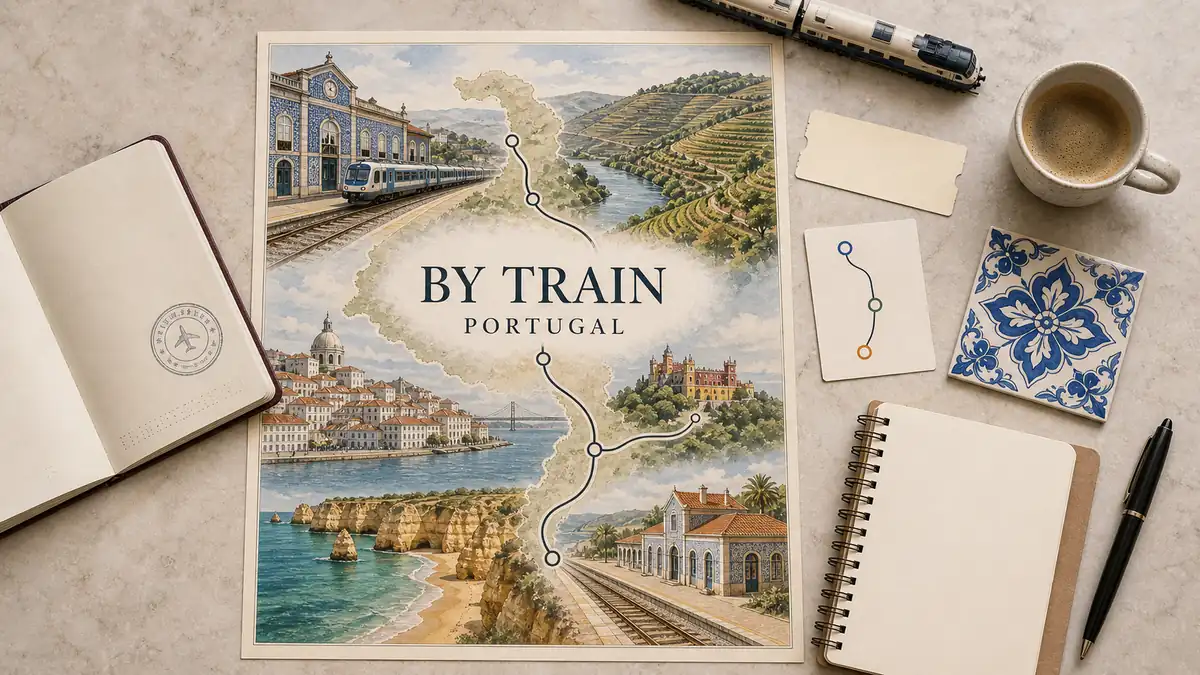
Start in Porto and ride south — Lisbon, then the Algarve — with day trips by rail from each base. The order follows the line itself: the Douro from Porto, the fast spine to Lisbon, Sintra on a suburban train, then the Algarve line to Faro and Lagos.
Route at a glance
- Porto — 2–3 nights: the route’s northern base.
- Douro Line — day trip: the leg ridden for itself.
- Lisbon — 3–4 nights: the fast leg’s destination.
- Sintra — day trip: palaces by suburban rail.
- Faro or Lagos — 2–3 nights: the coastal finish.
North to south is the stronger direction for two reasons. Trips gain momentum when they end on the coast, and the Algarve is the one stop where an extra unplanned day costs you nothing. Riding south also front-loads the effort: the long transfer happens early, while you are still fresh, and the legs get shorter as the trip goes on.
Journey times vary by train type and service; treat these as ranges and confirm current timings on cp.pt before booking.
| Leg | Typical journey time | Train type | Role in the route |
|---|---|---|---|
| Porto to Régua and Pinhão | Roughly 2 to 2.5 hours each way | Inter-Regional or Regional service | Scenic day trip along the river |
| Porto to Lisbon | Around 2.5 to 3 hours | Alfa Pendular or Intercidades | The spine’s fastest transfer |
| Lisbon to Sintra | Roughly 40 to 45 minutes each way | Lisbon suburban (Sintra line) | Day trip with no hotel move |
| Lisbon to Faro | Roughly 3 to 3.5 hours | Alfa Pendular or Intercidades | Transfer south to the coast |
| Faro to Lagos | Roughly 1.5 to 2 hours | Regional, on the Algarve line | The route’s western finish |
Porto: Where the Route Starts
Porto is the strongest opening base, worth two or three nights. It sits at the northern end of the spine, it is compact enough to walk, and it is the junction where the Douro Line branches inland — which is why the route begins here instead of in Lisbon. The riverfront Ribeira, the port lodges across the water in Vila Nova de Gaia, and São Bento station’s tiled hall cover the essentials without a car.
Two stations matter for planning: São Bento sits in the centre and serves regional and Douro departures, while Campanhã handles the long-distance trains south. They are a few minutes apart by connecting train. What to actually do with those two or three nights belongs to the Porto city guide.
You leave Porto twice — once out and back on the Douro day trip, once for good on the southbound spine.
The Douro Line: The Leg Worth Riding for Itself
The Douro Line is the one leg on this route where the train is the attraction. It runs from Porto inland along the river through Régua and Pinhão to Pocinho, and the final stretch hugs the water below terraced vineyards. Ride it as a day trip out of Porto: you keep the same hotel, you carry no luggage, and the return leg costs you nothing but an afternoon.
Régua is the practical turnaround for a short day; Pinhão is the prettier one and the better choice if you leave early. Service patterns and departure spacing change through the year, so check the day’s timetable when you plan — the last return of the day is the constraint that decides how far you can go. The valley itself, its quintas and its wine logic are covered in the Douro Valley guide.
Buying a Douro ticket for the outbound morning train and deciding the return in Pinhão is how most people overshoot the last departure. Fix the return before you go.
Porto to Lisbon: The Spine’s Fastest Leg
Porto to Lisbon is the route’s main transfer and its fastest long leg, taking roughly two and a half to three hours on the fast trains. Alfa Pendular services are the quickest; Intercidades cover the same corridor a little slower and usually cheaper. Both leave Porto from Campanhã and arrive at Lisbon’s Santa Apolónia or Oriente stations.
Coimbra sits on this line and can be taken as a break of journey if you want to split the transfer. Lisbon earns three or four nights as the route’s central base — the longest stay, because it also feeds the Sintra day trip and the Belém half-day. The city’s neighbourhoods, viewpoints and practicalities are handled in the Lisbon travel guide.
Book this leg first when you fix your dates. It is the one seat on the whole route that regularly sells out.
Sintra by Suburban Rail from Lisbon
Sintra is a suburban train ride from Lisbon, not a separate base. Trains run frequently from Rossio and Oriente, take roughly forty-five minutes, and use the same urban ticketing as the rest of Lisbon’s suburban network — no advance booking, no reservation. Cascais sits on a second suburban line along the coast and works the same way.
That frequency is what makes Sintra a day trip and not an overnight. Moving hotels for one night to save a forty-minute train ride is a bad trade, since the packing, check-out and check-in cost more time than the ride. Go early — the palaces queue badly by mid-morning. Which palaces are worth your day is covered in the Sintra day-trip guide.
South to the Algarve: Faro and Lagos
The route finishes on the Algarve line. Lisbon to Faro runs roughly three to three and a half hours on a fast train, and Faro is the regional hub where the coastal line continues west to Lagos and east to Vila Real de Santo António. Two or three nights here close the trip on the coast.
Lagos is the better base for a car-free finish: the old town is walkable, the beaches sit close, and it is the western terminus of the line, so there is no onward transfer to arrange. Albufeira is the alternative if you want a bigger resort base with more nightlife, though its station sits outside the town. The region’s coastline, towns and seasons are covered in the Algarve guide, with base-level detail in the Lagos guide and the Albufeira guide.
Several Algarve stations sit a taxi ride from the town they are named after, so confirm the station-to-hotel gap before you book the accommodation, not after.
Tours and activities
Book skip-the-line tickets, day trips and local tours with free cancellation on most activities.
You can also browse everything on getyourguide.com.
Tripstou may earn a commission if you book through this link, at no extra cost to you.
Which Train You’ll Ride: Alfa Pendular, Intercidades or Regional
CP runs four train types, and Alfa Pendular is the fast one. Intercidades follows close behind on the same spine, Inter-Regional and Regional trains cover the scenic and local lines, and Lisbon’s suburban units handle Sintra and Cascais. Your route uses all of them.
Mapped onto this itinerary, the split is clean:
- Alfa Pendular (AP): the fastest option on Porto–Lisbon–Faro. Air-conditioned, assigned seats, catering on board.
- Intercidades (IC): the same long-distance corridors at a slower pace and a lower fare. Also reserved seating.
- Inter-Regional and Regional (IR / R): the Douro Line and the Algarve coastal line. Slower, more stops, unreserved.
- Suburban: Lisbon to Sintra and Cascais. Turnstile-style ticketing, frequent departures, no seat allocation.
Comfort tracks the type, and so does the experience. Fast trains are quiet and forgettable, which is what you want on a transfer day. Regionals are older and busier. But they are the trains that run beside the Douro and along the Algarve coast, so on those two legs the slower ride is the point.
How to Buy CP Tickets (and When to Book)
Book Alfa Pendular and Intercidades ahead on cp.pt; regional and suburban trains are turn-up-and-go. The fast trains sell a fixed number of seats per departure, so buying early is what protects both the price and the departure you want. Everything else you buy at the station.
CP releases discounted advance fares on its long-distance services in limited quantities, and they disappear as a departure fills. Sales open roughly two months out, and the earlier you commit to a date and time, the cheaper and more available the fast legs are. Discounted fares also carry the tightest change and refund conditions, so they reward travelers who have already fixed their route and punish those still deciding.
That trade is the real booking decision on this route. If your dates are firm, book Porto–Lisbon and Lisbon–Faro as soon as you can and leave the Douro, Sintra and Algarve-line legs to the day itself. If your plans are still soft, pay the flexible fare on the two long legs and treat the difference as the price of changing your mind.
Leave a buffer at either end of a transfer day. Lisbon and Porto each use more than one long-distance station, and the station printed on your ticket is not always the one nearest your hotel — check it when you book, not on the morning you travel.
Where Trains Don’t Go — and When the Bus Wins
Portugal’s trains skip the islands, the Alentejo interior, and everything west of Lagos. Madeira and the Azores have no railways at all, so you fly. Inland Alentejo towns and the wild coast beyond Lagos are bus-and-road country, reached by intercity coach or by car.
The gaps, and what fills each one:
- Madeira: no railway. You fly from Lisbon or Porto, then use buses and taxis on the island — see the Madeira guide and the Funchal guide for the island base.
- The Azores: no railway, and inter-island travel means flights or ferries. Plan it as a separate trip with the Azores guide.
- Interior Alentejo: rail coverage thins out badly across the plains, so intercity coaches carry most of the towns. The Alentejo guide sets out what the region holds.
- West of Lagos: the Algarve line ends at Lagos. Sagres and the Costa Vicentina need a bus or a taxi from there.
Coach networks cover most of these gaps well, and the trip only breaks when you try to string several bus-only stops together in a short visit. At that point you are designing a road trip with buses, which is a different itinerary with different pacing.
Watch the western edge when you pick Algarve accommodation. A hotel twenty kilometres past Lagos looks like a small change on a map and quietly converts a car-free trip into a car trip.
How Many Stops Can a Rail Trip Support?
Plan two or three bases — Porto, Lisbon, and one Algarve stop — and day-trip by rail from each. The spine divides naturally into a northern third, a central third, and a southern one. Moving every night burns the hours that make rail travel comfortable.
The reason is arithmetic, not preference. Every base change costs a check-out, a walk or metro ride to the station, a buffer before departure, the ride itself, and a check-in that may not be ready until mid-afternoon. That is most of a usable day, whatever the timetable says. Two bases work for a short trip, three for a longer one, and a fourth almost always steals more time than the extra city gives back.
Rail day trips are what let you keep the base count low without seeing less. The Douro from Porto and Sintra from Lisbon both return the same evening, so you add two destinations without adding a single hotel move. Build the route that way and the trip feels slower even as it covers more ground.
How many nights each base actually gets depends on your trip length, and the day-count plans resolve that: the 7-day Portugal itinerary, the 10-day Portugal itinerary, and the 14-day Portugal itinerary. One practical note before you go: train travel rewards a bag you can carry up station stairs, which the Portugal packing list takes into account.
How to Adapt This Route with More or Fewer Days
Short on time, drop the Algarve leg first; with extra days, extend north into the Minho. The Algarve is the longest ride from the route’s Porto–Lisbon core, so cutting it recovers the most travel time. Added days work hardest at the northern end.
When time shrinks, cut in this order:
- The Algarve leg first. It is the longest transfer on the route and the only base that needs a second train to reach Lagos. Cutting it keeps Porto, Lisbon and both day trips intact.
- Then the Douro day trip. It costs a full day out of Porto. Painful to lose, but the core cities survive without it.
- Never the Porto–Lisbon leg. Remove that and the page stops being a route.
When time grows, add in this order:
- The Minho, by rail from Porto. Guimarães and Braga sit on the northern branch of the same network, so they extend the route without breaking the car-free rule — the Minho guide covers the region.
- A Silver Coast stop between Porto and Lisbon. Rail access varies by town and some stops need a connecting bus, so treat it as a detour with a transfer, using the Silver Coast guide to choose the base.
Add nights to existing bases before you add new ones. On a rail trip, a fourth base has to beat an extra day trip from a base you already have — and it usually loses.
Frequently Asked Questions
Do you need to reserve a seat on Portuguese trains?
Yes on the fast trains, no on the rest. Alfa Pendular and Intercidades tickets are sold for a specific train and seat, so you cannot take an earlier departure. Regional, Inter-Regional and Lisbon suburban services carry no seat allocation: buy a ticket and board whichever train comes.
Is a Eurail or Interrail pass worth it in Portugal?
Usually not for a Portugal-only trip. Point-to-point fares on CP are low by European standards, and the two legs that cost most — Porto to Lisbon and Lisbon to Faro — are cheap when booked ahead. A pass earns its price on multi-country rail trips, not inside one narrow country.
Are cheap CP train tickets refundable?
The discounted ones are not. CP’s promotional fares on Alfa Pendular and Intercidades trade flexibility for price: they are non-refundable once bought. Standard fares can be refunded, though a fee applies. Buy promo fares only when your dates are locked, and the flexible fare for anything still moving.
Which Lisbon train station should you use?
It depends on the line, not the city. Lisbon spreads its rail traffic across several stations: Santa Apolónia and Oriente handle the long-distance trains north and south, while the Sintra line runs from Rossio and Oriente. Check the station printed on your ticket before travel day, not on the morning itself.
Is first class worth it on the Alfa Pendular?
Only if space matters more than price. First class on the Alfa Pendular buys wider seating, more room and a quieter carriage, which is worth something on the three-hour Porto–Lisbon or Lisbon–Faro runs. The train arrives at the same time either way, so it is comfort, not speed.
Can you reach Madeira or the Azores by train?
No — neither archipelago has a railway. Madeira and the Azores are reached by air from Lisbon or Porto, and once there you move by bus, taxi or hire car. Between the Azorean islands, travel means short flights or ferries. Both work better as a separate trip than a rail-route extension.
Related Guides
Use these next to build the stops on this route into a full trip:
- Portugal travel guide — country-level planning context for the whole trip.
- Porto guide — what to do with the route’s northern base.
- Lisbon guide — neighbourhoods, sights and practicalities in the central base.
- Algarve guide — the coastal region where the route finishes.
- Douro Valley guide — the valley the scenic train leg runs through.
- 7-day Portugal itinerary — the same ground with day-by-day pacing.
Did this guide save you time or money? Tripstou is independent and reader-funded — if you'd like to give something back, you can support the site with a crypto contribution of any size.