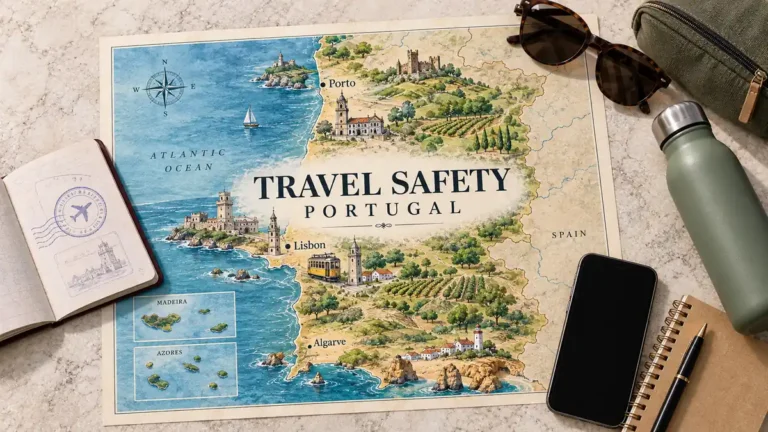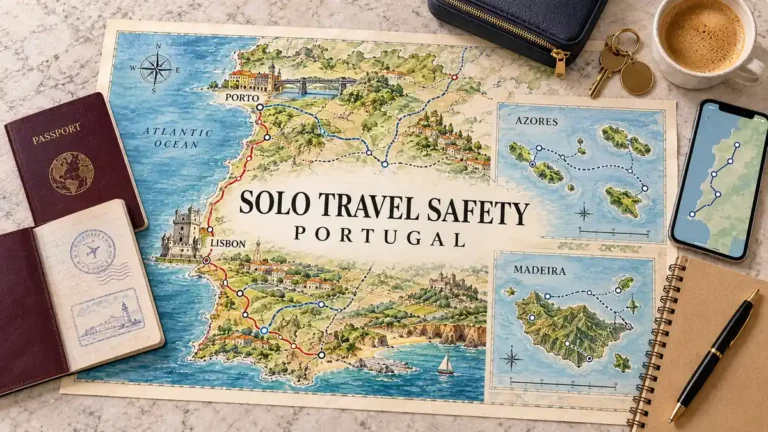

Choosing Portugal is the easy part. Choosing where to go inside it is where most trips stall. This page ranks Portugal’s best places by traveler fit — what each one is actually for — and groups them into four zones: the north, the centre, the south and the Atlantic islands. Lisbon and Porto form the spine of a first trip, and the real decision is which third region you attach to them. Ten places are profiled here, and each gets the same treatment: what it is, what makes it different from the other nine, and one line naming the traveler it suits. Every pick then routes to its own guide, so the shortlist stays a shortlist and the depth sits one click away. A traveler-fit table near the end re-cuts all ten picks by who is travelling — first-timers, couples, families, food-and-wine travelers, hikers and beach-led trips.
Quick Answer
Lisbon and Porto belong on almost every first Portugal shortlist, plus one third region: the Algarve, the Douro or Sintra. Trip style picks that third stop, and the shortlist splits into north, centre, south and islands so pairings stay realistic. Hikers and nature-led travelers should choose the Azores or Madeira as their own branch.
Trust Layer
Tripstou selection guide for travelers choosing between multiple places. Covers selection criteria, traveler fit, and trip value.
Produced with AI assistance and reviewed by Alex Perrut, working in tourism since 2015, for the Tripstou editorial team. See our editorial process for details.
Last factual review: August 28, 2026.
Official sources consulted: Visit Portugal, Turismo de Portugal.
Key Takeaways
- Lisbon and Porto cover the capital and northern-city experiences no other Portuguese pick replaces, so both belong on a first shortlist.
- Your third region decides the trip: the Algarve for beach-led families, the Douro or Alentejo for food and wine.
- Madeira and the Azores each need a separate flight and their own days, so they shorten any mainland plan.
- The Minho and the Silver Coast reward a car and a second visit more than a short first trip.
- Sintra earns an overnight instead of a rushed half-day, since its palaces draw the heaviest demand on this shortlist.
- Two shortlists overreach almost every time: the mainland spine plus both islands, and north plus south plus an island.
Table of Contents
Portugal’s Best Places Fall Into Four Zones
Portugal’s best places sort into four zones, and a good shortlist takes two or three of them, not all four. The north, the centre, the south and the Atlantic islands each reward a different trip. Every pick here earns its place by suiting a specific traveler, not by photographing well.
Three criteria decide what made the list:
- A distinct traveler fit — one clear kind of trip it rewards better than the alternatives do.
- Enough substance to justify an overnight, not a photo stop on the way somewhere else.
- A real difference from every other pick, so no two entries compete for the same slot.
That is why this page profiles ten places, not twenty-five. A list of twenty-five is not a shortlist; it is a map with the decision taken out of it, and every extra entry dilutes the reasoning behind the ones that matter. The rest of this page defends all ten in turn. Country-level practicalities — getting around, money, booking rhythm — sit in the Portugal travel guide, not here.
Lisbon and Porto Are the Spine of a First Trip to Portugal
For a first trip, put Lisbon and Porto both on the shortlist and add one third region. They are Portugal’s two largest cities, and they deliver two experiences no other pick on this page replaces: a wide-ranging Atlantic capital and a compact river city in the north. Choosing between them is usually the wrong question.
Lisbon — the capital-city pick for first-timers
Lisbon is Portugal’s largest city and the widest base a first trip can have. It is the capital, spread across hills above the Tagus, and it is where most international routes land.
What separates it from Porto is scale and reach. Lisbon holds more neighbourhoods than a short visit can cover, keeps the Atlantic coast within easy reach, and works as the natural launch point for Sintra, the Alentejo and the Algarve. Porto rewards a traveler who wants one city understood well; Lisbon rewards one who wants range. Neighbourhood detail, bases and getting around sit in the Lisbon guide.
Pick this if: this is your first visit to Portugal and you want the widest choice of neighbourhoods and onward routes.
Porto — the compact northern city pick
Porto is Portugal’s second city and the most compact pick on this list. It sits on the Douro river in the north, where the valley’s wine has been aged and shipped from the waterfront cellars for generations.
Its distinction is density. Porto delivers a river-and-wine identity inside a centre small enough to cross on foot, and it opens directly onto the Douro Valley and the Minho — the two northern regions Lisbon cannot reach as easily. The tradeoff is range: fewer neighbourhoods, fewer coastal options, less variety across a longer stay. Districts, stays and practical detail sit in the Porto guide.
Pick this if: you want a walkable city with wine country on its doorstep.
Lisbon or Porto: which one should anchor your trip?
Take both when time allows; when only one fits, let the third region decide. Lisbon anchors a trip built around Sintra, the Alentejo or the Algarve. Porto anchors one built around the Douro Valley or the Minho. That order matters more than any ranking of the two cities, because the anchor you choose quietly settles which half of the country you actually see.
- Lisbon if: your third region is central or southern, or you want more variety inside the city itself.
- Porto if: your third region is northern, or your trip is short and depth beats variety.
Best Places to Visit in Northern Portugal
The two northern picks beyond Porto are the Douro Valley and the Minho, each for a different traveler. The Douro is a terraced wine landscape built for slow days on the river. The Minho is green, rural and heritage-led, the quietest of Portugal’s mainland picks. Few travelers should attempt both on one trip.
Douro Valley — the wine-country pick
The Douro Valley is worth visiting if food, wine and slow travel are what you want from Portugal. The Alto Douro is UNESCO-listed, and the terraces cut into the hillsides above the river are the reason why.
Nothing else on this list looks like it. The Douro is a working agricultural landscape you sleep inside — quinta stays, river views, meals poured from the estate’s own cellar — instead of a city you tour. Its limits are real. Distances are slow, and a traveler indifferent to wine runs out of reasons by the second day. Harvest season changes the valley’s character completely, which is worth knowing before you fix dates. Estates, river towns and how to move around sit in the Douro Valley guide.
Pick this if: wine and long, slow meals are the point of the trip.
Minho — the green, historic north
The Minho is Portugal’s far north-west and the mainland’s most rural pick. Small historic towns, river valleys and dense green country define it more than any single landmark does.
It is distinct because there is no headline sight to tick. The Minho asks you to spend time in places rather than at them, and it draws fewer visitors than any other region on this shortlist. That is also its cost. You need a car or a great deal of patience, and a short first trip to Portugal will feel stretched by it. It suits a second visit far better than a first. Towns, routes and where to base sit in the Minho guide.
Pick this if: you are back for a second trip and want rural Portugal at its own pace.
Best Places in Central Portugal: Sintra and the Silver Coast
Sintra and the Silver Coast are the two central picks, one for palaces and one for a quieter coast. Both sit between Lisbon and Porto, close enough to the capital to attach to it without a long transfer. They pull in opposite directions: one is built beauty, the other is raw Atlantic.
Sintra — the palace-hills pick
Sintra is worth visiting, and it earns a place as a destination in its own right, not a half-day errand. Its cultural landscape is UNESCO-listed, and Pena Palace, Quinta da Regaleira and the Moorish Castle stand in the wooded hills above the town.
No other pick on this page is a built landscape. Sintra is romantic-era architecture set into a green microclimate, and the effect depends on the hills as much as on the buildings. The tradeoff is pressure: the main palaces are the busiest paid sights on this shortlist, and arriving without a booking is the most common way travelers spoil the visit. Staying overnight is what separates seeing Sintra from queuing in it. Sights, timing and stays are covered in the Sintra guide.
Pick this if: architecture and landscape design are what you travel for.
Silver Coast — the quieter Atlantic pick
The Silver Coast is the Atlantic stretch north of Lisbon and the coastal pick for travelers who do not want a resort. Fishing towns, cliffs, surf and long open sand set the tone along it.
It differs from the Algarve on every axis. The water is colder, the wind is stronger, the building is lighter, and Lisbon is much closer. That also caps what it can be. This is not a sun-holiday substitute, and a family expecting warm, calm sea will be disappointed by it. It rewards a car and a flexible plan. Towns, bases and how the coast strings together sit in the Silver Coast guide.
Pick this if: you want Atlantic coast with surf and space instead of resort infrastructure.
Tours and activities
Book skip-the-line tickets, day trips and local tours with free cancellation on most activities.
You can also browse everything on getyourguide.com.
Tripstou may earn a commission if you book through this link, at no extra cost to you.
Best Places to Visit in Southern Portugal
The Algarve and the Alentejo are the southern picks, and they suit almost opposite travelers. The Algarve is Portugal’s warm-water coast and the country’s main sun-and-sea region. The Alentejo is the wide inland plain above it, built for slow driving, wine and heritage towns. Most first-timers should take one, not both.
Algarve — the coastal pick, and where to base
The Algarve is Portugal’s southern coast and the only warm-water pick on this list. Cliffs, sheltered coves and a long, dependable season are what bring most travelers here.
No other region on this page delivers a genuine beach holiday, which is the whole case for the Algarve. The tradeoff comes with it: the central coast fills hard in high season, and the same stretch feels like a different region in and out of the peak months — so time the visit deliberately with the best time to visit Portugal guide. Region-wide detail sits in the Algarve guide.
Two towns cover most base decisions:
- Lagos — western Algarve, the scenery-led base. Suits couples and travelers who want cliffs and old-town character; it is busier and younger after dark than its size suggests.
- Albufeira — central Algarve, the resort-and-family base. Suits families who want everything within walking reach; the tradeoff is the least Portuguese-feeling stretch of the coast.
Pick this if: the beach is the reason for the trip, not a bonus.
Alentejo — the slow, inland pick
The Alentejo is the wide rural region between Lisbon and the Algarve, anchored by Évora, whose historic centre is UNESCO-listed. Cork oaks, wheat plains, whitewashed hill towns and serious wine estates fill the space between.
It is the only inland-heritage pick in the south, and the only one offering food and wine with no coast attached. The constraints are practical. It is car-dependent, and high summer inland is genuinely hot — the same months that make the Algarve work are the ones that make the Alentejo hard. Towns, estates and driving detail sit in the Alentejo guide.
Pick this if: you want long lunches, wine estates and empty roads.
Madeira and the Azores Are a Separate Decision
Madeira and the Azores belong on the shortlist as their own branch, not as an add-on to the mainland. Each needs a separate flight and its own block of days, so adding one shortens everything else. They suit travelers who want landscape and walking over cities and sights.
Madeira — the closer, greener island pick
Madeira is the island pick that sits far closer to Lisbon than the Azores, which makes it the easier one to reach. Mountains drop straight into the sea, and the interior stays walkable through the calendar.
Two things set it apart: the climate is mild year-round, and it has a real city base in Funchal, which no other island option here offers. The tradeoff is expectations. Madeira is a walking and mountain island, not a beach one, and it still costs a separate flight to reach. Levada walks, viewpoints and where to base sit in the Madeira guide.
Pick this if: you want mountain walking with a proper city to come back to.
Azores — the remote nature pick
The Azores are a nine-island archipelago roughly 1,400 km west of the mainland and the most nature-led pick on this page. Volcanic crater lakes, hot springs, whales and green hiking country define the trip.
Nothing else here is this remote or this raw, and everyday spending on the ground tends to be gentler than in the mainland’s tourist centres. That remoteness has a price. The weather changes fast and can rewrite a day’s plan without warning, and this is the most time-hungry pick to combine with a mainland trip. Islands, hikes and how to choose between them sit in the Azores guide.
Pick this if: hiking and volcanic landscapes outrank cities on your list.
Mainland and island weather are not the same trip. What works for Lisbon in high summer will not cover a wet ridge in the Azores or a cool evening in Madeira’s hills, and the Portugal packing list covers both cases.
Best Places in Portugal by Traveler Type
First-timers take Lisbon and Porto; couples lean Douro or Alentejo; families choose the Algarve; hikers choose the islands. The same ten picks re-sort completely once you cut them by who is travelling instead of where they sit. The table below gives one primary fit per pick. Two ties need a tiebreak.
| Destination | Best for | Zone |
|---|---|---|
| Lisbon | First visits needing range and easy onward routes | Central coast, on the Tagus estuary |
| Porto | Walkable city stays with wine country nearby | North, on the Douro river mouth |
| Douro Valley | Wine trips built around long, slow meals | North, inland along the river terraces |
| Minho | Second visits at rural Portugal’s own pace | Far north-west, near the Spanish border |
| Sintra | Architecture and landscape design as the draw | Centre, in the hills west of Lisbon |
| Silver Coast | Atlantic surf and space without resort infrastructure | Centre, on the shore north of Lisbon |
| Algarve | Beach-led trips where the sea is the point | South, the country’s main warm coastline |
| Alentejo | Wine estates, long lunches and empty roads | South, inland above the Algarve coast |
| Madeira | Mountain walking with a real city base | Atlantic island closest to the mainland |
| Azores | Hiking and volcanic landscape over city time | Atlantic archipelago far west of Portugal |
Couples split between the Douro and the Alentejo on transport, not on romance. The Douro rewards travelers happy to slow down inside one valley and let a boat or a train do the moving. The Alentejo needs a car and gives back distance — hill towns, estates and long empty roads between them. Take the Douro for a compact, wine-focused few days; take the Alentejo when the driving is part of the pleasure.
Families split between the Algarve and Madeira on what the children want from the water. The Algarve delivers warm, swimmable sea and infrastructure built around it. Madeira delivers walks, pools and dramatic scenery, but the Atlantic there is cold and rough. Younger children push the answer to the Algarve almost every time.
Once a place is chosen, the next question is what fills the days, and that lives in things to do in Portugal. Budget also moves by zone. Lisbon and the Algarve in peak season are the hardest on a tight budget, while the Alentejo, the Minho and the Azores tend to be gentler on everyday spending — the Portugal trip cost guide breaks that down by travel style.
Which Places Can You Combine in One Trip to Portugal?
Combine Lisbon and Porto with one neighbouring zone; adding a third zone or both islands spreads a trip thin. Realistic pairings follow geography, because every extra zone costs a travel day and a change of base. The islands work as a standalone trip or a single deliberate add-on.
Besides Lisbon and Porto, the third stop comes down to three directions:
- The coast-led south — the Algarve. Suits families and beach-first travelers; the tradeoff is the longest hop from the northern half of the spine and the heaviest high-season crowds.
- The wine-led north — the Douro Valley, with the Minho added on a longer trip. Suits food-and-wine and slow travelers; the tradeoff is that it only pays off if Porto is already on your route.
- The palace-and-heritage centre — Sintra, the Silver Coast and the Alentejo. Suits culture-led travelers anchored in Lisbon; the tradeoff is that none of the three gives you a warm-sea beach.
Two shortlists overreach almost every time: the mainland spine plus both islands, and north plus south plus an island. Both look fine on a map and come apart in practice, because each island is a separate flight and each zone change eats a day at either end. Portugal’s zones sit close enough on a map to tempt a five-stop trip and far enough apart in practice to punish one.
Day counts belong to the itinerary pages, not to a shortlist. The Portugal itinerary guide sets route order and pacing, the 7-day Portugal itinerary covers the shortest realistic spine, the 10-day Portugal itinerary adds one region to it, and the 14-day Portugal itinerary is where a second region or an island branch becomes workable.
Frequently Asked Questions
Is Évora worth visiting?
Yes, Évora is worth visiting for travelers drawn to heritage and slow inland travel. Its historic centre is UNESCO-listed, and it works as the Alentejo’s main base, not a passing stop. The tradeoff is pace: it is a walking-and-eating town, so beach-led or fast-moving travelers should skip it.
What is the most beautiful region in Portugal?
The Douro Valley is Portugal’s most beautiful region for landscape, with terraced vineyards cut into the hillsides above the river. The Azores win on raw nature — crater lakes and volcanic green — and Sintra wins on built beauty, where palaces sit inside a wooded microclimate. Choose by which kind of beauty moves you.
Do you need a car to visit the best places in Portugal?
No — the Lisbon–Sintra–Porto spine works on public transport and needs no car. A car becomes close to essential for the Minho, the Alentejo and the Silver Coast, where the appeal is spread across small towns and open country. On Madeira and in the Azores, driving is the practical way to reach trailheads.
Is northern or southern Portugal better for a first trip?
Northern Portugal usually wins a first trip, unless the beach is the reason you are going. The north pairs Porto with the Douro Valley, so a city and a landscape sit close together. The south splits into the Algarve’s coast and the Alentejo’s plains, which pull in different directions and rarely combine well.
Can you visit only Lisbon and still see the best of Portugal?
You can build a good first trip on Lisbon alone, but you will miss the north entirely. Sintra, the Silver Coast and the Alentejo all sit within Lisbon’s reach, which covers the centre and the south from a single base. What it cannot give you is Porto and the Douro Valley.
Which places in Portugal are best for a second trip?
A second trip suits the Minho, the Alentejo, the Silver Coast and the Atlantic islands. These are the picks a first visit rarely has room for, and each rewards a slower pace and usually a car. Madeira and the Azores fit here too, because a return trip can absorb the separate flight they need.
Related Guides
- Portugal travel guide — country-level practicalities once the shortlist is set.
- Portugal itinerary — route order, pacing and how the zones connect.
- Best time to visit Portugal — when each zone is at its best.
- Portugal trip cost — what a trip costs by travel style.
- Things to do in Portugal — experiences once a place is chosen.
- Portugal packing list — prep for mainland and island climates.
Did this guide save you time or money? Tripstou is independent and reader-funded — if you'd like to give something back, you can support the site with a crypto contribution of any size.