You land in France, switch your phone off airplane mode, and discover your home plan charges by the megabyte. That is the moment this decision gets made — usually badly, usually at an airport counter, usually more expensive than it needed to be.
Three routes exist. You can use your home plan’s roaming allowance, you can install an eSIM, or you can buy a local French prepaid SIM card. Each works. Each suits a different traveler.
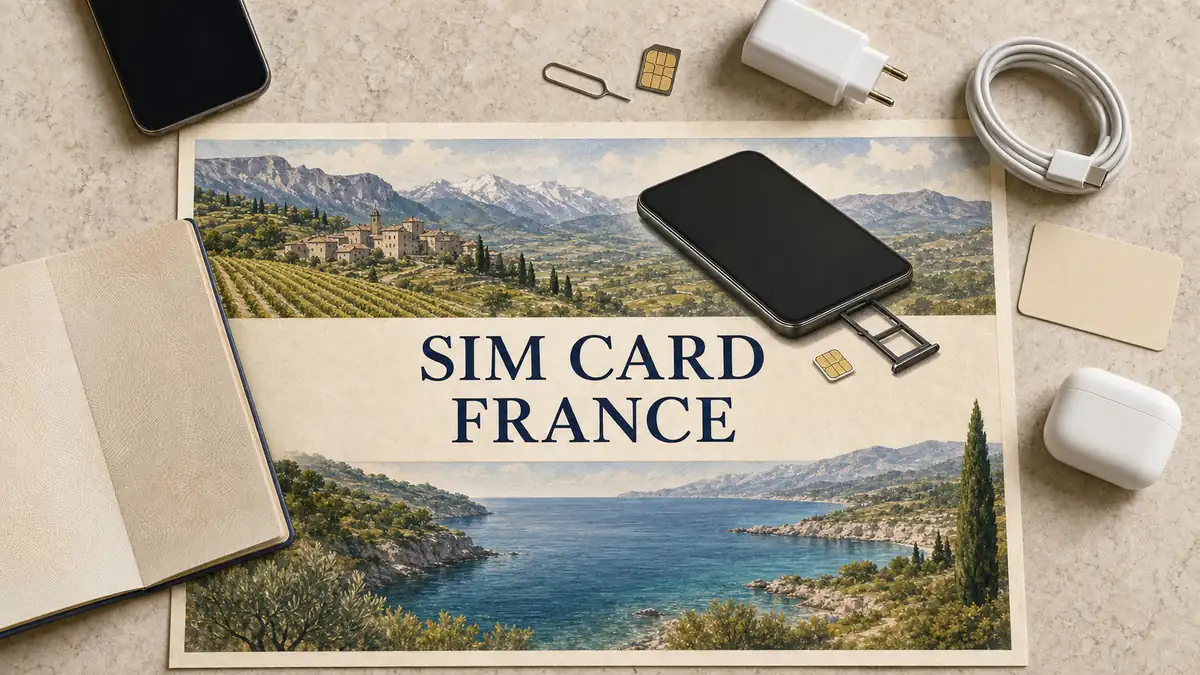
This page owns the third route: the physical SIM. It covers where you can actually buy one, what you need to bring to the counter, how activation works, which offers are open to visitors, and how a French SIM behaves once you travel on through Europe. It also gives you the honest answer about when a physical SIM is the wrong choice — because for a lot of short-trip travelers, it is. Written for visitors, not for people moving to France.
Quick Answer
Visitors can buy a prepaid French SIM card easily, with a passport, at retail counters and operator stores. The real fork is your handset and your stay length: eSIM-capable phones on short trips rarely need a physical card. Choose physical for longer stays, a French phone number, or a handset that cannot take an eSIM.
Trust Layer
Tripstou planning guide for travelers resolving one travel decision. Covers the main variable, traveler context, and practical tradeoffs.
Produced with AI assistance and reviewed by Alex Perrut, working in tourism since 2015, for the Tripstou editorial team. See our editorial process for details.
Last factual review: August 19, 2026.
Official sources consulted: France.fr, Atout France.
Key Takeaways
- Most short-trip visitors do not need a French SIM — check what your home plan charges in France first.
- A passport or national identity card is required to register a prepaid SIM; no French address or bank account is needed.
- Choose a physical SIM for long stays, a French phone number, or a handset with no eSIM support; otherwise take the eSIM.
- Operator boutiques often redirect prepaid buyers to Relay or tabac counters, and some prepaid offers are restricted to French residents.
- A French SIM works across the EU at domestic rates, though the EU-usable share of an allowance is usually smaller.
- Confirm your phone is carrier-unlocked weeks before departure — a locked handset is the most common reason a French SIM fails.
Table of Contents
Do You Need a SIM Card in France?
Most short-trip visitors to France do not need a local SIM card. Travelers from other EU countries already roam at domestic rates, and many non-EU plans include a workable travel-data allowance. A French SIM earns its place when your stay runs long, your plan is expensive abroad, or you need a French number.
The three-way decision resolves in an order most travelers skip. Check what your home plan already does in France first, because if roaming is included or cheap, the whole question disappears before you board. If it is not, the choice narrows to two routes: an eSIM bought from your sofa, or a physical card bought from a counter once you land.
A physical SIM is genuinely the right call for a specific set of travelers:
- Stays of several weeks or more, where a local prepaid line makes more sense than repeatedly extending a roaming bundle.
- Anyone who needs a real French number that people can dial — restaurant bookings, a clinic, a rental agency that will only call a local line.
- Handsets with no eSIM support, which still includes plenty of perfectly good phones.
- Dual-SIM users who want the home number live for verification codes while data runs on the French line.
- Travelers who prefer paying cash at a counter with no app, no account, and no card details stored online.
The mistake is comparing SIM prices to each other. Compare them to what your own carrier would bill you for the same fortnight in France — that figure decides the question. The rest of the on-the-ground practicalities, from payment habits to transport etiquette, sit in our France travel tips guide; this page stays on connectivity.
Should You Get a SIM Card or an eSIM for France?
Choose the eSIM if your phone supports one and your trip is short. Choose a physical SIM when your handset has no eSIM support, your stay runs long, or you need a French number. That rule settles the fork for almost everyone; the exceptions are narrow and easy to spot.
The category has tilted toward eSIM for honest reasons. An eSIM is bought and activated before departure, so you arrive already connected — no counter, no queue, no ID check, no shop that happens to be shut on a Sunday morning. If your phone supports it and your needs are ordinary, that convenience is difficult to argue with. Which product to pick is a separate decision, and it lives in our guide to choosing an eSIM for France.
Physical SIMs still win in four situations: an eSIM-incapable handset, a stay long enough that a local prepaid line makes sense, a genuine need for a French number people can call, and a preference for handing over cash at a counter instead of entering card details online. If none of those describe your trip, stop here and take the eSIM route.
Get online the moment you land
An eSIM installs before you fly — no SIM swap, no roaming bill, no queue at an airport kiosk. Two options, depending on how you travel:
Holafly — unlimited-data plans, so nothing counts against a
cap. Best for longer stays, remote work, and heavy map and video use.
Code TRIPSTOU applies automatically: 5% off any travel eSIM,
reusable on every order, or 10% off Holafly Plans.
Get a Holafly eSIM →
Airalo — pay for the data you need, across 200+ destinations,
trusted by 20M+ travelers. Best for short trips and light use.
Use code NEWTOAIRALO15 for 15% off your first order:
Get an Airalo eSIM →
Tripstou may earn a commission if you purchase through these links, at no extra cost to you.
Where to Buy a SIM Card in France
Prepaid SIM cards in France are sold at Relay shops, tabacs, supermarkets and operator boutiques. Some operators also let you order a tourist SIM before departure. Most visitors complete the purchase at a retail or press counter, and that difference matters more than it sounds.
Each channel trades convenience against advice. Airport and station counters are the fastest route to a working phone, but staff sell many things and SIMs are not their specialism; expect a transaction, not a consultation. Operator boutiques in the city centre have trained staff and the widest range, though they are organised around monthly contracts for residents and frequently send prepaid buyers back to a Relay or tabac. Supermarkets and tabacs are everywhere and quick, with no advice attached at all.
Pre-ordering before departure removes the arrival scramble and gives you time to actually read what you are buying. The trade-off is committing to a product before you know how your trip really uses data — which, on a first visit to France, you usually do not.
| Buying channel | What you get | Trade-off |
|---|---|---|
| Airport retail counter | A working phone within minutes of landing | Narrow range, queues, opening hours vary |
| Relay or tabac in town | Widely available, quick over-the-counter sale | Staff cannot advise on which offer fits |
| Supermarket service desk | Easy to fold into a normal shopping stop | Desk hours and stock are inconsistent |
| Operator boutique in the centre | Trained staff, full range, help with activation | Geared to resident contracts; may redirect you |
| Ordering before you fly | Time to read the terms; arrive already sorted | You commit before knowing your real usage |
How much help you get is decided by the channel, not by the product. If you already know which offer you want, a tabac is the fastest route to it. If you have questions, only a boutique can answer them — and it may send you to the tabac afterwards anyway.
Can You Buy a SIM Card at Paris CDG and Other French Airports?
Yes, SIM cards are sold at France’s major airports, through press and convenience retailers and tourist information desks. Full operator boutiques are not part of the airport picture. Availability is terminal- and airport-dependent, so treat an airport purchase as likely, never as guaranteed, when you plan your arrival.
Treat the airport counter as a convenience buy, never as the plan. If the shop in your terminal is closed, out of stock, or queued out the door, walking away costs you almost nothing — a Relay or tabac in town sells the same category of product, and you will pass several between the station and your accommodation. Bring the same photo ID you would need anywhere else; the registration requirement does not relax airside.
Getting into the city is the part actually worth planning: our guide to getting from CDG into Paris covers the train, bus and taxi options and how long each really takes. Landing at another French gateway, the onward-transport guides for Nice airport into the city, Lyon airport transfers, Marseille airport transfers, Bordeaux airport transfers and Strasbourg airport transfers cover the run into town.
What Do You Need to Buy a SIM Card in France?
Official photo identification is required. Registration is tied to an identity document, so you present a passport or a national identity card at the point of sale. Tourists do not need a French address, a French bank account, or any residence document to buy and activate a prepaid SIM.
Everything else is preparation you do before you reach the counter. Run this checklist and the purchase becomes a five-minute errand:
- Confirm your handset is carrier-unlocked — ask your home operator weeks ahead, because unlock requests are not always instant.
- Carry your actual passport or national ID card — photocopies and photos on your phone are routinely refused.
- Decide data-only or a full line — a package with a French number and calls costs more and does more.
- Check onward-Europe use — if France is one stop of several, ask how the offer behaves outside the country.
- Ask how top-ups work — the method varies by product, and you want to know before you run dry.
The item people skip is the number question, and it is the one that cannot be fixed later. A data-only SIM cannot take a confirmation call from a French car-hire desk or a clinic, and you will not discover that until the moment you need it.
France’s Four Mobile Networks — and What the Choice Really Means
Four operators own mobile network infrastructure in France: Orange, SFR, Bouygues Telecom and Free Mobile. Every other brand on the shelf — Lycamobile, Lebara, La Poste Mobile and others — is an MVNO reselling wholesale access on one of those four networks. Your signal comes from the host network, whatever the logo says.
For a visitor, the operator-versus-MVNO distinction matters less than it looks. All four networks cover French cities, motorway corridors and the main tourist regions comfortably, and an MVNO riding on one of them delivers that same coverage. Where the distinction does show up is service: MVNOs are cheaper and thinner on support, while the four network operators keep physical stores you can walk into when something goes wrong.
Orange carries a long-standing reputation for the strongest reach in rural France — mountain valleys, deep countryside, small coastal roads. Treat that as reputation rather than measurement, and check the operator’s own coverage map for the specific area you are heading to. If your trip stays in cities and on main rail lines, the choice barely registers.
Which Prepaid Offers Are Actually Open to Tourists?
Not every prepaid offer in France is available to visitors. Some carry residency conditions, and Free Mobile is the documented case where French resident status forms part of the qualification. Tourist-oriented prepaid packs exist as a separate category and are the ones built for people arriving with a foreign address.
Spotting the gate is straightforward at the counter. Ask one question — can I activate this with a foreign passport and no French address? — and the answer arrives immediately. Anything requiring French bank details, a proof of address, or a signature on a monthly commitment belongs to the resident contract market, which is a different world from what a visitor needs.
Willingness to serve tourists also varies by store. Some operator boutiques will happily sell a visitor a prepaid pack; others handle contracts only and point you to the retail channel. Neither reaction is unusual, and neither is worth arguing about. The Relay and tabac counters exist precisely for this.
How Do You Activate a French Prepaid SIM?
Activation happens in two parts: identity registration and network registration. Staffed channels usually handle both on the spot, so the SIM is working before you leave the shop. Where you register yourself, you insert the card, follow the operator’s activation flow, and wait for the line to attach to the network.
The sequence is the same across operators, even though the exact prompts differ by product:
- Hand over your passport so the SIM is registered to you, and keep any receipt or reference the shop gives you.
- Swap the card in with the phone powered off, then start up and let it search for a network.
- Follow whatever activation step the operator provides — an SMS, a short code, a web page or an app, depending on the offer.
- Check that mobile data is switched on, and that data roaming is enabled if the SIM is sold for use across Europe.
- Load a real webpage before you walk out the door.
- Write your new French number down if the offer includes one; you will need it, and it is not printed anywhere on the phone.
Anything that goes wrong is trivially fixable while you are still standing in the shop and genuinely annoying three streets away. Spend the extra two minutes at the counter.
Will a French SIM Card Work in Other European Countries?
Yes, a French SIM works across the European Union. Roam Like at Home means calls, texts and data come out of your French allowance at domestic rates, not as roaming charges. Crossing from France into Belgium, Spain or Italy changes nothing about how the SIM behaves.
Two qualifications sit underneath the principle. The portion of a French plan usable elsewhere in the EU is commonly smaller than the domestic allowance, so an offer that feels generous for a stay in France can run thin across a multi-country route — read that condition before you buy. And the scheme covers the EU, so check separately how your SIM behaves before travelling on to the United Kingdom or Switzerland.
Ask what the EU allowance is before you pay. A SIM sized for a fortnight in France can empty far faster once the trip starts crossing borders. If France is the anchor of a wider European trip, our France travel guide covers how those routes usually get built.
Most SIM Problems in France Are Avoidable Before You Fly
Nearly every “my SIM does not work” story traces back to something checkable at home. A locked handset, a phone with no SIM tray, or a data-only purchase when a French number was needed — those three account for most failures, and all three are settled before departure.
A locked handset is the most common cause and the easiest to fix. Phones bought on instalment plans are frequently locked to the carrier that sold them, and a locked phone simply refuses to register a French SIM. Ask your carrier to unlock it well before you fly. The night before is too late.
An eSIM-only phone closes the physical route entirely. Recent handsets in some markets ship without a SIM tray at all, which means no shop in France can sell you anything that fits. Check for the tray now; if there is none, the fork earlier on this page is already decided for you.
Buying data-only when you needed a number is the failure that surfaces late. Data-only SIMs are inexpensive and perfectly good for maps and messaging apps, but they cannot receive an SMS code or a call from a French restaurant, clinic or car-hire desk. Settle that question at the counter.
A dual-SIM setup prevents most of what remains. Keep the home SIM active for incoming verification codes from your bank, run data on the French line, and switch home-plan data off so nothing leaks onto an expensive roaming bill. The expensive failure is rarely the SIM itself — it is standing outside a rural gîte at eleven at night while your bank’s verification code lands on a number your phone can no longer receive.
Frequently Asked Questions
How do you top up a French prepaid SIM card?
Top-ups are sold through the operator’s app or website and as vouchers at tabacs, supermarkets and press counters. The method is set by the product you bought, so ask at the point of sale and note it down. Running out of credit abroad is easier to prevent than to fix.
How long does a French tourist SIM card last?
A French tourist SIM lasts as long as its product window or your top-ups, not a fixed standard period. Tourist packs are sold with a set usable window; ordinary prepaid lines stay active while credit or top-ups continue. Ask for the expiry condition at purchase; the pack will not always spell it out.
How do I know if my phone is unlocked for a French SIM card?
Ask your home carrier directly — they hold the answer and can confirm it in one call. The practical test is to borrow a friend’s SIM from a different network before you fly. A locked handset refuses to register the French line, and no shop in France can override that.
Can I get a French phone number with a prepaid tourist SIM?
Yes, provided you buy a voice-and-data offer instead of a data-only product. Data-only SIMs carry no dialable French number, which rules out restaurant callbacks, clinics and car-hire desks. The two categories sit side by side on the same shelf, so say which one you want out loud.
Is there an unlimited data prepaid SIM card in France?
Offers marketed as unlimited come and go on operator timelines, and most carry conditions on speed or fair use. Treat the word as a marketing shape, not a guarantee, and read what the offer actually commits to before you pay. The honest answer for a two-week trip is that the label rarely changes what you need.
What is a tabac, and can you buy a SIM card there?
A tabac is a licensed tobacconist and newsagent, found on most French high streets and in smaller towns too. Alongside stamps, transport tickets and top-up vouchers, tabacs sell prepaid SIM cards over the counter. Knowing the word matters, because directions to buy a SIM in France almost always end with it.
Related Guides
- Choosing an eSIM for France — the other side of the fork, if your phone supports one.
- France travel guide — the trip-planning hub this page supports.
- France travel tips — the wider set of on-the-ground practicalities.
- Paris airport transport — getting from CDG, Orly and Beauvais into the city.
- Nice airport transport — the run from the airport into Nice and the Riviera.
Did this guide save you time or money? Tripstou is independent and reader-funded — if you'd like to give something back, you can support the site with a crypto contribution of any size.