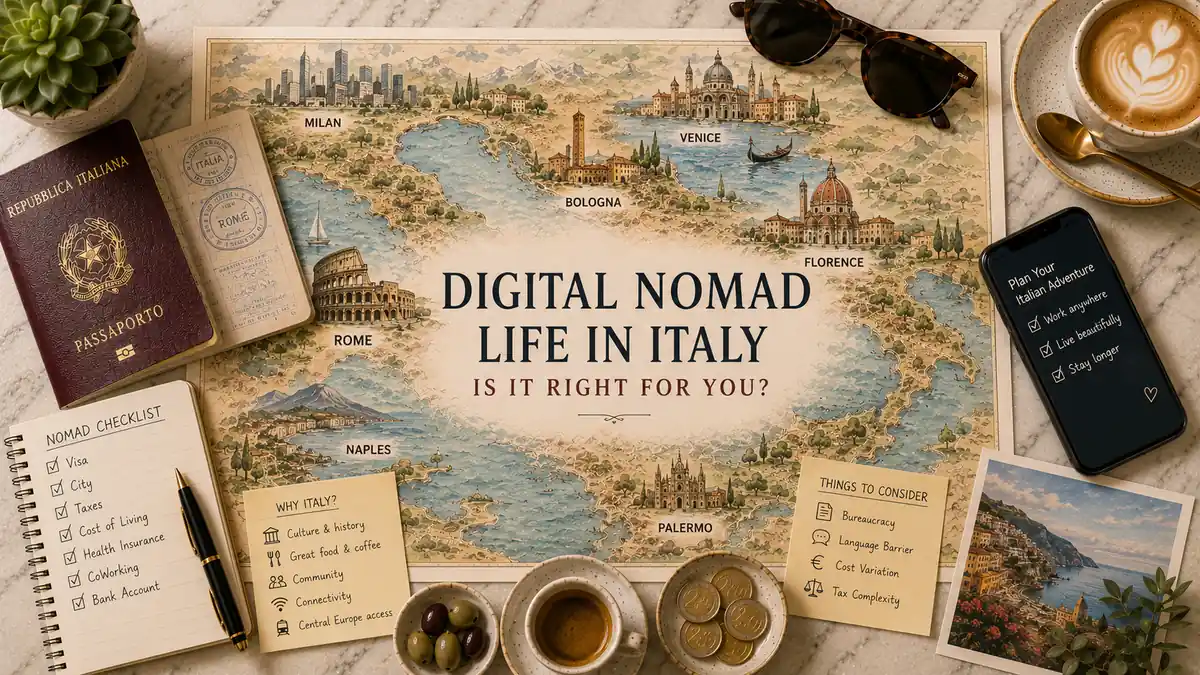
Can you actually base yourself in Italy as a remote worker, and is it the right call for you? This guide answers the feasibility question first: whether Italy is a realistic home for someone earning online, who it fits, and what committing to it genuinely involves. It is not a how-to, a city ranking, or a budget breakdown. Living somewhere is a different decision from visiting it — a two-week trip forgives friction that a six-month stay does not. Four deeper decisions sit underneath this one — the visa, the city, your taxes, and the monthly cost — and each gets resolved on its own dedicated page. Here you get the verdict, the trade-offs, and the order to tackle everything in.
Quick Answer
Italy is a viable base for non-EU remote workers through its dedicated digital nomad visa, with real trade-offs. The answer turns on your tolerance for bureaucracy, language barriers, and tax complexity against the lifestyle payoff. It suits those wanting culture, community, and reliable connectivity who resolve visa, city, tax, and cost decisions before committing.
Trust Layer
Tripstou planning guide for travelers resolving one travel decision. Covers the main variable, traveler context, and practical tradeoffs.
Produced with AI assistance and reviewed by Alex Perrut, working in tourism since 2015, for the Tripstou editorial team. See our editorial process for details.
Last factual review: July 11, 2026.
Official sources consulted: italia.it, enit.it.
Key Takeaways
- Italy works as a nomad base if you set up the dedicated visa and accept a bureaucracy-heavy, front-loaded setup.
- Choose Italy for culture, community, and European transport; skip it if low cost and effortless admin top your priorities.
- Base a long stay on the digital nomad visa, not repeated tourist entries, which are meant only for short visits.
- English covers remote work and city life, but government offices, leases, and smaller towns still run largely in Italian.
- Resolve four decisions in order — visa, then city, then taxes, then cost — because each one shapes the next.
Table of Contents
Can you actually live in Italy as a digital nomad?
Yes — Italy is a realistic base for remote workers who set up the right visa and accept the trade-offs. The country runs a dedicated digital nomad visa for non-EU freelancers and remote employees, fast internet across its cities, and an established expat network. Living there works. It simply asks more paperwork than a beach-hop through Southeast Asia.
Feasibility here is less about whether the infrastructure exists and more about whether you will tolerate the setup. Reliable co-working, mobile coverage, and rental supply are all in place in the major hubs. What trips people up is the administrative layer around them — residency permits, tax registration, and the pace of Italian officialdom. If you are only just visiting Italy for a few weeks, none of that applies; if you are moving your life, it becomes the real project.
The commitment is front-loaded, and that is the honest catch. Unlike visa-free hopping through cheaper nomad circuits, Italy makes you pay the setup cost in paperwork up front — but a legal base inside the EU buys a stability that short-stay hopping never delivers. Nomads who plan to stay six months or longer usually find the exchange worth it. Weekenders and one-month drifters rarely do.
Who is Italy right for as a digital nomad, and who should skip it?
Italy suits nomads who value culture, community, and a slower pace over speed and low-friction admin. It rewards people settling in for months, not those optimising for the cheapest, most frictionless remote-work setup. If you want deep place over easy logistics, Italy fits. If you want the opposite, it will frustrate you.
The people who thrive here treat Italian inefficiency as texture, not a bug to be fixed. They enjoy long lunches, regional food, walkable historic centres, and the fact that the rest of Europe is a cheap train or flight away. They are also patient with queues, closures, and forms.
Italy is a poor match for a specific profile. Consider skipping it if you:
- Need same-day, digital-first admin and lose patience in bureaucratic queues
- Are chasing the lowest possible cost of living above everything else
- Refuse to learn any local language for daily errands
- Want a plug-and-play nomad hub with zero residency paperwork
The clearest dividing line is temperament. Nomads who need everything resolved instantly burn out at the counter of the local questura, while those who accept the rhythm settle in fast and stay for years.
What are the real pros and cons of nomad life in Italy?
The payoff is lifestyle, transport, and community; the friction is bureaucracy, language, and tax complexity. Italy gives you a rich daily life and easy reach across Europe, then charges for it in admin overhead. Both sides are real, and neither cancels the other — you weigh them against how you actually work.
The upside is concentrated and hard to fake elsewhere:
- Lifestyle: food, historic cities, coastline, and a culture built around eating and gathering well
- Transport: fast domestic trains and cheap flights that put the rest of Europe within reach
- Community: established expat and nomad scenes in the larger cities and co-working hubs
The friction is equally concrete:
- Bureaucracy: residency permits and registrations move slowly and reward persistence
- Language: daily admin and smaller towns lean heavily on Italian
- Tax complexity: becoming resident can pull your income into the Italian system
Connectivity deserves a specific note, because it is where nomads get caught out. Italy’s coverage gap is regional, not national — major cities and the north run fast fibre, while rural southern villages and small islands can still stall a video call. Sort a local Italy SIM card and check ground-truth speeds before you sign a lease anywhere remote. In the cities, staying connected is a non-issue.
Can you work remotely in Italy on a tourist visa?
Short stays fall under standard Schengen limits; a longer nomad base needs the dedicated visa, not tourist entry. A tourist entry is designed for visiting, and basing your working life on it is the wrong tool. For anything beyond a brief visit, the correct route is the purpose-built nomad permit.
The practical read is simple: a genuine visit is fine on tourist terms, but planning your ongoing remote work around repeated tourist stays is not a stable footing. The exact eligibility, duration, and rules live on the canonical pages, not here. Start with the Italy digital nomad visa for the nomad-specific route, and check the general Italy entry requirements for how standard Schengen entry works. Confirm the current details there before you commit to any timeline.
Do you need to speak Italian to work remotely there?
English works for remote work and big-city life, but everyday admin and smaller towns reward some Italian. Your job stays in English; your errands do not always. You can live functionally without fluency, yet a working grasp of the basics removes real daily friction.
In Milan, Rome, Florence, and the main co-working scenes, English carries you through work, socialising, and most services. The gap shows up elsewhere. Government offices, leases, utility contracts, and life in smaller towns frequently run in Italian only, and that is exactly where a stay gets stressful without it.
You do not need fluency to make Italy work. Aim for enough Italian to handle appointments, forms, and shops, and lean on a bilingual helper or accountant for the heavy paperwork. Nomads who arrive with zero language and never build any tend to feel stuck at the edges of daily life.
The four decisions you must sort out before moving
Four decisions gate a move — visa, city, taxes, and cost — best resolved in that order. Each one narrows the next, so sequence matters as much as the answers. Settle them before you book anything, because getting the order wrong forces expensive rework later.
Resolve the visa first, because eligibility can quietly rule out plans you were counting on — and it decides whether the move is even possible. Then pick the city, which sets your community, connectivity, and rent baseline. Taxes follow, since residency is what pulls your income into the Italian system. Cost comes last, because it is the sum of the three decisions above it, not an independent choice. Work through them in this order:
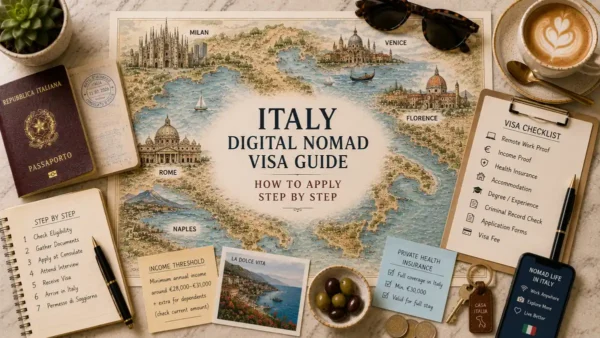
- Visa: confirm your route and eligibility first — see the digital nomad visa guide.
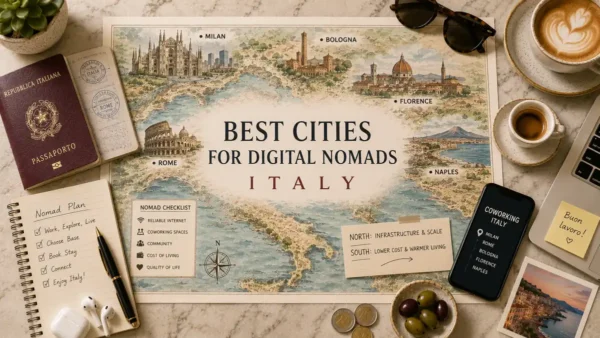
- City: match location to your budget and work style — compare the best cities in Italy for digital nomads.
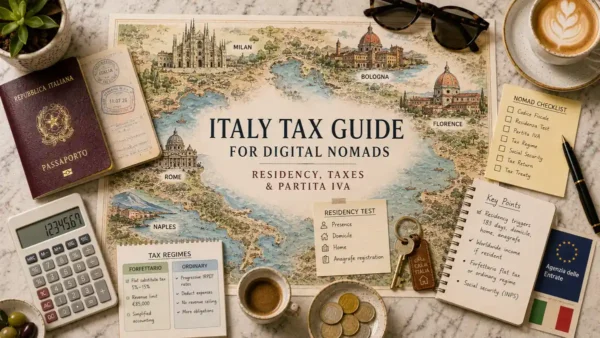
- Taxes: understand what residency triggers — read how digital nomads are taxed in Italy.
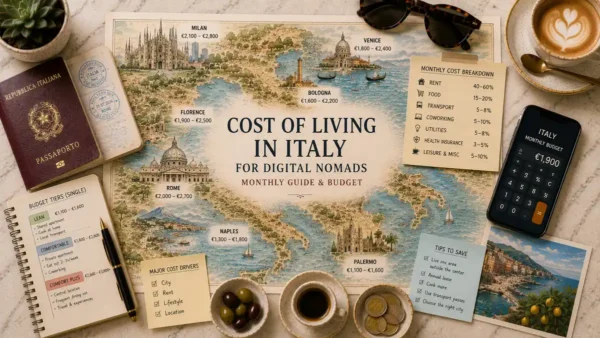
- Cost: build the real monthly number last — check the cost of living for nomads in Italy.
Frequently Asked Questions
How much do you need to live in Italy as a digital nomad?
Costs vary widely by city and lifestyle, so no single figure fits everyone. A northern hub like Milan runs far higher than a southern town, and your rent, dining, and travel habits move the number most. Build a realistic monthly budget on our cost of living guide before committing.
Is Italy safe and reliable for remote work?
Yes, Italy is reliable for remote work in its cities, with widespread fibre, mobile coverage, and established co-working spaces. The weak spots are rural southern areas and small islands, where speeds can stall a call. For dependable infrastructure, base yourself in or near a major hub.
How long can a digital nomad stay in Italy?
Short visits follow standard Schengen limits, while the digital nomad visa allows a longer, renewable stay. The exact day counts and renewal terms shift over time, so check the visa guide as the canonical source. For any stay beyond a brief trip, the dedicated visa is the stable route.
Is Italy a realistic long-term base, or better for a few months?
Italy works as both, but it rewards longer commitments more than short stints. The front-loaded visa and residency setup only pays off across many months or years, while a few weeks rarely justifies the paperwork. Nomads who settle in for a season or longer get the most from it.
Will you feel isolated as a digital nomad in Italy?
Not in the major cities, where established expat and nomad communities, co-working spaces, and events make connecting easy. Isolation is a real risk in small towns or rural areas, where social circles run in Italian and turn over slowly. Base yourself in a hub if community matters to you.
Do you pay Italian tax if you work remotely from Italy?
Possibly — becoming a tax resident can pull your remote income into the Italian system, even if your clients are abroad. The rules, regimes, and thresholds are specific and change, so treat this as a flag, not a calculation. Confirm your position on the taxes guide before you commit.
Related Guides
- Italy digital nomad visa — the route, eligibility, and application path for basing yourself legally.
- Best cities in Italy for digital nomads — where to base for community, connectivity, and value.
- How digital nomads are taxed in Italy — what residency means for your income.
- Cost of living for nomads in Italy — building a realistic monthly budget.
- Italy travel guide — the wider country context for planning your move.
- Italy SIM card — staying connected from day one.
Did this guide save you time or money? Tripstou is independent and reader-funded — if you'd like to give something back, you can support the site with a crypto contribution of any size.