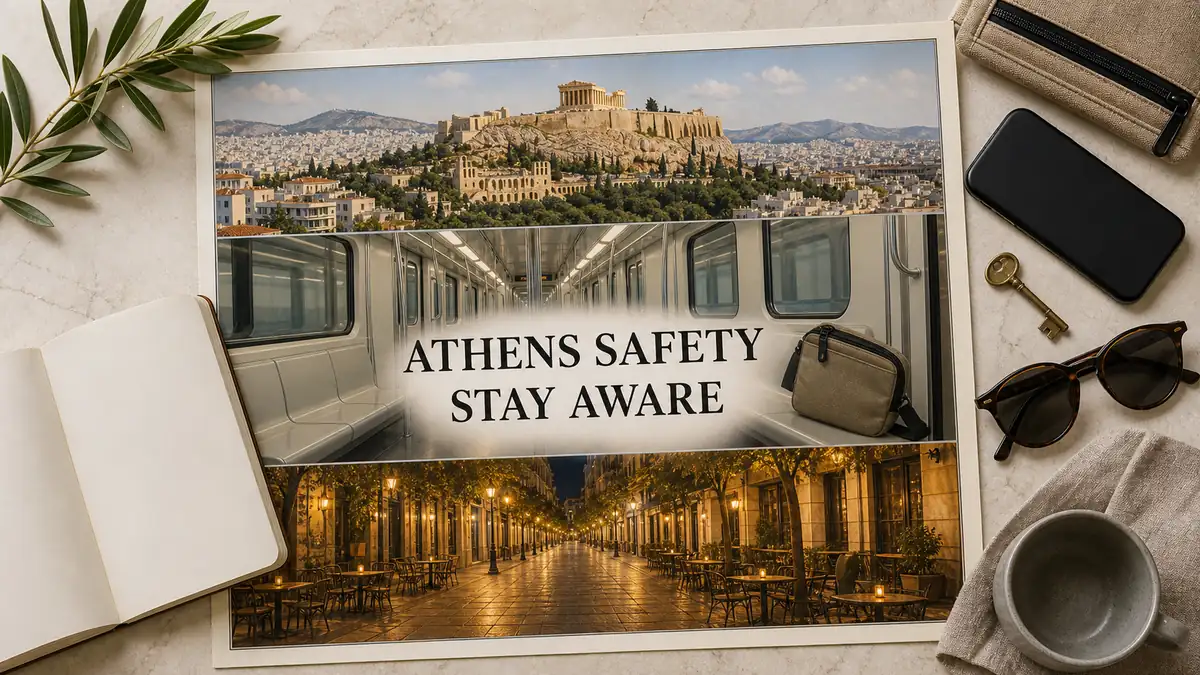
The worry behind “is Athens safe” is almost never about violence. It is about a crowded metro carriage with your bag behind you, a stranger being unusually friendly outside a bar, or a street that empties at eleven and looks nothing like it did at noon. Those are the right things to think about, and each of them has a concrete answer.
Athens is a large European capital, and its realistic risk is theft. What moves that risk up or down is the situation — crowd density, alcohol, an empty street late, a demonstration day — much more than the name on the street sign. Where this guide names a neighbourhood, it names the source that named it first, because on that question the official record is narrow and specific.
Quick Answer
Athens is a safe city for visitors, and the realistic risk is petty theft, not violence. Pickpocketing concentrates on the metro and in crowded tourist places, particularly around the main sights. Keep valuables zipped and in front of you in crowds and on the metro, and use licensed taxi apps at night.
Trust Layer
Tripstou safety guide for travelers deciding how safe a destination is and what precautions actually matter. Covers real risk levels, common scams, situational awareness, and protection choices.
Produced with AI assistance and reviewed by Alex Perrut, working in tourism since 2015, for the Tripstou editorial team. See our editorial process for details.
Last factual review: August 30, 2026.
Official sources consulted: Visit Greece, Greek Ministry of Tourism.
Key Takeaways
- The honest verdict is calibrated, not reassuring: theft is the risk worth planning around, and violence against visitors is rare.
- The UK FCDO reports passport, wallet and handbag thefts as common on the metro and in crowded central tourist places.
- No official source calls any part of Athens dangerous; the city’s own tourism board describes street scene, not risk to visitors.
- The scams all begin the same way, with a stranger picking the bar, the taxi or the spot where you stop.
- Three habits cover most of it: bag zipped and in front, phone pocketed before the platform, licensed cab when streets empty.
- Travel insurance is worth buying for an Athens city break, where a stolen phone or passport is the claim you would realistically make.
Table of Contents
Is Athens Safe for Tourists?
Athens is safe for tourists, with petty theft as the dominant realistic risk and violent crime against visitors rare. The city asks for the same crowd awareness as any large European capital: bags closed in queues, phones off café tables, attention on where your hands and pockets are in a crush.
Three different things get called unsafe in Athens, and they behave differently. Danger means a real threat to your person, and for visitors that is genuinely uncommon. Discomfort means a street scene you would prefer not to walk through — visible drug use, a square that feels frayed after dark — which is unpleasant without being a threat to you. Inherited reputation is the third: descriptions written during a hard economic decade and copied forward ever since, long after the streets they describe moved on.
Risk in Athens concentrates in four situations, and the rest of this page follows them: crowded central sights and the metro, nightlife streets late, the airport route with luggage, and demonstration days around the central squares. Outside those four, very little costs visitors anything. If you are still assembling the trip itself, the broad orientation to the city sits one level up, and the Greece-wide safety picture covers the national layer this page leaves alone.
Traffic deserves one sentence. Cars and scooters roll through pedestrian phases often enough that you look before stepping off a kerb, which makes it a mind-your-step nuisance and not a headline risk. The crossing habits themselves, and the rest of the daily-behaviour layer, live in Athens travel tips.
Theft in Athens follows attention, not addresses. It happens where people are looking up at something — the Acropolis approach, a packed carriage, a viewpoint queue — which is why the busiest and most visited places are also where wallets go.
How Safety Varies by Area in Athens
Risk in Athens varies more by situation and time of day than by neighbourhood. The only official area guidance comes from the city’s own tourism board, and it describes a street scene, not danger. No government or municipal source calls any part of Athens unsafe for visitors, and that absence is itself information.
The City of Athens tourism board is the only official body that names neighbourhoods at all, and what it names them for is visible open drug use: Omonia and Exarcheia squares, the Keramikos–Metaxourgeio area, Pedion tou Areos park, and the area around the Athens Law School. That is a description of what you may see, not a warning about what may happen to you. The same source advises keeping clear of Exarcheia and Syntagma squares on days when strikes or demonstrations are planned, because of tear gas.
The UK Foreign, Commonwealth & Development Office names no Athens neighbourhood. Its Athens guidance is about theft — passports, wallets and handbags taken on the metro and in crowded tourist places, particularly in central Athens — and about demonstrations concentrating on major central squares, in particular Syntagma. Two official sources: one names five specific spots for one specific street-scene reason, the other names none.
What that leaves is a comfort question, and comfort is real. The streets north and west of Omonia change character after dark, with fewer shops open, less foot traffic and more visible street life. Many residents and visitors walk them without incident, and many visitors would prefer not to. Comfort is a legitimate reason to choose a different route home. It is not the same claim as danger, and the two get printed as though they were one.
If area comfort is really a booking question — which street you want to walk back to at midnight — that decision sits upstream of this page, and choosing where to base yourself in Athens resolves it with the trade-offs laid out properly.
The gap worth noticing is the one between the two official sources: the city names five places and gives one reason for all of them, and the FCDO names none. Anything printed beyond that is somebody’s impression, which is useful as an impression and useless as a rule.
Is Omonia Safe?
Omonia is safe for visitors in the ordinary sense — violence directed at tourists there is rare — and uncomfortable in a specific, documented one. The City of Athens tourism board names Omonia Square among the places where open drug use is visible, and that is what most visitors are reacting to when they describe the area badly. In daily life it is a busy transport interchange with hotels, a metro hub and constant foot traffic through the working day. The honest sentence is about how it feels rather than what it does to you: the square and the streets running north of it get quieter and rougher-edged at night, and some visitors will want a taxi for that stretch. That is a preference, and it is a reasonable one.
Is Exarcheia Safe?
Exarcheia in daylight is an ordinary lived-in neighbourhood with one of the strongest bar, café and street-art scenes in Athens. It is residential, full of students and bookshops, and walked constantly by the people who live there. The City of Athens tourism board names Exarcheia Square — the square, not the district — among the places where open drug use is visible, and separately advises keeping clear of it on days when strikes or demonstrations are planned. That second point is the substance of the area’s official record: it is guidance about specific days. The reputation Exarcheia carries in search results is largely political history being read as a risk assessment. Visitors go there for the bars and the murals, and a night out there is a night out.
Is the Athens Metro Safe?
The Athens metro is safe to ride, and the real risk on it is pickpocketing. The FCDO reports that thefts of passports, wallets and handbags are common on the metro and in crowded tourist places, particularly in central Athens. Personal safety on the network is not the concern; your pockets are.
It happens where the crush is: crowded central stations, the platforms serving the main sights, and the airport route, where everyone is visibly a visitor and half of them are managing luggage with both hands. Density matters more than which line you are on, and density peaks at rush hour and at closing time for the big sights.
The method is dull and effective. A group forms at the doors as they close, someone blocks the flow, the crush becomes momentarily legitimate, and a bag on a hip or a phone in a back pocket changes hands. Distraction versions run the same way — a dropped object, a question, an unfolded map — with a second pair of hands doing the actual work. Nobody reaches into a bag you are visibly holding.
- Wear your bag across your body and in front of you, with the zip against your chest instead of out toward the carriage.
- Move your phone and wallet to a front or inside pocket before you reach the platform, not while you are standing in the crowd.
- Leave your passport at the accommodation and carry a photo or copy for the day.
- Step onto the carriage and then move away from the doors. The doorway is where it happens.
- If someone crowds you as the doors close, put a flat hand on your bag. That alone ends most attempts.
Tickets, validation, which line goes where and which taxi apps are worth installing are network questions, and getting around Athens covers them properly.
The airport line deserves extra attention for a reason unrelated to crime patterns: it is the only ride where you are tired, holding luggage, and carrying every document you brought, all at the same time.
Common Scams in Athens
Athens has a small, recognisable set of scams, and all of them stop working the moment you know the pattern. The flagship is the friendly-stranger bar lure in the tourist streets below the Acropolis. The rest are taxi overcharging, street distraction routines, and metro pickpocketing. None require confrontation to escape.
- The friendly-stranger bar lure. Where: pedestrianised tourist streets in the historic centre and around the main squares, usually in the evening. How to recognise it: a well-dressed, fluent English speaker opens a conversation — he is a fellow traveler, or he has a cousin in your country — and after a few minutes suggests a bar he knows nearby. The bar is quiet, hostesses appear and order drinks, and the bill at the end is enormous and presented as non-negotiable. What to do: never let a stranger choose the venue. If you want the drink, name the bar yourself and walk there. Leaving before anything is ordered costs nothing.
- Taxi overcharging. Where: ranks at the airport and the port, and outside major sights — anywhere a driver can tell you have just arrived. How to recognise it: the meter is not running, or a price appears mid-journey, or a second passenger is collected on the way. On the airport run a regulated flat fare into the centre exists, so a driver improvising a number is the tell. What to do: confirm the meter or agree the fare before the car moves, and ask for the regulated flat rate by name on the airport run. The FCDO advises using pre-arranged transport or a licensed-cab hailing app such as Uber or Free Now, both of which price the trip before you get in.
- Distraction and street routines. Where: crowded squares, sight entrances, metro exits. How to recognise it: something breaks your rhythm — a petition on a clipboard, a bracelet tied to your wrist, a spilled drink, an offered flower, a request to take a photo. The interruption is the whole point; a second person is the reason for it. What to do: keep walking, keep a hand on your bag, and accept nothing placed into your hands. There is no penalty for not stopping.
- Metro pickpocketing. Where: the crush at carriage doors in crowded central stations and on the airport route. How to recognise it: covered in full in the metro section above. What to do: the same bag habits, applied before you reach the platform.
Every Athens scam that costs real money begins with somebody else choosing the location — the bar, the taxi, the spot on the pavement where you stop walking. Keeping that one decision yours removes most of the ladder.
Is Athens Safe at Night?
Athens is safe at night in the centre and on busy nightlife streets, where people are out until very late. Darkness itself changes little. Emptiness and alcohol change a lot: a quiet street at 3am and a heavy night out are the two variables that actually move risk.
Athens nightlife runs late and it runs in company, which is most of the safety story. Bars fill after eleven and the nightlife streets stay populated until the metro reopens. What trouble there is concentrates at the thin edges of that — walking home alone at four, or leaving a bar considerably drunker than you arrived.
The FCDO warns about drink spiking around clubs and bars, which converts into two habits: watch your drink being poured, and decline one offered by a stranger who has been working the room. The same source advises using pre-arranged transport or a licensed-cab hailing app, and Uber and Free Now both operate in Athens. That habit closes more night-time exposure than anything else on this page.
- Take the populated route home even when it is longer.
- Order a licensed cab through an app when the street empties out or the group splits up.
- Keep your phone charged. The app is the plan.
- Watch your drink poured, and cover it or finish it before you move.
The after-dark comfort shift on the northern edge of the centre is the same question handled in the area section above: a comfort call, not a danger call, and a taxi resolves it.
The riskiest moment of an Athens night is a transition, not a place — the point where the group splits and one person walks. Deciding how everyone gets home before the first drink is worth more than any route advice.
Is Athens Safe for Solo Female Travelers?
Athens is safe for solo female travelers, and the risks are the same risks. Petty theft in crowds, drink spiking around bars, and discomfort on empty streets late apply the same way. What changes when you are solo is that nobody else is watching the bag or sharing the taxi home.
The one official anchor here is the FCDO’s drink-spiking warning around clubs and bars, and it is not addressed to women specifically. It is guidance for everyone, and it is worth following for the same reason.
Street harassment exists in Athens as it does in most large cities, and it is usually verbal — comments, persistence, being talked at in tourist areas by someone trying to sell something. It is wearing, and it rarely becomes more than that. Not engaging and continuing to walk ends most of it.
The practical differences of travelling alone are logistical, not gendered: one pair of eyes on your bag on the metro, nobody to hold a table, and the taxi decision falling entirely to you. Solo travelers of any gender benefit from the same three habits — bag in front in crowds, an app-hailed cab when a street empties, and someone knowing roughly where you are at night.
There is no advice here that would not be given to a male traveler. No clothing requirement applies to walking around Athens, no official source names an hour after which women should be indoors, and no official source names a district women are told to stay out of.
The city’s late schedule is an advantage that a lot of safety advice quietly inverts. Streets that would be deserted at eleven elsewhere are still busy in Athens, so the instinct to get home early can put you on the pavement at its emptiest instead of its busiest.
Do Athens Protests and Strikes Affect Tourists?
Athens protests rarely affect visitors, and when they do it is predictable. Demonstrations are announced in advance, localised around central squares, and normally over within a few hours. The real hazard is tear gas drifting off the square, not the crowd itself, which makes a demonstration something you route around.
The FCDO describes the pattern as demonstrations concentrating around major central squares, in particular Syntagma. The City of Athens tourism board adds the practical version: keep clear of Exarcheia and Syntagma squares on days when strikes or demonstrations are planned, because of tear gas. Both are guidance about specific days.
Strike days are the more common disruption. A general strike can pause metro lines, buses, ferries or museum staffing for part of a day, and it is normally announced ahead of time. The response is a reshuffle, not a cancellation — swap the museum-heavy day for the walking day, or move a ferry.
If a strike lands mid-trip, a fixed route is the easiest thing to re-cut. The two-day Athens route and the fuller three-day Athens plan both sequence the sights so that a swapped day still works.
If you do walk into one, leave the square, move uphill and upwind, and do not stop to photograph the police line. Tear gas is unpleasant and short-lived. The mistake is standing still in it.
Strike days cost visitors far more than demonstrations do, and they cost it in lost transport, not in risk. Checking whether one has been announced is a transport question wearing safety clothes.
Do You Need Travel Insurance for Athens?
Yes, travel insurance is worth buying for an Athens city break. The realistic claims on a trip like this are a stolen phone, a stolen wallet or passport, and a cancelled flight, not a hospital bill. Medical cover is the part you hope never to use, and the part that justifies the price.
The shape of the trip decides this more than the destination does. A city break puts you in exactly the conditions where theft happens — crowded metro, packed sight entrances, café tables with a phone on them — carrying a handset that costs several hundred euros to replace and documents that cost a day of your holiday to replace. That is the claim most Athens visitors would actually make.
It helps to size the loss against the trip. A stolen phone plus an emergency travel document can wipe out a meaningful share of the whole budget, and what an Athens trip actually costs puts that in proportion. For most travelers the premium lands somewhere under a single day’s spending.
Medical is the tail risk rather than the likely one. European travelers arriving with public health cover from home have a baseline for state treatment, and that baseline does not stretch to repatriation, private clinics, or the cost of rebooking a flight you were too ill to take. Travelers from outside Europe have no baseline at all.
It is less critical on a short trip with cheap kit, flexible flights, and a credit card that already includes travel cover. Check the card first. A surprising number of travelers buy the same protection twice.
For the standard Athens trip — a few nights, non-refundable flights, a phone in your pocket, days spent in the exact crowds where theft concentrates — cover is worth it, and the cheapest policy that includes medical, theft and cancellation does the job. Buy it on the day you book the flights, because cancellation cover only protects what has not happened yet.
Travel medical insurance
SafetyWing Nomad Insurance provides travel medical coverage designed for travelers and digital nomads, with flexible Monthly and Annual plans.
Check Nomad Insurance coverage and current pricing →
New Nomad Insurance Essential members can get 8 weeks of electronic theft coverage free with reward code TRIPSTOU8.
Apply the reward before creating your SafetyWing account by looking for the pink camera icon on the Nomad Insurance page.
Tripstou may earn a commission if you purchase through this link, at no extra cost to you.
Emergency Numbers in Athens
112 works everywhere in Greece, from any phone, and it reaches police, ambulance and fire alike. The numbers below cover the direct lines, including the tourist police — the service to call when the problem is a theft, a scam, or a report you need for an insurance claim.
- 112 — European emergency number, works across Greece
- 100 — police
- 1571 — tourist police
- 166 — ambulance
- 199 — fire brigade
- 14944 — hospitals and pharmacies on duty
Frequently Asked Questions
Is Athens safe compared to other European cities?
Athens sits in the normal range for a large European capital. The dominant risk is petty theft in crowds and on public transport, not violence against visitors, which is the same profile most big European cities carry. Comparative crime rankings circulating online come from sources that name no authority.
Is Athens safe for LGBTQ travelers?
Athens is broadly comfortable for LGBTQ visitors, and no official source consulted for this guide flags a specific risk. As in any large capital, attitudes are more relaxed in the central nightlife districts than on the outskirts. The situational advice does not change: busy streets, licensed cabs late, drinks watched.
Are stray dogs in Athens a problem?
Stray dogs are visible in Athens, and they are rarely a problem for visitors. Most are settled, well fed by the neighbourhood, and completely uninterested in people walking past. Do not feed or touch them, and give any dog that is sleeping or eating a wide berth.
What should you do if your phone or wallet is stolen in Athens?
Report it, because an insurance claim needs a police report. Call the tourist police on 1571, or 112 in an emergency, and file the report before you leave Greece. Cancel cards immediately, and contact your embassy if a passport went with the bag. Keep a copy of the report.
How do you know if a strike is planned during your Athens trip?
Strikes in Greece are announced in advance, through local news and the transport operators’ own notices. The practical channel for most visitors is hotel reception, which tracks them for guests. If one lands on your day, swap the plan around it: a strike costs you transport and museum hours, not safety.
Is Athens safe to visit in the summer heat?
Yes, with the day restructured around it. Midsummer heat in Athens is a health issue before it is anything else, and the exposed sites — the Acropolis above all — offer almost no shade. Go at opening or late afternoon, carry water, and treat the middle of the day as indoor time.
Related Guides
- Athens city guide — orientation, neighbourhoods and how the city fits together
- Where to stay in Athens — the base decision, with the trade-offs of each area
- Getting around Athens — metro, buses, tickets and taxi apps
- Athens travel tips — cash, tipping, dress and daily habits
- Is Greece safe? — the national safety picture behind this city page
- What a trip to Athens costs — daily spend and where the money goes
Did this guide save you time or money? Tripstou is independent and reader-funded — if you'd like to give something back, you can support the site with a crypto contribution of any size.