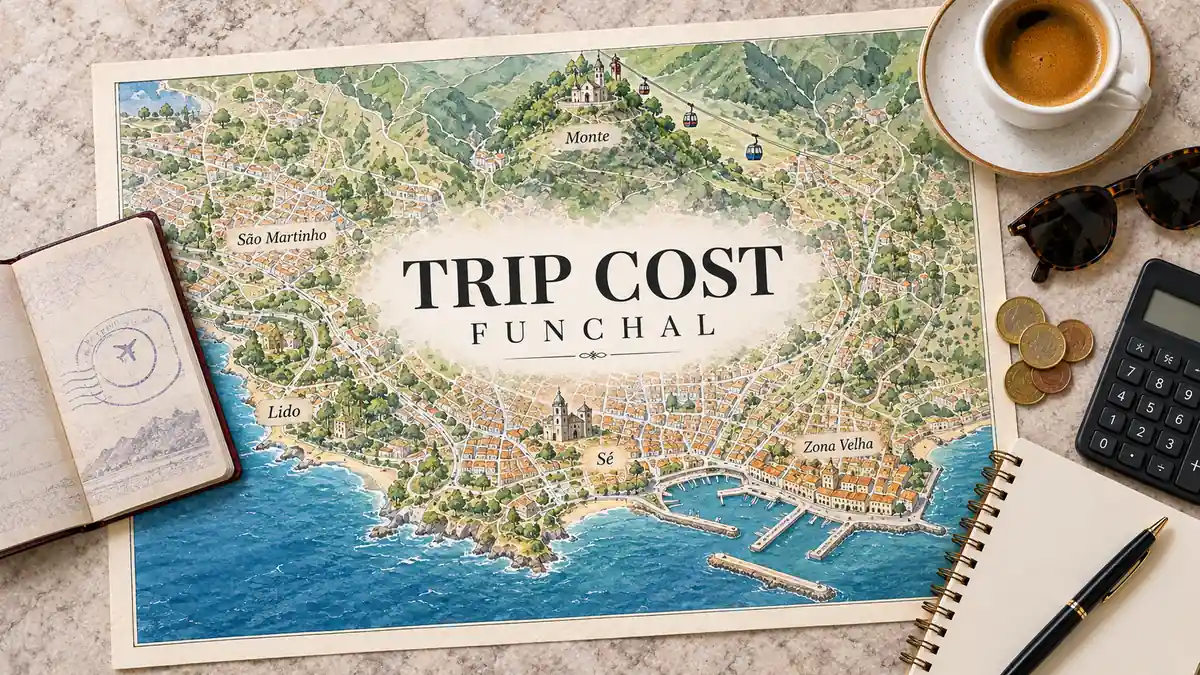
The real question about Funchal is not what a day costs. It is which choices move your total, and whether you can shape the trip around them. Funchal sits above mainland Portugal on price and below the expensive end of European island travel. That position is stable, and it is set less by hotels or restaurants than by how you get around the island once you have arrived. The city itself is walkable. The rest of Madeira is not, and the decision you make about that gap shapes the budget more than the hotel does. This guide names the four decisions that set a Funchal total, describes a lean, a comfortable and an indulgent trip by what each one gets you, splits what is genuinely cheap here from what is reliably expensive, and prints what the two marquee paid experiences charge.
Quick Answer
Funchal is moderately priced: dearer than mainland Portugal, cheaper than most European island destinations. How you move around the island decides the total more than accommodation or food does. Basing yourself in the walkable centre and choosing your paid experiences deliberately keeps a Funchal trip modest without shrinking it.
Trust Layer
Tripstou planning guide for travelers resolving one travel decision. Covers the main variable, traveler context, and practical tradeoffs.
Produced with AI assistance and reviewed by Alex Perrut, working in tourism since 2015, for the Tripstou editorial team. See our editorial process for details.
Last factual review: September 9, 2026.
Official sources consulted: Visit Portugal, Turismo de Portugal, Madeira Cable Car, Carreiros do Monte.
Key Takeaways
- Funchal costs more than mainland Portugal and less than the established expensive European islands, and that position holds year-round.
- How you move around the island is the biggest lever: the city is walkable, and the rest of Madeira is not.
- A lean Funchal trip gives up island range and restaurant dinners, but it gives up none of the city itself.
- The walking, the viewpoints and the market cost nothing; unplanned island transport, tours and waterfront tables are where money goes.
- The cable car and the Monte toboggan are the two experiences worth pricing first, and both publish their own fares.
- Low-demand winter weeks outside the festive period are the cheapest time to be here; the celebration weeks are the priciest.
Table of Contents
Is Funchal Expensive?
Funchal costs more than mainland Portugal and less than the established expensive European islands. It is an island, so much of what you consume arrives by sea or air. It is also a working city with a resident population, which keeps everyday prices closer to the mainland than the location suggests.
The island premium lands on the things that had to be shipped or driven: supermarket goods, fuel, hire cars, the supply chain behind a restaurant menu. It does not land on the parts of Funchal most visitors remember afterwards. Walking the old town, climbing to a viewpoint, following the seafront promenade, browsing Mercado dos Lavradores — none of that carries a surcharge, because none of it was imported.
Set against the European islands travelers usually weigh it against — the Balearics in season, Santorini, the busier Canaries resorts — Funchal reads as the calmer option on price. There is no short summer window here that resets every rate at once, and demand spreads across the year instead of concentrating into ten weeks. The country-level figures and the national per-day framing belong to a different page: see what a Portugal trip costs.
The island premium in Funchal is a transport premium wearing other clothes. Almost everything that feels expensive here is expensive because it moved.
What Sets the Cost of a Funchal Trip
Four decisions set a Funchal budget, and a daily average hides all four. How you move around the island, how often you eat out, how many paid experiences you book, and when you come. Where you base yourself adjusts all of them. The same day in Funchal costs wildly different amounts depending on those answers.
Ranked by how far each one moves the total:
- Island mobility. Whether you leave Funchal, and how, moves the total further than anything else you decide.
- Paid experiences. Each is small on its own; booked one at a time, they accumulate faster than any other line.
- Eating-out frequency. The variable is how many of your meals are restaurant meals, not what any single menu asks.
- Season. Demand sets the rate in Funchal, and demand here is event-shaped.
- Your base. A base you can walk out of removes daily transport from the trip before you spend anything.
A daily rate is the wrong unit for Funchal, because the largest variable is lumpy. A hire car, an organised tour, a cable-car-and-toboggan morning — these land on specific days and skip the rest entirely. Average them out and you get a number that describes no day you will actually have.
That last driver is why the area you pick matters: a walkable base quietly deletes a line item every morning. Which area suits you is its own decision — start with where to stay in Funchal.
Getting Around the Island Is the Biggest Budget Decision
You do not need a car in Funchal; you need one only if you plan to leave it. Walking covers the centre, the old town and the seafront. Everything beyond the city needs a bus, a hire car or an organised tour, and which of those you choose moves the total more than any other booking you make.
| Option | What it gives you | What it costs you in effort | Relative cost |
|---|---|---|---|
| Walking the city centre | The old town, seafront and viewpoints on foot | Steep streets and a lot of your own legs | Lowest of the four, by a wide margin |
| Public buses out of town | Coastal towns and some trailheads without driving | Timetables, connections and long half-days | Low, and the cheapest way to leave the city |
| A hire car for part of the stay | The whole island, on your own schedule | Mountain roads, tunnels and parking in Funchal | Highest overall, once fuel and parking are counted |
| An organised day tour | The far side of the island with no planning | A fixed group schedule and no detours | High on the days you book, nothing on the others |
Buses suit travelers staying long enough to plan around a timetable and happy to give a half-day to each trip out. A hire car suits anyone with a long list of west-coast and north-coast stops, and it earns its keep only on the days it actually moves. Organised tours suit short stays, because they compress the far side of the island into a day nobody has to organise. Walking suits everybody, all the time, in the city itself.
The most common overspend in Funchal is a hire car booked for the full stay, because the city gives it nothing to do — a car taken for two or three days of the trip does the same work and sits idle for none of them.
What a Lean, a Comfortable and an Indulgent Funchal Trip Get You
The three spend styles differ in range and experiences, not in how much of Funchal you see. A lean trip stays in the city and on foot. A comfortable one adds mobility beyond it and dinners out. An indulgent one buys the marquee experiences, the sea-view base and the restaurant every night.
A lean Funchal trip is a city trip, and a good one. It walks the old town and the promenade, eats from the market and the streets behind it, takes the viewpoints and the coastal paths, and uses the bus when it wants sea air somewhere else. What it gives up is island range and the habit of a restaurant dinner. It gives up none of Funchal.
A comfortable trip adds movement and a table. It puts a car or a couple of guided days into the middle of the week, so the north coast stops being theoretical, and it eats out most evenings without weighing the decision. What it gives up is the expensive one-offs, which stay optional throughout.
An indulgent trip buys position and headline experiences: a sea-view base, dinner every night, the cable car and the toboggan, a driver for the day nobody wants to plan. It gives up nothing except the total.
Moving from lean to comfortable buys range. Moving from comfortable to indulgent buys comfort. That is why the first step changes what the trip contains and the second only softens how it feels — and why the middle style is where most travelers land.
All three styles work on a short stay, they just fill it differently. 2 days in Funchal stays largely inside the city, while 3 days in Funchal is where a full day beyond it starts to fit without rushing.
What Is Cheap and What Is Expensive in Funchal
Most of what makes Funchal memorable is free; what costs is leaving the city and eating on the waterfront. The old town on foot, the levada and coastal walking, the viewpoints and the market ask nothing of your budget. Island-wide tours, waterfront tables and the marquee experiences are where the money reliably goes.
What Costs Nothing in Funchal
These are the parts of the city that ask for nothing at the door:
- The old town streets and the painted doors of Rua de Santa Maria.
- The seafront promenade, walked in either direction for as long as you like.
- The city viewpoints reachable on foot from the centre, if your legs agree.
- Levada and coastal paths that start near the city and need only decent shoes.
- Browsing Mercado dos Lavradores, where looking is most of the point.
- The churches and public gardens that charge nothing to walk into.
Where Eating Out Actually Costs You
Eating out in Funchal is priced by where you sit and how often you sit down. The waterfront and the marina charge for the view, and they charge it on every table regardless of what arrives on it. Walk a block or two inland and the same kind of meal stops carrying that premium. Lunch and dinner also behave differently: the midday table is the local one, and the evening table is the visitor one.
Build your meals around what the island actually produces and the value question answers itself. Espetada, bolo do caco and scabbard fish are what people here eat, and they are at their best and their cheapest where they are most ordinary. Funchal’s cheap version and its expensive one happen on the same streets — the difference is usually one block inland.
How Much the Cable Car and the Monte Toboggan Cost
The cable car and the toboggan are the two paid experiences most visitors price first. Both sets of fares below come from the operators themselves. The cable car carries you from the seafront up to Monte; the toboggan is how you can come back down.
Funchal Cable Car Prices
The Funchal–Monte cable car costs €16 one way and €22 return for adults. Ages 7 to 14 pay half price, and children under 7 travel free. The return fare is only the right ticket if you are coming back down by cable car; anyone planning the toboggan needs the one-way up, and buying the return by reflex is the common waste here.
Monte Toboggan Prices and Conditions
The Monte toboggan costs €30 for one person, €40 for two and €60 for three. Tickets are sold on site for the same day only, and there is no online booking, so the ride cannot be locked in before you arrive. It operates Monday to Saturday, and it does not run on Sundays.
Three-person rides are withdrawn in rain and on wet ground. That condition matters more than the fares: three people share the cheapest ride per head, and it is the option that disappears first when the weather turns. Plan the toboggan for a dry morning, and treat a wet one as a day it simply does not happen.
How to Spend Less in Funchal Without Gutting the Trip
The biggest saving is deciding how you leave the city, once, before you arrive. Improvised island trips cost far more than planned ones, because every unplanned departure gets solved with whatever is most convenient that morning. After that, cluster your paid experiences, stay somewhere walkable, and let the market carry some meals.
- Settle the island question before you land. You lose spontaneity and you avoid the expensive improvised fix.
- Take a car only for the days it will actually move. You do a little more planning and stop paying for a vehicle parked in Funchal.
- Cluster paid experiences into one or two days. You lose the drip of small treats and gain a total you can see coming.
- Stay inside the walkable centre. You trade quiet and a view for a trip with no daily transport at all.
- Let the market and the neighbourhood places carry lunch. Dinner out then stops being a budget decision.
What should survive every cut is the one or two experiences you came for, and the walking days. Cutting the experiences turns a cheaper trip into a duller one, and the walking already costs nothing, so trimming it saves you nothing and removes the best of the city. The on-the-ground habits that make these levers easy — how the market runs, how quickly the hills eat a day — sit in our Funchal travel tips.
Spending money abroad
A Wise account converts your money at the mid-market exchange rate and shows every fee upfront, with a card you can spend in the local currency.
Check Wise’s rates and fees for your currency →
Tripstou may earn a commission if you sign up through this link, at no extra cost to you.
When Funchal Is Cheapest
Funchal is cheapest in the low-demand winter weeks that fall outside the festive period. Demand, not weather, sets rates here, and the island’s mild winter means the cheap window is still a usable one. The end-of-year celebration and the flower-festival season sit at the other end: those are the weeks the whole island is booked.
The festive window prices as an event because it is one. It is the island’s headline occasion, it draws visitors who plan a year ahead, and the rates hold regardless of what the sky is doing. The flower season works the same way on a smaller scale. Weather has almost nothing to do with either.
The cheap window costs you something real: shorter daylight for long walks, more variable conditions on the levadas and higher trails, and weeks with nothing scheduled in them. For a city-and-coast trip that is a fair trade. For anyone travelling specifically to see the celebration or the flower parade, it is no trade at all — the saving is genuine and the reason you came is not there. The full when-to-go picture, weather and events included, sits in our Funchal guide.
Frequently Asked Questions
What is free to do in Funchal?
Almost everything that defines the city. The coastal and levada walking, the viewpoints above town and the old town streets are all free here, and several are ticketed experiences elsewhere. Add the seafront promenade, the public gardens and churches, and browsing Mercado dos Lavradores.
Can you pay by card in Funchal, or do you need cash?
Card works almost everywhere in Funchal, including restaurants, shops and taxis, so you do not need to arrive with much cash. A little cash still smooths market stalls and small neighbourhood cafés — our Funchal travel tips cover the everyday habits in full.
How much should a couple budget for a week in Funchal?
The week is set by three choices, not by a nightly rate: whether you hire a car or book tours, how many evenings you eat out, and how many paid experiences you add. A car-free week based in the walkable centre sits far below a touring one.
Do you tip in Funchal?
Tipping in Funchal is modest and entirely discretionary. Rounding up a bill or leaving small change after a good meal is normal, and nobody expects a set share of the total. It is not a line that changes what a trip costs, so treat it as a courtesy, not a budget item.
How much is the transfer from Funchal airport to the city?
Your choice is between the public bus, a taxi and a pre-booked private transfer, and they trade cost against convenience. The bus is the cheapest and asks the most of you with luggage; a taxi is the simplest on arrival; a pre-booked transfer removes the decision and costs the most.
What do first-time visitors underestimate in Funchal?
Two things: what it costs to move around the island, and how fast one-off paid experiences accumulate. Visitors price the city, which is walkable and cheap, then meet the island, which is neither. Each experience also looks small on its own, and they are almost never decided together.
Related Guides
- Funchal travel guide — orientation, when to go and what the city is for.
- Where to stay in Funchal — which area fits your trip, and what each one trades away.
- 2 days in Funchal — what a short city-led stay realistically contains.
- 3 days in Funchal — the same city plus one day beyond it.
- Funchal travel tips — practical habits on the ground, from cards to walking the hills.
- Portugal trip cost — the national picture this page deliberately leaves alone.
Did this guide save you time or money? Tripstou is independent and reader-funded — if you'd like to give something back, you can support the site with a crypto contribution of any size.