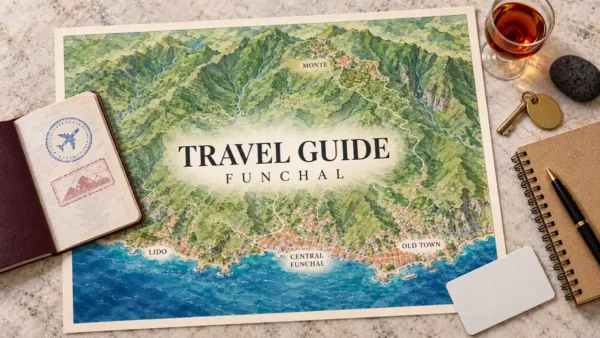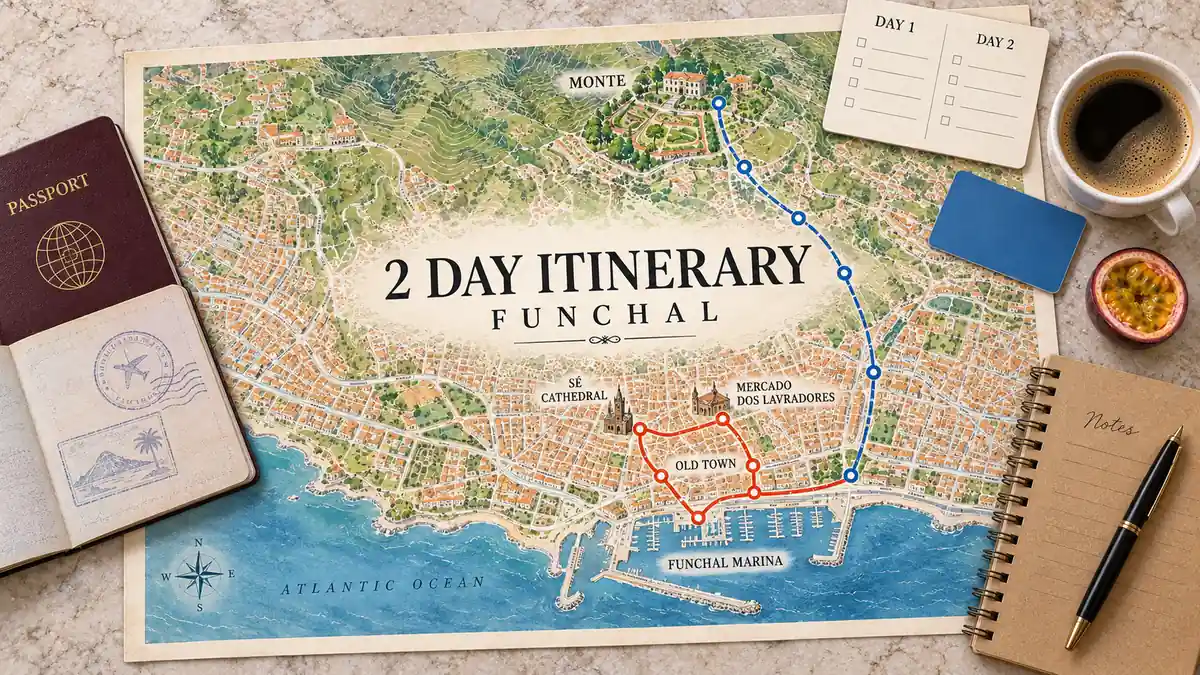
The question on a two-day trip to Funchal is not what to see. It is what order to see it in, because the wrong order sends you up and down the same hill twice and burns half of your 48 hours on movement. Funchal splits cleanly into two blocks: the flat centre, where the old town, Mercado dos Lavradores and the seafront sit within walking distance of each other, and Monte, up on the hillside above the city. This itinerary commits to one order for those two blocks, needs no car, and solves the Monte half-day end to end — how you go up, what you realistically choose at the top, and how you come back down, which is the part most plans get wrong. It also answers the question underneath the plan: whether two days is actually enough.
Quick Answer
Two days works for Funchal: the old town, market and seafront on day 1, Monte on day 2. The pacing variable is the Monte block — cable car up, one garden, and a descent that does not return you to the centre. It suits car-free visitors, and it covers Funchal, not the rest of Madeira.
Trust Layer
Tripstou itinerary guide for travelers planning a route. Covers pacing, stop count, stop order, base logic, and trip length.
Produced with AI assistance and reviewed by Alex Perrut, working in tourism since 2015, for the Tripstou editorial team. See our editorial process for details.
Last factual review: September 9, 2026.
Official sources consulted: Visit Portugal, Turismo de Portugal, Madeira Islands Tourism Board.
Key Takeaways
- Two days covers Funchal itself — the market, old town, seafront and Monte — but not the north, west or levada network.
- Walk the flat centre on day 1 and give Monte the whole of day 2, never the reverse.
- The cable car works as the plan’s connector, not a bolt-on attraction, because Monte sits too high to walk to.
- The toboggan is a ride, not a way home: it stops on the hillside, so plan the return leg first.
- Pick one garden on a two-day trip: Monte Palace, because it sits inside the block you are already in.
- Give day 2 to an organised trip out only if you already know Funchal from the top of the hill.
Table of Contents
Two Days Is Enough for Funchal, Not for Madeira
Two days is enough for Funchal itself, and not enough for the rest of Madeira. The city’s sights cluster into two blocks — the walkable centre and the hill at Monte — and one cable-car ride connects them. What two days cannot absorb is the north, the west and the levada network.
In practice, “enough” means one city day, one Monte day and two evenings. That covers the market, the old town, the cathedral, the seafront and the marina on foot, plus the gardens and the church at the top of the hill, without a single rushed transfer. Nothing in the plan needs to be cut for time.
This fits three kinds of visitor: someone on a short break who chose Funchal as the destination, someone using the city as the urban half of a longer Madeira trip, and someone spending a day or two ashore. All three want the same thing, which is the city solved properly instead of the island sampled badly.
The trade-off is worth naming plainly. Two days costs you the island, not the city — you leave with Funchal seen properly and Madeira barely seen at all. Orientation, when to visit and how people get to the island are covered in our Funchal guide, which is the page that sets the frame this itinerary sits inside.
Most people who feel two days was too short in Funchal were not short of time in the city. They were short of island, and no amount of reshuffling the 48 hours fixes that.
How to Split Two Days in Funchal: The Route at a Glance
Day 1 is the old town, the market and the seafront on foot; day 2 is Monte. That order puts the walkable core first, while legs are fresh and the market is at its liveliest early. It gives Monte a whole half-day, so the ride up and the descent are never squeezed into a tired afternoon.
Here is the sequence, one line per half-day:
- Day 1 morning: Mercado dos Lavradores and the old town — the city at street level
- Day 1 afternoon: the cathedral, Avenida Arriaga and the marina — the flat, walkable core
- Day 1 evening: Rua de Santa Maria — dinner without transport
- Day 2 morning: cable car up to Monte — one garden, one church
- Day 2 afternoon: the descent and the return to the seafront
| Half-day | Day 1 | Day 2 |
|---|---|---|
| Morning | Market and old town, the city at street level | Cable car up to Monte, garden and church |
| Afternoon | Cathedral, Avenida Arriaga and the marina on foot | The descent, then back to the seafront |
| Evening | Dinner on Rua de Santa Maria, no transport needed | Seafront evening, an easy walk from the centre |
The order is not arbitrary. Monte is the block most exposed to weather and to crowds, and it is the one that depends on a single connector working in your favour. Running it on day 2 means you arrive at the hill having already banked the city.
Reverse the days and a grey, packed morning at Monte takes the plan’s best block with it, because day 2 is where you would otherwise retry it. Doing the city first keeps that option open. It costs nothing to sequence it this way.
The plan also assumes you sleep in or near the flat centre, close enough to the old town and the seafront that both evenings are walkable — the reasoning behind that base, and the alternatives, are in where to stay in Funchal.
Getting Around Funchal Without a Car
You do not need a car for two days in Funchal. The centre, the old town and the seafront are flat enough to walk end to end. The one part of the plan that walking cannot reach is Monte, and the cable car covers it, running from downtown Funchal to Monte in about 15 minutes.
The split is between the core and the hill. Everything on day 1 sits in the flat strip between the market, the cathedral and the marina, and the distances between them are short enough that you will walk them without thinking about it. Monte is the exception. It sits at the top of the cable-car line, well above the city, and that gradient is exactly why it earns a half-day of its own instead of being tacked onto an afternoon.
That makes the cable car the plan’s connector, not an attraction bolted onto it. The ride up is also the view, so the transport and the sightseeing are the same purchase. Buses and taxis exist and cover the same ground, and they are a reasonable fallback if the weather or your legs argue for it, but the itinerary does not need them.
What does matter is what you put on your feet. The centre is flat, the old town is cobbled, and Monte is a hillside where the temperature and the cloud can differ from the seafront — layers and grippy shoes make more difference here than in most European city breaks. More of that practical prep sits in our Funchal travel tips.
Train and bus tickets
Compare routes, schedules and prices across rail and bus operators in one search, with mobile tickets on your phone.
New to Omio? Code NEW10 takes 10% off your first booking — or APPNEW10 if you book inside the Omio app. Both apply to bookings up to €80.
Search routes and compare prices on Omio →
Tripstou may earn a commission if you book through this link, at no extra cost to you.
Day 1 in Funchal: The Market, the Old Town and the Seafront
Day 1 starts at Mercado dos Lavradores and stays on foot all day. The market comes first because it is at its best before the tour groups arrive. From there the route runs through the old town and the cathedral, then out to Avenida Arriaga and the marina, ending with dinner on Rua de Santa Maria.
Morning: Is Mercado dos Lavradores Worth It?
Mercado dos Lavradores is worth it if you go early and go to look, not to shop. It is a working market wrapped in a tourist one, and the tourist layer thickens as the morning goes on — the earlier you arrive, the more of the real thing you see.
Go for three things: the building itself, with its tiled facade and galleried courtyard; the fish hall downstairs, where the scabbard fish is the local signature; and the produce floor, where the tropical fruit is the giveaway that this is an Atlantic island and not the mainland. Take the offered fruit tastings as a sales pitch, because that is what they are, and enjoy them on that basis.
The onward move is simple. Walk out of the market and straight into the old town — the two are neighbours, and the transition takes minutes.
Midday: What to See in Funchal’s Old Town
The old town is the historic core between the market and the sea, and it is the middle of day 1. Keep it to three anchors so the block stays a walk and not a checklist.
Rua de Santa Maria is the spine: a narrow lane whose doors were turned into an open-air painting project, which is why it photographs the way it does. The cathedral, the Sé, sits a short walk west and is the city’s oldest landmark — a stop of a few minutes inside, not an afternoon. The third anchor is the fort and the seafront edge below the old town, which is where the walk naturally spills out towards the water.
From there you continue on foot along the front. Nothing in this block needs transport.
Afternoon and Evening: Avenida Arriaga, the Marina and Dinner
The afternoon is the flat end of the day. Avenida Arriaga is the city’s main promenade, wide and shaded, and the marina at its foot is where the day slows down. This is the stretch to walk without a plan, because nothing here needs to be timed.
Time a stop here rather than eating on the clock. The dishes worth building it around are espetada, beef skewered on bay laurel and grilled; bolo do caco, the flat bread served hot with garlic butter; and scabbard fish, paired with banana in a combination that sounds wrong and works.
Dinner goes back up to Rua de Santa Maria, which after dark becomes the city’s dining street. The point of ending here is that the evening needs no transport and no booking — you walk out of your day and into it.
Day 2 in Funchal: Cable Car Up to Monte, and How You Get Back Down
Ride the cable car up to Monte, pick one garden, then choose your way down. At the top, the church and one garden fill the morning comfortably. The descent is where the real decision sits: the toboggan is a ride, not a way home, and it stops well above the city centre.
Morning: Is the Funchal Cable Car Worth It?
The cable car is worth it, because it is the plan’s only realistic connector to Monte and the ride itself is the view. The official route runs from downtown Funchal to Monte and takes about 15 minutes, climbing over rooftops, gardens and terraced slopes on the way up.
Go up early. The hillside collects cloud as the day warms, so the first rides tend to give the cleanest view back over the bay and the roofs. Early also buys you the quiet version of the top — the church, the garden and the viewpoint before Monte reaches its midday peak — and it leaves the whole afternoon free for the descent.
At the top, the Igreja de Nossa Senhora do Monte sits at the head of its staircase and is a short, worthwhile stop before the garden. Ticket and admission questions for everything on this hill — cable car, toboggan and gardens — belong with what a trip to Funchal costs, not with the plan.
How the Monte Toboggan Works, and Where It Leaves You
The Carreiros do Monte toboggan covers only the upper stretch of the hill and stops well above central Funchal. That single fact reshapes the rest of day 2, because it means the descent does not end where your day does.
The mechanics are straightforward. You sit in a wicker sled mounted on wooden runners, two drivers in white with straw hats stand on the back, and they steer and brake with their boots as the sled runs down a public road between garden walls. It is a genuine local invention that became a ride, and it is the reason people remember Monte.
What it is not is transport. When the sled stops you are still on the hillside, well above the seafront, with another leg to cover before you are back in the centre — so the afternoon has to absorb that leg instead of assuming it away. Plan the return before you commit to the ride, not while standing at the bottom of it.
The alternative is to ride the cable car back down. That puts you exactly where you started, at the edge of the centre, and it costs the afternoon nothing.
Afternoon and Evening: Back Down to the Seafront
The afternoon is about recovering the day after the descent, and it does not need much. Once you are back at sea level, the seafront and the promenade absorb the rest of it comfortably, which is exactly why the plan leaves this half-day loose instead of filling it.
One extra beat fits well here: a visit to one of the city’s Madeira wine lodges, where the tasting is the point and the history comes with it. It is indoors, it is central, and it works whether the afternoon turned bright or grey. Dinner is another seafront or old-town walk, as transport-free as day 1 was.
Tours and activities
Book skip-the-line tickets, day trips and local tours with free cancellation on most activities.
You can also browse everything on getyourguide.com.
Tripstou may earn a commission if you book through this link, at no extra cost to you.
Monte Palace or the Madeira Botanical Garden: Which One on Two Days?
On two days, choose Monte Palace Tropical Garden. It sits inside the Monte block you are already committed to, so it costs the plan no extra movement. The Madeira Botanical Garden is a separate visit, and fitting it in on a two-day trip fragments the half-day that Monte already fills.
The two read differently. Monte Palace is a landscaped, layered garden built as an experience — paths that descend through it, water, tiled panels, Asian-influenced set pieces and collections held alongside the planting. The Madeira Botanical Garden reads as a botanical collection first, organised around the plants themselves, with an outlook over the city and the bay.
Two kinds of visitor should flip the choice. Plant-focused travelers who came for Madeira’s flora specifically will get more from the botanical collection than from the landscaping. So will repeat visitors who have already done the Monte block once and are looking for the thing they missed.
Everyone else takes the sequencing answer, because the cost of doing both is not paid in the gardens. It is paid on day 1 — the second garden comes straight out of the old town or the seafront afternoon, which is why this page tells you to pick one.
Should You Give Day 2 to a Trip Out of Funchal?
On a first visit, keep both days in Funchal. Swap day 2 for an organised trip out only if you have seen the city before, or came to Madeira for the island and not the town. An organised day removes the entire Monte block, which is the half of the plan most visitors return for.
It helps to see exactly what a day out costs the itinerary, in the order it gets cut:
- The Monte block goes first — cable car, garden and descent all disappear together, because they are one half-day, not three separate stops.
- The seafront and marina afternoon goes next — a full day out returns late, and the flat, unhurried end of day 1 is what absorbs the loss.
- The market and the old town survive — they fit a single morning, which is why they are the last thing a two-day plan gives up.
For car-free visitors, an organised trip is the practical way out of the city, since it removes the driving and the mountain roads from the equation entirely. Whale watching and boat trips leave from the marina and are a shorter alternative that does not break the plan, running best in the warmer part of the year — a half-day at sea can slot into day 1’s afternoon without touching Monte.
If you want the north, the west or a proper levada walk, that is a third day, and the plan for it is in our 3 days in Funchal itinerary.
The honest version of the fork is this: the organised day out pays off most for people who already know what Funchal looks like from the top of the hill.
Frequently Asked Questions
How long does the Funchal cable car take?
The Funchal cable car takes about 15 minutes between the downtown station and Monte, according to the Madeira Islands tourism board. That covers the whole climb from the seafront edge of the city to the parish above it, and the ride doubles as the plan’s best viewpoint.
Does the Funchal toboggan go all the way down to the city?
No. The Carreiros do Monte toboggan runs only part of the way down, finishing on the hillside above Funchal instead of ending in the centre. You still have a further leg to cover afterwards, so treat the sled as an experience and decide how you are getting back before you board.
Is Funchal walkable?
Funchal is walkable where it is flat. The centre, the old town, the market and the seafront promenade link up on foot without any transport. What defeats walking is the gradient above the city: Monte sits high on the slope, which is why the cable car exists and why the plan uses it.
Can you do Funchal in 2 days without a car?
Yes. Both days in this plan run without a car: day 1 is walked end to end, and day 2 uses the cable car for the one leg walking cannot cover. Buses and taxis remain available as a fallback, and nothing in the 48 hours depends on driving yourself.
What should you eat in Funchal?
Build a stop around espetada, beef skewered on bay laurel and grilled over wood, and bolo do caco, the flat bread served hot with garlic butter. Scabbard fish with banana is the local pairing worth trying, and poncha is the drink, taken as a single stop, not an evening.
When is Monte busiest?
Monte fills through the middle of the day, because the cable car and toboggan combination is a standard cruise shore excursion and those groups arrive together and move as one. Going up early puts you at the church, the garden and the viewpoint ahead of that pattern entirely.
Related Guides
- Funchal travel guide — orientation, when to visit and how the city fits into a Madeira trip.
- Where to stay in Funchal — the areas, and which base keeps both evenings walkable.
- 3 days in Funchal itinerary — what a third day buys you outside the city.
- Funchal trip cost — what two days in the city adds up to, item by item.
- Funchal travel tips — practical prep, what to wear and how the city works day to day.
Did this guide save you time or money? Tripstou is independent and reader-funded — if you'd like to give something back, you can support the site with a crypto contribution of any size.