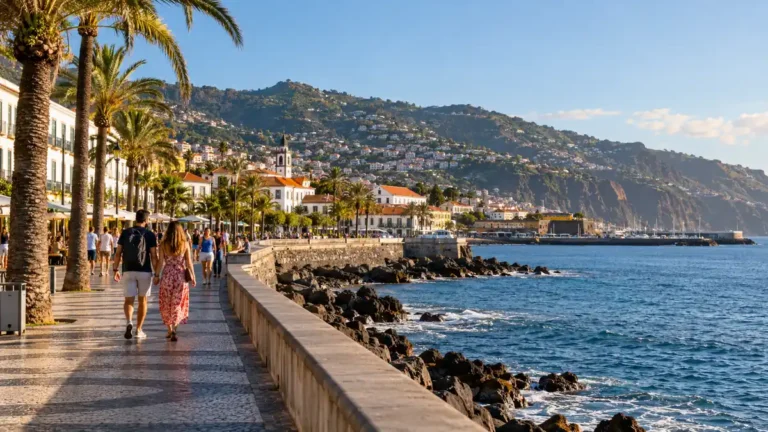
Lisbon is booked. The base is not — and that is the harder decision, because the two neighbourhoods that sold you the trip are the two hardest to sleep in. Alfama’s lanes and Bairro Alto’s nights photograph beautifully. They also come with stairs, gradient and bar noise that no listing photo shows.
That tension — charm against liveability — is the axis this page resolves. Lisbon’s areas are not interchangeable. Each one charges you something: a climb home, a noisy window, a longer trip into the centre, or a higher nightly spend for the privilege of walking everywhere.
What follows is the full set of areas worth considering, each with a verdict, an honest catch and the traveler type it actually fits. Seven areas get a profile. Six more get a one-line case. By the end you should be clicking one neighbourhood guide, not searching again.
Quick Answer
Baixa-Chiado is the best base for a first visit: central, walkable, and built on Lisbon’s flat grid. Lisbon’s prettiest areas, Alfama and Bairro Alto, trade sleep and easy access for atmosphere. Choose Príncipe Real or Avenida da Liberdade instead if you want quieter evenings, more space and comfort-first surroundings.
Trust Layer
Tripstou stay guide for travelers choosing where to base. Covers area atmosphere, budget, convenience, noise, and traveler fit.
Produced with AI assistance and reviewed by Alex Perrut, working in tourism since 2015, for the Tripstou editorial team. See our editorial process for details.
Last factual review: September 17, 2026.
Official sources consulted: Visit Portugal, Turismo de Portugal.
Key Takeaways
- Baixa-Chiado is the safest booking for a first visit: flat, central, and the shortest walk to almost everything.
- Alfama and Bairro Alto are not mistakes, but they charge you in gradient and late-night noise respectively.
- Príncipe Real and Avenida da Liberdade are the strongest bases nobody shortlists: quiet, comfortable, and priced at the high end.
- Stepping one district off the centre — Mouraria, Avenidas Novas, Campo de Ourique — is where Lisbon’s value sits.
- Judge any Lisbon address twice: on the climb home at the end of the day, and at 1am.
- The shorter the trip, the more central you book; longer stays can afford a quieter, residential base.
Table of Contents
How Lisbon’s Layout Decides Where You Stay
Lisbon is a city of hills with one flat grid — Baixa — between two high sides. Where you sleep decides how much climbing your trip contains. The address you choose sets your daily gradient long before it sets your budget. Every area below is a different answer to that one question.
The shape is simple once you see it. Baixa runs flat from the river inland, with Chiado climbing away from it on the western side. Above Chiado sit Bairro Alto and, further along the same high ground, Príncipe Real. On the opposite side, Alfama spills down the eastern hill below the castle. Cais do Sodré and Santos hold the riverfront just west of Baixa, Belém sits well west of the centre along the water, and Parque das Nações is flat, modern and northeast of everything.
That geography sorts the areas into three families: the flat centre, the two hills, and the outliers along the river or beyond it. Flat means you walk everywhere without thinking. Hills mean views, quiet and effort in a package you cannot unbundle. Outliers mean space and calm bought with a commute in and out each day. For orientation beyond the stay decision — what to see, how the districts connect as a visit — start with our Lisbon travel guide.
The hills matter most at the end of the day, not the start. You are choosing a base for the walk home at midnight, not the walk out at nine.
| Area | Best for | Character | The catch |
|---|---|---|---|
| Baixa-Chiado | First visits with limited time | Central, polished, busy day and night | Least local feel in the centre |
| Alfama | Atmosphere above everything else | Medieval lanes below the castle | Stairs, gradient, awkward luggage arrivals |
| Bairro Alto | Going out late on foot | Residential by day, bars by night | Late-night noise on the core streets |
| Príncipe Real | Quiet evenings near the action | Boutique, leafy, grown-up garden square | Uphill position and high-end pricing |
| Avenida da Liberdade | Comfort and step-free walking | Grand boulevard, formal and unhurried | Feels more avenue than neighbourhood |
| Cais do Sodré | Nightlife with daytime centre access | Transformed riverfront quarter with a food market | Nightlife noise around the riverfront core |
| Belém | Museums, calm and slow mornings | Monumental, open, low-rise riverside | Daily commute back into the centre |
Baixa-Chiado Is the Best Base for a First Visit
Baixa-Chiado is the best base for a first visit to Lisbon. It sits at the centre of everything you came to see, on the city’s one genuinely flat stretch, with the shortest walks to the river, the main squares and the surrounding hills. Nothing else in Lisbon is this convenient.
Baixa and Chiado function as one base, not two choices. Baixa is the flat commercial grid; Chiado is the smarter, uphill edge above it, with the theatres, cafés and shopping. You can walk between them in minutes, which is why the decision that matters is the street, not the district — our Baixa-Chiado stay guide splits that ground properly.
The character is polished and busy. This is the most visited part of Lisbon, so you trade a local, residential feel for the shortest possible distance to everything. Prices sit at the high side of mid-range, with the most central addresses pushing higher. For the full first-timer logic — what to prioritise, what to skip, how to book — see our guide to staying in Lisbon for the first time.
Trip length pushes this verdict harder. The shorter the stay, the more central you should book: on a two-day Lisbon itinerary the centre is close to mandatory, while a three-day itinerary leaves enough room to consider a quieter base.
Best for: first visits with limited time.
Convenience compounds on a short trip. The twenty minutes you do not spend getting into the centre each morning is, in practice, an extra sight per day.
Hotels and places to stay
Compare hotels, apartments and stays for your dates in one search.
Search hotels and stays on hotels.com →
Tripstou may earn a commission if you book through this link, at no extra cost to you.
Is It a Mistake to Stay in Alfama or Bairro Alto?
No, staying in Alfama or Bairro Alto is not a mistake — if you accept what the address costs. Alfama charges you in gradient and stairs. Bairro Alto charges you in late-night bar noise on the core streets. Both pay you back in atmosphere no flat, quiet address in Lisbon can match.
The honest way to decide is to price the address at two moments: one in the morning, when you climb back up carrying shopping, and one at 1am, when the street outside is either silent or not. Neither area fails that test for everyone. Both fail it for someone.
Alfama
Alfama is worth it when atmosphere is the point of the trip. The lanes below the castle are the oldest and most photogenic part of Lisbon, and sleeping inside them buys you the early mornings and late evenings without the day-trippers. The cost is physical. The area is built on a hillside of stairs and steep lanes, arriving with luggage is awkward, and reaching the rest of the city takes longer than the map suggests. Our guide to staying in Alfama works through which parts are genuinely liveable and how far up is too far.
Best for: atmosphere-first travelers who accept the climb.
Bairro Alto
Bairro Alto is two different places at the same address. By day it is quiet and residential, almost sleepy. By night the core streets become the city’s oldest bar district, and late-night noise there is a pattern, not an accident. It sits high on the western hill, and with the Glória funicular out of service the walk up from Baixa is a real climb. Our Bairro Alto stay guide covers which streets sit inside the noise and how many blocks back you need to book.
Best for: going out until late with no taxi home.
Príncipe Real Is Lisbon’s Most Underrated Base
Príncipe Real gives you the polish of Chiado without the crowds. It is Lisbon’s most grown-up base: boutique stays, a garden square at its centre, and quiet evenings within walking distance of the nightlife. The catch is its hill position and a price level at the high end.
Day to day it feels residential in a way the centre never does. Independent shops, small restaurants and a leafy square set the pace, and the crowd skews local and unhurried. Evenings are calm by default — you go out to the noise and come home away from it.
Convenience is good in one direction. Bairro Alto and Chiado are a short downhill walk, which means the return trip is uphill every night. Connections into the rest of the city are workable but this is a walking base first, and the walking involves gradient.
On price it leans high-end. The boutique, design-led character that makes the area appealing also keeps it above the mid-range, and there is less inventory here than in the centre. Couples in particular tend to land here once they know the city — our guide to where couples should stay in Lisbon goes deeper on that fit.
Best for: return visitors and couples who want quiet evenings.
Príncipe Real is the only Lisbon base that puts you five minutes from the bars and out of earshot of them. That combination is what you are paying the premium for.
Avenida da Liberdade Suits Comfort-First Travelers
Avenida da Liberdade suits travelers who want space, calm and no hills. Lisbon’s grand boulevard runs flat from Restauradores up towards Marquês de Pombal, lined with wide pavements and the city’s most formal hotels. The catch is atmosphere: it reads as a polished avenue more than a neighbourhood.
The feel is grand and unhurried. Tree-lined lanes, luxury storefronts and generous distances give the area a capital-city calm, and the Marquês de Pombal end is quieter still. What it does not give you is street life. Nobody stumbles into a local bar here.
Convenience is the strongest argument. The walk down into Baixa is flat and short, so the centre is available without a single climb, and connections outward are among the easiest in the city. For anyone who would prefer not to think about gradient at all, this is the answer.
Prices sit at the high end. This is where Lisbon’s luxury hotel row lives, which lifts the whole area’s positioning — our guide to luxury stays in Lisbon covers the area logic, and Lisbon’s best luxury hotels takes the decision down to property level.
Best for: comfort-first and luxury travelers who hate hills.
Cais do Sodré and Belém: Two Riverfront Bases, Opposite Personalities
Cais do Sodré and Belém share the river and almost nothing else. Cais do Sodré puts you inside the centre’s night energy, a short flat walk from Baixa. Belém buys calm, monuments and space at the price of distance from everything else. One suits late nights; the other suits slow mornings.
Cais do Sodré and Santos
Cais do Sodré works for travelers who want nightlife without leaving the centre. The quarter has shifted a long way from its old port-district reputation and now reads as one of Lisbon’s most energetic riverfront areas, with Santos continuing the same strip west. The Time Out Market sits on the doorstep, which solves dinner permanently. Nights are loud around the core bar streets — that is the trade, and it is predictable. Prices land in the mid-range. Our guide to where to stay in Lisbon for nightlife compares it against the other going-out bases.
Best for: night owls who still want the daytime centre.
Belém
Belém works for travelers who value calm and monuments over centrality. It sits well west of the city, flat, open and low-rise, with the major museums and the riverside walk on your doorstep and none of the centre’s density. Belém Tower runs on timed entry slots, so that one stop needs booking ahead, which changes the daily rhythm less than you would expect. The real catch is the commute: everything else in Lisbon is a trip in and a trip back. Prices sit in the mid-range.
Best for: slow-paced return visitors prioritising museums and calm.
Belém rewards a second visit and punishes a first. On a short trip you spend the calm you paid for on the journey back into town.
Other Lisbon Areas Worth Knowing
Six more Lisbon areas work as bases for the right traveler. None made the main list, and none is a mistake — each trades a piece of centrality for something else: better value, more residential calm, or more space. Here is the one-line case for each.
- Estrela and Lapa — elegant, embassy-quiet and residential, west of the centre. Suits travelers who want a genuine neighbourhood and do not mind a longer walk in.
- Parque das Nações — modern, flat and northeast of the city, built for space and easy movement. Suits families and business travelers; it is far from historic Lisbon and does not pretend otherwise.
- Mouraria and Intendente — the most rapidly changing part of central Lisbon, diverse and better value than the areas around it. It still feels rougher-edged after dark than Baixa or Chiado, which is a comfort question more than a danger one; our Lisbon safety guide gives the honest read.
- Campo de Ourique — an actual residential quarter with a market, good food and almost no visitors. Suits longer stays and repeat visitors who want to live somewhere rather than sleep somewhere.
- Alcântara — riverside, industrial-turned-creative, west towards Belém. Suits travelers drawn to the design and nightlife scene there who are happy to travel in for the classic sights.
- Avenidas Novas — flat, modern and business-oriented north of the centre. Suits travelers who want space and better value without going far out.
These areas are where Lisbon’s value sits. Stepping one district off the centre generally buys more room and a softer rate for the cost of a short trip in — our guide to staying in Lisbon on a budget works through that tradeoff properly.
Best Lisbon Areas by Traveler Type
Every traveler type has one clear Lisbon area, and this block is the whole decision compressed. First-timers, couples, families, night owls, budget travelers and luxury travelers each land somewhere different — and the reason is usually one variable: noise, gradient, space or price. Read this if you read nothing else.
- First-time visitors → Baixa-Chiado. Everything you came to see is within a flat walk, which matters most when time is short.
- Couples → Príncipe Real. Quiet, boutique and grown-up, with the nightlife close enough to visit and far enough to sleep.
- Families → Parque das Nações or Estrela. Space, flat ground and residential calm beat centrality once you are pushing a stroller; our guide to the best areas in Lisbon for families resolves which of the two fits.
- Nightlife → Cais do Sodré or Bairro Alto. Both put you inside the noise; Cais do Sodré keeps the daytime centre closer.
- Budget travelers → Mouraria, Intendente or Avenidas Novas. One district off the centre is where the rates soften.
- Luxury and comfort → Avenida da Liberdade. Flat, formal, and the only area where you never negotiate with a hill.
Still torn between the two obvious finalists? If the choice is central convenience against going out on your doorstep, our Baixa-Chiado vs Bairro Alto comparison settles it; if it is convenience against atmosphere, use Baixa-Chiado vs Alfama.
Frequently Asked Questions
Is Lisbon walkable between neighbourhoods?
Yes, Lisbon’s central neighbourhoods connect on foot. Baixa, Chiado, Bairro Alto, Príncipe Real, Alfama and Cais do Sodré all sit within walking distance of each other. The distances are short; the effort is vertical. Belém and Parque das Nações are the exceptions — both need a ride in.
Which Lisbon areas are flat and which mean climbing hills?
Baixa, Avenida da Liberdade, Parque das Nações and Belém are flat. Alfama, Bairro Alto, Príncipe Real and Chiado all sit on high ground and involve real climbs. Cais do Sodré is flat along the river but rises quickly if you walk inland from it.
Is it safe to stay in Mouraria or Intendente?
Yes, for confident travelers — the caveat is comfort, not crime. Both areas are central, well-connected and among the better-value parts of inner Lisbon. The streets feel busier and rougher-edged after dark, which unsettles some first-timers and bothers others not at all.
Are Lisbon hotels noisy at night?
Only in specific areas. The core bar streets of Bairro Alto and the Cais do Sodré riverfront are loud late, and that is a reliable pattern, not bad luck. Elsewhere — Avenida da Liberdade, Príncipe Real, Belém, Estrela — nights are genuinely quiet. Cobblestone streets carry sound further than you expect.
Is Parque das Nações too far out to be a good base?
Not for everyone, but it is a trade. The district is flat, modern and spacious, which suits families and business travelers well. What it cannot give you is historic Lisbon on your doorstep — every classic sight is a journey out and a journey back.
Should you change neighbourhoods during a longer Lisbon stay?
Rarely — Lisbon is small enough that one base covers a week comfortably. Splitting makes sense only if your trip has two distinct halves: sightseeing first, then a slower stretch. Otherwise you spend a morning moving luggage over cobbles and hills for very little gain.
Related Guides
These are the next steps once you have narrowed the area down to one or two candidates.
- Where to Stay in Lisbon for the First Time — the full first-timer booking logic.
- Staying in Baixa-Chiado — street-level detail for the central base.
- Staying in Alfama — whether the atmosphere is worth the climb.
- Staying in Bairro Alto — which streets are inside the noise.
- Baixa-Chiado vs Bairro Alto — the direct verdict between the two.
- Lisbon Travel Guide — the full city planner behind this decision.
Did this guide save you time or money? Tripstou is independent and reader-funded — if you'd like to give something back, you can support the site with a crypto contribution of any size.