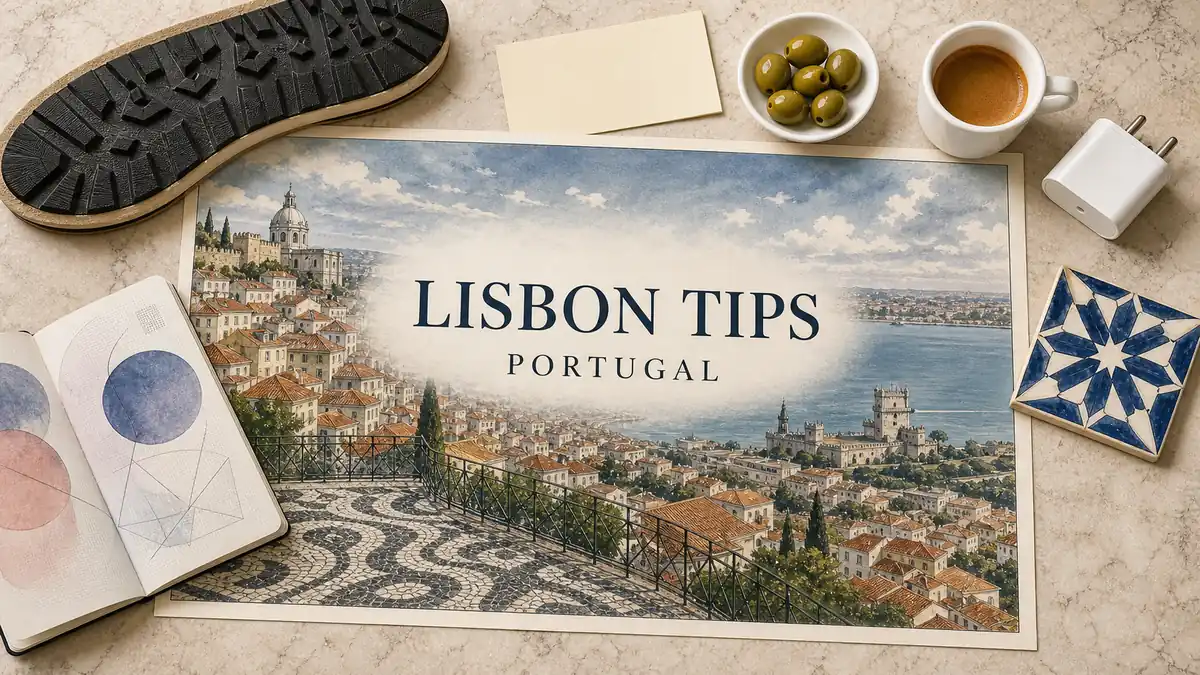
Your Lisbon trip is booked, so the only thing left is not getting the first two days wrong. Lisbon is unusually good at punishing small, avoidable errors: the wrong shoes on polished calçada, no table booked at the restaurant you crossed the city for, a mid-morning arrival at a queue that formed at opening. None of it ruins a trip. All of it costs hours you would sooner spend eating.
This page groups what matters into the decisions they belong to — terrain and footwear, restaurant customs like the couvert, what genuinely needs booking, which famous things are worth the wait, language, and when to come. It is opinionated, and it is specific to Lisbon. Generic European advice will not tell you why your map’s walking times are lying to you.
Quick Answer
Pack grippy shoes for Lisbon’s hills and cobbles, book the headline sights ahead, and learn the restaurant customs. How much friction you hit depends mostly on timing — season and hour of day drive the queues. Start sightseeing early, carry a little cash, and treat the couvert as optional and paid.
Trust Layer
Tripstou planning guide for travelers resolving one travel decision. Covers the main variable, traveler context, and practical tradeoffs.
Produced with AI assistance and reviewed by Alex Perrut, working in tourism since 2015, for the Tripstou editorial team. See our editorial process for details.
Last factual review: September 17, 2026.
Official sources consulted: Visit Portugal, Turismo de Portugal.
Key Takeaways
- Grippy flat soles beat style in Lisbon: polished calçada turns slippery when wet, and gradients make map times lie.
- The couvert is not free — bread and olives are charged if you touch them, and declining causes no offence.
- Kitchens pause mid-afternoon and dinner starts late, so plan a real lunch or accept a pastry-and-coffee gap.
- If you make only one booking for this trip, make it Sintra’s Pena Palace, not anything inside Lisbon itself.
- Ride Tram 28 early or late as an attraction, and start every sightseeing day before the queues form.
- Shoulder season wins on crowds and heat; winter suits city-focused trips, summer only if you want the beaches.
Table of Contents
What Are the Biggest Mistakes First-Timers Make in Lisbon?
The costliest first-timer mistakes in Lisbon are underestimating the terrain, skipping advance bookings, and misreading mealtimes. Add a fourth: treating Tram 28 as transport instead of a ride. Each one is cheap to fix before you fly, and expensive to discover on your first morning.
Underestimating the terrain is the one that reshapes a whole day. Visitors plan six sights that look close together on a map, then discover the map never mentioned the staircases between them. The correction is grouping your sightseeing by neighbourhood and by height, which the hills section below sets out properly.
Skipping bookings costs differently. Almost nothing in Lisbon requires a reservation, which lulls people into booking nothing at all — including the two or three things that genuinely need a timed slot, and the Sintra palace that fills faster than anything inside the city.
Misreading mealtimes is the quietest mistake, because it does not feel like a mistake until you are standing outside a shuttered kitchen at half past four. Lisbon eats later than northern Europe does, and its restaurants close a long window in the afternoon.
Four smaller ones are worth clearing before you arrive:
- Safety: Lisbon is a comfortable city to walk, and the only real caution is pickpocketing in tourist crowds and on packed trams — the detail sits in our page on how safe Lisbon really is.
- Arrival: decide how you are getting from the airport before you land, because the options changed and improvising at arrivals is where the first bad decision usually happens — see getting from Lisbon airport to the centre.
- Connectivity: sort data before departure so maps, bookings and translation work the moment you switch your phone on, which is what an eSIM for Portugal is for.
- Orientation: what to see, how many days, and how the districts fit together belong in the wider Lisbon guide, not here.
Is Lisbon Really That Hilly — and What Shoes Should You Wear?
Yes, Lisbon is genuinely hilly, and grippy flat-soled shoes are the best packing decision you will make. The city climbs and drops constantly, and its pavements are calçada portuguesa — small limestone setts polished smooth by decades of footfall. Smooth soles slide on them. Heels catch in the gaps.
The practical consequence is that walking-time estimates mislead you here more than in almost any European capital. Route planners measure horizontal distance; Lisbon charges you vertically. A ten-minute walk from Baixa up into Alfama or Bairro Alto can involve a stepped alley and a genuine climb, and it will take longer and cost more effort than the number on your screen suggests.
The surface is the other half of the problem. Dry calçada is merely uneven. Wet calçada on a gradient is properly slippery, and Lisbon gets rain across much of the year outside high summer. Wet calçada is more dangerous downhill than uphill, which is why the sensible move in rain is to climb on foot and ride back down.
Lisbon is still a very walkable city for most travelers, with a caveat. If you accept that a good day here includes several climbs, you will love walking it. If you have limited mobility, a knee that objects to stairs, or small children in a buggy, the terrain stops being charming and starts being the main planning variable — and the answer is to build days around the trams, lifts and flat riverside stretches instead of pretending the hills are optional.
Terrain should also shape where you sleep. A room at the top of Alfama has the view and the stairway; a room in flat Baixa or Chiado spares your legs twice a day and puts you inside walking range of most of the centre. That tradeoff is exactly what our guide to where to stay in Lisbon works through, area by area.
How Eating Out in Lisbon Actually Works
Three restaurant customs catch visitors out in Lisbon: the couvert is charged, kitchens pause mid-afternoon, and dinner starts late. None of them is a scam, and none requires you to change your habits much. They only cost you if nobody explains them before your first meal.
Is the bread on the table free?
No. The bread, olives, butter or cheese brought to your table unprompted is the couvert, and it is charged if you eat it. This is standard practice across Portugal, the items are priced on the menu, and untouched plates come off the bill. Declining it is completely normal and causes no offence — a simple “não, obrigado” as the plate lands ends the matter. The only rule worth remembering is that one olive buys the whole couvert.
When do people actually eat?
Later than you probably do. Lunch runs long, kitchens in most restaurants close for a stretch in the afternoon, and dinner service starts late by northern-European standards — early enough that you can eat before the locals do, late enough that turning up at what you consider dinner time may find an empty room or a closed door. Plan a proper lunch, or accept a gap filled with a pastry and a coffee.
Do you tip in Lisbon?
Tipping in Lisbon is discretionary and modest. Rounding the bill up is the ordinary gesture after a normal meal, and leaving a small amount extra after a genuinely good one is welcome without being expected. Check the bill for an included service charge before adding anything, since some places aimed at visitors add one. Nobody treats a small tip, or none at all, as an insult.
Two habits smooth the rest. Book ahead for dinner anywhere popular, especially at weekends — the small, good places in Lisbon have very few tables, and walking in hopefully at nine on a Saturday is how people end up eating badly on a main street instead. And keep a little cash on you, because the smallest and often best tascas are exactly the places least likely to take a card.
What Do You Need to Book in Advance in Lisbon?
Book Sintra’s Pena Palace and the headline Belém sights ahead; most of Lisbon needs no reservation at all. Timed entry is increasingly the norm at the biggest names, so check the official site when you book. The day trip matters more than the city.
What to book ahead — and what to leave open
The principle is narrow. A handful of monuments now run on timed entry, and those are worth locking down before you arrive. Everything else in Lisbon — viewpoints, churches, neighbourhoods, markets, most museums — absorbs walk-ups without drama, and over-booking a Lisbon trip just removes the freedom that makes the city enjoyable.
Booking requirements change; confirm on the official site of each site before you pay.
| Sight | Book ahead? | Why it works that way |
|---|---|---|
| Pena Palace, Sintra | Yes, before anything else | Demand far outstrips what the hilltop can absorb |
| Jerónimos Monastery, Belém | Yes, and avoid Mondays | Closed Mondays, and the queue builds from mid-morning |
| São Jorge Castle | Worth booking in busy months | Hilltop entrance concentrates everyone at one gate |
| Belém Tower | Yes, entry runs on timed slots | Slots are fixed in advance, so your hour is decided before you arrive |
| Miradouros and neighbourhoods | No, leave completely open | Free, unticketed, and better decided on the day |
Belém Tower deserves one clean sentence: entry runs on defined time slots, so fix your hour before you go, and it remains worth the walk out along the riverside, where the exterior and its setting are half the appeal anyway.
Sintra sells out before Lisbon does. If you make only one booking for this trip, make it Pena Palace — Lisbon’s own sights rarely turn anyone away, and Sintra’s headline palace regularly does.
What each of these actually costs, and whether a city pass changes the maths, is a separate question we answer in what a Lisbon trip costs.
How to beat the worst queues
Three habits do almost all the work. Start early, because queues at the headline sights build from mid-morning and rarely shrink again before late afternoon. Group your sightseeing by neighbourhood so you are not crossing the city twice. And where the geography allows, start at the high point and walk down — you see the same things, in the same order, without the climb.
Closing days are the other trap, and Jerónimos is the example that catches most people: it is closed on Mondays, and a Monday morning in Belém with no plan B is a wasted half-day. Check the closing day of anything you have set your heart on before you fix the shape of that day.
Where those anchors land in your trip is a sequencing decision that changes with length — our 2-day Lisbon itinerary stacks them tightly, while the 3-day Lisbon itinerary has room to give Belém and Sintra separate mornings.
Tours and activities
Book skip-the-line tickets, day trips and local tours with free cancellation on most activities.
You can also browse everything on getyourguide.com.
Tripstou may earn a commission if you book through this link, at no extra cost to you.
Is Tram 28 Worth It — and What Else Is Overrated?
Tram 28 is a slow, packed heritage ride, not a way to get around Lisbon. Ride it as an attraction and it delivers; board it as transport and it will disappoint you. The same test sorts most of Lisbon’s over-hyped set pieces.
Expect to stand, and expect to be pressed against strangers for most of the route in daylight hours. The famous yellow tram is small, the demand is enormous, and the middle of the day is when it is worst. If you want the ride, take it at the very start or the very end of the day, when there is a real chance of a seat and a window. If you want to get somewhere, almost anything else is faster.
It is also the city’s most reliable pickpocket magnet, purely because of the crush. Keep your bag in front of you and your phone out of a back pocket, and the risk drops to ordinary. Route, fares, boarding points and the quieter tram lines that cover similar ground are all mechanics we keep in one place — see getting around Lisbon. The same page carries the funicular picture, including the Glória, which has been suspended since a derailment with a multi-year restoration underway.
Santa Justa Lift is the clearest case of a queue you can simply decline. The lift is a handsome piece of ironwork, and the platform at the top gives you a view over Baixa — but Lisbon is a city of free miradouros, and the terrace beside the Carmo ruins reaches nearly the same height on foot, without the wait.
Time Out Market is convenient and genuinely good, but it is not cheap and it is not a discovery. It works best as a solution to a specific problem: a group that cannot agree on one kitchen, or a late arrival with no reservation anywhere. As the anchor of your eating in Lisbon, it costs you the tascas.
Pastéis de Belém is worth the trip and not worth the takeaway queue. The long line snaking out of the door is the counter; the rooms inside have table service and usually move faster, which is the reverse of what everyone assumes. The honest test for every Lisbon set piece is whether the wait buys you something the free version nearby does not.
Do People Speak English in Lisbon?
Yes — English is widely spoken across tourist Lisbon, in hotels, restaurants, museums and ticket offices. You will not get stuck. What a few words of Portuguese change is the warmth of the exchange, not your ability to order lunch. Open in Portuguese and the room softens.
Greetings carry most of the weight, and they follow a rhythm. You say bom dia in the morning and boa tarde from early afternoon onward, on entering a shop, a café or a lift, and it is closer to obligatory politeness than to a friendly extra. Thanks agrees with your own gender, not the other person’s: men say obrigado, women say obrigada. Getting that one right is a small, noticeable signal.
A short list covers nearly everything a visitor needs:
- Bom dia / boa tarde / boa noite — good morning, afternoon, evening
- Por favor — please
- Obrigado / obrigada — thank you, matched to your own gender
- Desculpe — excuse me, for both apologies and getting attention
- A conta, por favor — the bill, please
- Fala inglês? — do you speak English?
One habit grates, and it is worth knowing why. Defaulting to Spanish because it feels close enough reads as erasing the difference between two countries with distinct languages, histories and a long, complicated relationship. Portuguese people are not hostile about it; they are simply not Spanish, and being addressed as though they were is tiring. English is the better fallback every time. The broader conventions that apply nationwide sit in our Portugal travel tips.
When Is the Best Time to Visit Lisbon?
Spring and autumn are the best times to visit Lisbon, beating summer on both crowds and heat. Winter is mild and quiet, with more rain and shorter days as the trade. Summer works only if you want beach heat and accept queues everywhere.
The best months for weather and crowds
Shoulder season wins on every axis that matters for a city trip. Spring and autumn give you warm days that are comfortable for climbing hills, evenings you can sit outside in, and crowd levels that leave the miradouros and the small restaurants usable. Peak summer inverts all three: the heat makes the gradients punishing at midday, and the headline sights carry their longest queues.
Winter is genuinely underrated here. Lisbon stays mild by European standards, the light is beautiful, and the city belongs to the people who live in it again. The tradeoffs are real — more rainy days, shorter afternoons, and some seasonal terraces closed — but for a first visit focused on the city itself, they are minor.
Traveler fit decides the rest. If you are here for the city — neighbourhoods, food, viewpoints, museums, Sintra — shoulder season and winter are better trips than summer. If you want the Atlantic beaches within reach of Lisbon to actually be swimmable and lively, summer is the only season that delivers that, and the crowds are the price.
The month decides your Sintra day more than your Lisbon days. The city absorbs summer visitors across dozens of streets and viewpoints; Sintra funnels the same crowd through a couple of palace gates on one hilltop.
What to wear, season by season
Layers beat any single warm garment in Lisbon, in every season. The city sits on a river mouth open to the Atlantic, so the wind picks up as the sun drops and an evening on a terrace or a miradouro is consistently cooler than the afternoon led you to expect. A light jacket you can carry is the item people most often wish they had packed.
- Spring and autumn: light layers, a packable jacket, and something waterproof for the shower that arrives without warning.
- Summer: loose, breathable clothing, sun cover for the exposed viewpoints, and a light layer for river-breeze evenings.
- Winter: a proper waterproof over a warm mid-layer, and clothes you can peel back on a bright, mild afternoon.
Whatever the season, the footwear rule from the hills section does not change: grippy, flat, broken-in, and never new.
Frequently Asked Questions
Can you drink the tap water in Lisbon?
Yes. Lisbon’s tap water is treated to European drinking standards and is safe straight from the tap. Some visitors notice a faint chlorine taste, which a filter jug or a few hours in the fridge removes. Refilling a bottle at your accommodation saves both money and plastic.
Do you need cash in Lisbon, or can you pay by card?
Cards work almost everywhere in Lisbon, from restaurants and shops to museums and supermarkets. Carry a small amount of cash anyway. The smallest family-run tascas, market stalls, kiosks and a few older cafés still prefer or require it, and cash is the easy way to round up a bill.
Can you go inside Belém Tower?
Yes. Belém Tower is open to visitors, and entry runs on defined time slots, so book your slot before you go, not on the day itself. The setting is half of it either way: the tower sits out on the riverside, and the walk along the Tagus to reach it costs nothing and needs no ticket.
How far ahead should you book Pena Palace in Sintra?
Book Pena Palace as soon as your Sintra date is fixed, and weeks ahead in spring, summer and autumn. Demand concentrates on one hilltop site with limited capacity, so the calmest hours go first. Booking on the day itself is a gamble rather than a plan.
What plug adapter do you need in Portugal?
Portugal uses the standard European two-round-pin sockets, types C and F, running on 230 volts at 50 hertz. Visitors from the UK, the US, Canada and Australia need a plug adapter. Most phone and laptop chargers handle 230 volts already, so a simple adapter is usually enough.
Is it rude to treat Portugal as part of Spain?
Yes, it lands poorly, though nobody will be hostile about it. Portugal has its own language, cuisine and centuries of separate history, and being folded into its larger neighbour is a tiring experience locals have had many times. Treating Lisbon as its own place, not a Spanish city, is the whole fix.
Related Guides
- Lisbon guide — orientation, what to see, and how the districts fit together.
- Getting around Lisbon — trams, metro, funiculars and every mechanical detail this page routes away.
- Lisbon airport to the centre — the options, and which one suits your arrival.
- Where to stay in Lisbon — area by area, including which ones spare you the hills.
- What a Lisbon trip costs — where the money actually goes across a few days.
- 2-day Lisbon itinerary — the tight version, with Belém already placed.
- 3-day Lisbon itinerary — room to give Sintra its own morning.
- Portugal travel tips — the national conventions behind the Lisbon-specific ones.
Did this guide save you time or money? Tripstou is independent and reader-funded — if you'd like to give something back, you can support the site with a crypto contribution of any size.