Rome rewards travelers who treat it as a base, not just a checklist to clear. Once you have given the city its own days, the surrounding region of Lazio opens up a ring of day trips that most visitors never reach — imperial villas, a ruined Roman port, hilltop wine towns, and quiet stretches of coast. This guide covers which nearby places are worth leaving Rome for, how to sort them by direction and theme, and how to reach each one by train or guided tour. It is a base-and-radius planner, not a city walkthrough or a fixed itinerary. Expect clear logic on how far a sensible day trip reaches, how many Rome days to bank first, and which trip fits which kind of traveler. Fares and opening hours shift often, so we keep those as ranges and point you to the sources that stay current.
Quick Answer
Yes — Rome is an excellent base, with strong day trips reachable within roughly an hour or two. The choice is direction: Roman ruins like Tivoli and Ostia Antica, wine towns in the Castelli Romani, or the coast. Give Rome its own days first, then travel by train for independence or by tour for distant stops.
Trust Layer
Tripstou region guide for travelers planning a regional trip. Covers sub-areas, trip shape, base strategy, timing, and mobility tradeoffs.
Produced with AI assistance and reviewed by Alex Perrut, working in tourism since 2015, for the Tripstou editorial team. See our editorial process for details.
Last factual review: July 12, 2026.
Official sources consulted: italia.it, enit.it.
Key Takeaways
- Rome works best as a single base, letting you reach ruins, wine hills, and coast on separate days without changing hotels.
- Keep sensible day trips within about an hour or two each way; beyond that, a place works better as an overnight.
- Sort your options by direction — Tivoli east, Ostia Antica west, the Castelli southeast, the coast along the shore.
- Take a regional train for close, rail-served stops and a guided tour for scattered sites or wine trips with transport.
- Give Rome its own days before adding day trips, then match each trip to your main travel interest.
Table of Contents
Is Rome Worth Using as a Base for Day Trips?
Yes, Rome works well as a base, because the region around it packs varied, close, well-connected day trips. Few European capitals put so many different day trips within such easy reach. From one hotel, you keep a single base and still see ruins, wine hills, and coast on separate days.
The base logic only holds once Rome itself is handled. This is a day-trip page, not a city walkthrough — for what fills your in-Rome days, from the Colosseum to the neighborhoods and getting around, see our Rome city guide. Treat the day trips here as the second layer, added after the capital has had its due.
Rome also sits at the center of Italy’s rail and road network, which is what makes the radius work at all. Where the city and Lazio rank against other Italian regions is a separate question — our guide to the best places to visit in Italy sets that national context. For a committed Rome trip, the surrounding region is the payoff most visitors skip.
What makes Rome a rare base is direction: within the same hour or two you can head east to villas, southeast to wine, or west to the sea. Few Italian cities give you three genuinely different kinds of day, each pointing a different way off the same map.
How Far You Can Realistically Day Trip From Rome
The most rewarding day trips from Rome sit within about an hour or two each way. Beyond that, travel time eats the day and the trip is better as an overnight. Inside that radius, you get close hilltop towns, flagship ruins, and reachable coast without rushing anything.
It helps to think in three distance tiers instead of fixed timetables, since fares and schedules move. Each tier answers the same three things: how you reach it, what that distance buys, and who it fits.
- Under about an hour — the close ring. Ostia Antica, Tivoli, and the main Castelli Romani towns sit here by regional train or a short drive. This buys a relaxed half or full day with time to spare. It fits first-timers and anyone who wants a trip that does not swallow the whole day.
- About one to two hours — the flagship ring. Orvieto, Bracciano, and much of the Lazio coast fall in this band. This buys a full, satisfying day built around one early start. It fits travelers happy to commit a whole day to a single destination.
- Beyond about two hours — the edge. Naples, Pompeii, and Florence are reachable on fast trains but tight in a day. This buys a rushed, highlights-only visit. It fits determined single-sight travelers; for everyone else these work better as an overnight.
How far you should stretch also depends on how Rome fits your wider trip — our Italy travel guide covers the national picture when Lazio is one stop among several. One rule cuts through the map: rail time beats straight-line distance here. A fast train can make a farther city easier than a nearer town stranded on a slow regional line.
The Best Day Trips From Rome, by Direction
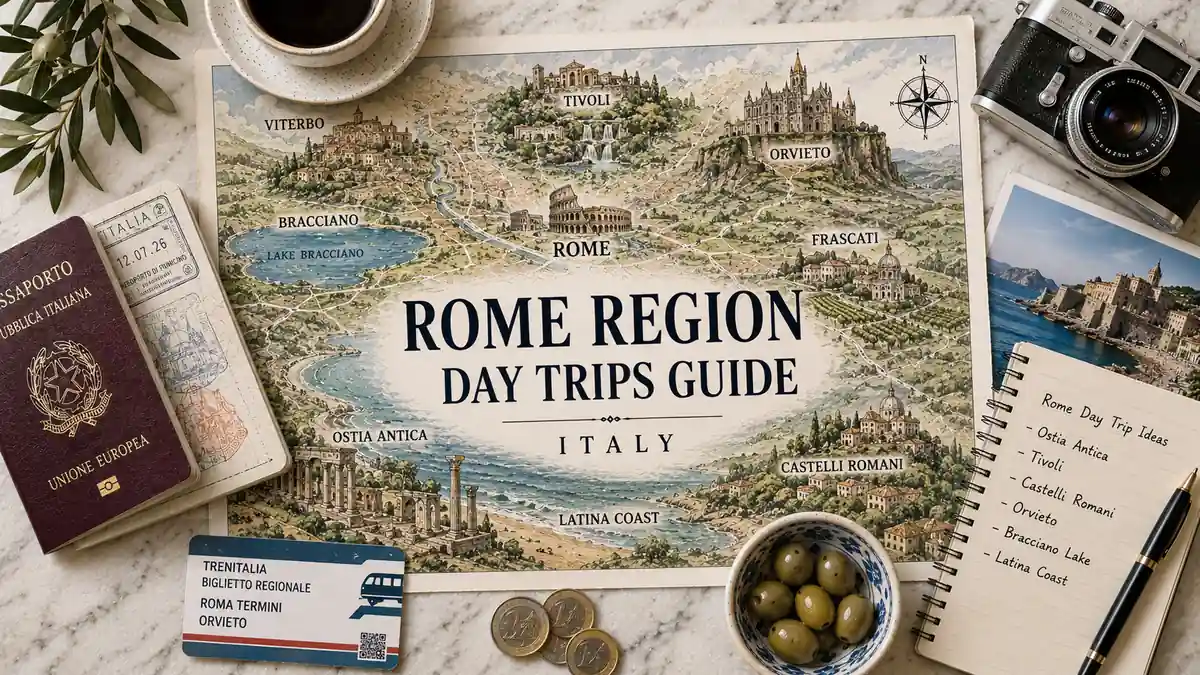
The strongest day trips from Rome sort cleanly by direction and theme. East lie the villas of Tivoli, west the ruined port of Ostia Antica, southeast the wine towns of the Castelli Romani, and along the shore the beaches of coastal Lazio. Pick by the kind of day you want.
| Direction and place | Character in one line | Best for |
|---|---|---|
| Tivoli — east | Renaissance gardens and imperial villa ruins | Gardens, fountains, and an easy half-day |
| Ostia Antica — coast | Rome’s remarkably intact ancient port city | Ruins lovers wanting fewer crowds |
| Castelli Romani — southeast | Hilltop wine towns and long cellar lunches | Food and wine travelers |
| Coastal Lazio — west | Train-reachable Tyrrhenian beaches and coves | Warm-season beach-seekers without a car |
Tivoli (East): Villas and Gardens
Tivoli is Rome’s villa town in the eastern hills, built around two UNESCO gardens. Its anchor experience is Villa d’Este, a Renaissance palace fronting a terraced garden of fountains, paired with the sprawling ruins of Hadrian’s Villa nearby. Regional trains and buses reach it from Rome in around an hour. Best for: travelers who want gardens, fountains, and imperial ruins in one unhurried half-day.
Ostia Antica (Coast): Rome’s Ruined Port Town
Ostia Antica is the strikingly intact ruin of Rome’s ancient seaport, west of the city near the coast. Its anchor experience is walking real streets, warehouses, baths, and a theater with far fewer crowds than the Forum. A direct regional train from Rome reaches it in roughly half an hour. Best for: ruins lovers who want a Pompeii-style site without leaving Lazio.
Frascati and the Castelli Romani (Southeast): Wine Towns
The Castelli Romani are a cluster of hilltop wine towns southeast of Rome, Frascati the best known. The anchor experience is a long lunch of porchetta and local white wine in cellars called fraschette, with crater-lake and volcano views. Regional trains and buses reach the main towns in under an hour. Best for: food and wine travelers who want a slow, tasting-led day.
Coastal Lazio: Beaches You Can Reach by Train
Coastal Lazio is the region’s train-reachable seaside, from Santa Marinella and Anzio along the wider Tyrrhenian shore. The anchor experience is a swim-and-lunch beach day, on sand or rocky coves depending on the town. Regional trains from Rome reach the closer resorts in roughly an hour. Best for: warm-season travelers who want sea time without a car. Because beach access and services swing hard with the calendar, check timing before you commit — our guide to the best time to visit Italy covers when the Lazio coast is actually worth the trip.
Train and bus tickets
Compare routes, schedules and prices across rail and bus operators in one search, with mobile tickets on your phone.
New to Omio? Code NEW10 takes 10% off your first booking — or APPNEW10 if you book inside the Omio app. Both apply to bookings up to €80.
Search routes and compare prices on Omio →
Tripstou may earn a commission if you book through this link, at no extra cost to you.
Should You Take the Train or a Guided Tour From Rome?
Take the train for close, rail-served stops, and a guided tour for the furthest or logistics-heavy trips. Most Lazio day trips are easy and cheap by regional train. Tours earn their price when a place is scattered, poorly connected, or genuinely better understood alongside a guide.
Laid out as options, each suits a different traveler and carries one defining tradeoff. Fares and tour prices move often, so treat any figure as a range and confirm before booking.
- Regional train — best for Ostia Antica, Tivoli, the Castelli, and the closer coast. Tickets are inexpensive, often only a few euros each way, and depart frequently from Rome’s main stations. Tradeoff: you handle your own connections and timing on the ground.
- High-speed train — best for far cities like Orvieto, Naples, or Florence when you still want independence. Fast and comfortable, though pricier and best booked ahead. Tradeoff: a day trip this far leaves little slack if anything runs late.
- Guided tour — best for scattered sites, wine tastings with transport included, or trips where a driver and local context add real value. Tradeoff: higher cost and a fixed group schedule you cannot bend.
The call usually comes down to one question: does the trip involve wine, several stops, or a site off the rail line? If yes, a tour quietly pays for itself. If it is one town on a train line, doing it yourself wins on both cost and freedom.
Tours and activities
Book skip-the-line tickets, day trips and local tours with free cancellation on most activities.
You can also browse everything on getyourguide.com.
Tripstou may earn a commission if you book through this link, at no extra cost to you.
Matching Rome Day Trips to Your Kind of Traveler
The right Rome day trip depends on what kind of traveler you are. First-timers, ruins lovers, food travelers, families, and beach-seekers each have a natural first pick. Match the trip to your main interest and the day essentially plans itself.
- First-timers: Ostia Antica or Tivoli — close, easy, and hard to get wrong on a first Rome trip.
- Ruins lovers: Ostia Antica for the port city, Tivoli’s Hadrian’s Villa for imperial scale.
- Food and wine travelers: the Castelli Romani, where lunch and local wine are the whole point.
- Families: Ostia Antica’s open ruins or a Castelli lake day — room to roam without museum fatigue.
- Beach-seekers: the train-reachable Lazio coast in the warm months.
The clearest fit signal is repetition. If you loved the Forum, you will love Ostia Antica; if the best part of Rome was a two-hour lunch, the Castelli is your day. When a favorite grows into an overnight — a wine weekend in the hills, a slow stretch of coast — it stops being a day trip and becomes part of a route. Our Italy itinerary guide shows how to fold these stops into a longer trip.
Frequently Asked Questions
Can you visit Orvieto as a day trip from Rome?
Yes, Orvieto makes a comfortable day trip, reachable by high-speed or regional train in roughly one to two hours. The hilltop Umbrian town rewards a full day around its striped cathedral, cliffside views, and underground caves. Start early and treat it as your single stop for the day, not one half of a two-town dash.
Can you do a day trip to Naples or Pompeii from Rome?
Yes, but it makes for a long, rushed day. Fast trains reach Naples in around an hour, putting Pompeii within a determined day trip. You will see the highlights and little else, so committed single-sight travelers manage it. For a fuller visit, fold it into a southern route instead.
Do you need a car for day trips from Rome?
No, most Rome day trips work well without a car. Regional trains reach Ostia Antica, Tivoli, Frascati, and the closer coast directly and cheaply. A car only earns its place for scattered Castelli hill towns or quiet stretches of coast off the rail line, where a guided tour is often the easier fix.
How many days in Rome before doing day trips?
Give Rome at least three full days before adding day trips. The city’s core sights — ancient Rome, the Vatican, and the historic center — comfortably fill that time. On a shorter stay, keep every day in the city. With four or more days, day trips become a rewarding second layer.
Which is the easiest day trip from Rome for first-timers?
Ostia Antica is the easiest first day trip, thanks to a short, direct regional train and self-explanatory ruins. You wander an intact Roman port at your own pace, with no tour or connections to manage. Tivoli runs a close second if gardens and fountains appeal more than an ancient street grid.
Are Rome day trips worth it in the off-season?
Yes, most Rome day trips hold up off-season, and some improve. Tivoli’s gardens, Ostia Antica’s ruins, and Castelli wine towns stay rewarding with thinner crowds and cooler walking weather. The clear exception is the coast, where beach services wind down; save Lazio’s seaside for the warmer months instead.
Related Guides
- Rome city guide — what to see, where to stay, and how to get around inside the city.
- Best places to visit in Italy — where Rome and Lazio sit among the country’s regions.
- Italy itinerary guide — turn day trips into a multi-day route across the country.
- Best time to visit Italy — seasonal timing, including when the Lazio coast is worth it.
- Italy travel guide — the national planning hub for a wider Italian trip.
- Best Day Trips from Rome
Did this guide save you time or money? Tripstou is independent and reader-funded — if you'd like to give something back, you can support the site with a crypto contribution of any size.