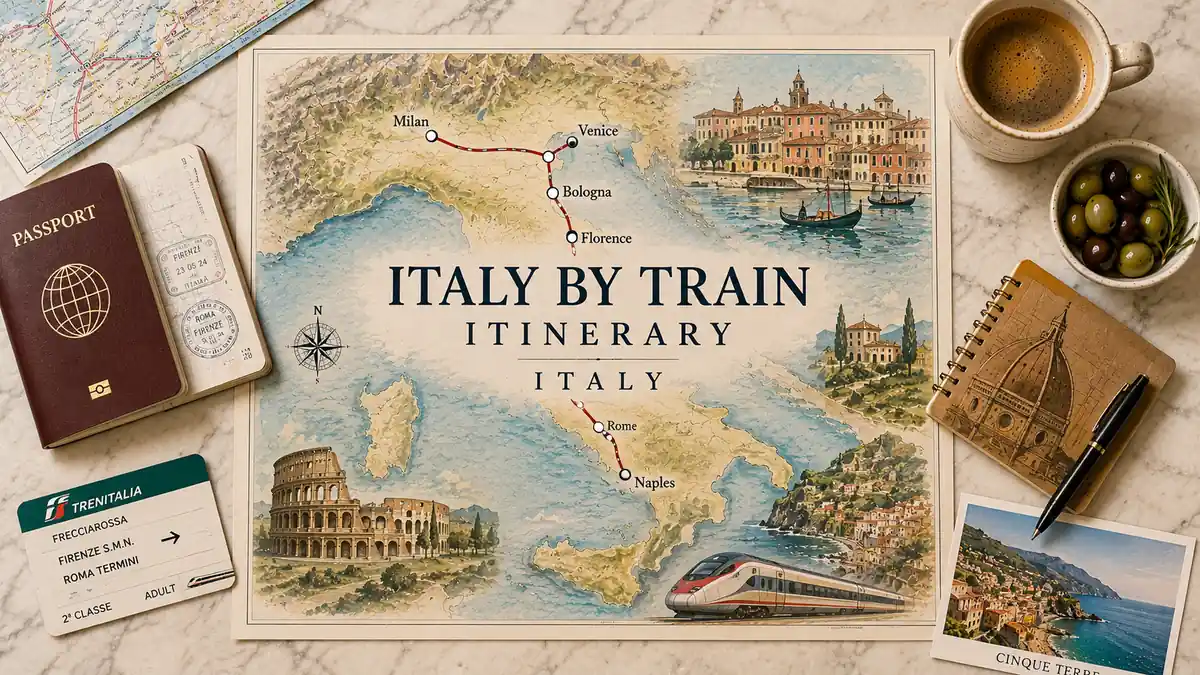
You’ve decided to see Italy by train, so you need the route, not a day-by-day sightseeing plan. The good news is that Italy’s high-speed network makes the decision easy: one fast spine connects almost every city worth visiting, so the real question is the order you ride it and how long to give each stop. This guide lays out the recommended north–south city chain, how many days and bases a rail trip realistically needs, and which legs genuinely beat driving. It also flags the handful of regional stretches where the high-speed pattern breaks, so nothing on your route catches you out. What it deliberately leaves to other guides: buying tickets, navigating individual stations, choosing exactly what to see in each city, and planning anything by car. Here, the focus is the route shape — the connective logic that turns a list of Italian cities into a clean, trainable itinerary.
Quick Answer
Chain Italy’s major cities north–south — Venice or Milan, Bologna, Florence, Rome, then Naples — over about seven to ten days. Fast Frecciarossa and Italo trains let you base in a few hubs instead of moving every night. It suits first-timers wanting the big cities without a car; add regional detours only if time allows.
Trust Layer
Tripstou itinerary guide for travelers planning a route. Covers pacing, stop count, stop order, base logic, and trip length.
Produced with AI assistance and reviewed by Alex Perrut, working in tourism since 2015, for the Tripstou editorial team. See our editorial process for details.
Last factual review: June 29, 2026.
Official sources consulted: Italia.it, ENIT.
Key Takeaways
- Chain Italy’s major cities north–south along the high-speed line, so every leg is short and you never backtrack.
- Allow about seven to ten days to cover three or four cities comfortably without rushing each stop.
- Base in a few well-connected hubs like Florence, Rome or Bologna and day-trip outward to cut hotel changes.
- On core pairs like Rome–Florence and Rome–Naples, the high-speed train beats driving door-to-door on time and stress.
- Cinque Terre and the Naples–Sorrento coast run on regional trains only, so plan them as deliberate detours.
- Book an open-jaw flight into one city and out of another to keep the route linear and skip backtracking.
Table of Contents
How Italy’s high-speed rail backbone works
Italy’s high-speed spine links Turin, Milan, Venice, Bologna, Florence, Rome and Naples on one fast corridor. Trenitalia’s Frecciarossa and rival Italo run it frequently all day, connecting nearly every city first-time visitors want. That single backbone is why a rail trip can skip the car and still reach the headline destinations.
The corridor behaves like one continuous line, not a web of separate routes. Trains depart through the day, so you rarely plan a whole leg around a single timetable slot, and the two operators compete on the busiest stretches, which keeps frequency high. Leg times are short by car standards — Rome to Florence runs around 1h30, Rome to Milan around 3h, and Rome to Venice around 3h45 — but treat these as approximate ranges and confirm current schedules before you book.
For planning, the practical takeaway is simple: if a city sits on this spine, it is easy to reach and easy to chain. The route logic in the rest of this guide assumes the high-speed line as your connective tissue, and treats anything off it as a deliberate detour.
Train and bus tickets
Compare routes, schedules and prices across rail and bus operators in one search, with mobile tickets on your phone.
New to Omio? Code NEW10 takes 10% off your first booking — or APPNEW10 if you book inside the Omio app. Both apply to bookings up to €80.
Search routes and compare prices on Omio →
Tripstou may earn a commission if you book through this link, at no extra cost to you.
The best train route through Italy
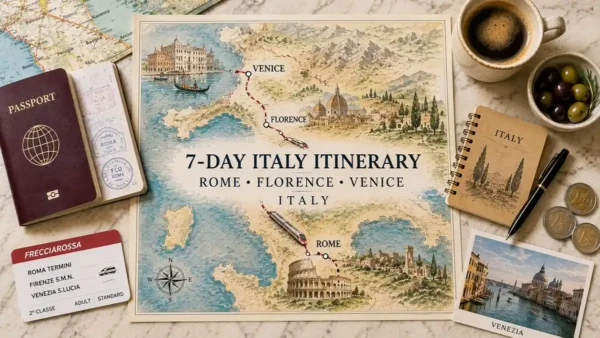
The best train route through Italy runs north–south: Venice, Bologna, Florence, Rome, then Naples. This chain follows the high-speed line in one direction, so every leg is short and you never double back. Start or finish in Milan if your flights land there, and drop Naples on a shorter trip.
This north–south chain works because it never backtracks. Each city hands off to the next along the same line, so you keep momentum and waste no time crossing the country twice. Assume the destinations themselves earn their place — that question belongs to our roundup of the best places to visit in Italy, while the wider trip context sits in the Italy travel guide.
Approximate door-to-door feel on the core chain; confirm current times before booking.
| Leg | Approximate high-speed time | What it means for pacing |
|---|---|---|
| Venice to Bologna | About 1h30 between city centres | Short enough to move in a morning |
| Bologna to Florence | Around 40 minutes on Frecciarossa | Easy as a day-trip or quick hop |
| Florence to Rome | About 1h30 city centre to centre | Comfortable single leg, no rush |
| Rome to Naples | Roughly 1h10 between centres | The fastest hop on the chain |
Fewer bases usually beats more stops. Every hotel change costs you half a day in check-out, transfers and check-in, so a tighter chain often sees more, not less. If you only have a week, hold the line at three or four cities instead of squeezing in a fifth.
Rome, Florence and Venice by train
Rome, Florence and Venice form the classic three-city core, and they connect in a straight high-speed line with no awkward changes. Most first-timers build their route around these three, then add Bologna or Naples if the calendar allows. The order is natural: arrive in the north at Venice, ride south through Florence, and finish in Rome — or reverse it to match your flights. Once the route is set, layer in the per-city depth from our Rome guide, Florence guide and Venice guide to decide how long each stop deserves.
Where to start and end your Italy rail trip
Run the route north–south or south–north, and bookend it with the cities nearest your airports. Most travellers start in Venice or Milan and end in Rome or Naples, because that matches the busiest long-haul gateways. The direction barely changes the trip; your arrival and departure points decide it.
Northern arrivals usually open in Milan or Venice, both well connected to international flights and sitting at the top of the high-speed spine. Southern-leaning trips often close in Rome, or push one stop further to Naples if you want the route to end on the coast. The key planning move is to avoid a “rubber-band” trip — landing in the north, sightseeing south, then doubling all the way back for departure. Booking an open-jaw flight (into one city, out of another) lets the route stay linear and saves a wasted travel day.
How many days do you need for Italy by train?
Allow about seven to ten days to chain Italy’s main cities comfortably by train. Seven days covers three or four cities at a steady pace; ten lets you add Naples or slow down without rushing. Fewer than seven days means cutting cities, not just shortening each stop.
Pacing scales with stops, not just total days. A useful rule of thumb is two nights per major city plus the travel time between them, which keeps each city from collapsing into a single rushed afternoon. Seven days suits Venice–Florence–Rome; ten days comfortably adds Bologna and Naples; two weeks gives room for a regional detour or a slower base-and-day-trip rhythm. For a full day-by-day breakdown across seven, ten or fourteen days, see our Italy itinerary guide, which sequences what to actually do in each city.
Best base cities for train day trips in Italy
Base in a few well-connected hubs — Florence, Rome and Bologna — and day-trip outward by rail. These cities sit on the high-speed line, so you sleep in one place and reach nearby towns in under an hour. Fewer hotel changes means less packing and more time actually seeing places.
The strongest bases share one trait: they sit on the spine and put other destinations within an easy out-and-back. A few work especially well:
- Florence — central Tuscany base, with Bologna and Pisa within a short high-speed or regional hop.
- Rome — the deepest base, with Naples reachable in around an hour for a long day out.
- Bologna — sits dead-centre on the line, making it the most flexible hub for reaching both Florence and the north.
Pick bases where the day-trips come to you. A hub on the high-speed line turns three or four destinations into one unpacking, which is the single biggest time-saver on a train trip. The tradeoff is less time waking up inside the smaller towns themselves — fine for day-trippable stops, worth a real overnight only when a place is the point of the trip.
Hotels and places to stay
Compare hotels, apartments and stays for your dates in one search.
Search hotels and stays on hotels.com →
Tripstou may earn a commission if you book through this link, at no extra cost to you.
Which Italian city pairs are faster by train than by car?
On the high-speed corridor — Rome–Florence, Milan–Bologna, Rome–Naples — the train beats the car door-to-door. Trains run city centre to city centre with no parking, traffic or fuel stops, while these same drives crawl through congestion. For these pairs, driving adds time and stress without adding freedom.
Approximate comparisons; train times exclude city parking, traffic and fuel stops.
| City pair | By high-speed train | By car | Verdict |
|---|---|---|---|
| Rome to Florence | About 1h30 centre to centre | Around 3 hours plus parking | Train wins comfortably door-to-door |
| Milan to Bologna | About 1 hour on Frecciarossa | Roughly 2h30 with traffic | Train is the clear choice |
| Rome to Naples | Roughly 1h10 between centres | Around 2h30 plus city traffic | Train wins on time and stress |
| Florence to Venice | About 2 hours by high-speed | Roughly 3 hours plus parking | Train wins and you avoid driving |
Count door-to-door, not just the drive — stations sit in city centres while parking rarely does. A car only starts to earn its keep off the high-speed spine, where rural regions and hill towns are genuinely easier with your own wheels. If you do want to drive parts of Italy, that’s a different trip; our Italy road trip guide covers the routes where a car actually pays off.
Where Italy’s high-speed network breaks (and how to plan around it)
A few stretches — the Cinque Terre and the Naples–Sorrento coast — are regional-only, not high-speed. You reach them by slower regional trains from the nearest big-city hub, so plan them as detours rather than mainline stops. Slot these legs at the start or end of the route, where the slower pace fits best.
The high-speed line gets you close, but the last stretch shifts to regional service. For the Cinque Terre, you ride the spine to a gateway like Florence or Milan, then change to the slower coastal regional train that links the five villages. For the Sorrento coast, you take high-speed to Naples, then switch to the separate regional line down the peninsula. Build these in as deliberate side-trips with their own pace, not as quick hops between major cities — and keep ticketing and station detail for the relevant city transport pages, which own that depth.
Frequently Asked Questions
How long are the train journeys between Italian cities?
Most high-speed legs between major Italian cities run under two hours. Bologna to Florence takes around 40 minutes, Florence to Rome about 1h30, and Rome to Naples roughly 1h10. Longer end-to-end runs like Rome to Venice sit nearer 3h45. Treat all of these as approximate, and confirm current schedules before you book.
Do you need to book Italy trains in advance?
For high-speed Frecciarossa and Italo trains, booking ahead is worth it because cheaper fares sell out as departure nears. Advance tickets typically open a few months before travel. Regional trains work differently — they carry a fixed fare and don’t need a reservation, so you can buy those on the day with no penalty.
What is the difference between Trenitalia and Italo?
Trenitalia is Italy’s national operator, running Frecciarossa high-speed services plus regional trains nationwide. Italo is a private competitor running only high-speed routes on the busiest corridors. On shared routes both are fast and comparable, so travellers usually choose on price and timing rather than brand. Only Trenitalia covers the regional and rural lines.
Is a rail pass worth it for Italy, or should you buy point-to-point tickets?
For most Italy rail trips, point-to-point tickets win because the high-speed network is cheap when booked early and your route is fixed. A pass mainly pays off if you take many spontaneous, long legs across several countries. For a planned north–south Italy chain, individual advance tickets are usually simpler and cheaper.
Which parts of Italy don’t have high-speed trains?
The high-speed network skips most coastal, rural and island areas, including the Cinque Terre, the Amalfi and Sorrento coast, and much of Sicily, Puglia and Tuscany’s hill towns. You reach these on slower regional trains from the nearest hub, or by car. Plan them as detours off the main north–south spine.
Related Guides
- Italy travel guide — the parent hub for planning the wider trip beyond the rail route.
- Italy itinerary — day-by-day plans across seven, ten and fourteen days.
- Best places to visit in Italy — decide which destinations earn a stop on your chain.
- Italy road trip — the routes where driving beats the train.
- Rome guide — per-city depth for the southern anchor of the route.
- Florence guide — per-city depth for the central Tuscan base.
Did this guide save you time or money? Tripstou is independent and reader-funded — if you'd like to give something back, you can support the site with a crypto contribution of any size.