Málaga is Andalusia’s coastal capital and the main city of the Costa del Sol: a compact, walkable city break with Picasso’s birthplace and museum, a Moorish fortress above a Roman theatre, a covered food market, a city beach and the rail gateway to Córdoba and Granada. Two to three days covers the city; four or more adds day trips.
For a long-haul first-timer it sits on Spain’s southern coast, a short rail ride from its airport, and most long-haul visitors reach it by connecting through a European hub. This page walks the planning decisions in order: whether to go, for how long, when, where to base, how to arrive, what it costs and which day trips earn a place.
Quick Answer
Málaga is worth visiting as a city break with a beach, not a resort stay: the Picasso Museum, the Alcazaba above the Roman Theatre, the Atarazanas market and a walkable centre are the draw. Plan two to three days for the city, four or more with Córdoba or Granada. Beach-first travelers should base along the Costa del Sol.
Málaga is a city break with a beach, not a beach holiday with a city
Málaga is worth it for a first trip to southern Spain, and its strength is the combination: Picasso, a Moorish fortress, a food market and a city beach all sit within walking distance of each other, with rail links that turn the city into a base. The tradeoff is that Málaga is a working city. Its beach is a city beach, and the resort feel lives further along the coast.
That working-city energy is what separates it from the other Andalusian candidates. Seville and Granada are monument cities, built around their headline sights and the crowds those draw. Málaga has fewer blockbuster monuments and more daily life: port promenades, a busy market, bars that fill with locals as well as visitors. A traveler who wants to see the great Moorish palaces still can, as a day trip.
The sea changes the rhythm of a city break here. An afternoon on the sand after a morning in a museum is a normal Málaga day, and both are on foot from the same hotel.
If Málaga is one stop on a wider route, the Spain travel guide sets out how the country fits together, and the best places to visit in Spain shows where Málaga ranks among the alternatives.
What Málaga Is Known For: Picasso, the Alcazaba and the Market
Málaga is known for Picasso, its Moorish hilltop fortress and its market. The defining names are the Casa Natal, where Picasso was born, and the Museo Picasso Málaga; the Alcazaba, with the Roman Theatre at its foot and Gibralfaro castle above; the Cathedral; the Mercado Central de Atarazanas; Soho’s street art; the Muelle Uno port promenade; and La Malagueta, the city beach.
The sights cluster tightly. The fortress hill, the old town, the port and the beach form one walkable area, and the core of it fits into a single full day. The Alcazaba and the Roman Theatre sit side by side at the foot of the hill, so they make one stop, and a guide helps the layered Roman and Moorish history make sense: book a guided visit if you want the context with the views. Gibralfaro is the steep part, above everything else.
Out on the water, a catamaran trip on the bay is a popular way to see the city from the sea, especially towards evening. The full list of sights, with how to visit each one, is in the guide to things to do in Málaga.
Atarazanas belongs on any first visit as a food stop as much as a sight. It is where the city shops, so go hungry and early. The Spain food guide explains what to look for on the counters.
Do you need to book the Picasso Museum in advance?
Yes, in practice: all Museo Picasso Málaga tickets are sold online, and the museum advises buying online to be sure of a place. Dates that sell out online are sometimes still available at the ticket office at quieter times, which is a fallback, not a plan. Entry is free every Sunday in the last two hours before closing.
The museum is the one sight in Málaga worth fixing before you travel. Book it first, then build the rest of the day around the time you enter, since the old town, the Cathedral and the Alcazaba all lie a short walk away.
Tours and activities
Book skip-the-line tickets, day trips and local tours with free cancellation on most activities.
You can also browse everything on getyourguide.com.
Tripstou may earn a commission if you book through this link, at no extra cost to you.
How many days do you need in Málaga?
Two full days covers Málaga’s main sights, three days is the comfortable length for a first trip, and four or more is when day trips earn their place. The city is compact, so extra days go to pace, the beach and the region beyond it.
- Two days: enough for the Picasso Museum, the Alcazaba and Gibralfaro, the Cathedral, Atarazanas and an evening on the port. What gets squeezed is slack time: the beach becomes an hour, not an afternoon. The two-day Málaga itinerary shows how the sights fit together.
- Three days: the sweet spot. The same sights at a walking pace, plus a proper beach afternoon at La Malagueta, Soho and a slow market lunch. Follow the three-day Málaga itinerary for a paced version.
- Four days or more: the city plus one or two day trips, usually Córdoba or Granada by train, or Ronda, Nerja or Caminito del Rey on the road. Each day trip needs its own full day, so count them on top of the city time.
A third day in Málaga buys more than a fourth city squeezed into a rushed route. Travelers who cut the city to a single night usually see the fortress and miss everything that makes it feel lived in.
Spring and autumn beat the summer peak in Málaga
Spring and autumn are the best seasons for Málaga: comfortable for walking the fortress hill, good for the beach on warm days, and calmer than the summer peak. July and August are the hottest and busiest months, with the Feria de Málaga filling the city in August. Winter is mild and quiet, with November and December the wettest stretch.
Spring has its own pull. Semana Santa brings processions through the old town, which make the city crowded and memorable at once. Plan accommodation early if those dates matter to you.
The season to pick depends on the kind of trip. A city-sights trip works in every month, and winter suits museum-and-fortress visitors who dislike crowds. A beach-weather trip points to late spring through early autumn, with the high summer weeks the costliest and most packed.
Summer in Málaga is a beach season, not a sightseeing one. Climbing to Gibralfaro in the midday heat of July is the mistake first-timers make most.
For the countrywide picture, see the best time to visit Spain, and pack for the season with the Spain packing list.
Where to Base Yourself: City Centre or a Costa del Sol Beach Town
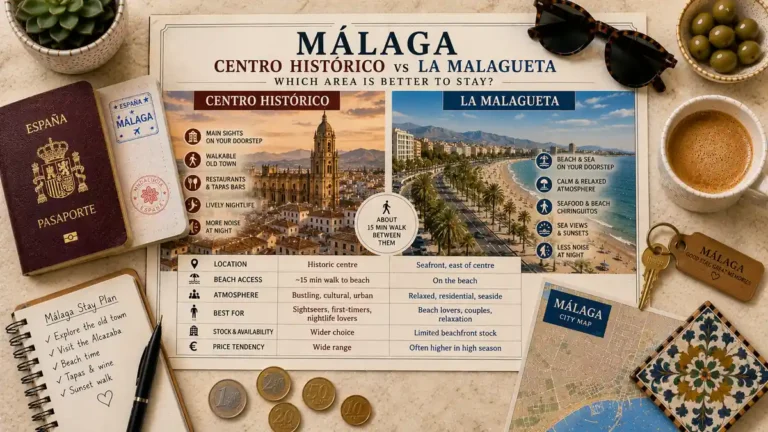
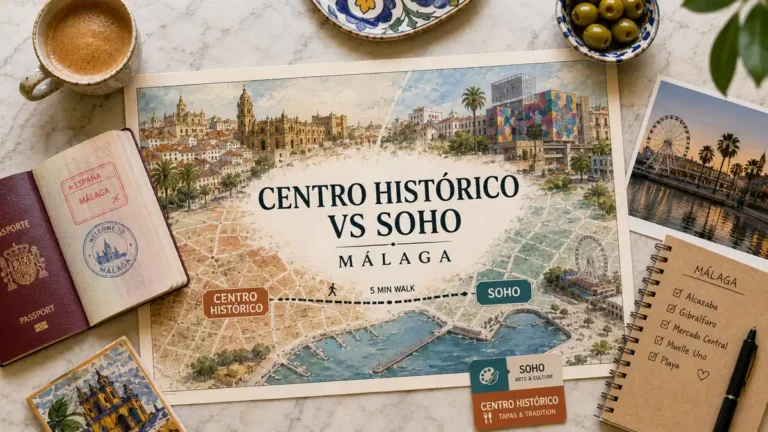
Base in the city for a first trip. Centro Histórico puts you inside everything, Soho gives a quieter arts-district feel a few streets from the centre, La Malagueta keeps the beach within walking distance of the old town, and the streets near María Zambrano suit rail day trips and lower prices. A Costa del Sol beach town is the right base only when the beach, not the city, is the point of the trip.
- Centro Histórico: the old town, with the museums, the Cathedral and the market on your doorstep and the liveliest evenings. It is the easy first-visit choice, at the cost of noise on weekend nights. The guide to where to stay in Málaga for a first visit narrows it down.
- Soho: street art, galleries and smaller bars a short walk from the centre, with a calmer feel after dark. Couples who want character away from the busiest streets should look here or at the quieter edges of the Centro, covered in where to stay in Málaga for couples; travelers who want to be out late lean towards the Centro itself, as the guide to where to stay in Málaga for nightlife explains.
- La Malagueta and the seafront: the city beach outside the door and the old town a walk away, which makes it the natural pick for a trip that mixes sights and sand. Families get the beach without giving up the city, as where to stay in Málaga with kids shows, and the seafront also holds the stays covered in Málaga’s luxury areas.
- Near María Zambrano: the practical base for a trip built around rail day trips, with lower prices than the old town and a plainer setting. Value-minded travelers will find the options in where to stay in Málaga on a budget.
A beach town such as Marbella, Nerja or Torremolinos makes sense when days on the sand are the holiday and Málaga is an outing. The Costa del Sol guide compares the coast’s towns, the best beach hotels in Málaga covers the in-between option of staying on the sand within the city, and the best beaches in Spain sets the Costa del Sol against the rest of the coastline. For the full comparison of neighbourhoods, use the guide to where to stay in Málaga.
Hotels and places to stay
Compare hotels, apartments and stays for your dates in one search.
Search hotels and stays on hotels.com →
Tripstou may earn a commission if you book through this link, at no extra cost to you.
Arriving in Málaga and Getting Around on Foot
Fly into Málaga Airport and take the Cercanías C1 train: it reaches Málaga Centro Alameda in about 12 minutes and María Zambrano in about 8 (Aena). Arriving by train from elsewhere in Spain, you step out at María Zambrano, a short walk or one C1 stop from the centre. Once there, the centre is walkable, and most first-time visitors never need public transport inside it.
The C1 suits light packers heading for the centre or María Zambrano. A pre-booked transfer or a taxi makes more sense with heavy luggage, small children or a late arrival, and the airport express bus is the other public option. The Málaga airport transport guide compares all three.
On foot, the old town, the port and La Malagueta form one easy triangle. A bus or taxi is worth it for the climb to Gibralfaro and for the beaches beyond La Malagueta; the guide to getting around Málaga covers both.
María Zambrano is also the node for a wider rail trip, with trains to Córdoba, Granada and Seville. The Spain train itinerary shows how Málaga fits into a route by rail.
Check the entry rules that apply to your passport before booking.
How much does a trip to Málaga cost per day?
A budget trip to Málaga runs around €45–€80 per person per day. A mid-range trip runs around €100–€180. A luxury trip starts at roughly €250 and goes upward. All three exclude flights. Málaga rewards the mid-range traveler and punishes nobody: the centre is compact enough that getting around costs little at every spend style.
| Spend style | Per person per day, flights excluded | What it buys in Málaga |
|---|---|---|
| Budget | Around €45–€80 per day | Hostel or simple room, market and tapas-bar meals, everything on foot |
| Mid-range | Around €100–€180 per day | Hotel in the centre or by the beach, sit-down meals, paid museums, one or two day trips |
| Luxury / high-end | Roughly €250 and upward | Seafront or boutique hotel, restaurant dining, private transfers and guided day trips |
Where you sleep moves the daily figure more than anything else, and summer pushes it towards the top of each band. Day trips add to it, so a four-day trip with two of them sits higher in the band than four days in the city.
The full breakdown by category is in the Málaga trip cost guide, the national picture is in the Spain travel budget, and the everyday habits that keep spending down are in the Málaga travel tips.
Córdoba and Granada are the day trips that work; Seville is a long day
From María Zambrano, Córdoba is the closest and easiest rail day trip, and Granada with the Alhambra is a full but genuine day, as long as the Alhambra is booked first. Ronda with Setenil and Nerja with Frigiliana are easier by car, Caminito del Rey is a half-day activity that needs a ticket, and Seville is a long day that works better as an overnight.
| Destination | How you get there | Day-trip verdict |
|---|---|---|
| Córdoba | Train from María Zambrano | Genuine day trip, the easiest of the set |
| Granada and the Alhambra | Train | Genuine but full day; book the Alhambra first |
| Ronda with Setenil de las Bodegas | Car or organised coach | Genuine day trip by road |
| Nerja caves with Frigiliana | Bus or car, no train | Genuine day trip along the coast |
| Caminito del Rey | Regional train to El Chorro, or car | Half-day activity; ticket required, no entry for under-8s |
| Seville | Train | Long day; better as an overnight |
Granada works as a day trip from Málaga, provided the Alhambra is booked ahead; without a slot, stay a night in Granada so the palace and the city both get a fair visit. Travelers who would sooner skip the logistics can book this day trip with the Alhambra visit built in.
Ronda and Setenil de las Bodegas pair well because they share the same inland trip, and a car lets you take both at your own pace. Without one, a coach day is the simple fix: reserve a seat on an organised trip. Nerja’s caves and the white village of Frigiliana make the coastal counterpart, covered with the other coast towns in the Costa del Sol guide.
Caminito del Rey needs a ticket and some planning. Children under eight cannot enter, and tickets are sold on the official site or at the northern access, not at the Visitors’ Reception Centre. Book early, because tickets are released in batches.
Seville is the outlier. It is worth seeing, but as a day trip it leaves little time on the ground, and one night there changes the visit completely. For the car-based pairings and longer loops through Andalusia, see the Spain road trip guide.
Who Málaga Suits, and Who Should Base Elsewhere
Málaga suits first-time visitors to Spain who want a real city by the sea, food-market eaters, culture-first couples, families who want a beach a walk from the sights, and rail travelers using it as a southern base. It suits less well travelers who want a resort beach as the whole holiday, who should base along the Costa del Sol, and travelers chasing the big monument cities, who should give Seville and Granada their own nights.
Couples and culture-led travelers get the most from the centre: museums by day, the old town and the port by night, everything on foot. Families gain from the city beach, which turns a sightseeing trip into one children enjoy too.
Rail travelers get a different value. Málaga works as the southern anchor of a route, with Córdoba and Granada reachable as days out and the airport a short train ride from the centre.
Solo and solo female travelers find the centre easy to walk and lively into the evening. The Málaga safety guide covers the specifics, the guide to solo female travel safety in Spain adds country-wide advice, and the rundown of common scams in Spain explains what to watch for in busy areas.
About This Málaga Guide
This guide is a first-trip planner for Málaga city: how long to stay, which season to pick, where to base, how to arrive, what each spend style costs and which day trips work. Sights, neighbourhoods, day-by-day plans and transport detail live on the linked Málaga pages.
Alex Perrut, working in tourism since 2015, went over this Málaga planner for the Tripstou editorial team after it was written with AI assistance; our editorial process sets out how pages are checked.
Official sources consulted: Aena, Museo Picasso Málaga, Caminito del Rey, Spain.info.
The Short Version
- Málaga works best as a city break with a city beach attached, so travelers who want the beach as the whole holiday should base in a Costa del Sol town instead.
- Two to three days covers the city at a comfortable pace, and each day trip to Córdoba, Granada, Ronda or Nerja needs a full day of its own on top.
- Spring and autumn are the best seasons for Málaga, while July and August are the hottest and busiest months and suit the beach more than the climb to Gibralfaro.
- A first trip is easiest from a base in the city: Centro Histórico, Soho or La Malagueta for walking distance to everything, the streets near María Zambrano for rail day trips.
- The Museo Picasso Málaga sells all its tickets online and is the one Málaga sight worth booking before you travel.
Málaga Questions Before You Book
Can you reach the Costa del Sol beach towns from Málaga by train?
Yes, to the west of the city: the Cercanías C1 runs from Málaga Centro Alameda past the airport to Benalmádena and Fuengirola, so a beach day there needs no car. Nerja, to the east, has no train and is a bus or car trip. The Costa del Sol guide compares the towns themselves.
Do you need a car for a trip to Málaga?
No, not for the city or the rail day trips. The centre is walkable, the C1 train links the airport, and Córdoba, Granada and Seville are reached by train from María Zambrano. A car pays off only for Ronda with Setenil, or Nerja and Frigiliana at your own pace, and an organised coach day covers Ronda without one.
Keep Planning Your Spain Trip
- Costa del Sol guide: the coast around Málaga, its beach towns and Nerja.
- Spain itinerary: how Málaga fits into a first route through Spain.
- Spain in seven days: a one-week route with room for the south.
- Spain in ten days: time for Málaga, Andalusia and a big city.
- Spain in two weeks: the long route that links the south to the rest of the country.
- Spain’s islands: for readers weighing the mainland coast against an island trip.
Did this guide save you time or money? Tripstou is independent and reader-funded — if you'd like to give something back, you can support the site with a crypto contribution of any size.