
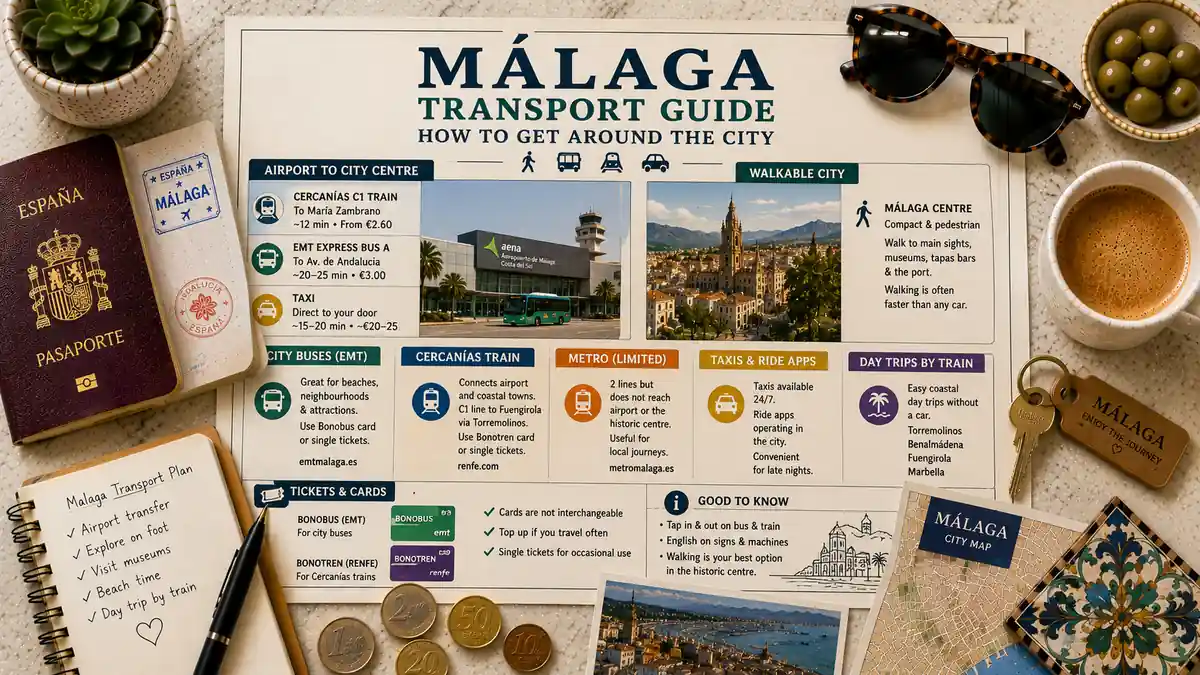
Getting around Malaga comes down to one early question: how do you reach the city from the airport, and then move around once you arrive? This guide answers both, starting with the airport transfer and working through every city mode you’ll realistically use. The good news is that Malaga’s historic centre is compact and largely walkable, so much of a typical visit happens on foot. Beyond the centre, you have a clear set of options — the Cercanías train, EMT city buses and the airport express, a limited metro, taxis and ride apps, and the coastal train line for day trips. We resolve the airport-to-city decision first, then explain when each city mode is worth using and how tickets and transit cards work in practice, so you can plan your movement before you go.
Quick Answer
Malaga’s historic centre is walkable, so most visitors explore it on foot. From the airport, the Cercanías C1 train and the EMT express bus both reach the centre cheaply, while a taxi is fastest door-to-door. Which mode wins depends on where you stay and how much you’ll move; buy a transit card only if you ride often.
Trust Layer
Tripstou planning guide for travelers resolving one travel decision. Covers the main variable, traveler context, and practical tradeoffs.
Produced with AI assistance and reviewed by Alex Perrut, working in tourism since 2015, for the Tripstou editorial team. See our editorial process for details.
Last factual review: June 12, 2026.
Official sources consulted: travel-europe.europa.eu, european-union.europa.eu.
Key Takeaways
- Malaga’s compact historic centre is largely pedestrian, so you’ll walk to the cathedral, Alcazaba, and port without needing any transport.
- From the airport, the Cercanías C1 train and EMT express bus reach the centre cheaply, while a taxi wins for luggage or late arrivals.
- The metro rarely helps sightseers, since its two lines miss both the airport and the historic old town entirely.
- Take the Cercanías C1 coastal line for easy, car-free day trips to Torremolinos, Benalmádena, and Fuengirola.
- Buy a rechargeable card only if you ride one mode often; occasional travelers save more with single tickets.
Table of Contents
How do you get from Malaga Airport to the city centre?
The Cercanías C1 train and EMT express bus are cheapest; a taxi is fastest and door-to-door. The train suits travelers staying near the centre or coast, the express bus suits those close to its route, and a taxi makes sense with heavy luggage, late arrivals, or a group splitting the cost.
All three options drop you in or near the centre, so the right choice is mostly about your base and your bags. The Cercanías C1 train is the most flexible because it links the airport directly to Malaga Centro and continues along the coast, making it ideal if your hotel is near a central or coastal station. The EMT express bus runs a direct service into the city and is convenient when you’re staying close to its route. A taxi removes every transfer and waiting step, which is why it wins for late flights, lots of luggage, or a group that can share the fare.
Costs and best-fit are general guidance — confirm current fares before you travel.
| Option | Relative cost | Best for | Key point |
|---|---|---|---|
| Cercanías C1 train | Low, flat fare per ride | Stays near Malaga Centro or the coast | Runs to the centre and on toward Fuengirola |
| EMT express bus | Low, single flat fare | Stays close to the express route | Direct service straight into the city |
| Taxi or ride app | Highest of the three | Luggage, late arrivals, or groups | Door-to-door with no transfers or waiting |
Because the best route depends heavily on your hotel’s location, it pays to settle your base before deciding — start with our guide to where to stay in Malaga.
Train and bus tickets
Compare routes, schedules and prices across rail and bus operators in one search, with mobile tickets on your phone.
New to Omio? Code NEW10 takes 10% off your first booking — or APPNEW10 if you book inside the Omio app. Both apply to bookings up to €80.
Search routes and compare prices on Omio →
Tripstou may earn a commission if you book through this link, at no extra cost to you.
Is Malaga’s historic centre walkable?
Yes, Malaga’s historic centre is highly walkable. The old town, cathedral, Picasso sights, Alcazaba, and the port promenade sit within a compact, mostly pedestrian core. Most visitors cover the headline sights on foot in a day or two, with no need for buses, metro, or taxis inside the centre itself.
Distances between the main attractions are short, and the streets between them are largely pedestrianised, so walking is usually faster than waiting for any vehicle. The historic core flows naturally from the cathedral and Calle Larios shopping street up to the Alcazaba and Gibralfaro hill, then down to the marina and beach promenade — a route you can string together comfortably on foot. This is exactly why a typical first visit barely touches public transport inside the centre.
If you want a ready-made way to sequence these walkable sights, our 2 days in Malaga plan covers the essentials, while 3 days in Malaga adds time for nearby trips and a slower pace.
When should you use Malaga’s city buses (EMT)?
Use EMT city buses when you travel beyond the walkable centre — to outlying beaches, hilltop viewpoints, or residential districts. Within the old town they rarely save time, since walking is faster over short distances. Buses earn their place mainly for longer hops the centre’s pedestrian core can’t cover on foot.
EMT runs the city bus network and the airport express service, so it’s the backbone for trips that stretch past the centre. A single bus fare is paid on board, and the same buses connect the kinds of places that sit just too far to walk comfortably:
- Beaches and seafront stretches beyond the central La Malagueta area
- Higher viewpoints and districts up the hill when you’d rather not climb
- Outlying neighbourhoods, shopping areas, and transport hubs outside the old town
For most sightseeing inside the centre, though, you’ll still walk — the buses are a tool for the longer journeys, not the short ones.
Is the Malaga metro useful for visitors?
The metro rarely helps a sightseeing visitor. Malaga’s two metro lines run through El Perchel toward the university and western suburbs, serving neither the airport nor the historic old town. For headline sights, the centre is walkable and the train covers the airport, so most visitors never need the metro.
The system is built for resident commuting rather than tourism, which is why its route misses the attractions most travelers come for. It can still make sense in a few narrow cases:
- You’re staying near a metro stop on one of the two lines
- You’re heading to the university area or a western suburb
- You have a specific errand along the line rather than sightseeing in the centre
Outside those situations, walking, the Cercanías train, and city buses cover everything a visitor typically needs.
How do you reach the coastal towns by train?
Take the Cercanías C1 line to reach the coastal towns. The same line that links the airport runs west along the coast toward Fuengirola, stopping at resort towns like Torremolinos and Benalmádena. It makes easy, low-cost day trips from Malaga without a car, leaving from the central Cercanías station.
Trains run regularly through the day, so you can travel out, spend a few hours by the sea, and head back without much planning. Because the line is a straight coastal run, it’s the simplest car-free way to sample the Costa del Sol from a Malaga base — you board in the centre, ride a short distance along the shore, and step off in the resort town of your choice. Keep day trips light and flexible rather than over-scheduled, and check return times before the last service so you’re not caught out in the evening.
When does a taxi or ride app make sense in Malaga?
Use a taxi or ride app for door-to-door, late-night, or group trips. They win when you’re carrying luggage, travelling after the trains and buses wind down, or splitting the fare among several people. For daytime sightseeing in the centre, walking is almost always faster and cheaper than waiting for a car.
Official metered taxis are widely available across the city and at the airport, and ride-hailing apps operate in Malaga too, though availability and which apps work can vary. In practice, the decision is about convenience rather than routine transport: a taxi is worth it for an awkward late arrival, a tired evening with shopping bags, or a group where the shared cost rivals several single fares. For everything else inside the compact centre, you’ll move faster on foot.
Should you buy single tickets or a transit card?
Buy a rechargeable transit card only if you’ll use transit a lot. For light use, single tickets bought per ride are simpler and cheaper overall. Malaga uses separate cards — Bonobus for EMT buses and Bonotren for Cercanías trains — so a card pays off mainly when you ride the same mode repeatedly.
The cards are rechargeable and give a reduced fare per ride compared with paying single each time, so the more you travel on one mode, the more they save. The catch is that buses and trains use different cards, so a visitor who mostly walks and only rides occasionally rarely recoups the value. If your trip is centre-based with a couple of airport or coastal journeys, single tickets keep things simple; if you’ll commute daily on the bus or the coastal train, a card earns its place.
How these fares add up across your whole trip is a budgeting question rather than a transport one — our Malaga trip cost guide folds transport into the wider total.
Frequently Asked Questions
Is Uber available in Malaga?
Ride-hailing apps do operate in Malaga, though which ones work and how many cars are available can vary. Official metered taxis remain the most reliable on-demand option, especially at the airport and late at night. For short central trips, walking is usually faster than waiting for any car.
Do I need to rent a car to visit Malaga?
No, you do not need a car to visit Malaga. The historic centre is walkable, the Cercanías train links the airport and coastal towns, and city buses cover outlying areas. A car only helps for inland villages or flexible road trips beyond the reach of public transport.
Can I use the same card for buses and trains in Malaga?
No, Malaga’s buses and trains use separate cards. The Bonobus card works on EMT city buses, while the Bonotren card covers Cercanías trains, so a single card won’t cover both modes. If you mostly walk and ride occasionally, single tickets are usually simpler than topping up either card.
Is Malaga Airport far from the city centre?
No, Malaga Airport sits close to the city, just southwest of the centre along the coast. The Cercanías C1 train and the EMT express bus both run directly into town for a low flat fare, while a taxi offers the quickest door-to-door ride for those with luggage.
Can you get around Malaga without speaking Spanish?
Yes, you can get around Malaga comfortably without Spanish. Signage, ticket machines, and transport apps typically offer English, and the walkable centre needs little navigation help. Learning a few basic phrases is courteous and useful, but English is widely understood across the tourist-facing parts of the city.
Does Malaga have a hop-on hop-off tourist bus?
Yes, Malaga runs a hop-on hop-off sightseeing bus that loops the main attractions. It suits first-time visitors who want an orientation circuit without planning routes, though the compact centre is easily walked. For everyday movement beyond the sights, the regular EMT buses and Cercanías train are cheaper and more flexible.
Related Guides
Use these guides to plan the rest of your Malaga trip once your transport is sorted:
- Malaga travel guide — the cluster hub that ties every Malaga planning decision together.
- Where to stay in Malaga — pick a base, which in turn shapes your best airport route.
- 2 days in Malaga — a tight plan that sequences the walkable centre’s headline sights.
- 3 days in Malaga — adds room for coastal day trips by train and a slower pace.
- Malaga trip cost — fits transport spending into your overall travel budget.
- Malaga travel tips — practical local know-how for a smoother first visit.
Did this guide save you time or money? Tripstou is independent and reader-funded — if you'd like to give something back, you can support the site with a crypto contribution of any size.