
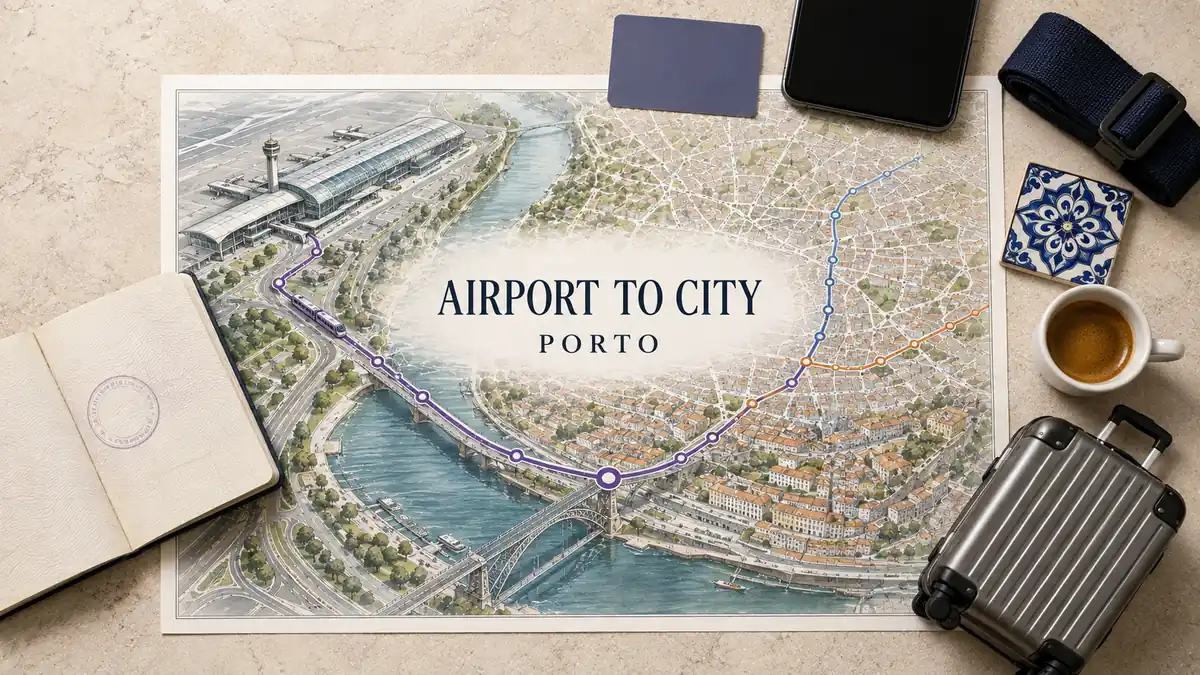
You land at Porto Airport with one decision left: how to reach the city centre. Four modes compete for the run — the metro, ride-hailing, a taxi, and the city bus — plus a pre-booked transfer if you want a driver holding a sign at arrivals. Three variables settle it: what the trip costs, how much luggage and how many people you are moving, and what time your flight touches down. Most arrivals resolve in about a minute, because Porto made the easy answer genuinely easy — the metro station sits inside the terminal building. The harder case is the late flight. This guide covers the cost and journey time of each mode, the ticket you actually buy at the machine, the traveler profiles where a car wins, and a straight answer for landing after midnight, once the metro has stopped.
Quick Answer
The metro (Line E) is the best way from Porto Airport into the centre for most arrivals. The station sits inside the terminal and the ride costs about €3. Uber, Bolt or a taxi suit heavy luggage and groups of three or more. After the last train, shortly after midnight, the hourly 3M night bus takes over.
Trust Layer
Tripstou transport guide for travelers deciding how to make a specific journey. Covers realistic options, tradeoffs by traveler type and luggage, passes, and arrival cases.
Produced with AI assistance and reviewed by Alex Perrut, working in tourism since 2015, for the Tripstou editorial team. See our editorial process for details.
Last factual review: August 30, 2026.
Official sources consulted: Visit Portugal, Turismo de Portugal.
Key Takeaways
- Line E runs from inside the Porto Airport terminal to Trindade in 25–35 minutes for about €3 all in.
- A car wins on heavy luggage, groups of three or more, and any landing after the metro has stopped.
- The last train leaves shortly after midnight; the 3M night bus then runs hourly between the airport and Aliados.
- Buy your Andante title from a station machine: a ticket bought from the bus driver always costs more.
- Split three ways, a taxi drops to single figures per head, which changes the maths for groups with suitcases.
- The metro’s weak point is the last stretch on foot — cobbles and hills between Trindade and an old-centre door.
Table of Contents
How Do You Get from Porto Airport to the City Centre?
Five realistic options connect Porto Airport to the city centre, and the metro is right for most travelers. Line E runs from inside the terminal to Trindade for about €3. Cars — taxi, Uber, Bolt or a pre-booked transfer — win on luggage and party size, and the city buses trail everything else.
- Metro, Line E (violet): the default. Suits anyone with manageable luggage. Tradeoff: you finish the last stretch to your door on foot.
- Uber or Bolt: the cheaper car option. Suits couples with big bags and groups splitting a fare. Tradeoff: prices climb when demand surges.
- Taxi: always there, no app needed, no data needed. Suits arrivals who want to walk out and go. Tradeoff: the highest routine cost of the four.
- STCP city bus: cheap and slow. Suits people staying near a bus corridor away from the metro line. Tradeoff: local streets, frequent stops.
- Pre-booked transfer: a named driver waiting in arrivals. Suits families and late landings with luggage. Tradeoff: you pay a premium for certainty.
| Mode | Cost band | Journey time | Best for |
|---|---|---|---|
| Metro, Line E | About €3 all in, card included | 25–35 minutes to Trindade | Most arrivals with normal luggage |
| Uber or Bolt | €15–25 typical, higher when surging | Door to door, traffic dependent | Heavy bags, groups splitting one fare |
| Taxi | €25–35, more at night and weekends | Door to door, traffic dependent | Walking straight out without an app |
| STCP city bus | Andante title, similar band to the metro | Considerably slower than the metro | Addresses off the metro line |
| Pre-booked transfer | Fixed fare agreed when you book | Door to door, driver waits for you | Families and late-night arrivals |
The ladder collapses quickly in practice. Two of the five options — the metro and ride-hailing — cover almost every arrival, and the choice between them is really a choice about how much you are carrying. Buses stay in the list because they are genuinely useful for a handful of addresses, and a transfer stays because arrival hour changes what comfort is worth. If you are still assembling the wider trip around this journey, our Porto travel guide covers what to do once you are in the centre.
Train and bus tickets
Compare routes, schedules and prices across rail and bus operators in one search, with mobile tickets on your phone.
New to Omio? Code NEW10 takes 10% off your first booking — or APPNEW10 if you book inside the Omio app. Both apply to bookings up to €80.
Search routes and compare prices on Omio →
Tripstou may earn a commission if you book through this link, at no extra cost to you.
The Metro Is the Best Way into Central Porto for Most Arrivals
Take Line E from inside the terminal: it reaches Trindade in 25–35 minutes with no changes. Nothing about the journey is awkward — no shuttle bus to the station, no outdoor walk, no traffic to sit in. Trindade puts you a short walk from Aliados and the historic centre. That is the whole appeal.
Line E, the violet line, is the airport line. Trindade is the interchange where every other Porto metro line meets, so if your accommodation is not walkable from there, you change platforms and continue on the same journey. Departures run frequently through the day, and the last train leaves the airport shortly after midnight, around 00:40.
What Line E removes is variance. The fare is fixed before you board, and so, near enough, is the arrival time. Every car on this run is priced by the traffic it meets between the airport and the centre — and you learn what that costs only once you are sitting in the back of it.
Trindade and Aliados sit at the top of the historic core, which matters when you pick your base: an address in Baixa or near Aliados makes the metro drop-off feel like arriving at your door, while a riverside or Gaia stay adds an onward hop or a steep walk. Our guide to where to stay in Porto maps the areas against that trade. Travelers the metro does not suit — heavy luggage, groups, after-midnight landings — are covered in the sections below.
What Ticket Do You Buy at the Airport?
Buy a Z4 Andante title from the ticket machines in the airport metro station: €2.30 for the journey, plus €0.60 for the reusable Andante Azul card on a first purchase — about €2.90 all in. The card is not a single-use ticket. It stays in your wallet, and every later trip costs the title alone, including the ride back out to the airport at the end of the trip. The machines sit by the platform entrance. The wider system — how zones, top-ups and validation work across the network — is covered in our Porto transport guide.
How Much Is a Taxi or Uber from Porto Airport?
Expect €15–25 with Uber or Bolt and €25–35 by taxi from the airport to the centre. Both run door to door, both are easy to arrange at the terminal, and ride-hailing is usually the cheaper of the two. Taxi meters add a luggage charge, and night and weekend rates run higher.
- Uber and Bolt: both operate at Porto Airport, with a marked pickup area outside arrivals. You see the price before you accept it, which removes the meter guesswork. Demand surges — bad weather, a bank of flights landing together, late evenings — push the fare toward the taxi band.
- Taxi: the rank sits outside arrivals and does not run dry. You pay for that reliability. Fares are metered, so a slow run through evening traffic costs more than the same trip at dawn.
Split three ways, a taxi lands around €8–12 a head. That is still several times the metro fare, and it still wins the moment three people are wrestling real suitcases through a platform change.
One practical condition applies to ride-hailing: the apps need mobile data the second you clear customs, and airport wi-fi is not a plan you want to lean on with a queue behind you. Sorting a Portuguese SIM or eSIM before you fly keeps Uber and Bolt usable on landing. Without data, the taxi rank is your car option by default.
Is There a Direct Bus from the Airport to the Centre?
Yes — STCP buses 601 and 602 run from the airport to Cordoaria in the centre. They follow local streets with frequent stops, so they are considerably slower than the metro for a comparable fare. Line 604 serves S. João Hospital. For almost every arrival, the metro is the better ride.
The buses earn their place for one reason: they stop in places the metro does not. If your accommodation sits along a 601 or 602 corridor, the bus can save you a change and a walk. Everyone heading for Trindade, Aliados, Baixa or the river is better served by Line E, which covers the distance without meeting a single traffic light.
Buy your Andante title from a machine before boarding. A ticket bought from the driver costs more than an Andante title, and it is the one avoidable overpayment on this journey.
What to Do When You Land After Midnight
After the last train, the hourly 3M night bus and a car are the two real options. The metro’s last departure is shortly after midnight, around 00:40. The 3M runs between Avenida dos Aliados and the airport from 00:30 to 05:30, hourly. Your arrival time inside that hour decides which one to take.
The hourly gap decides this more than the fare does: miss the 3M by five minutes and the wait outlasts the ride.
The decision resolves cleanly once you know your landing time and your luggage:
- Bus due within about 20 minutes, light luggage: take the 3M. It is cheap, it goes straight to Aliados, and the wait is shorter than a taxi queue behind a full flight.
- Bus just gone, or you are carrying big suitcases: take a taxi or a ride-hailing car. A near-empty road at 02:00 is the fastest this journey ever gets.
- Group of three or more: split a car. At that party size the per-head cost barely registers against an hour of standing in an empty terminal.
- Family, small children, or a flight you already know lands late: pre-book a transfer. This is the one arrival profile where the premium buys something concrete — a named driver, a fixed price, and no decisions to make at 01:00.
A pre-booked transfer is poor value on a midday arrival, when the metro is running and a car is a five-minute app tap away. On a 01:30 landing with two checked bags and a hotel across the river, it stops being a luxury.
Heavy Luggage and Groups Tip the Decision Toward a Car
With big suitcases or three-plus travelers, a car usually beats the metro on comfort per euro. Solo travelers and couples with cabin bags should stay on Line E — the saving is real and the walk is short. Once three fares split one car, the gap narrows to a handful of euros a head.
The metro’s weak point at OPO is not the ride but the last two hundred metres at the other end. Trindade to a hotel door in the old centre means cobbles and, often, a hill. That stretch is where two heavy suitcases stop being manageable, and it is the reason a family’s answer differs from a backpacker’s on the identical journey.
- Solo or a couple, cabin bags: metro. Nothing else is worth paying for.
- Family with checked suitcases: a car, door to door. The fare buys you an arrival with no stairs and no stops.
- Three or more adults: a car, split. The per-head cost falls to single figures, and you skip both the transfer at Trindade and the walk at the far end.
One aside on renting a car: it makes sense only if you are driving straight out of Porto — to the Douro Valley or up the coast — on the day you land. For a stay in the city itself, a car is a parking problem in a place built for walking.
Getting Back to the Airport for Your Flight
The return leg is the same journey in reverse, and cheaper, because your Andante card is already in your wallet — you pay for the title alone. Allow a comfortable buffer over the 25–35-minute metro time: add the walk to the station, the wait for a train, and the fact that morning trains carry commuters. For very early departures the metro may not be running yet, which is when a pre-booked car or taxi becomes the only option. Slot the airport run into the last morning deliberately, whether you are working from a 2-day Porto itinerary or the longer 3-day version, so the final hours are not a rush.
Frequently Asked Questions
What is the cheapest way from Porto Airport to the city centre?
The metro is the cheapest way, at about €3 all in on a first purchase including the reusable Andante card. The STCP city bus costs a similar fare but takes considerably longer, so it saves nothing. Every car option — taxi, Uber, Bolt, transfer — costs several times more.
What is the best way from Porto Airport to the city centre?
For most arrivals it is the metro: Line E leaves from inside the terminal and reaches Trindade in 25–35 minutes. Three things flip that answer — several heavy suitcases, a party of three or more sharing one fare, or a landing after the last train.
Can you pay contactless on the Porto metro?
Plan on buying an Andante title, not on tapping a bank card. The ticket machines inside the airport metro station sell the airport title and the reusable Andante Azul card together, and validating that card at the gate is the route that always works. Later trips cost the title alone.
How do you get from Porto Airport to Ribeira?
Take Line E to Trindade, then walk downhill through Aliados and Baixa to the river, or change onto another metro line for part of the way. The descent is steep and cobbled, so with heavy suitcases a taxi or ride-hailing car direct to Ribeira is the easier arrival.
Is the Porto metro manageable with large suitcases?
Yes for the airport end: the platform is inside the terminal, so there are no shuttles, no kerbside transfers and no outdoor walk with bags. The problem is the far end, where Trindade to an old-centre door means cobbles and often a hill. Two large cases usually justify a car.
Related Guides
- Porto transport guide — how the Andante card, zones and the metro network work once you are in the city.
- Porto travel guide — the wider planning picture: what to see, when to go, how long to stay.
- Where to stay in Porto — the neighbourhoods, and how each one sits relative to the Trindade drop-off.
- 2 days in Porto — a short-stay plan that accounts for arrival and departure days.
- 3 days in Porto — the longer version, with room for the Douro or Gaia.
- Portugal SIM cards and eSIMs — getting mobile data before you land so ride-hailing apps work at arrivals.
Did this guide save you time or money? Tripstou is independent and reader-funded — if you'd like to give something back, you can support the site with a crypto contribution of any size.