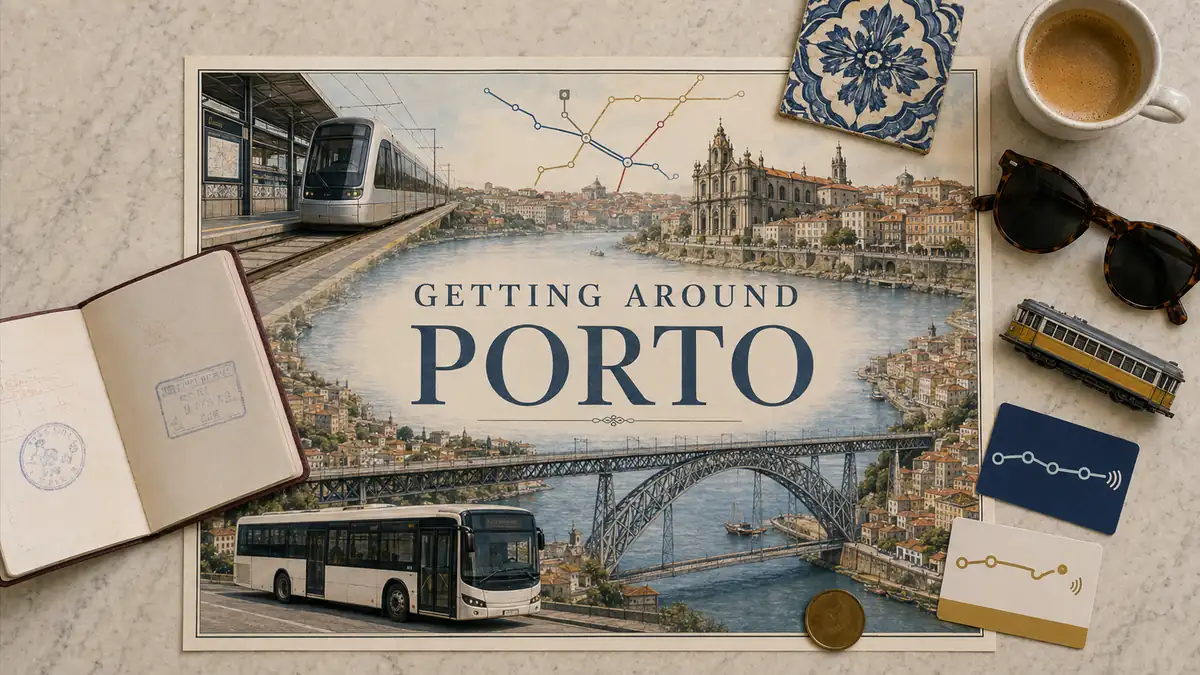
Porto’s transport problem is not the network. It is the ticket system. The metro is modern, the bus network is dense, and the historic centre is small enough to cross on foot — yet almost every visitor mistake happens before the journey starts: buying the wrong zone, trying to share a card, or boarding without validating. The system has three moving parts that have to be understood in order: a rechargeable card, a travel title loaded onto it, and a zone count measured from wherever you first validate. Get those three right and Porto becomes an easy city to move around on a small budget. The centre is also steeply hilly, which makes the walk-or-ride decision a genuine one instead of a formality. This guide covers which card to buy, how zones and validation work, what happens when you get it wrong, and which mode to take for each journey you are actually likely to make.
Quick Answer
The metro plus walking covers most Porto journeys, paid with a rechargeable Andante card. Buses take over where the metro does not reach, including Foz and the riverside west, and the same card works on both. Validate on every journey and every change of mode — that habit keeps the system simple and fine-free.
Trust Layer
Tripstou transport guide for travelers deciding how to make a specific journey. Covers realistic options, tradeoffs by traveler type and luggage, passes, and arrival cases.
Produced with AI assistance and reviewed by Alex Perrut, working in tourism since 2015, for the Tripstou editorial team. See our editorial process for details.
Last factual review: August 30, 2026.
Official sources consulted: Visit Portugal, Turismo de Portugal.
Key Takeaways
- One rechargeable Andante Azul card, bought once for €0.60, pays for every metro and STCP bus trip you take.
- Zones count outward from your first validation, and Z2 at €1.40 covers the journeys most visitors make.
- Validate on every journey and every change of line or mode; unvalidated travel carries a €95 fine.
- The historic tram, the Guindais funicular and the Gaia cable car sit outside Andante and sell separate tickets.
- The Azul beats the Andante Tour unless you ride roughly six times a day, which few Porto trips do.
- Porto’s gradient flips the walk-or-ride call: cross the bridge’s upper deck and one metro stop erases a climb.
Table of Contents
How Do You Get Around Porto?
Most Porto journeys are covered by the metro and your own feet, with buses filling the gaps. The metro handles cross-city moves, the river crossing to Gaia and the run to the coast; walking handles the historic centre. One Andante card pays for both metro and bus.
Walking is Porto’s real default mode. The metro map is misleading on this point: the triangle visitors spend most of their time in — Ribeira, the Sé, Clérigos — has very few stations inside it, so the metro earns its place on the journeys that leave that triangle, not the ones inside it. The realistic options break down like this:
- Metro — best for cross-city hops, the crossing to Gaia and the run out to Matosinhos. Fast and frequent, but thin on coverage inside the old centre itself.
- Bus (STCP) — best for the riverside west, Foz do Douro and Serralves, where no metro line runs. Slower and traffic-dependent, but it takes the same Andante card.
- Historic tram — best for the riverside ride itself. It is an attraction with its own ticket, and it will not get you anywhere faster.
- Walking — best for everything inside the historic centre. Free and usually the quickest door to door, though the gradients are punishing.
- Ride-hailing — best once the metro stops for the night. Inexpensive by Western European standards, but a late-night fallback, not a daily default.
The airport sits on the metro network, which makes arrival the one journey you can solve with the same card you use all week — full routing, night options and the taxi comparison live in the dedicated Porto airport transport guide. If you are still assembling the trip around these journeys, the wider Porto guide is the next step.
Train and bus tickets
Compare routes, schedules and prices across rail and bus operators in one search, with mobile tickets on your phone.
New to Omio? Code NEW10 takes 10% off your first booking — or APPNEW10 if you book inside the Omio app. Both apply to bookings up to €80.
Search routes and compare prices on Omio →
Tripstou may earn a commission if you book through this link, at no extra cost to you.
One Andante Card Covers Porto’s Metro and Buses
The Andante Azul is a €0.60 rechargeable card that carries every metro and bus trip you load onto it. The card and the travel are separate purchases: you pay once for the plastic, then top it up with journeys. It works across the metro and STCP buses.
The card itself is not a ticket. Andante splits into two things — the card, which is only a carrier, and the title, which is the actual right to travel loaded onto it. That is why the €0.60 appears once and never again: you keep the same card for the whole trip, recharging it as the trips run out. Cards are sold and topped up at metro station ticket machines and authorised sales points around the city.
One card carries one passenger — loading ten trips onto it does not make it shareable, so two travelers need two cards.
How Do Porto’s Metro Zones Work?
Zones count outward from where you first validate, and the smallest ticket covers two zones. Porto’s network is divided into rings; your title buys a number of zones, and those zones are measured from the zone of first validation. Every occasional title starts at two zones, written Z2.
Z2 covers the standard visitor day. The centre, the crossing to Vila Nova de Gaia and most of the urban core sit within it, and a visitor rarely needs to buy beyond Z4 unless the trip runs well out into the metropolitan area. Titles also carry a time limit as well as a zone limit — a Z2 or Z3 title runs for one hour from validation and a Z4 title for 1h15 — so a change of line inside that window does not consume a second trip.
Buying one zone too few is more expensive than buying one too many. A Z3 title costs €0.45 more than a Z2; travelling beyond the zones you bought counts as travelling without a valid title.
| Title | Price and validity | What it covers |
|---|---|---|
| Z2 single | €1.40, valid one hour from validation | The central zone plus one ring outward |
| Z3 single | €1.85, valid one hour from validation | One further ring, covering most urban journeys |
| Z4 single | €2.30, valid one hour and fifteen minutes | Longer runs towards the outer metropolitan area |
| Z9 single | €4.65, the widest single title sold | The full extent of the Andante network |
| Andante Tour 1 | €7.75, 24 consecutive hours from first validation | Unlimited metro and bus travel while it runs |
| Andante Tour 3 | €16.55, 72 consecutive hours from first validation | The same coverage across three consecutive days |
Against the rest of a trip, these are small numbers — the fuller picture of what a Porto trip costs puts transport in proportion against accommodation and eating out.
Validation Is Mandatory on Every Journey
Every journey starts with a validation, and every change of line or mode requires validating again. Hold the card less than 10 cm from the black circle until it reads. Travelling with an unvalidated title is treated as travelling without a ticket, and the fine is €95.
Nothing physically stops you. Porto’s metro platforms are open and there are no barriers to force the habit, which is exactly why unvalidated travel is the error visitors make most often — the check happens on board, after it is too late to fix. A title can be validated at most 10 minutes before you travel, so validating early on the platform and then waiting out a long gap does not work either.
One card equals one passenger, even when it is loaded with several trips. A couple cannot tap twice on the same card, and doing so leaves the second person travelling unvalidated. The classic visitor errors are short and repetitive:
- Boarding without validating, usually on a bus or after changing lines.
- Buying a title one zone short of the journey actually made.
- Assuming the historic tram and the funicular run on the Andante network.
Getting these right is mostly about behaviour on the first day; the broader set of first-timer habits sits in our Porto tips for first-timers.
Andante Azul or Andante Tour: Which Should You Buy?
Most visitors do better with the rechargeable Azul card; the Tour card only pays off on ride-heavy days. At €1.40 a Z2 journey, a Tour 1 at €7.75 needs roughly six rides in 24 hours to break even. Few Porto trips involve that much riding.
The clock is unforgiving. A Tour 1 runs 24 consecutive hours from first validation and a Tour 3 runs 72 — the count starts when you tap, not at midnight, so a card validated on an evening arrival spends its first hours while you sleep. Tour cards also cannot be topped up once they expire, and they are not accepted on the Funicular dos Guindais or the STCP historic tram. Judge the decision by trip pattern first:
- Choose the Azul if you are staying central, walking the historic core, and riding two or three times a day — most short Porto trips look like this.
- Choose a Tour if you are based outside the centre, or planning dense days that string together Gaia, Matosinhos, Foz and Serralves with repeated hops.
Over three days the Tour 3 at €16.55 needs about twelve Z2 rides to justify itself — four a day, every day, with no slow morning. That is a demanding pattern in a city where the best hours are spent on foot.
The Historic Tram and Funicular Need Their Own Tickets
The historic tram, the Funicular dos Guindais and the Teleférico de Gaia all sit outside the Andante network. Each sells its own ticket at the stop or station. The Andante Tour is explicitly not valid on the funicular or the tram, so neither ride is covered by a pass.
Ride it for the ride. The riverside tram is an experience rather than a transport option — it is slow, it runs a short heritage route, and the walk alongside it is often quicker. The funicular and the Gaia cable car work the same way: they solve a view or a climb, and they are ticketed as attractions, separately from the card in your pocket.
Is Porto Easy to Walk Around?
Porto’s centre is compact enough to walk, but its hills make some short trips worth riding. The distances between the Ribeira, the Sé and Clérigos are small on a map; the gradient between them is what tires people out. Walking is the default; the climb is the exception.
Direction matters more than mode. The Dom Luís I bridge makes the point: its upper deck carries the metro plus a pedestrian walkway and lands you at the level of the upper city, while the lower deck connects the Ribeira waterfront to the Gaia quayside. Cross on the upper deck and you skip the climb entirely; cross on the lower and you pay for it later on the way back up. Downhill walks and uphill rides is the pattern that works in Porto, and one metro stop is often enough to erase a punishing ascent.
Because the gradient does so much work here, the address you book changes how much transport you use at all — the trade-offs by area are covered in where to stay in Porto.
How to Reach Gaia, Foz do Douro and Matosinhos
Cross to Gaia on foot or by metro, take a bus to Foz do Douro, and the metro to Matosinhos. These three trips account for most journeys visitors make beyond the historic centre, and each has one obvious mode. All three are covered by the same Andante card.
One card handles all three. The routing rules are simple enough to memorise before you arrive:
- Vila Nova de Gaia — walk across the Dom Luís I bridge, or take the metro one stop over the upper deck. Walking wins on views; the metro wins when you are climbing back up to the upper city.
- Foz do Douro — take a bus west along the river. No metro line reaches Foz, so the bus is the direct option; the historic tram covers part of the riverside as a sightseeing ride, on its own ticket.
- Matosinhos — take the metro. It is the longest of the three journeys and the one most likely to need a title beyond Z2, since the zone count runs outward from where you first validate.
How these journeys sequence across real days is a separate question — our 2 days in Porto itinerary and 3 days in Porto itinerary show which of them fit together without doubling back.
Frequently Asked Questions
What happens if you don’t validate your ticket in Porto?
Inspectors check on board, and an unvalidated title is treated as travelling without a ticket: the fine is €95. Porto’s metro platforms are open, so nothing stops you boarding — the check comes later. A title bought but never tapped, or used beyond its zones, counts the same way.
Can two people share one Andante card?
No. One Andante card carries one passenger, however many trips are loaded onto it, so a couple needs two cards. The card itself costs €0.60, so the second one is cheap, and both people validate separately at the start of every journey and at every change of line or mode.
What time does the Porto metro stop running?
Porto’s metro runs from early morning until around 1am, which covers dinner and most evenings out. The last train matters most on the longer runs, Matosinhos and the outer suburbs, where walking back is not an option. Inside the historic centre, most late journeys are short enough to walk.
Can you buy a bus ticket from the driver in Porto?
Yes, STCP drivers sell a single on-board ticket, but it is the expensive way to ride: it costs more than the same trip on an Andante card and covers one journey only. Load an Andante Azul before you board and the same card then works on the metro too.
Is Uber available in Porto?
Yes, Uber operates in Porto alongside licensed taxis and rival ride-hailing apps, so getting a car in the centre is rarely a problem. Its real use for visitors is the trip home once the metro has stopped, or a steep climb with luggage that walking would make miserable.
Related Guides
- Porto guide — the full orientation to the city, from neighbourhoods to timing.
- Porto airport transport — the arrival journey in detail, including night options.
- Where to stay in Porto — how each area affects the transport you actually need.
- Porto trip cost — what a Porto trip costs overall, with transport in proportion.
- 2 days in Porto itinerary — a short-stay route built around walkable distances.
- 3 days in Porto itinerary — the extra day that adds Gaia, Foz or Matosinhos.
- Porto tips — the first-timer habits that prevent the common mistakes.
Did this guide save you time or money? Tripstou is independent and reader-funded — if you'd like to give something back, you can support the site with a crypto contribution of any size.