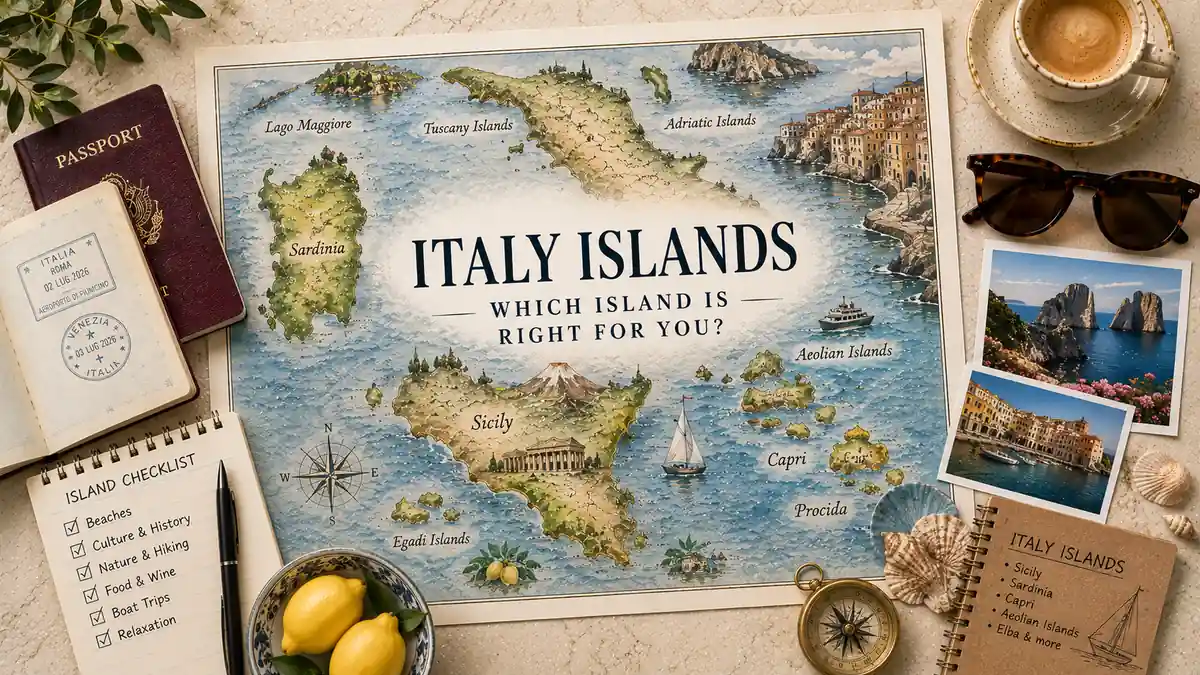
Italy has dozens of inhabited islands, and they could hardly be more different from one another. Sicily layers Greek temples, baroque towns, and some of the country’s best food across a landmass the size of a small nation. Sardinia trades that history for turquoise coves and white-sand beaches. Off Naples, Capri delivers postcard glamour while neighbouring Procida stays small and unhurried. The Aeolians rise from the sea as active volcanoes, and a scatter of smaller islands reward travelers who want calm over crowds. So the real question is not which island is objectively best — it’s which one fits your trip. This guide sorts the field by trip style and traveler type, hands you a confident first-timer pick, and settles the Sicily-versus-Sardinia question. Deep single-island planning lives on the dedicated island and region guides; here you choose the right one first.
Quick Answer
Sicily suits culture and food-led trips, Sardinia suits beach holidays, and Italy’s smaller islands suit slower, quieter escapes. Your choice hinges mainly on trip style — culture, beaches, glamour, or quiet — and how many days you have. First-timers should default to Sicily for its variety; beach-focused travelers should choose Sardinia instead.
Trust Layer
Tripstou selection guide for travelers choosing between multiple places. Covers selection criteria, traveler fit, and trip value.
Produced with AI assistance and reviewed by Alex Perrut, working in tourism since 2015, for the Tripstou editorial team. See our editorial process for details.
Last factual review: July 2, 2026.
Official sources consulted: Italia.it, ENIT — Italian National Tourist Board.
Key Takeaways
- Choose your Italian island by trip style first: culture points to Sicily, beaches to Sardinia, glamour to Capri, and quiet to the smaller islands.
- Sicily wins for depth and variety, while Sardinia wins for beaches and coastal downtime — the split is that clean for most trips.
- First-time island visitors should default to Sicily, which packs history, cities, coast, and food into one manageable trip.
- In the Bay of Naples, pick Capri for glamour, Ischia for thermal spas, and Procida for small-scale colour and calm.
- Base yourself on Lipari and treat the rest of the Aeolians as day trips to keep boat time and planning simple.
- Treat smaller islands like Elba and the Tremiti as slow-escape add-ons to a longer trip, not the main anchor.
Table of Contents
How to Choose the Right Italian Island for Your Trip
Choose your Italian island by trip style first, then by how long you have. Culture and food point to Sicily, beaches to Sardinia, glamour to Capri, and quiet to the smaller islands. Match that mood to your available days, and the shortlist narrows to one or two obvious candidates.
The fastest way to sort the field is to name the one thing you most want from the trip, then read across to the island that owns it:
- Culture, food, history, and variety: Sicily
- Beaches and coastline above everything else: Sardinia
- Iconic glamour and a day-trip wow: Capri
- Thermal spas and slow resort time: Ischia
- Small-scale colour and quiet: Procida or the smaller islands
- Volcanoes and boat-day adventure: the Aeolians
Trip length quietly decides more than mood. Sicily and Sardinia each want close to a week to repay the journey there, so they suit a dedicated island holiday or a longer Italy loop. The Bay of Naples trio works differently — Capri, Ischia, and Procida slot into an existing Naples or Amalfi Coast trip in a day or two, which makes them the easier add-on for a first Italy visit.
Two common travelers should route out before committing. If beaches are the entire point of the trip, compare the coastlines properly in our guide to the best beaches in Italy before you lock an island. And if you still want mainland cities and regions in the mix, weigh the islands against the best places to visit in Italy so an island doesn’t crowd out Rome, Florence, or the Amalfi Coast.
Sicily vs Sardinia: Italy’s Two Big Islands
Pick Sicily for depth and Sardinia for beaches. Sicily is Italy’s largest island and rewards travelers who want history, food, and variety in one trip. Sardinia, the second-largest, is built around its coastline — its whole appeal is sea, sand, and coves. For most trips the split is that clean.
Both are also administrative regions, which hints at how much each contains. Sicily gives you Greek temples, three distinct coasts, Mount Etna, baroque cities, and a food culture that shifts town to town. Sardinia concentrates its magic on the shoreline: the Costa Smeralda’s glamour in the north, wilder empty beaches in the south and west, and a rugged interior most visitors barely touch.
| Factor | Sicily | Sardinia |
|---|---|---|
| Best for | Culture, food, history, variety | Beaches, coves, coastal downtime |
| Overall vibe | Lived-in, layered, energetic | Scenic, relaxed, resort-led |
| Landscape | Volcano, cities, three coasts | Turquoise coast, rugged interior |
| Ideal trip length | Around a week or more | Around a week, beach-paced |
| Food emphasis | Street food and regional depth | Coastal, simpler, seafood-led |
The honest tie-breaker is whether you get restless on a beach. Sicily keeps travelers who need variety busy for a week; Sardinia is close to wasted on anyone who won’t sit still by the water. Once you’ve made the call, plan the detail on our Sicily travel guide or Sardinia travel guide — this page only picks the island, not the itinerary.
The Bay of Naples Islands: Capri, Ischia and Procida
Choose Capri for glamour, Ischia for thermal spas, and Procida for quiet colour. All three sit in the Bay of Naples and reach easily from Naples or Sorrento, but they suit very different trips. Capri is the day-trip icon, Ischia rewards slower resort stays, and Procida stays small and low-key.
Each island answers a different mood, so the choice is really about pace:
- Capri — the postcard island of dramatic cliffs, designer shopping, and the Blue Grotto. It runs at high volume and high prices, and works best for travelers who want the icon and the views.
- Ischia — larger, greener, and built around thermal spa gardens and beach resorts. It suits a slower stay, wellness-minded travelers, and anyone wanting the Bay of Naples without Capri’s crush.
- Procida — the smallest and most low-key, all pastel fishing harbours and narrow lanes. It rewards travelers chasing colour, calm, and a photographer’s Italy over big-name sights.
Capri is better as a day trip than an overnight for most travelers. The day crowds thin once the last ferries leave, but the island’s prices don’t — so an overnight buys you quieter evenings at resort rates for the same views you already saw at lunch. Ischia and Procida reward the overnight far more, because their whole appeal is the unhurried rhythm you only feel after dark.
The Aeolian Islands: Italy’s Volcanic Archipelago
The Aeolian Islands are a volcanic archipelago off Sicily’s north coast, and Lipari is the best first pick. Seven main islands rise straight from the sea, two of them still volcanically active. They suit travelers who want dramatic scenery, boat days, and a slower rhythm than the mainland resorts. Lipari makes the easiest base.
The archipelago splits neatly by what each island is known for:
- Lipari — the largest and best-connected, with the most places to stay and eat. It’s the natural hub for a first visit and the easiest launch point for day trips to the others.
- Stromboli — a near-constantly active volcano and the archipelago’s showpiece, drawing travelers for its glowing night eruptions.
- Vulcano — closest to Sicily, known for its crater walk and mud baths, and an easy first stop.
- Salina — the greenest and most laid-back, with vineyards and a gentler pace for slower stays.
- Panarea, Filicudi and Alicudi — progressively smaller and quieter, for travelers who want the archipelago stripped back to near-silence.
Base on Lipari and treat the rest as day trips instead of sleeping on a different island each night. Hopping between tiny harbours eats your days and thins your options for food and lodging, while a single base keeps the boat time short and the planning simple. The Aeolians pair naturally with a Sicily trip, since most travelers reach them from the Sicilian coast anyway.
Smaller Italian Islands Worth the Detour
For a slower, quieter escape, choose Elba or the Tremiti over the headline islands. These smaller islands swap nightlife and big-name sights for calm harbours, clear water, and short distances. They reward travelers who want to unwind rather than sightsee, and they pair well with a longer Italy trip that already covers the mainland.
A few stand out for different reasons:
- Elba — the largest island in the Tuscan Archipelago, with beaches, hill villages, and gentle hiking. It’s an easy add-on for travelers already in Tuscany who want a few coastal days.
- The Tremiti Islands — a tiny archipelago off the Adriatic coast, prized for clear water and a diving-and-swimming pace. Best for travelers happy to trade choice for calm.
- The Egadi Islands and Pantelleria — off Sicily, for travelers who want wind-scoured landscapes and near-empty coves well away from the crowds.
These islands are add-ons, not the anchor of a trip. Their appeal is exactly what they lack — big crowds, heavy sights, and a packed schedule — so they work best folded into a longer itinerary once the must-see mainland is behind you. Keep expectations simple. On the smallest islands, a handful of restaurants and one ferry route may be the whole show, and that is the point.
The Best Italian Island for First-Time Visitors
For a first Italian-island trip, choose Sicily. It packs the widest range of experiences — ancient sites, lively cities, beaches, and standout food — into one island, so a first visit rarely feels thin. The one condition that flips the answer: if you mainly want beaches and downtime, Sardinia is the stronger first choice.
Sicily wins for first-timers because it doubles as a whole-country sampler. You get the history, the food culture, the coast, and the drama of Etna without island-hopping, which keeps logistics light on a first visit. Sardinia takes the top spot only when the brief is simple — sun, sea, and as little sightseeing as possible — and there it beats Sicily comfortably. Plan either as part of a wider trip using our Italy travel guide.
Where first-timers overreach is trying to combine a major island with the Bay of Naples trio in one short trip. Pick one island family and go deep; save the second for a return visit. On a longer trip, the smart move is to anchor on Sicily or Sardinia and add a smaller island — the Aeolians off Sicily, Elba off Tuscany — only if you have the extra days to slow down.
Frequently Asked Questions
How many islands does Italy have?
Italy has several hundred islands in total, but only a few dozen are inhabited and fewer still see regular tourism. The headline choices cluster around Sicily and Sardinia, the Bay of Naples trio, the Aeolian archipelago, and a scatter of smaller Tuscan and Adriatic islands worth a slower visit.
What is the biggest island in Italy?
Sicily is the biggest island in Italy and the largest in the Mediterranean. It is also an autonomous region, which is part of why it packs so much variety — Greek temples, baroque cities, Mount Etna, and distinct coasts. Sardinia, Italy’s second-largest island, comes next and leads on beaches.
How do you get to the Italian islands?
Most Italian islands are reached by ferry or faster hydrofoil from mainland ports, and several also have airports. Sicily and Sardinia connect by both flights and car ferries; the Bay of Naples islands run frequent boats from Naples and Sorrento; the Aeolians sail from Sicily’s north coast.
Can you island hop in Italy?
Yes, but island hopping works best within a single archipelago, not across the country. The Aeolians and the Bay of Naples islands are easy to combine because they sit close together with regular boats. Jumping between Sicily, Sardinia, and distant groups eats days in transit and rarely pays off.
When is the best time to visit the Italian islands?
Late spring and early autumn are the best times to visit the Italian islands. May, June, and September bring warm water, open beaches, and lighter crowds than the July–August peak, when prices climb and ferries fill. Winter is quiet and scenic but many island resorts and boats scale back.
Related Guides
Once you’ve chosen an island, these guides carry the planning depth this selector deliberately leaves out — region detail, beaches, and wider Italy framing:
- Sicily travel guide — when to go, where to base, and how Sicily fits a wider Italy trip.
- Sardinia travel guide — planning the coast, choosing a base, and timing a Sardinia visit.
- Best beaches in Italy — the full beach ranking for travelers choosing by coastline.
- Best places to visit in Italy — the mainland shortlist when islands are only part of the trip.
- Italy travel guide — the overall trip framing that ties islands and mainland together.
Did this guide save you time or money? Tripstou is independent and reader-funded — if you'd like to give something back, you can support the site with a crypto contribution of any size.