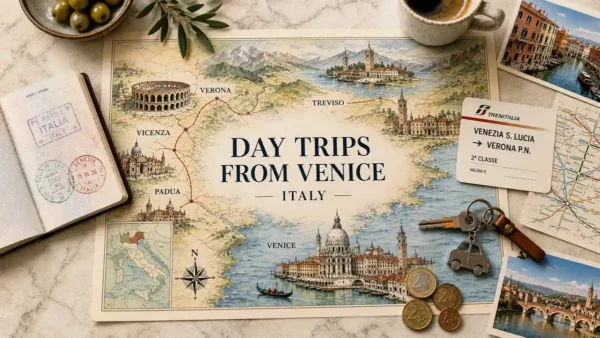
Verona is Italy’s most romantic city—home to Shakespeare’s Romeo and Juliet, the ancient Arena, and a perfectly walkable historic center. Unlike Venice or Florence, Verona rewards slower travelers who want authenticity without overwhelming crowds. This Verona travel guide cuts through the hype and focuses on smart planning: where to stay in Verona (Centro vs Porta Nuova vs Borgo Trento), whether the Verona Card saves money and time, and how to plan an easy Lake Garda day trip from Verona to Sirmione. Verona is best experienced as a 2–3 day base with good rail connections to Milan, Venice, and Bologna. This guide is updated regularly with planning tips, costs, and transport advice.
Built for: Romantic travelers, history lovers, and anyone looking for an authentic Italian city with easy access to Lake Garda and other northern Italy destinations.
Last updated: January 2026 (museum hours, Verona Card pricing, and train schedules can change; always verify official sources before booking).
Verona at a Glance (Fast Planning Snapshot)
- 1 day: Fast icons (Arena, Piazza Bra, Juliet’s House) plus a sunset viewpoint at Castel San Pietro. Rushed but possible.
- 2 days: The sweet spot. Day 1 covers classic icons; Day 2 adds history (Castelvecchio, Basilica di San Zeno) and calmer neighborhoods. This is ideal for most travelers.
- 3 days: Add a Lake Garda day trip to Sirmione (scenery and reset), or stay in Verona and explore neighborhoods, museums, and cafés at a slower pace.
- Best areas to stay: Centro Storico for walkability and romance. Porta Nuova for train logistics and day trips. Borgo Trento for a local, quieter vibe.
- Must-book (if relevant): Arena di Verona tickets (especially if opera nights are happening). Check the official website for availability.
- Day trip fit: Lake Garda and Sirmione. Worth it if you want scenery and a reset day; skip it if you’re short on Verona time.
- Quick anti-trap rule: Walk 5–10 minutes off the main squares (Piazza Bra, Piazza delle Erbe). Prices spike dramatically right next to the icons.
Table of Contents
1. Do This First (Before You Arrive)
Verona works best when you plan a few key decisions before arrival. Here are the eight steps that matter most:
1. Choose 2 vs 3 days (pace): Two days is tight but ideal—covers the classic route and neighborhoods. Three days lets you slow down, explore deeper, or add a Lake Garda day trip. Decide your pace first; everything else follows.
2. Choose your base (Centro vs Porta Nuova vs Borgo Trento): Centro Storico for maximum walkability and romance. Porta Nuova for train logistics and day trips (trade-off: less charm at night). Borgo Trento for a local, quieter vibe (trade-off: more commuting). Your neighborhood choice shapes your entire Verona experience.
3. Decide: Is the Arena a priority? (timed tickets/opera): The Arena is Verona’s most iconic sight. If opera nights are happening and you want to attend, book well in advance. If you’re not attending a show, prioritize a morning/day visit to reduce event-related disruption and queue time. If you just want the exterior, you can keep this flexible.
4. Make the “vibe check” on Juliet’s House (expectation vs reality): Juliet’s House is famous but crowded. The courtyard is free and iconic for photos. The museum inside requires a ticket. Most travelers just visit the courtyard—know what you’re getting before you go.
5. Decide 0–1 day trip (Sirmione/Lake Garda): Lake Garda is beautiful but can take a full day. If you only have 2 days, skip it. If you have 3 days and want scenery and a reset, it’s worth it. Otherwise, stay in Verona and explore neighborhoods instead.
6. Make the “sunset anchor” (Castel San Pietro): Castel San Pietro offers the best panoramic views of Verona. It’s a short walk uphill from the center. Book this moment—it’s your memory anchor.
7. Make the “food plan” (aperitivo + 1 good dinner away from main squares): Aperitivo (happy hour) is a Verona tradition. Choose one neighborhood for your aperitivo—Veronetta is often the most local-feeling option. Plan one sit-down dinner away from Piazza Bra and Piazza delle Erbe (prices spike there).
8. Pre-check: Is the Verona Card worth it for you? It’s usually worth it if you’re doing 3+ paid attractions in 24/48 hours. Skip it if you’re doing mostly vibes + walking with only 1–2 paid entries. See the cost-analysis section below.
2. Where to Stay in Verona (Best Areas + Trade-Offs)

Verona is small and walkable, but location shapes your experience. Here’s where to stay in Verona depending on your vibe and logistics.
Centro Storico (Città Antica)
The heart of Verona—Piazza Bra, Arena, Piazza delle Erbe, and Juliet’s House are all here. It’s the most convenient location for sightseeing and the most romantic. Trade-off: higher prices and more crowded, especially around the main squares. Best for first-timers and travelers who want maximum walkability and evening vibe.
Porta Nuova (Near the Train Station)
Practical and budget-friendly. Close to the train station for day trips and early trains. Trade-off: less charm at night, more commuting to the center, noisier area. Best for travelers who prioritize logistics and early departures over atmosphere.
Borgo Trento
A more “local” alternative. Good for families and travelers who want quieter evenings. Trade-off: you need to walk or take a bus to reach the main tourist center. Best for travelers who want to experience Verona beyond the tourist zones.
Stay Near Porta Nuova? When It Helps vs When It Hurts
Helps: You’re catching an early train for a day trip or onward journey. You want cheaper accommodation. You’re okay with less charm at night and more commuting.
Hurts: You miss the evening vibe of Centro Storico (where locals hang out after 6 PM). You’re commuting daily, which adds friction. The station area is noisier and less charming. You’re paying for convenience you might not use.
Tripstou rule: Pay for walkability if you’ll be out at night. Verona’s best moments happen in the evening—aperitivo, dinner, post-sunset walks. Being in Centro means you experience this naturally. Being near Porta Nuova means you’re commuting back.
Hotels and places to stay
Compare hotels, apartments and stays for your dates in one search.
Search hotels and stays on hotels.com →
Tripstou may earn a commission if you book through this link, at no extra cost to you.
3. Verona Travel Guide Itinerary: 2 Days (The Classic Route)
This section is your Verona itinerary 2 days plan: the Arena, the historic lanes, and a sunset viewpoint—without turning your trip into a checklist.
Day 1: Classic Icons + Vibe
Morning (8–11 AM): Arrive and settle into your accommodation. Head to Piazza Bra and the Arena di Verona. Spend 1–1.5 hours here. The light is better in the morning, and crowds are smaller. If you have a timed ticket, use it now. If not, admire the exterior and keep moving.
Midday (11 AM–2 PM): Walk to Casa di Giulietta (Juliet’s House). Spend 30 minutes here—the courtyard is free and iconic for photos. Grab lunch at a casual spot nearby (walk away from Piazza Bra to avoid tourist traps).
Afternoon (2–5 PM): Explore Piazza delle Erbe and the surrounding lanes. This is “wander time”—the best part of Verona. Visit small churches, craft shops, and local spots. Grab a coffee. Get intentionally lost in the side streets.
Evening (5 PM–bedtime): Walk uphill to Castel San Pietro for sunset views. Spend 45 minutes here. Return to the center for aperitivo (6–8 PM). Then dinner at a neighborhood restaurant. Ask your hotel for recommendations away from the main squares. End with a nightcap at a local bar.
Day 2: History + Calmer Corners
Morning (8–11 AM): Early breakfast. Visit Castelvecchio (fortress and museum). Spend 1–1.5 hours here. The riverside walk is peaceful and offers a different perspective on Verona.
Midday (11 AM–2 PM): Walk across Ponte Pietra (stone bridge with river views). Explore the Veronetta neighborhood on the east bank—this is where locals live and eat. Grab lunch at a casual trattoria here.
Afternoon (2–5 PM): Visit the Basilica di San Zeno (one of Italy’s greatest Romanesque churches). Spend ~1 hour here. Then explore the surrounding neighborhood. Grab a coffee. This is “deep Verona” time—fewer tourists, more authenticity.
Evening (5 PM–bedtime): Aperitivo at a different spot (Veronetta is often the most local-feeling option). Dinner at another neighborhood restaurant. Take a final walk through the historic center at dusk. End with a nightcap.
4. Verona Travel Guide Itinerary: 3 Days (The Lake Garda Connection)
This is your Verona itinerary 3 days plan: keep Days 1–2 classic, then add one focused day trip or a slower city day.
Days 1–2 (Same as 2-Day Itinerary)
Day 3: Choose Your Adventure
Option A: Deeper Verona (Museums + Cafés + Vistas Without Rushing)
Stay in Verona and slow down. Visit the Basilica di Santa Anastasia (Gothic church with art). Explore the Roman Theatre (often a quieter historic stop). Spend the afternoon in a neighborhood café. Add one small museum or gallery. Dinner at another restaurant. This option is best if you want to really absorb Verona.
Option B: Lake Garda Day Trip to Sirmione (Scenery + Reset Day)
Take the train from Verona to a Lake Garda rail gateway (check which station gives you the simplest connection on your date), then connect onward to Sirmione by bus or boat. Explore the town, take a boat ride, grab lunch, and optionally visit Scaliger Castle. Return to Verona by evening.
Verona to Sirmione Day Trip (Train + Bus/Boat Logic)
Book an early departure to protect your day and reduce waits. For the smoothest experience, pick the connection with the fewest transfers and shortest gaps, even if it’s slightly longer on paper. Sirmione works best as a single-focus day—don’t try to “do the whole lake” in one go.
Tripstou rule: Choose one lake village. Sirmione is the easiest classic. Enjoy it, then return refreshed.
Tours and activities
Book skip-the-line tickets, day trips and local tours with free cancellation on most activities.
You can also browse everything on getyourguide.com.
Tripstou may earn a commission if you book through this link, at no extra cost to you.
5. Is the Verona Card Worth It? (Cost Analysis)
The Verona Card bundles entry to major attractions (and may include transport depending on the card/version). Whether it’s worth it depends on your pace and interests.
Choose the Verona Card If…
You’re planning 3+ paid attractions in 24 or 48 hours. You want simplicity and bundled pricing. You’re visiting the Arena, Castelvecchio, and 1–2 other paid sites.
Skip the Verona Card If…
You’re doing more vibe and walking with only 1–2 paid entries. You want to spend most of your time in neighborhoods and cafés. You’re mainly hitting free sights (squares, bridges, viewpoints).
How to Calculate (Without False Precision)
Add up the cost of 3 attractions you really plan to visit. Compare that total with the Verona Card price. Then factor in “time saved” (reduced ticket friction). Check the official Verona Card website for current pricing and inclusions.
Info can change; check official sources.
6. Top Things to Do in Verona (Curated List)
Worth it: Arena di Verona (timed entry if possible). Castel San Pietro (sunset views). Piazza delle Erbe. Ponte Pietra. Castelvecchio. Basilica di San Zeno. Veronetta neighborhood walk.
Skip or Caution: Juliet’s House museum (the courtyard is the main moment for most people). Restaurants right next to Piazza Bra or Piazza delle Erbe (front-row pricing—walk away). Multiple church visits (one or two is enough). Expensive walking tours (self-guided works well here).
7. Getting Around (The Walk-First Rule)

Verona is compact and extremely walkable. Most sights are within 15–20 minutes on foot. Walking is also the best way to find good food and calmer streets. Public transport (buses) helps for outer neighborhoods or if your feet need a break, but walking covers most classic sightseeing.
Train station (Porta Nuova): Use it for arrivals, departures, and day trips. It’s about a 15–20 minute walk to Centro Storico (or a short bus ride). If you’re staying near Porta Nuova, factor in daily commuting—especially at night.
Train and bus tickets
Compare routes, schedules and prices across rail and bus operators in one search, with mobile tickets on your phone.
New to Omio? Code NEW10 takes 10% off your first booking — or APPNEW10 if you book inside the Omio app. Both apply to bookings up to €80.
Search routes and compare prices on Omio →
Tripstou may earn a commission if you book through this link, at no extra cost to you.
8. Costs, Safety, and Rain Plan (Quick Reality Blocks)
Budget Reality Ranges
Budget (€60–€100/day): Hostels or budget hotels, simple lunches, aperitivo, free sights, minimal paid attractions.
Mid-range (€100–€180/day): 3-star hotels, casual meals plus one sit-down dinner, some paid attractions (Arena, Castelvecchio).
Comfort (€180+/day): Boutique hotels, nicer dinners, multiple paid attractions, occasional tours.
Cost drivers: Accommodation location (often the biggest lever). Paid attractions (Arena, Verona Card). Sit-down meals. Weekends and major events can spike prices.
Safety
Verona is generally safe, but it’s a tourist city. Use big-city habits: keep valuables secure, watch out for pickpockets near the Arena and the train station, and avoid flashing expensive items. Stay alert but not paranoid.
Rainy Day / Low Budget Alternate Plan
On rainy days, prioritize indoor stops (Castelvecchio, smaller museums, churches) and café time. Keep your route compact and walk the covered streets where possible. Verona still works well at a slower pace in bad weather.
Spending money abroad
A Wise account converts your money at the mid-market exchange rate and shows every fee upfront, with a card you can spend in the local currency.
Check Wise’s rates and fees for your currency →
Tripstou may earn a commission if you sign up through this link, at no extra cost to you.
9. Frequently Asked Questions
How many days in Verona is enough?
For most travelers, 2 days is the sweet spot—covers the classic icons and neighborhoods. One day is possible but rushed. Three days lets you slow down or add a Lake Garda day trip to Sirmione.
Is the Verona Card worth it for 24/48 hours?
It depends on your pace. Choose the Verona Card if you’re planning 3+ paid attractions in 24/48 hours and want to simplify tickets. Skip it if you’re doing mostly vibe + walking with only 1–2 paid entries.
Can you do a Lake Garda day trip from Verona?
Yes—Lake Garda is accessible with a short train ride plus a local connection. Sirmione is the most popular “classic” day trip. It’s worth it if you want scenery and a reset day outside the city.
How do you plan a Verona to Sirmione day trip?
Take an early train from Verona to a Lake Garda rail gateway, then connect to Sirmione by bus or boat. Pick the option with the fewest transfers and shortest waits on your date. Avoid trying to see multiple lake villages in one day.
Where to stay in Verona near the train station (Porta Nuova)?
Staying near Porta Nuova helps with day trips and early trains, but you lose the evening vibe of the historic center. If logistics matter more than atmosphere, choose Porta Nuova. Otherwise, stay in Centro Storico and accept the early start.
Is Juliet’s House free?
The courtyard is free to enter and see the famous balcony. Entering the house/museum requires a ticket. Most travelers just visit the courtyard for the photo and move on.
10. Next Steps: Plan Your Italy Route
Start with the Italy planning overview
Pair Verona with other Italian cities
Build your route with our city guides organized by region:
Sideways — North
- Florence Travel Guide
- Venice Travel Guide
- Bologna Travel Guide
- Milan Travel Guide
- Turin Travel Guide
- Genoa Travel Guide
Sideways — Central
Sideways — South and Islands
Core Europe Planning Spokes
- Best Time to Visit Europe (weather vs crowds)
- Getting Around Europe (train vs flight rules)
- Europe Travel Budget (real cost logic)
- Where to Stay in Europe (base strategy)
- Europe Safety Tips (smart habits)
Or explore by country
Discover other European destinations in our Europe Travel Guide.

Did this guide save you time or money? Tripstou is independent and reader-funded — if you'd like to give something back, you can support the site with a crypto contribution of any size.