Milan is the capital of Lombardy and Italy’s second city, and it asks a blunt question of every first-time Italy traveler: does it earn two or three days, one night between other stops, or nothing at all? Milan is a working, design-led city — a place of offices, showrooms and trams, not an open-air museum in the way Rome or Florence are. That is exactly why it splits opinion.
This guide decides the things you need decided before you book. Whether Milan is worth your time and who should skip it. How many days it takes. Which of its three airports suits your trip. Where to base yourself among five named areas. What a day costs. And the one attraction you must reserve long before you arrive: Leonardo’s Last Supper. Along the way you get the Duomo, the Galleria, Brera, Navigli and the day trips that genuinely work by train.
Quick Answer
Milan is worth 2–3 days as a stopover or northern-Italy base for design, fashion and food. It is a working city, not an open-air museum, so it rewards a short planned visit and disappoints anyone expecting Rome or Florence. Book the Last Supper weeks ahead and base near the Duomo or in Brera.
Trust Layer
Tripstou city guide for travelers planning a city trip. Covers trip length, stay style, season, cost, and mobility tradeoffs.
Produced with AI assistance and reviewed by Alex Perrut, working in tourism since 2015, for the Tripstou editorial team. See our editorial process for details.
Last factual review: September 4, 2026.
Official sources consulted: Italia.it, ENIT — Italian National Tourism Agency, ATM Milano, Malpensa Express.
Key Takeaways
- Give Milan two to three days: two cover the essential set, a third buys a neighbourhood day or one train day trip.
- Book Leonardo’s Last Supper weeks to months ahead — it is timed entry, it sells out, and it should set your dates.
- Fly into Linate when you can, Malpensa for long-haul, and Bergamo only when the fare saving clears the coach ride.
- Base in Centro or Brera on a first visit; choose Navigli for evenings and near Centrale for early departures.
- Avoid August and the trade-fair weeks: the first empties the city, the second fills every hotel and spikes rates.
- Only Como, Bergamo and Verona are genuine day trips by train; Venice and Cinque Terre deserve their own nights.
Table of Contents
Is Milan Worth Visiting?
Milan is worth two to three days if you want design, fashion, food and Leonardo’s Last Supper. It is not worth a longer stay if you came to Italy for Renaissance streets and Roman ruins. Milan is a working, modern city, and it rewards travelers who plan around that.
Milan reads differently from Rome, Florence and Venice because it is still busy being a city. Its centre mixes a colossal Gothic cathedral with glass towers at Porta Nuova, and the streets between them carry commuters, not just visitors. The historic core was heavily rebuilt after wartime damage, so the pleasure here is concentrated rather than continuous: the Duomo, the Galleria Vittorio Emanuele II and Teatro alla Scala sit within a few minutes of each other, and the rest of the city unfolds in pockets — Brera, Navigli, the Quadrilatero della Moda.
What Milan does better than any other Italian city is design, opera and evening rhythm. Teatro alla Scala is one of the world’s great opera houses. Aperitivo — a drink that arrives with food, taken in the early evening — is a Milanese habit that other cities imported. Shopping is not a side activity here; it is part of the city’s identity. And Milano Centrale puts the Alps, the lakes and Verona within easy reach, which is why Milan works so well as a base for northern Italy.
The tradeoff is honest. Milan gives you less per hour of walking than Florence does, and it asks you to know what you came for. Travelers who arrive with a plan — one museum, one rooftop, one neighbourhood, one long aperitivo — leave impressed. Travelers who arrive expecting the postcard version of Italy tend to leave underwhelmed by lunchtime on day two.
Milan is the only major Italian city where the smartest first move is booking, not walking. Get the Last Supper slot before you fix your dates, because the rest of the trip bends around it.
Who should skip Milan, or give it one night
Skip Milan if your first Italy trip runs 7–10 days and you want the classic triangle of Rome, Florence and Venice. Those three already fill that window, and adding Milan means cutting something better suited to a first visit. If you are still choosing between destinations, compare the alternatives in our guide to the best places to visit in Italy before you commit nights to Milan.
Skip it too if large commercial cities tire you, or if your dates fall in August, when much of the city shuts and the heat sits heavy over the plain. Give Milan one night — not zero — if you land at Malpensa and need a soft first evening, or if you are connecting north by rail and the city sits on the route anyway. One evening covers the Duomo, the Galleria and an aperitivo, which is a fair return for a night you were spending in transit regardless.
What Milan Is Known For: Duomo, Last Supper, Fashion and Design
Milan is known for the Duomo, the Galleria Vittorio Emanuele II, Teatro alla Scala and Leonardo’s Last Supper. Beyond those, the city is known for fashion and design: the Quadrilatero della Moda for shopping, and Salone del Mobile for furniture. Both shape how the centre looks and feels.
The Duomo is Italy’s largest Gothic cathedral, and its roof terraces let you walk among the spires. The Galleria Vittorio Emanuele II — a glass-vaulted nineteenth-century arcade — adjoins the cathedral square and leads through to Teatro alla Scala, so the three sit on one short walk. West of there, the Castello Sforzesco is the brick fortress of Milan’s ruling dynasty, now holding city museums. Brera is the district of narrow streets and the Pinacoteca di Brera, the city’s main painting gallery. The Navigli are the surviving canals, lined with bars. Porta Nuova is the skyline district of Bosco Verticale and Piazza Gae Aulenti. For what each of these actually costs you in time, and which ones deserve your two days, see our full breakdown of things to do in Milan.
Do you need to book the Last Supper in advance?
Yes. Leonardo’s Last Supper is painted on the refectory wall of Santa Maria delle Grazie and is visited through the Cenacolo Vinciano, which admits small groups on timed entry — a fixed slot you reserve in advance, not a queue you join. Tickets are released in advance batches on the official site and routinely sell out. Book weeks to months ahead on the official site, where standard entry runs around €15.
Because the slots are timed and limited, the Last Supper is the one Milan attraction that should set your dates instead of fitting into them. If your trip is fixed and no slots remain, plan the visit out rather than building the days around a ticket you do not hold.
Shopping in Milan: the Quadrilatero della Moda and beyond
The Quadrilatero della Moda is Milan’s fashion quarter, bounded by Via Montenapoleone and Via della Spiga — flagship territory, and worth walking even if you buy nothing. The Galleria Vittorio Emanuele II holds the historic luxury houses under its glass roof. For mainstream high-street shopping, Corso Vittorio Emanuele II runs off the Duomo square, and Corso Buenos Aires is the long, dense retail avenue north-east of the centre. Brera and Navigli are where the independents sit: design objects, small labels, vintage. Shopping in Milan is genuinely part of the sightseeing, which is one reason the city needs fewer museum hours than its rivals.
Tours and activities
Book skip-the-line tickets, day trips and local tours with free cancellation on most activities.
You can also browse everything on getyourguide.com.
Tripstou may earn a commission if you book through this link, at no extra cost to you.
How Many Days You Need in Milan
Two to three days is the right length for Milan. Two full days cover the Duomo, the Galleria, La Scala and the Last Supper if you booked it. A third day buys Brera and Navigli at a slower pace, or one day trip by train.
- One night — buys the Duomo, the Galleria and an evening aperitivo. Fits the traveler in transit: a Malpensa arrival, or a stop on a northern rail route.
- Two days — buys the essential set, including the Last Supper if you hold a slot, plus one neighbourhood and one proper meal. Fits most first-timers, and is the length we would defend as standard. See the 2-day Milan itinerary for how the days actually fall.
- Three days — buys a slower neighbourhood day in Brera or Navigli, or a day trip to Como, Bergamo or Verona. Fits travelers using Milan as their northern base. The 3-day Milan itinerary sets out both versions.
Inside a wider Italy route, Milan works as an entry point, an exit point or a hinge — rarely as the centrepiece. It is the natural first stop for a trip that continues to the lakes, the Dolomites or Switzerland, and the natural last stop for a trip that ends on a long-haul flight from Malpensa. Slotting it into a longer national route is covered in our Italy itinerary planner.
Adding a fourth night in Milan almost always buys less than moving that night to Verona or the lakes. Milan is a city you finish.
When to Visit Milan
Spring and early autumn are the best times to visit Milan. August is the month to avoid: much of the city closes and the heat is heavy. Winter is quiet and cheap, but grey and often foggy, with short days over the Lombardy plain.
Milan sits on a flat plain below the Alps, and that geography drives its weather. Summer is hot and humid with little breeze, and the city holds the heat late into the evening. Winter brings cold, damp air and the low fog Lombardy is known for — atmospheric for a night at La Scala, less so for the Duomo terraces. Spring and early autumn give you mild days, working streets and a city doing what it normally does, which is the version of Milan worth seeing.
Two timing patterns matter more here than in most Italian cities. The first is August: many restaurants and independent shops close for the summer break and residents leave, so the city runs at half strength even though the major sights stay open. The second is the trade-fair effect. When Fashion Week or Salone del Mobile is running, hotels fill across the city and rates spike hard, and the events themselves are largely trade-only — so a leisure visitor pays the surge without getting the show. Check your dates against the fair calendar before booking, and if they clash, either book far ahead or move the trip. For how Milan’s calendar fits the rest of the country, see the best time to visit Italy.
Getting to Milan: Which Airport to Fly Into and Arriving by Train
Fly into Linate if you can, Malpensa for most long-haul arrivals, and Bergamo only for cheap fares. Linate sits closest to the centre and connects by metro. Malpensa handles intercontinental flights and has its own train. From elsewhere in Italy, arrive by high-speed train at Milano Centrale.
Which Milan airport is best for your trip
Milan has three airports, and the right one depends on where you are flying from. Malpensa (MXP) is the intercontinental gateway and where most travelers from the US, India and Canada land. Linate (LIN) is the small close-in airport used mainly for European and domestic flights, and it is the easiest arrival of the three. Bergamo–Orio al Serio (BGY) is the low-cost airport, sits well outside Milan, and has no direct rail link to the city — it only makes sense when the fare difference is real.
| Airport | Best for | Official way into the centre | Approximate time |
|---|---|---|---|
| Malpensa (MXP) | Long-haul and intercontinental arrivals | Malpensa Express train, around €13, every 15–30 minutes | About 30 min to Cadorna, 50 min to Centrale |
| Linate (LIN) | European and domestic flights, short trips | Metro line M4 straight into the city | About 12–15 minutes to the centre |
| Bergamo (BGY) | Low-cost fares when the saving is large | Airport coach only — no direct train | About 45 minutes to 1 hour |
For ticket purchase, taxi and night-arrival options, and the full mechanics of each route, use our guide to Milan airport transport. The Bergamo saving is only real once the coach fare and the extra hour are priced in — on a two-day trip, that hour is a meaningful share of what you came for.
Arriving in Milan by train from Rome, Florence or Venice
Milano Centrale is the main rail hub, and high-speed Frecciarossa and Italo services from Rome, Florence, Venice and Naples arrive there. The station is a monumental building north-east of the historic centre, connected by metro, so arrival does not mean you are already at the Duomo. Milan also has other stations — Cadorna and Porta Garibaldi among them — and some services use them, so check which station your ticket names before you book a hotel around it. For country-level planning, including entry requirements, start with our Italy travel guide.
Where to Stay in Milan: Five Areas and Who Each Suits
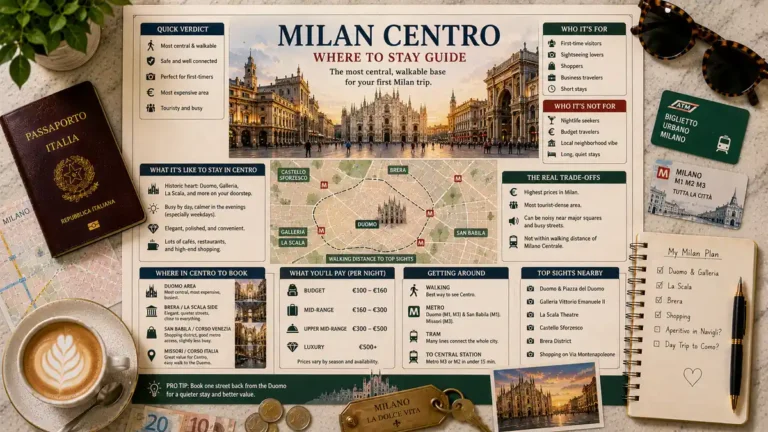
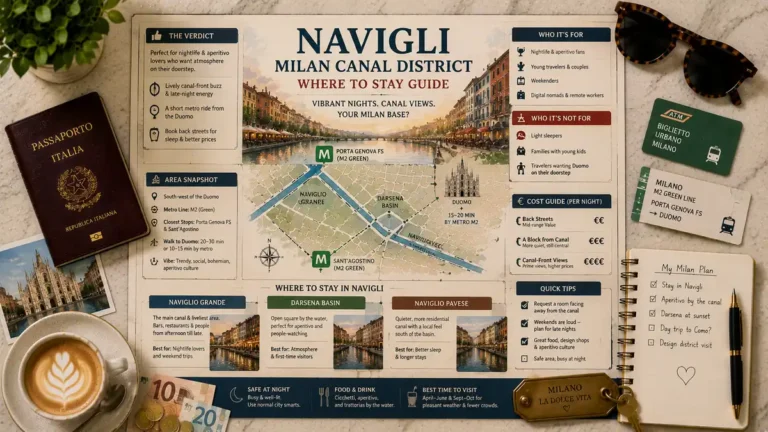
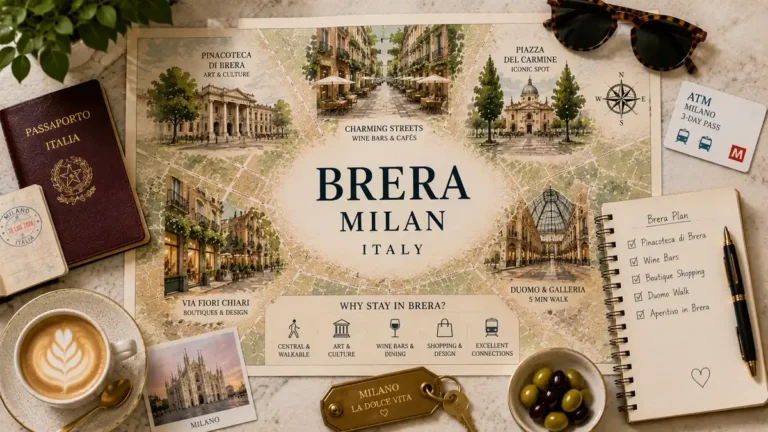
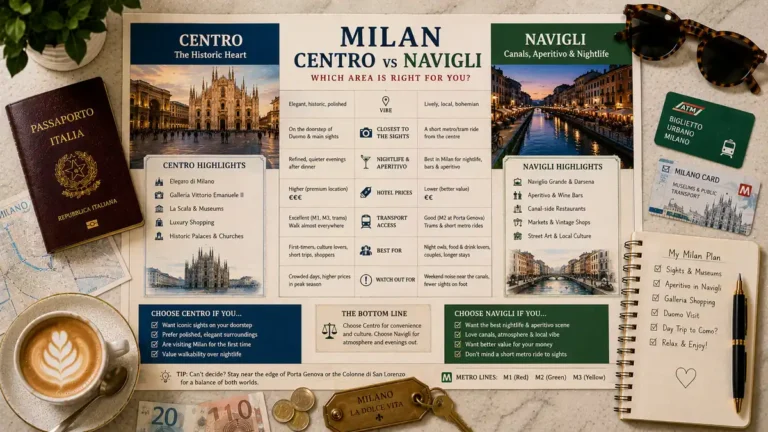
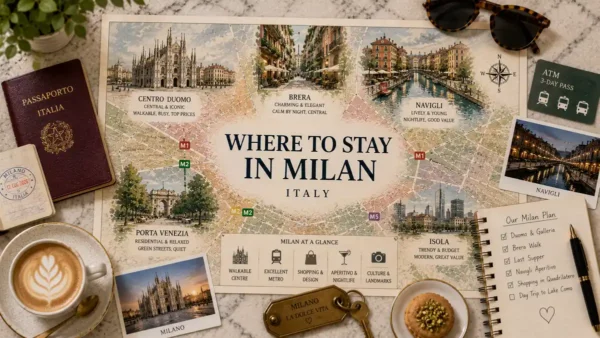
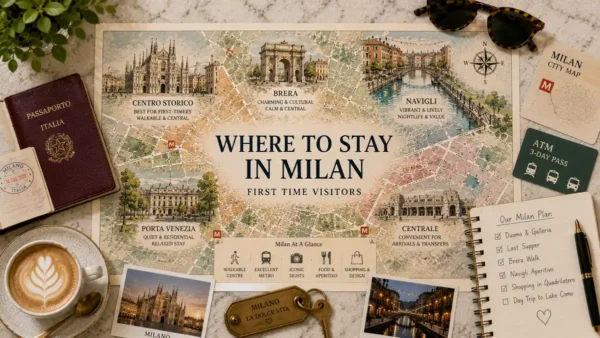
First-time visitors should base in Centro near the Duomo, or in Brera for quieter streets. Navigli suits evenings by the canals, Porta Nuova suits modern hotels and families, and the area near Milano Centrale suits early trains and lower rates. All five sit on the metro.
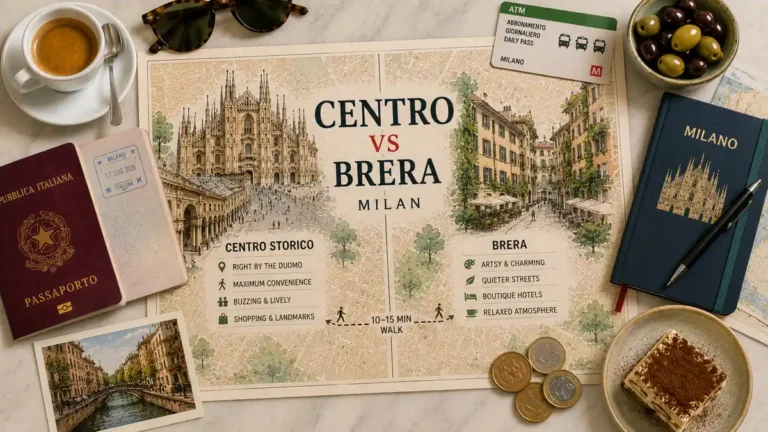
- Centro / Duomo — Best for: first visits and walking to everything. You wake up inside the postcard, with the cathedral, the Galleria and La Scala on foot. The tradeoff is crowds and the highest rates in the city. Our Milan first-time stay guide covers the streets worth targeting here.
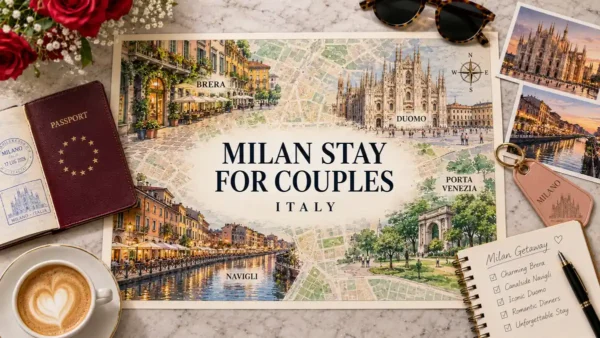
- Brera — Best for: couples wanting quiet, characterful streets. Cobbled lanes, galleries and small restaurants a short walk north of the Duomo, with a village feel the rest of central Milan lacks. The tradeoff is fewer big-hotel options and boutique pricing. See our Milan stay guide for couples.
- Navigli — Best for: nightlife and canalside evenings. The canal district turns into the city’s aperitivo and bar quarter after dark, and it is where Milan feels least corporate. The tradeoff is noise and a tram or metro ride to the main sights. Details in our Milan nightlife stay guide.
- Porta Nuova — Best for: modern hotels and families wanting space. The new skyline district around Piazza Gae Aulenti has large contemporary rooms, open plazas and easy metro access. The tradeoff is a business-district atmosphere with little historic texture. Our Milan family stay guide goes further.
- Near Milano Centrale — Best for: budget rates and early departures. The cheapest central-ish beds and instant access to onward trains. The tradeoff is real: the immediate area has little atmosphere at night and feels more like a transit zone than a neighbourhood.
For the full area comparison, including how each one prices out and which segment guide fits your trip, start with where to stay in Milan.
Hotels and places to stay
Compare hotels, apartments and stays for your dates in one search.
Search hotels and stays on hotels.com →
Tripstou may earn a commission if you book through this link, at no extra cost to you.
How to Get Around Milan
Milan’s centre is walkable, and a single ATM ticket costs €2.20 for 90 minutes. You can cross the historic core on foot in under half an hour. For Navigli, Santa Maria delle Grazie or anything past the ring, take a tram or the metro instead.
Walkable, in Milan, means a specific thing. The Duomo, the Galleria, Teatro alla Scala, the Quadrilatero and Brera form one continuous walking zone, and you will cover it on foot without thinking about transport. The Castello Sforzesco sits at the edge of that zone. Everything else — Navigli, Porta Nuova, Santa Maria delle Grazie, Milano Centrale — is a short ride. The metro is fast and simple, but the orange historic trams are the pleasant way to move, and they run through the centre instead of under it. Ticket types, passes and validation rules are all covered in our guide to Milan public transport.
One caution: pickpockets work crowded metro carriages, the trams around the Duomo and the concourse at Milano Centrale, so keep bags closed and phones out of back pockets — the fuller picture is in our Milan safety guide.
How Much a Milan Trip Costs
Most travelers spend €120–€200 per person per day in Milan, before flights. Budget visitors hold €70–€110 by staying in hostels and eating casually; luxury trips pass €350. Accommodation is the swing line, and it moves with the season and the trade-fair calendar.
- Budget — around €70–€110 per person per day. A hostel bed or a simple room near Centrale, coffee standing at the bar, lunch from a bakery and aperitivo doing the work of dinner. Milan is kind to this style: transport is cheap, the walking zone is free, and the aperitivo habit means a drink plus food for the price of a drink. Area options are in our Milan budget stay guide.
- Mid-range — around €120–€200 per person per day. A three-star or boutique room in Centro or Brera, sit-down meals, museum entries and occasional taxis. This is where most short breaks land, and where Milan behaves like any prosperous Western European city.
- High-end — €350 and up per person per day. Four- and five-star hotels in the Quadrilatero or Brera, fine dining, La Scala tickets and taxis instead of trams. Milan punishes this tier hardest during Fashion Week and Salone, when rooms are scarce at any price. Our Milan luxury stay guide and the round-up of luxury hotels in Milan cover the options.
For the detailed breakdown by category — hotels, meals, transport, attractions — see our Milan trip cost guide, and for how Milan compares with the rest of the country, the wider Italy trip cost guide.
Your travel dates move the Milan budget further than your hotel category does, because trade-fair weeks reprice the whole city at once. Shift your dates by seven days and the same room can cost half.
What to Eat in Milan and When Aperitivo Happens
Eat risotto alla milanese, cotoletta alla milanese, ossobuco and panettone — the four Milanese classics. Milanese cooking runs on butter, rice and slow-braised meat, so it tastes different from Rome or Naples. Then treat aperitivo as the early-evening ritual the whole city keeps.
- Risotto alla milanese — short-grain rice cooked with saffron and butter until deep yellow and loose on the plate.
- Cotoletta alla milanese — a bone-in veal cutlet, breaded and fried in butter, served plain.
- Ossobuco — veal shank braised slowly until the marrow softens, often served with the risotto.
- Panettone — the tall, domed sweet bread born here as a Christmas cake and now eaten across the year.
The pattern behind the list is the point. Northern Lombardy cooks with butter, rice and dairy where Rome and Naples cook with olive oil, tomato and pasta, so a Milan food day tastes richer and less obviously “Italian” than a first-timer expects. Brera, Navigli and Isola are the districts where eating out is most rewarding, each with its own register — Brera formal, Navigli casual, Isola young. For the broader rhythms of the city, from tipping to timing, see our Milan travel tips.
What aperitivo is in Milan and when it starts
Aperitivo in Milan is a drink bought at a bar that comes with food included, taken in the early evening before dinner. You order one drink, and snacks — or a small buffet — arrive with it. Navigli and Brera are the districts where the ritual is densest, and the bars fill from early evening onward. The etiquette point that catches visitors out: for most Milanese, aperitivo precedes dinner and does not replace it, so nobody is judging you either way, but the kitchen you were counting on may still expect you later.
Day Trips from Milan Ranked by Train Time
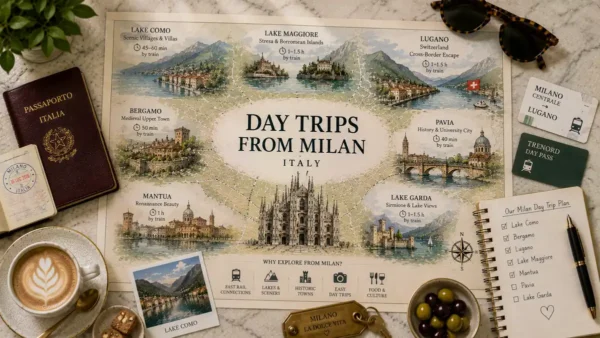
Lake Como, Bergamo and Verona are Milan’s three genuine day trips by train. All three sit around an hour or so from Milano Centrale, with frequent departures. Venice and Cinque Terre are not day trips from Milan; treat them as your next stop instead.
A real day trip has a simple test: roughly an hour each way, frequent trains, and a destination that gives you a full day without a plan. Three places clear it comfortably. Bergamo is the one most first-timers skip and most repeat visitors rate highest, because the walled Città Alta delivers the medieval Italy that Milan itself cannot.
| Destination | Rail time from Centrale | Day-trip verdict | Best for |
|---|---|---|---|
| Como and the lake | About 40–60 minutes | The strongest day trip from Milan | Lake scenery and a boat ride |
| Bergamo | About 50–60 minutes | Easy half or full day | Walled hilltop old town, Città Alta |
| Verona | About 1 hour to 1 hour 15 by high-speed | Works as a full day, not a half | Roman arena and Renaissance streets |
Venice and Cinque Terre are the two stretches travelers most often propose, and both fail the test from Milan. Each sits far enough away that a day trip means a long outbound leg, a compressed few hours on the ground and a tired return in the dark. Both deserve their own nights, so plan them as the next leg of the route instead of a day out. Lake Como is the opposite case: close enough for a day, but with enough lake towns and ferry routes to justify staying. For the lakes and the rest of Lombardy at guide depth — including how to turn Como into a base — see our Milan region guide.
Frequently Asked Questions
Is August a bad time to visit Milan?
Yes for most travelers, though the sights themselves stay open. What closes is the city’s texture: independent restaurants, small shops and the neighbourhood rhythm you came for. If your dates are fixed, plan the Duomo, the Galleria and museums, and use the lakes for cooler air.
Is Lake Como a good day trip from Milan?
Yes, it is the strongest day trip from Milan. Trains from Milano Centrale reach Como in roughly 40 to 60 minutes, so a lake day works comfortably. Be realistic about scope: one lakeside town plus a boat ride fills the day, and the wider lake deserves its own nights.
Is Milan walkable?
The central core is, and the rest of the city is not. You can cover the Duomo, the Galleria, La Scala, the Quadrilatero and Brera on foot in a single day without touching transport. Santa Maria delle Grazie, Navigli and Porta Nuova each need a tram or metro hop.
Milan or Rome — which is better to visit?
Rome, if this is your first trip to Italy and you have one city to spend. It carries the ruins, the scale and the postcard Italy most first-timers picture. Choose Milan for design, fashion, food and fast rail access to the Alps and the lakes. With ten days, take both.
What should I wear in Milan?
Smart-casual works everywhere and reads as normal here. Milan is a fashion city and dresses up more than most of Italy. Bring shoes you can walk stone streets in, and cover shoulders and knees for the Duomo, which enforces a dress code at the door.
Do you need to book Duomo rooftop tickets in advance?
No — the rooftop is not the ticket that must be locked in months ahead; the Last Supper is. Booking a Duomo slot online before you travel still spares you the ticket-office queue, which builds fast on weekends and through high season. Treat advance booking here as convenience, not necessity.
What happens in Milan during Fashion Week and Salone del Mobile?
The city fills and hotel prices spike across every neighbourhood. Both events are largely trade-only, so a leisure visitor pays the surge without getting into the show. Rooms sell out well ahead across the city. Check your dates against the fair calendar, and if they clash, move the trip.
Is Milan worth a one-night stopover?
Yes, when the night was already going to be spent in transit. A Malpensa arrival before an onward flight, or a rail leg heading north, both make Milan a sensible overnight. One evening realistically buys the Duomo square, the Galleria and an aperitivo — not the Last Supper, which needs a booked slot.
Related Guides
- Things to do in Milan — the attractions worth your two days, ranked and explained.
- Where to stay in Milan — the full neighbourhood comparison and segment picks.
- 3-day Milan itinerary — how the days fall when you have a third one.
- Milan public transport — tickets, passes, metro lines and trams.
- Milan trip cost — the daily budget broken down by category.
- Milan region guide — Lombardy, Lake Como and the northern lakes.
Did this guide save you time or money? Tripstou is independent and reader-funded — if you'd like to give something back, you can support the site with a crypto contribution of any size.