
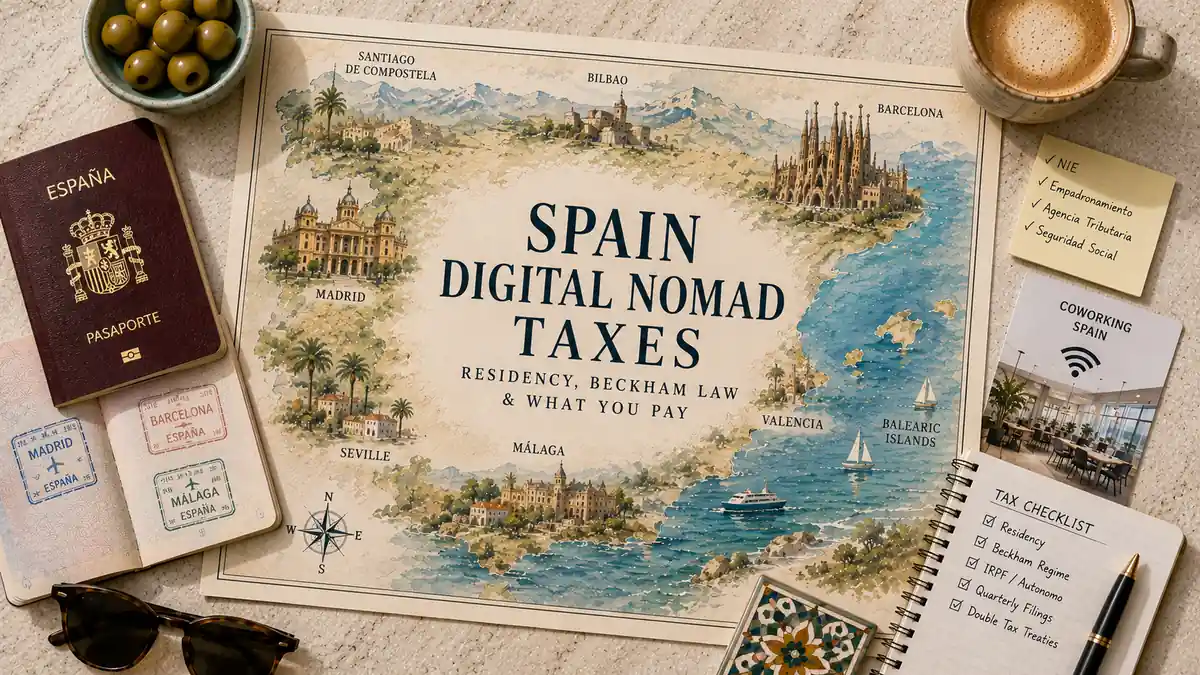
Digital nomads become Spanish tax residents after 183 days in Spain in a calendar year, and from then on Spain taxes their worldwide income. The variable that changes the bill is the regime: remote employees of foreign companies may qualify for the flat-rate Beckham regime, while most freelancers pay progressive IRPF as autónomos. Decide your regime early and engage a gestor before arrival, because the Beckham opt-in window is short.
Moving your remote income to Spain raises one planning question with three forks. First: will you become a Spanish tax resident at all — the switch that turns worldwide income into Spanish taxable income? Second: if you do, which regime applies — the flat-rate Beckham option or standard progressive IRPF? Third: are you on the employee path or the autónomo path, since each carries its own registration and social security obligations. This guide works through each fork in plain language: when residency triggers, what the Beckham regime is and who actually qualifies, what each regime implies for your tax bill, and how freelancers register. It also draws a clear line around where a guide stops being enough. Spanish tax positions are set early, some elections cannot be undone, and the final numbers belong with a gestor. The goal is that you arrive knowing which questions to ask, and when.
Do Digital Nomads Pay Taxes in Spain?
Yes — digital nomads who become Spanish tax residents pay Spanish tax on their worldwide income. The trigger is residency status, which depends on where you spend the year — the visa you hold neither creates nor prevents tax liability. Stay below the residency thresholds and Spain generally taxes only Spanish-source income.
The digital nomad visa itself does no tax work. It is an immigration permit. The tax rules run on a separate track and ask a different question: how much of the year do you spend in Spain, and where is your life centred? A nomad who holds the visa but spends most of the year elsewhere can remain non-resident, while someone who settles in full-time crosses into residency whatever their paperwork says.
That fork — resident or non-resident — organises everything on this page. Residents owe Spanish tax on worldwide income and file an annual return. Non-residents are taxed only on Spanish-source income, which for remote workers with foreign employers and clients usually means little or nothing. Every later decision — Beckham or standard IRPF, employee or autónomo — only matters once you are on the resident side of the line. For the broader picture of what settling in involves beyond tax, see our guide to living in Spain as a digital nomad.
When Do You Become a Tax Resident in Spain?
You become a Spanish tax resident by spending 183 or more days in Spain during a calendar year. The days do not need to be consecutive, and the count resets every January. Economic interests and close family in Spain can also make you resident, even below the day threshold.
Spain assesses residency per calendar year, and the outcome is binary — you are resident for the whole year or for none of it. There is no part-year residency. Because the count runs January to December, a mid-July arrival usually leaves you under 183 days and non-resident for that first partial year — a timing lever most nomads discover only after it has passed.
How does the 183-day rule actually count?
The rule counts days of physical presence in Spain between January and December, consecutive or not. Sporadic absences still count as Spanish days unless you can prove tax residency in another country — a weekend in Lisbon does not pause your count. Two secondary triggers matter below 183 days. Spain deems you resident if your centre of economic interests — your main income base or business — sits in Spain, and it presumes residency when your spouse and minor children live there. Both criteria come straight from Spanish tax law, and both catch nomads who count days carefully while moving their whole life to Spain anyway.
What Is the Beckham Law for Digital Nomads?
The Beckham law is a special regime that lets qualifying new residents pay a flat tax rate. Instead of progressive IRPF, you are taxed at a fixed rate on employment income for a limited period. The Startups Law extended the regime to remote workers, which is why it matters to digital nomads.
The regime matters for two reasons. The flat rate replaces progressive brackets on employment income, which favours higher earners. Employment income is taxed at the flat rate wherever it is earned. And it narrows what Spain taxes: broadly, you are treated closer to a non-resident for much of your non-employment foreign income — a materially different position from standard worldwide taxation. The fine print of that treatment is exactly where professional advice earns its fee.
Opting in is a formal act with a deadline:
- Confirm your employment structure qualifies before you relocate — eligibility is fixed by how you arrive.
- File Form 149 with the Agencia Tributaria within the opt-in window — around six months, and missing it is final.
- Ask a gestor which registration event starts your clock, because the starting point varies by case.
- Wait for confirmation before assuming flat-rate treatment applies to your payroll.
The deadline is the part that catches people. There is no late entry. Treat the opt-in as a task for your first weeks in Spain, never your first year.
How long does the Beckham regime last?
The regime is commonly described as lasting up to six years — the year you become resident plus the five that follow. After it ends, you move onto standard progressive IRPF. Confirm your exact window with a gestor, since the duration and its conditions are set by law and can change.
Who Qualifies for the Beckham Regime on the Digital Nomad Visa?
Remote employees of foreign companies generally qualify for the Beckham regime; the self-employed generally do not. Your employment structure on arrival decides which path you are on. Narrow exceptions exist for certain highly qualified freelancers, but the mainstream position treats contractor income as incompatible with the regime.
The conditions are structural, and none can be fixed retroactively:
- You move to Spain because of remote work performed for a foreign employer, under a genuine employment relationship.
- You were not a Spanish tax resident in the years before the move — commonly stated as the previous five; have a gestor confirm your own count.
- You file the opt-in within the deadline after arriving and registering.
The Spanish digital nomad visa is the gateway status that puts remote employees in a position to use the regime; its requirements and application process are covered in our guide to the Spanish digital nomad visa.
For freelancers the picture is murkier. The Startups Law opened a route for some highly qualified self-employed professionals, but ordinary contractor income is widely read as ineligible, and practice varies case by case. If you invoice clients through your own business, plan on the standard regime and let a professional test the exception — the reverse assumption is how people miss both the window and the fallback planning. Whether you land as employee or contractor is effectively decided before your flight; the opt-in window is too short to restructure an employment relationship after arrival.
How Much Tax Do Digital Nomads Pay in Spain?
Digital nomads pay either a flat rate under the Beckham regime or progressive IRPF under the standard rules. Which regime applies is the one variable you can influence; the rates themselves are set by law. Expect a flat rate near 24% under Beckham, and progressive rates from roughly 19% to 47% under standard IRPF.
The comparison below is the decision in one view. Spanish rates move with annual budgets, so the table states ranges, not point values.
Figures are ranges as of the last factual review — verify current rates with the Agencia Tributaria or your gestor before filing.
| Decision factor | Standard IRPF regime | Beckham impatriate regime |
|---|---|---|
| What income is taxed | All worldwide income once you are resident | Employment income at the flat rate, narrower overall base |
| Rate structure and range | Progressive, roughly 19–47% depending on income and region | Flat near 24% up to about €600,000, then 47% |
| Treatment of foreign income | Taxed in Spain, with treaty credits offsetting | Most non-employment foreign income stays outside Spanish tax |
| Who the regime fits | Freelancers, autónomos, and settlers at moderate incomes | Higher-earning remote employees of foreign companies |
| How you enter it | Applies by default once residency triggers | Opt in via Form 149 within the deadline |
Beckham’s flat rate is not automatically the cheaper option: at modest incomes, the lower opening brackets of progressive IRPF can undercut the flat 24%, so run both calculations before opting in. Two boundaries keep this section honest. Regional governments set part of the progressive scale, so standard IRPF differs noticeably between regions — this page deliberately skips regional bracket tables. And high-net-worth readers carry additional exposure — wealth and solidarity taxes plus foreign-asset reporting under Modelo 720 — which belongs in a conversation with your gestor.
What these rates mean for your monthly budget is a separate question. For rent, food, and the rest of the ledger, see the cost of living in Spain for digital nomads.
Do Freelancers Have to Register as Autónomo?
Yes — freelancers who are tax resident in Spain must normally register as autónomo to invoice clients legally. Registration brings progressive IRPF, quarterly filings, and monthly social security quotas. Since most freelancers cannot access the Beckham regime, autónomo status is the default path for self-employed nomads settling in Spain.
Autónomo status brings a full compliance system with it, and the registration sequence matters:
- Register your activity with the Agencia Tributaria before invoicing your first client from Spain.
- Join the self-employed social security scheme, where monthly quotas scale with your declared income.
- Set up quarterly filings — income tax prepayments and, for many service businesses, VAT returns.
- Hand the filing calendar to a gestor; missed quarterly deadlines carry automatic surcharges.
Quotas follow a two-stage pattern: new registrants typically start on a reduced flat quota, then move onto income-based tiers. The structure is the stable part. The euro amounts shift with government budgets, and your gestor will quote the current tier at registration.
Do Remote Workers Pay Social Security in Spain?
Yes — most tax-resident remote workers pay into Spanish social security in some form. How you pay depends on your path: employees rely on employer arrangements or home-country coverage certificates, while autónomos pay their own monthly quotas. Social security is a separate obligation from income tax.
For employees, contributions follow the employer. A foreign employer with staff resident in Spain generally has Spanish social security obligations, which some companies handle directly and others through local arrangements. The alternative is a certificate of coverage: where a totalisation agreement exists between Spain and your home country, you can often stay in your home system for a limited period. That certificate is frequently the make-or-break detail for the employee path — many foreign employers refuse Spanish registration outright, so confirm what yours will accept before you commit to the move.
For autónomos, the mechanism is the quota system covered above — you pay your own way monthly. Keep the two ledgers separate in your planning. Social security funds healthcare and pension access and is paid monthly, while income tax settles annually, and qualifying for one obligation says nothing about the other.
Will You Be Taxed Twice in Spain and Your Home Country?
Usually no — Spain’s double-taxation treaties and credit mechanisms exist to prevent the same income being taxed twice. The outcome depends entirely on your home country and how its treaty with Spain allocates taxing rights. US citizens are the notable exception, because American filing obligations continue regardless of where they live.
Two mechanisms work together here. Treaties allocate taxing rights between the residence country and the source country, and where both keep a claim, credits or exemptions offset one tax bill against the other. Spain maintains an extensive treaty network, so for most nationalities the practical result is one net tax burden — though which country collects, and how much paperwork it takes, varies by treaty.
US citizens are the standing special case. The United States taxes by citizenship, so American filing continues from Spain; credits and exclusions usually soften the outcome, but the dual-filing workload is permanent. Cross-border cases like this sit beyond any general guide.
Do You Need a Gestor or Tax Advisor in Spain?
Yes — engage a gestor or asesor fiscal for your first year at minimum, and ideally before you arrive. A gestor handles the elections that cannot be reversed: the Beckham opt-in, registration sequence, and quarterly calendar.
Residency clocks, opt-in windows, and registration sequences all start running early, several of them cannot be rewound, and a professional who sets your structure up correctly in the first weeks routinely saves multiples of their fee. Fees are modest relative to the cost of a missed deadline, and many nomads keep one on retainer for filings. It is the best money you will spend on the move.
Who Wrote This
This page settles one planning decision for remote workers moving to Spain: how Spanish tax will treat your income, under which regime, and on which registration path. It is not a Spain destination guide, a visa walkthrough or a catch-all relocation page, and it does not replace a gestor’s advice on your own figures.
Produced with AI assistance under our editorial process, then reviewed by Alex Perrut, working in tourism since 2015, for the Tripstou editorial team.
Last factual review: July 17, 2026.
Official sources consulted: spain.info, tourspain.es.
Did this guide save you time or money? Tripstou is independent and reader-funded — if you'd like to give something back, you can support the site with a crypto contribution of any size.