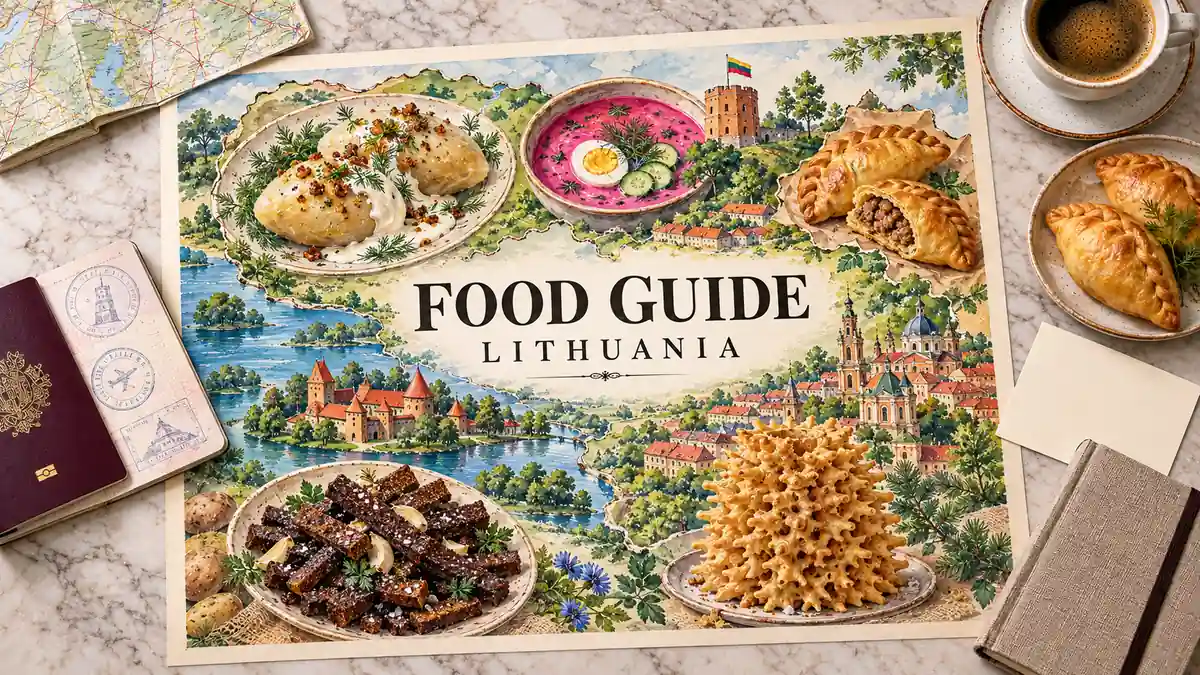
Lithuanian menus are full of long words with unfamiliar accents, and most visitors have no idea which ones are a snack, a soup or a meal that will keep them full until evening. The food behind them is simpler than the spelling. This is a cuisine of rye, potato, beetroot, curd cheese and pork, cooked for long winters and short, bright summers. The real question on a first trip is what to order, in what order, and what to skip so you still have room for the next plate.
This guide explains every traditional dish and drink in plain English, with the native name kept so you can point at the menu. Dishes are grouped by what they do for you: a hearty main, a summer starter, a beer snack, a hand-held lunch, a celebration sweet. That way you can choose by appetite, season and occasion instead of working through a checklist.
Quick Answer
Order cepelinai (potato dumplings) first, then šaltibarščiai (pink soup) in summer and kibinai (filled pastries) for a lighter meal. Appetite and season set the order: cepelinai are filling, and pink soup is mainly a summer dish. Pair meals with kepta duona (garlic fried rye bread) and local beer or gira; vegetarians pick curd-filled cepelinai or varškėčiai.
Trust Layer
Tripstou planning guide for travelers resolving one travel decision. Covers the main variable, traveler context, and practical tradeoffs.
Produced with AI assistance and reviewed by Alex Perrut, working in tourism since 2015, for the Tripstou editorial team. See our editorial process for details.
Last factual review: September 30, 2026.
Official sources consulted: Lithuania Travel, Lithuanian Ministry of the Economy and Innovation.
Key Takeaways
- Order cepelinai first: grated-potato dumplings filled with meat or curd cheese, served with sour cream and spirgučiai, and one is often enough.
- Šaltibarščiai, the cold pink beetroot-and-kefir soup with hot potatoes on the side, is mainly a summer dish and already a light meal.
- In a tavern, start with a shared plate of kepta duona (garlic fried rye strips) alongside local beer or low-alcohol gira.
- Kibinai (crescent pastries of the Karaim community, traditionally filled with mutton) make a hand-held bakery lunch, best tried in Trakai.
- Šakotis (the spit-baked tree cake) is a wedding and celebration cake that keeps well, making it the dessert to bring home.
- Vegetarians eat well but narrowly: curd-filled cepelinai without cracklings, varškėčiai, potato pancakes and pink soup; most other dishes contain pork.
Table of Contents
What Is Traditional Lithuanian Food Like?
Traditional Lithuanian food is hearty, rustic cooking built on potatoes, dark rye bread, beetroot, curd cheese and pork. It was shaped by long winters and farm kitchens, so dishes are filling and simply seasoned with dill, garlic and sour cream. Its best-known dishes are cepelinai (potato dumplings), šaltibarščiai (cold beetroot soup) and kepta duona (garlic fried rye bread).
The staple ingredients repeat across the whole menu. Rye gives the dense dark bread served with almost every meal. Potato is the base of the main courses. Beetroot colours the summer soup, curd cheese (varškė) fills pancakes and dumplings, and pork is the default meat. Forest mushrooms and berries round out the seasonal table.
Outside influences are easy to taste. German cooking left the sausages, smoked meats and potato bakes; Polish and Russian kitchens share the dumplings and pancakes; and the Karaim, a small Turkic community, brought the filled pastries now tied to Trakai. The result feels familiar to anyone who knows Central European food, with its own names and a heavier hand with dairy.
A first meal works best built around one dish. Pick a main, add a shared beer snack, and stop there. The table below is the short version of this whole page. For the wider trip around the meals, see our Lithuania travel guide.
| Dish | What it is | When to order it |
|---|---|---|
| Cepelinai | Grated-potato dumplings filled with meat or curd cheese | As one filling main when you are hungry |
| Šaltibarščiai | Cold beetroot-and-kefir soup with hot potatoes alongside | As a light lunch or starter, mainly in summer |
| Kibinai | Crescent pastries of the Karaim community, traditionally mutton | As a hand-held lunch, above all in Trakai |
| Kepta duona | Fried dark rye strips rubbed with garlic | With the first round of beer, shared |
| Šakotis | Spit-baked “tree cake” made for weddings and celebrations | As a dessert slice or a gift to take home |
| Gira | Fermented rye-bread drink with little or no alcohol | With any meal when you want no strong alcohol |
Cepelinai and the Potato Dishes You Should Try
Cepelinai are large grated-potato dumplings filled with minced meat, usually pork, or curd cheese. They arrive with sour cream and spirgučiai (fried pork cracklings), and they are the dish to order first. The potato family continues with bulviniai blynai (potato pancakes), kugelis (baked potato pudding) and vėdarai (potato sausage), all built on grated potato.
Cepelinai, blynai and kugelis share the same grated-potato base, so ordering two of them in one meal means eating the same dish twice in a different shape. Choose one potato main and let the rest of the table be bread, soup or a snack.
Smaller dishes sit on the same menus and suit a lighter appetite:
- Koldūnai (small dumplings) are the dainty cousin of cepelinai. Order them if you want dumplings without the weight.
- Varškėčiai (curd-cheese pancakes) are small, thick and lightly sweet, usually with sour cream or jam. They make a meat-free breakfast or lunch.
- Balandėliai (cabbage rolls) are cabbage leaves rolled around a savoury filling. They are a good middle ground between a snack and a full potato main.
Cepelinai (didžkukuliai)
Cepelinai, also called didžkukuliai, take their name from their zeppelin shape. Raw grated potato is wrapped around minced meat or curd cheese and boiled until dense and glossy. They come topped with sour cream and spirgučiai. One is often enough. Order this if you are hungry and want the national dish; vegetarians should pick the curd filling and ask for it without spirgučiai.
Bulviniai blynai
Bulviniai blynai (potato pancakes) are grated potato fried into thin rounds with crisp edges and a soft centre. They are served hot, usually with a bowl of sour cream for dipping. The texture is lighter than any boiled dumpling. Order this if you want the flavour of Lithuanian potato cooking without the heaviness of cepelinai, or a simple meat-free main.
Kugelis (bulvių plokštainis)
Kugelis, also called bulvių plokštainis (baked potato pudding), is grated potato baked in a tray and cut into squares. It is dense and soft inside, browned on top, and served with sour cream and often spirgučiai. A square is a full plate. Order this if you want a filling main that is easy to share, or cepelinai feel like too much.
Vėdarai
Vėdarai (potato sausage) is a natural casing stuffed with grated potato, sometimes with pork, and baked until the skin crisps. It arrives in a long coil or cut lengths, with sour cream and spirgučiai on the side. It is rich and salty. Order this if you like crisp, fatty farmhouse food and want the least familiar dish on the potato list.
When Should You Order Šaltibarščiai, the Pink Soup?
Order šaltibarščiai mainly in summer, as a cold starter or a light lunch on a warm day. It is a chilled soup of beetroot and kefir with cucumber, dill and chopped boiled egg. A plate of hot boiled potatoes comes on the side, and the contrast between cold soup and hot potato is the point.
The colour comes from the beetroot meeting the kefir. The result is a vivid, almost neon pink that surprises most first-timers. The taste is tangy, fresh and herby, closer to a cold yoghurt soup than to hot borscht.
Eat the potatoes between spoonfuls, or drop a few into the bowl; both are normal. The soup suits vegetarians who eat eggs and dairy, and it is the lightest traditional meal on a hot afternoon. In colder months, menus lean towards hot soups, and pink soup is harder to find.
Ordering pink soup as a starter before cepelinai is the classic first-timer overload. With its potatoes, a bowl of šaltibarščiai is already a light meal, so pair it with bread or a snack and save the dumplings for another day.
Kepta Duona and Rye Bread: What to Order with a Beer
Kepta duona is strips of dark rye bread fried until crisp and rubbed with garlic. It is the standard Lithuanian beer snack, often served with a cheese dip, and it is the first thing to order in a tavern. A single plate shared across the table works well alongside drinks.
The garlic goes on hot, so the strips are sharp and pungent. That is the appeal with cold beer. Order kepta duona with the first round, then decide whether you still want a main. It fills people up faster than they expect.
The bread behind it is juoda duona (dark rye bread), the daily staple on every Lithuanian table. It is dense and slightly sour, and it keeps well. That makes it one of the best foods to bring home.
For a cold table with beer, the classic trio is:
- Kepta duona — the garlic fried rye strips, shared, with the cheese dip.
- Skilandis (cold-smoked sausage) — dense, dry and sliced thin, a traditional smoked meat that also travels well.
- Lašiniai (cured pork fat) — sliced thin and eaten on rye bread.
Vegetarians can keep to kepta duona and the cheese dip. The other two are pure pork.
What Are Kibinai and Where Do You Find Them?
Kibinai are crescent-shaped pastries from the Karaim, a small Turkic community long settled in Lithuania. The traditional filling is mutton or lamb, and they are most strongly associated with Trakai. Eat them as a hand-held meal, bought hot from a bakery or café, not as a sit-down dish with sides.
The Karaim origin is why Trakai matters. The town is home to the community most closely tied to the pastry, and kibinai there are part of a living food heritage. Elsewhere they are a popular bakery snack.
Mutton or lamb is the original, but other fillings exist, and cafés offer several side by side. Kibinai are also sold in bakeries and cafés well beyond Trakai. Two make a light lunch for most appetites.
If Trakai is on your route anyway, save your first kibinai for there. A bakery version in the capital answers the question of what they taste like; the Trakai version answers why they exist.
Šakotis, Spurgos and Kūčiukai: Desserts and Celebration Foods
Šakotis is the Lithuanian dessert to know: a spit-baked “tree cake” with branch-like spikes, made for weddings and celebrations. It is sold whole or by the slice. For everyday sweets, order varškės spurgos (curd-cheese doughnuts) or skruzdėlynas (the “anthill” cake of fried dough pieces).
Šakotis (tree cake) is built by pouring batter onto a turning spit over heat, layer after layer, until it forms its hollow, spiky cone. The texture is dry and eggy. Order a slice if you want the celebration cake without a celebration.
Varškės spurgos (curd-cheese doughnuts) are small, round and dusted with sugar. They are the easiest sweet to grab with coffee. Order them if you want a quick, simple treat at a café counter.
Skruzdėlynas (anthill cake) is a mound of crisp fried dough pieces, named for its anthill shape. Order it if you prefer crunch over cream, or you want a dessert to share.
Kūčiukai (small biscuits) belong to the Christmas Eve table. They are an occasion food, not a year-round dessert, and you will mostly see them around the holiday season.
Šakotis is the dessert to take home. It is dry by design, keeps well and is often sold boxed. The spikes are fragile, though, so a smaller cake in a rigid box survives a suitcase better than a tall one.
What Are the Traditional Lithuanian Drinks?
The traditional Lithuanian drinks are gira and local beer for everyday meals, and midus and trauktinė for something strong. Gira is a fermented rye-bread drink with little or no alcohol. Midus is mead made from honey, and trauktinė is a bitter spirit infused with herbs or fruit, usually sipped in small measures.
Gira (bread kvass) is slightly sweet, slightly sour and very refreshing. It is the drink to order with lunch or with pink soup, and it suits anyone who wants no alcohol.
Beer is where Lithuania stands out. The north of the country — Biržai, Pasvalys, Pakruojis and Kupiškis — keeps a farmhouse brewing tradition that produces cloudy, unusual beers unlike standard lager. Ask for a beer from one of those towns by name. A bar that stocks them usually knows it.
Midus (mead) and trauktinė (herbal or fruit bitters) are the traditional strong drinks, usually taken in a small glass after a meal. Lithuanian fruit wines, made from berries and orchard fruit, are a softer option.
Birch sap is a seasonal curiosity, drunk fresh or lightly fermented and found mainly in spring. Order it if you see it; it rarely appears on menus for long.
Where to Find Traditional Food and How to Order It
Traditional Lithuanian food is easiest to find in traditional taverns and self-service cafeterias. Bakeries sell kibinai, and markets are the place for rye bread and smoked meats. Order one hearty main with a beer snack to share, not three courses, because a single plate of cepelinai or kugelis is already a full meal.
Each venue type does one job well:
- Traditional taverns — the full menu of cepelinai, kugelis, kepta duona and local beer, with table service.
- Self-service cafeterias — everyday home-style cooking you can point at, good for trying several small portions.
- Bakeries and cafés — kibinai, varškės spurgos and šakotis by the slice.
- Markets — juoda duona, skilandis, lašiniai and seasonal produce to take away.
In the capital, food markets and tastings are part of the city’s own activities, covered in our guide to things to do in Vilnius.
Vegetarians eat well but narrowly. The reliable picks are curd-filled cepelinai (without spirgučiai), varškėčiai, bulviniai blynai and šaltibarščiai. Most other traditional dishes are built on pork, so check before ordering.
Tipping is not mandatory. Rounding up or leaving around 10% for good table service is appreciated. Card tipping is common.
Tours and activities
Book skip-the-line tickets, day trips and local tours with free cancellation on most activities.
You can also browse everything on getyourguide.com.
Tripstou may earn a commission if you book through this link, at no extra cost to you.
Frequently Asked Questions
What is Lithuania’s national dish?
Cepelinai are widely regarded as Lithuania’s national dish. They are large dumplings of grated raw potato, filled with minced meat, usually pork, or with curd cheese, and served with sour cream and spirgučiai (fried pork cracklings). Their zeppelin shape gave them the name; in Lithuanian they are also called didžkukuliai. One portion is usually a full meal.
Is it necessary to tip in Lithuanian restaurants?
Tipping in Lithuanian restaurants is not mandatory, and typical tips have been getting smaller. Rounding up the bill or leaving around 10% for good table service is appreciated. Card tipping is common, so you can add the tip when paying by card. For a quick snack at a café counter, rounding up is plenty.
Is Lithuanian food vegetarian-friendly?
Lithuanian food is only partly vegetarian-friendly: the cuisine leans on pork, but dairy-based dishes give vegetarians reliable options. Safe picks are curd-filled cepelinai ordered without spirgučiai, varškėčiai (curd pancakes), bulviniai blynai and šaltibarščiai. Watch the toppings, because cracklings are added to many potato dishes. Vegans will find the traditional menu much harder.
What is gira?
Gira is a traditional Lithuanian drink made by fermenting rye bread, similar to the kvass found elsewhere in Eastern Europe. It tastes slightly sweet and slightly sour, and it contains little or no alcohol. Order it with lunch, alongside pink soup, or whenever you want something local without beer or spirits.
What Lithuanian food can you bring home?
The best Lithuanian foods to bring home are juoda duona (dark rye bread), šakotis and skilandis. The rye bread and the cold-smoked sausage both keep well, and šakotis is dry by design and often sold boxed. Markets are the easiest place to buy bread and smoked meats; pick a small šakotis in a rigid box.
Is Lithuanian food spicy?
Lithuanian food is not spicy. Traditional cooking is seasoned simply, mostly with dill, garlic, salt and sour cream, and the strongest flavours come from smoked meat, garlic-rubbed rye bread and the sourness of rye and kefir. Travelers who avoid chilli heat can order freely; the bigger adjustment is how rich and filling many dishes are.
Related Guides
- Lithuania travel guide — the wider trip plan these meals fit into: where to go, how long to stay and how to get around.
- Things to do in Vilnius — the capital’s markets, food experiences and sights, for turning a food interest into a day plan.
Did this guide save you time or money? Tripstou is independent and reader-funded — if you'd like to give something back, you can support the site with a crypto contribution of any size.