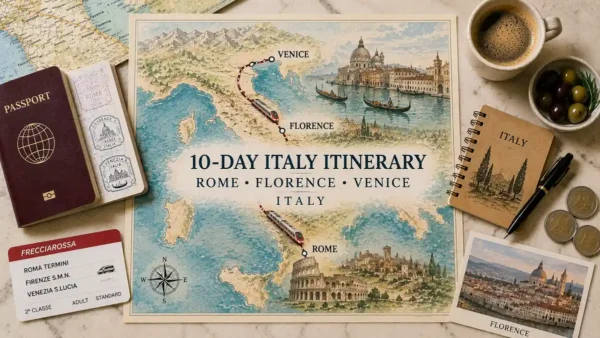
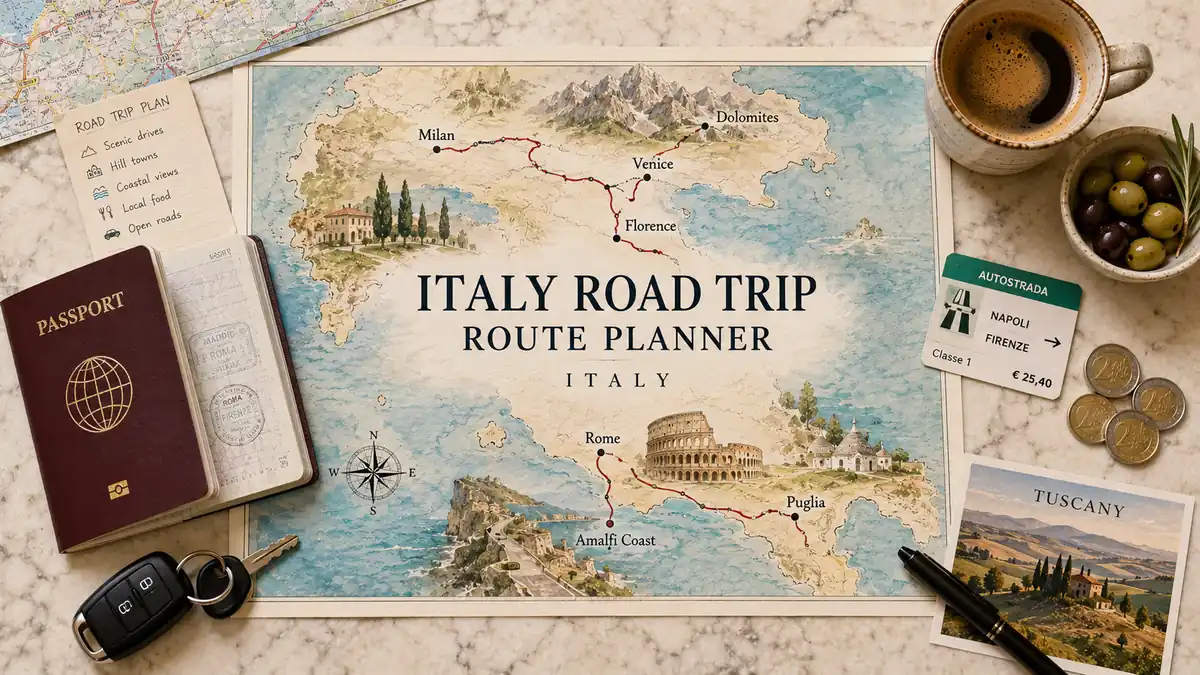
Italy can be driven brilliantly or miserably, and the difference is the route you choose. A car unlocks the parts of Italy that public transport reaches poorly: the Tuscan hill towns, the Dolomite passes, the Amalfi Coast and the deep south. The same car becomes a liability the moment you point it at a big-city historic center, where camera-enforced ZTL zones and scarce parking turn driving into stress and fines. This guide resolves the route question first: which drives are worth doing, sorted by region and by how many days you have. Then it covers the honest driving reality — pacing, season, tolls, ZTL rules and when a train simply beats a car. The aim is a confident yes or no on a road trip, and a route that matches the trip you actually want.
Quick Answer
An Italy road trip is worth it for countryside regions — Tuscany, the Dolomites and the south — not big cities. Pick a regional loop and plan 7–10 days; a car wins in the countryside, the train wins for Rome, Florence and Venice. It suits travelers wanting scenic flexibility who will avoid driving into ZTL-restricted city centers.
Trust Layer
Tripstou itinerary guide for travelers planning a route. Covers pacing, stop count, stop order, base logic, and trip length.
Produced with AI assistance and reviewed by Alex Perrut, working in tourism since 2015, for the Tripstou editorial team. See our editorial process for details.
Last factual review: June 29, 2026.
Official sources consulted: Italia.it, ENIT.
Key Takeaways
- A car wins in countryside Italy — Tuscany, the Dolomites, the south — but becomes a liability in big-city historic centers.
- Build the trip around one region — a Tuscan loop, the Great Dolomites Road or Puglia — rather than crossing the country.
- Plan 7–10 days for a single region; combining two contrasting regions realistically needs around 14 days.
- Drive in spring or autumn for mild weather and open roads; summer brings heat and clogged coastal routes.
- ZTL cameras photograph every plate, including rentals, so park outside historic centers to avoid fines arriving months later.
- Combine modes: take the train between Rome, Florence and Venice, then rent a car only for the countryside.
Table of Contents
Is an Italy road trip worth it?
An Italy road trip is worth it for scenic, rural Italy — and a liability in major cities. A car earns its keep in Tuscany, the Dolomites and the south, where the best stops sit between towns and trains thin out. In Rome, Florence, Milan or Naples, it mostly adds cost and ZTL risk.
The deciding factor is what your itinerary is actually built around. If your trip is a string of major cities, a car spends most of its time parked at expensive rates while you take trains anyway. If your trip is hill towns, mountain passes, vineyards and coastline, the car becomes the whole point — it reaches places no timetable serves and lets you stop on impulse.
This suits travelers who want flexibility and scenery over speed, and who are comfortable with assertive traffic. It works against travelers focused on city sightseeing, on a tight budget, or nervous about narrow roads and restricted zones.
Reality check: the car only pays off when the route is designed around countryside, not cities. Decide the shape of the trip first, then decide whether to rent — not the other way around.
The best road trip routes in Italy by region
Italy’s strongest road trips are regional loops, each built around one landscape. Tuscany suits hill towns and vineyards, the Great Dolomites Road delivers alpine passes, and the Amalfi Coast and Puglia open up the south. Pick by the landscape you want, then match it to your days.
Choosing one region rather than crossing the whole country keeps drives short and the trip relaxed. The table below pairs each classic route with its region, a realistic length and why a car genuinely helps there. Treat these as route nodes, not sightseeing lists — for what to actually see along the way, see our roundup of the best places to visit in Italy.
| Route | Region | Suggested days | Why a car helps |
|---|---|---|---|
| Tuscany hill-town loop | Val d’Orcia, Chianti, Siena | 3–5 days at a relaxed pace | Vineyards and hilltop villages sit off the rail lines |
| Great Dolomites Road | Bolzano to Cortina d’Ampezzo | 3–4 days for the passes | Mountain passes and trailheads need door-to-door driving |
| Amalfi Coast and the south | Sorrento, Amalfi, the Cilento | 4–6 days including coastal stops | Coastal villages reward flexible, unhurried timing |
| Puglia and the heel | Itria Valley, Salento, Bari | 5–7 days across the region | Trulli towns and beaches spread far apart |
| Northern lakes and Piedmont | Lake Como, Garda, Piedmont | 4–6 days touring the lakes | Lakeshore towns and wine country link best by car |
Tuscany route
Tuscany is the most forgiving first road trip in Italy. The drives between Siena, the Val d’Orcia and Chianti are short, the scenery is constant, and a car reaches the agriturismi and hilltop villages that buses serve poorly. Base in one or two farmhouses and treat each day as a loop.
Great Dolomites Road (Bolzano–Cortina)
The Great Dolomites Road from Bolzano to Cortina d’Ampezzo is one of Europe’s great alpine drives. It strings together high passes, hairpins and trailheads that only make sense by car. Confirm pass access before you go, as the highest sections are seasonal.
Amalfi Coast and the south
The Amalfi Coast is spectacular but the most demanding drive on this list — narrow, busy and slow in season. Many travelers prefer to base in Sorrento and use buses or boats for the cliff road itself, then drive the quieter Cilento and inland south.
Puglia
Puglia rewards a car more than almost anywhere in Italy. Trulli towns, baroque Lecce, beaches and the Itria Valley sit far apart with thin public transport. A loop from Bari through the Salento gives you the region at its own slow rhythm.
Northern / lakes loop
The northern lakes and Piedmont make an easy, efficient loop on well-kept roads. Lake Como, Garda and the Piedmont wine country link naturally by car, and central nodes like Bologna make a comfortable gateway — see our Bologna guide for a base on the way north.
Northern vs Southern Italy: which road trip suits you?
Choose the north for efficient, dramatic driving and the south for slow, scenic coastal roads. Northern Italy — the Dolomites, lakes and Piedmont — has well-kept roads and tight, rewarding distances. The south — Amalfi, the Cilento and Puglia — trades speed for coastline, character and longer, slower legs.
The north suits travelers who want maximum scenery per hour of driving, confident mountain roads and easy logistics. Distances are short, surfaces are good, and you are rarely far from a town. It is the safer pick for a first Italian road trip or a shorter window.
The south suits travelers chasing coastline, food and a slower pace, who do not mind narrower roads, looser timing and more driving between highlights. Naples is the gateway but not a place you want to drive into — base outside and explore from there, as our Naples guide explains. The tradeoff is simple: the north is easier, the south is wilder.
How many days you need for an Italy road trip
Most Italy road trips work best at 7–10 days for a single region. That gives time to settle into a couple of bases, take day drives and avoid repacking every night. Combining two regions — say Tuscany and the Dolomites — realistically needs around 14 days.
The pacing logic is straightforward: the more bases you add, the more of each day disappears into packing, checking in and finding parking. Fewer, longer stays mean more actual exploring and far less admin. A long weekend covers one compact area; a full week covers one region properly; two weeks is the point at which a second, contrasting region becomes realistic.
| Trip length | Pace | What fits comfortably |
|---|---|---|
| Long weekend (3–4 days) | Fast, a single base only | One compact area like Chianti or the lakes |
| One week (5–7 days) | Steady, one or two bases | A full regional loop such as Tuscany |
| Ten days (8–10 days) | Relaxed, two bases | One region in depth plus nearby detours |
| Two weeks (12–14 days) | Varied, multiple bases | Two contrasting regions, north and south |
Reality check: fewer bases is almost always the calmer, cheaper itinerary — resist adding a region just because it looks close on the map. If you want a city-led plan that mixes trains and a short drive, our general Italy itinerary covers the non-car sequencing in detail.
Best time of year to drive Italy
Spring and autumn are the best times to drive Italy — mild weather, open roads, fewer crowds. Summer brings heat, heavy traffic and packed coastal roads, especially around Amalfi and the lakes. High Dolomite passes can close in winter, so check seasonal access before planning a mountain route.
From roughly April to June and September to October, you get comfortable temperatures, quieter roads and easier parking. Summer is drivable but the coastal and lake routes clog, and city heat makes the inevitable parking walks unpleasant. Winter favors lower-altitude regions like Tuscany and Puglia, while alpine routes depend on pass and snow conditions that change year to year.
Seasonal road access in the mountains is freshness-sensitive: always confirm that high passes on your route are open before committing, rather than assuming a fixed schedule.
What driving in Italy is really like
Driving in Italy is easy on the open road and stressful in city centers. Expect assertive drivers, narrow rural lanes and tolled autostrade, but generally well-signed, well-surfaced highways between regions. The hard part is not speed or distance — it is parking and restricted historic centers.
A few principles cover most of the experience:
- Drivers are confident and fast; keep right on the autostrada and let quicker traffic pass.
- Autostrade are tolled — you take a ticket and pay on exit, so budget a modest per-trip cost and verify current rates rather than guessing.
- Rural and coastal roads are often narrow and winding; plan slower average speeds than the map suggests.
- Fuel is widely available but pricier than in much of the world; treat costs as a range and check at the pump.
- City historic centers are the real obstacle — restricted, camera-enforced and short on parking.
For general planning that sits outside driving itself, see our broader Italy travel guide; for ETIAS and the entry rules themselves, see Italy visa and entry requirements. Keep cost expectations at the principle level: tolls and fuel move over time, so verify before you rely on a figure.
Renting a car
DiscoverCars searches local and international rental companies at once and shows each supplier’s rating, fuel policy and deposit before you book.
Compare rental cars on DiscoverCars →
Tripstou may earn a commission if you book through this link, at no extra cost to you.
ZTL zones and how to avoid fines
ZTL zones are camera-enforced restricted areas in Italian city centers, and they read every plate. Cameras photograph all cars entering, including rentals, so a single wrong turn can trigger a fine. The simple rule: park outside the center and never drive into the historic core.
ZTL stands for zona a traffico limitato — a limited-traffic zone covering most historic city centers. Enforcement is automatic and the cameras do not distinguish a tourist’s rental from a resident’s car, so fines often arrive months later via the rental company. Penalties vary by city and typically fall in the region of €80–130 per entry; treat that as a range and verify locally, since amounts change.
The fix is behavioral, not technical: stop at a parking garage or lot on the edge of the center and walk or take transit in. City-specific ZTL boundaries and parking are best handled per destination — see our Rome guide, Florence guide and Milan guide for local detail.
Rule: if in doubt, assume the historic center is a ZTL and park on the edge — it is far cheaper than a fine and almost always faster than hunting for a space inside.
Road trip vs train: when a car wins
A car wins for the countryside; the train wins for the Rome–Florence–Venice corridor. Trains link the major cities faster and cheaper than driving, with no parking or ZTL worries. For many trips, the best plan combines both: train between cities, then rent a car for the countryside.
Italy’s high-speed rail makes city-to-city driving pointless — you arrive in the center, not a distant garage, and skip tolls entirely. For the full city sequence, our Italy by train guide handles the rail logistics. Venice seals the case: it is car-free, so any plan ending there needs a train or a parked car on the mainland, as our Venice guide explains.
Reality check: the cheapest, least stressful trips usually train between cities and rent a car only for the days that genuinely need one — the Dolomites, Tuscany or Puglia — then drop it before the next city.
Train and bus tickets
Compare routes, schedules and prices across rail and bus operators in one search, with mobile tickets on your phone.
New to Omio? Code NEW10 takes 10% off your first booking — or APPNEW10 if you book inside the Omio app. Both apply to bookings up to €80.
Search routes and compare prices on Omio →
Tripstou may earn a commission if you book through this link, at no extra cost to you.
Frequently Asked Questions
Do I need an international driving permit to drive in Italy?
Yes, most non-EU visitors should carry an International Driving Permit alongside their home licence to drive in Italy. The IDP is an official translation, not a standalone licence, and rental companies and police may ask for both. Requirements depend on your nationality, so confirm the current rules before you travel.
How much are tolls on Italy’s autostrade?
Most Italian motorways (autostrade) are tolled, and you pay based on distance — take a ticket on entry and pay on exit. Costs add up over a long route but stay modest per trip. Rates change over time, so check current toll estimates for your specific route rather than relying on a fixed figure.
Where do you park when visiting Italian cities by car?
Park in a garage or lot on the edge of the historic center, then walk or take transit inside. Most Italian cities mark these as parcheggio, and many sit just outside the ZTL boundary. This avoids both fines and the near-impossible task of finding a space inside the old core.
Are rental cars exempt from ZTL fines?
No, rental cars are not exempt from ZTL fines. Cameras read every plate and cannot tell a tourist’s rental from a resident’s car, so entering a restricted zone triggers a penalty either way. The rental company typically passes the fine on to you later, often with an administrative fee added.
Is it safe to drive in Italy?
Yes, driving in Italy is generally safe, with well-maintained, clearly signed highways between regions. The main challenges are assertive local drivers, narrow winding rural and coastal roads, and tight historic centers rather than danger itself. Drive defensively, keep right on the autostrada, and plan slower speeds on mountain and coast roads.
Can you do an Italy road trip without driving in the big cities?
Yes, and it is the recommended approach. Base in the countryside or smaller towns, park outside any historic center, and use trains to reach major cities like Rome, Florence and Venice. This keeps the car for scenic regions where it adds value while avoiding ZTL zones and city parking entirely.
Related Guides
- Italy travel guide — country basics, entry rules and how the whole trip fits together.
- General Italy itinerary — a city-led route plan for travelers not driving the whole way.
- Italy by train — rail sequencing for the Rome–Florence–Venice corridor and beyond.
- Best places to visit in Italy — what to actually see along your chosen route.
- Rome guide — ZTL, parking and getting around the capital without a car.
- Florence guide — a car-free base at the heart of any Tuscany trip.
Did this guide save you time or money? Tripstou is independent and reader-funded — if you'd like to give something back, you can support the site with a crypto contribution of any size.