
Booking a solo trip to Italy as a woman comes with one recurring question: will I actually be safe on my own? It is a fair worry, and it deserves specifics instead of vague reassurance. The short version is encouraging. Every year, millions of women travel Italy alone — through crowded stations, late-night piazzas, and unfamiliar neighbourhoods — and the overwhelming majority come home with nothing worse than a good story. That does not mean switching off. It means knowing which situations call for attention and which you can simply relax into. This guide works through the real concerns one at a time: pickpockets, taxis and trains, nights out, where to book a bed, unwanted attention, what to wear, and the cities that make a first solo trip feel easy. No scare tactics, no data dumps — just the judgement calls that keep a solo woman confident and in control.
Quick Answer
Italy is generally safe for solo female travellers, and everyday street awareness is the main requirement, not fear. The real risks are petty theft and occasional unwanted male attention, not violent crime. Stay in central, well-reviewed areas, keep your guard up around stations and after dark, and trust your instincts.
Trust Layer
Tripstou planning guide for travelers resolving one travel decision. Covers the main variable, traveler context, and practical tradeoffs.
Produced with AI assistance and reviewed by Alex Perrut, working in tourism since 2015, for the Tripstou editorial team. See our editorial process for details.
Last factual review: July 2, 2026.
Official sources consulted: italia.it, enit.it.
Key Takeaways
- Italy is generally safe for solo female travellers; violent crime is rare, so everyday awareness matters far more than fear.
- Petty theft and occasional catcalling are the two real risks — both manageable, neither aimed specifically at women.
- Carry a zipped crossbody bag worn in front and stay alert around stations, crowds, and busy tourist sights.
- Choose central, well-reviewed, walkable accommodation over cheap station-adjacent bargains that empty out and feel edgy after dark.
- Handle catcalling with calm non-engagement, and step into a busy shop or café if anyone persists.
- Florence, Bologna, Verona, and Turin make compact, walkable first solo trips that are easy to navigate alone.
Table of Contents
Is Italy safe for solo female travellers?
Yes — Italy is generally safe for solo female travellers, and ranks among Europe’s more reassuring destinations for women. Violent crime against tourists is rare; the everyday concerns are petty theft and occasional catcalling, both manageable with ordinary awareness. Solo women of every age and travel style navigate Italy comfortably each year.
The broader national and regional safety breakdown sits in our general Italy safety guide, which is worth reading for the full crime and region picture. Scams do exist here, from ticket-machine “helpers” to padded restaurant bills, but they target tourists broadly and are not aimed at women in particular. Being solo barely changes your actual risk level. What it changes is how alert you need to be, since no companion is watching your bag or reading the room alongside you.
Travelling alone shifts one thing above all: your own awareness now has to cover the job a companion would normally share — half-watching your things and sensing when a situation turns. That is the real adjustment, and it is a habit, not a hardship.
How do you avoid pickpockets in Italy as a solo woman?
Pickpocketing is the most likely problem you will face, and also the most preventable. Thieves work crowds, public transport, and famous sights where distracted tourists cluster. Carry a zipped crossbody bag worn in front, keep your phone off café tables, and split your cash and cards. Awareness beats any anti-theft gadget.
The habits that matter are simple and easy to build. A few practical rules cover most situations:
- Wear a zipped crossbody bag across your front in crowds, and rest a hand on it on packed metros or buses.
- Keep your phone, wallet, and jewellery out of sight when you are not using them.
- Stay switched on in the high-risk zones — stations, metro platforms, city buses, and the busy approaches to major attractions.
- Treat distraction tactics as red flags: someone bumping you, a map thrust in your face, a “petition” clipboard, a staged squabble.
- Leave a backup card and some spare cash at your accommodation, so one bad moment never strands you.
Solo travellers are a slightly softer target simply because no one is covering your blind spot. Pickpockets read body language before they choose a mark. Walking with clear direction, bag in front and eyes up, signals you are switched on, and most crews quietly move to an easier target.
Are taxis and trains safe for women travelling alone in Italy?
Yes — licensed taxis and Italy’s trains are generally safe for women travelling alone. The judgement calls are choosing official, marked taxis over unlicensed touts, and staying aware of your carriage and seat on quieter services. Booking through a reputable app or an official taxi rank removes most of the uncertainty.
A handful of transport habits keep things easy:
- Use official taxi ranks or a licensed taxi-booking app, and ignore anyone offering a ride inside station halls or airport arrivals.
- Check the taxi is marked and metered before you get in, and have the address ready.
- On trains, pick busier carriages; on quiet regional or late services, sit near other passengers or families.
- Keep your bag where you can see it, especially at station stops when people board and leave quickly.
- Trust a bad feeling and move seats or carriages. You owe no one an explanation.
On regional trains, timing matters more than the route. A half-empty late carriage feels very different from the same seat mid-afternoon, so solo women often plan longer legs for daylight hours and save the sleepy night services for when they are not essential.
Is it safe to travel Italy alone at night as a woman?
Nights are generally fine in central, lively areas, and warrant more care around stations and empty backstreets. Well-lit piazzas full of people stay welcoming late; deserted streets and station surrounds are where solo women should tighten up. Stick to populated, well-lit routes and you can enjoy Italian evenings confidently.
Italian cities come alive after dark, and a busy square at 11pm is often as relaxed as it is at noon. The care applies to the edges: streets that empty out, underpasses, and the immediate area around big stations, which thin out fast once the last trains go. Plan your route home before you head out. Favour main, well-lit roads over shortcuts, keep your phone charged, and share your live location with someone you trust.
In Italian cities the safe-versus-sketchy line often falls within a block or two — the lit café strip and the dark side lane sit right next to each other. The move is to route along the busy edge, even when it adds five minutes, because a longer well-lit walk beats a quick dark one every time.
Where should a solo female traveller stay in Italy?
Prioritise central, well-reviewed, walkable neighbourhoods near good transport over cheaper spots that are isolated or right beside major stations. A safe base lets you walk home at night, reach sights on foot, and return easily after dark. Read recent reviews from other solo women before booking anywhere.
Where you sleep quietly shapes your whole trip, so it is worth spending a little more for a good base. Look for accommodation with a staffed reception, in a lively central area, on a street that stays populated in the evening. Reviews are your best tool — filter for mentions of “solo”, “female”, “safe”, and “easy to get back at night”, and set overall trip context with our Italy travel guide when you are mapping the route between cities. Hostels with female dorms are a strong pick for first-timers, combining a safety margin with an easy way to meet people. The tradeoff is real: the cheapest beds are usually cheapest for a reason, and price alone is a poor filter when you are arriving alone.
The station-adjacent bargain is the classic solo-female trap in Italy. Those hotels are cheap precisely because the immediate area empties and can feel edgy after dark — exactly when you are wheeling a suitcase back to your room alone.
Hotels and places to stay
Compare hotels, apartments and stays for your dates in one search.
Search hotels and stays on hotels.com →
Tripstou may earn a commission if you book through this link, at no extra cost to you.
How do you handle catcalling and unwanted attention in Italy?
Occasional catcalling can happen, but it is rarely threatening and usually fades the moment you don’t engage. A calm non-response, confident body language, and a steady pace defuse most attention. If someone persists, step into a busy shop, café, or crowd. You owe no one politeness, conversation, or a smile.
Most attention is a low-level comment that goes nowhere once it gets no reaction. Keep walking, eyes forward, at your normal pace — sunglasses or headphones make an easy, low-effort shield. A firm “no” and continued movement handles the persistent ones. If someone genuinely follows you, head straight into a public space, a shop, or a busy café and, if needed, ask staff for help. Escalation beyond words is rare, and drawing other people in ends it quickly.
The instinct to be polite is the thing to override here. A warm smile or a quick reply can read as interest to a persistent catcaller, so blank non-acknowledgement usually ends the exchange faster than courtesy does. Being firm is not being rude — it is the tool that works.
What should a solo female traveller wear in Italy to blend in?
Blending in lowers unwanted attention, and Italians dress smart-casual rather than sporty or obviously touristy. Neat, put-together outfits draw less notice than gym clothes, big logos, or beachwear away from the coast. For churches, cover shoulders and knees. This is about attention and access, not fashion rules or modesty policing.
Looking less like an obvious visitor helps on two fronts, quietly lowering your visibility to both pickpockets and hasslers. Aim for tidy, comfortable clothes and shoes you can walk all day in, and keep flashy jewellery packed away, which doubles as theft prevention. Covering shoulders and knees is a genuine access point, not just a style note: many churches and religious sites will turn you away without it, so a light scarf earns its place in your bag. For broader packing and etiquette planning beyond safety, our Italy travel tips cover the wider ground so this page can stay focused on attention.
Blending in does double duty here. An outfit that reads local draws less notice from both thieves and unwanted attention, which is why smart-casual is a safety choice as much as a style one — the goal is “put-together and unremarkable”, not covered up.
The safest Italian cities for a first solo trip
A few Italian cities make an especially easy first solo trip: Florence, Bologna, Verona, and Turin. Each pairs a compact, walkable centre with steady foot traffic and strong train links. They are forgiving if plans change and simple to navigate alone. Treat them as reassuring starting points, not a strict ranking.
These cities share the qualities that make solo life low-stress — small, busy centres you can cross on foot without needing late-night transport:
- Florence — a compact Renaissance centre, walkable end to end, and thoroughly used to solo visitors.
- Bologna — a lively student city with busy porticoed streets that stay populated into the evening.
- Verona — small, elegant, and easy to cover on foot, with a relaxed pace.
- Turin — a graceful grid layout that is simple to navigate and pleasantly under-touristed.
Bigger names like Rome, Milan, and Naples are perfectly doable solo too; they just ask for standard big-city awareness. For a first trip, though, walkability matters more than fame. A compact centre means fewer transfers, less time lost, and shorter walks home after dark — which is exactly why smaller cities often feel easier to land in than the giants.
Frequently Asked Questions
Is it safe to walk around Italian cities alone at night?
Yes, walking alone at night is generally safe in central, well-lit, busy parts of Italian cities. Stick to populated main streets and lively piazzas, and avoid deserted backstreets, underpasses, and the area right around big stations. Keep your phone charged, walk with purpose, and favour the longer, brighter route home.
Is Rome safe for solo female travellers?
Yes, Rome is safe for solo female travellers, with standard big-city awareness the main requirement. Pickpocketing is the real concern, concentrated around the main station, crowded metro lines, and headline sights like the Colosseum and Trevi Fountain. Keep valuables zipped and hidden, stay in a central area, and evenings in busy districts feel relaxed.
What emergency number do I call in Italy?
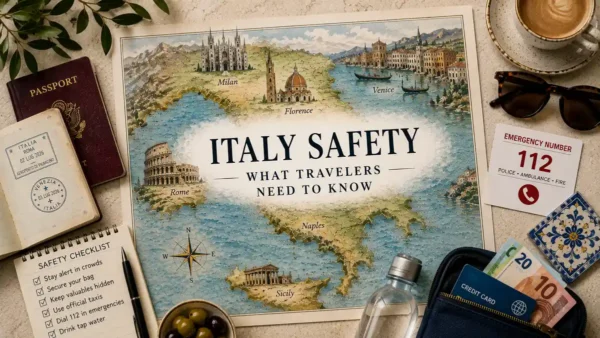
Dial 112, the free EU-wide emergency number, which works across Italy from any phone for police, ambulance, or fire. Operators can connect you to the right service and often handle English. Save it before you travel, and don’t hesitate to call if you ever feel genuinely unsafe or threatened.
Is Italy a good first solo trip destination for a woman?
Yes, Italy is one of the easiest first solo trips for a woman. It combines a low violent-crime profile, excellent train links, walkable historic centres, and a steady stream of fellow travellers, so you’re rarely truly alone. English is widely understood in tourist areas, which makes navigating and asking for help straightforward.
Do solo female travellers need to speak Italian to stay safe?
No, you don’t need to speak Italian to stay safe travelling solo in Italy. English is widely understood in cities, transport hubs, and tourist areas, and staff can usually help. Learning a few basics — grazie, no, aiuto (help) — is courteous and useful, but confident body language matters far more than fluency.
How can a solo female traveller meet other travellers safely in Italy?
Stay in social accommodation like hostels with female dorms or well-reviewed guesthouses, which make meeting people effortless. Join free walking tours, group day trips, or cooking classes to connect in daylight, public settings. Vetted women’s travel communities and apps help too. Always meet new contacts in busy public places first.
Related Guides
Keep planning your trip with these companion guides, each resolving a decision that sits next to solo-female safety:
- Italy safety guide — the general national picture, crime context, and regional spread for every traveller.
- Italy travel tips — broader practical prep, etiquette, and packing beyond the safety lane.
- Italy travel guide — overall trip-planning context to shape your route and itinerary.
- Common scams in Italy — the full catalogue of setups worth recognising before they start.
- Italy travel insurance — what cover is worth having, and what it actually pays for.
Did this guide save you time or money? Tripstou is independent and reader-funded — if you'd like to give something back, you can support the site with a crypto contribution of any size.