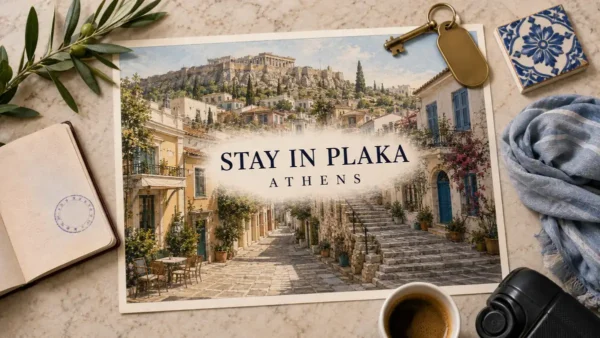
You have picked Psyrri, or you are one click from picking it, and what you want now is not another list of areas. You want to know what the quarter is actually like once you are standing in it with a key in your hand.
This page walks Psyrri through its own day. Which lanes carry the late tables and which ones do not. When the street noise starts and how long it holds. What the same walls and shutters are doing at ten in the morning, when the bars are closed, the wholesalers are loading vans and the painted metal has the lane to itself.
That morning half is the part almost nobody writes down, and it is the part that decides whether the address works for you. Everything else on this page — the streets, the squares, the heritage layer, the building stock, the price position — hangs off the same clock.
Quick Answer
Psyrri is central Athens’s late-night bar-and-workshop quarter, immediately north of Monastiraki: compact, walkable and mural-covered. You get a characterful, well-priced address and pay for it in sleep, because the late tables and music concentrate around Iroon Square. Light sleepers should book a courtyard-facing room, or the quieter, workaday edges.
Trust Layer
Tripstou stay guide for travelers choosing where to base. Covers area atmosphere, budget, convenience, noise, and traveler fit.
Produced with AI assistance and reviewed by Alex Perrut, working in tourism since 2015, for the Tripstou editorial team. See our editorial process for details.
Last factual review: August 30, 2026.
Official sources consulted: Visit Greece, Greek Ministry of Tourism.
Key Takeaways
- Psyrri buys you a central, walkable, characterful address at honest value, and charges for it in sleep.
- The quarter runs on a clock: workshops and wholesalers in the morning, cafés and murals by afternoon, tables late.
- The Iroon Square core and the lanes towards Monastiraki carry the late tables; the Evripidou and Sarri edges stay quieter.
- A courtyard- or inward-facing room buys the address without the street, and matters more than which block you pick.
- Psyrri prices below the polished central areas for a comparable position, so the value shows up as a better building.
- Most regret here comes from booking over the loud core while expecting quiet, or judging Psyrri without seeing its morning.
Table of Contents
Where Psyrri Sits in Athens — and What Surrounds It
Psyrri sits in the historic centre of Athens, north-west of the Acropolis and immediately north of Monastiraki. Monastiraki is its metro station, which puts the quarter directly on the city’s main transport spine. Everything the ancient core holds is reachable from its lanes on foot.
The neighbours do the orientation work better than any boundary line. Omonoia lies to the north, Kerameikos to the west, Akadimia to the east, and Monastiraki closes the southern side, next door and continuous with it. Ermou runs along the southern edge as a street you will cross constantly. Athinas Street marks the eastern flank, and Varvakios, the central food market, sits on it — adjacent to Psyrri, not inside it, which is a distinction worth holding when you read a listing that claims the market as its own.
Nobody agrees on exactly where Psyrri stops, and you do not need them to. If you are still deciding between this and the rest of the city’s areas, the comparison belongs to the hub on staying in Athens; for how the quarter fits into the wider city, our Athens travel guide sets the frame. What matters on the ground is that you are north of Monastiraki, east of Kerameikos, and inside the walkable core.
The Maze Around Iroon Square: Streets, Squares and Painted Shutters
Psyrri is a compact maze of narrow, largely pedestrianised lanes radiating out from Iroon Square. Its walls and shutters are painted end to end, and its three squares carry different crowds at different hours. The scale is small, and the lanes rarely run straight for long.
Iroon Square — Plateia Iroon, Heroes’ Square — is the centre of gravity, and the streets feeding into it carry the names of War of Independence heroes. Learn the roster of lanes and the quarter stops being a maze:
- Agion Anargyron, Navarchou Apostoli, Riga Palamidou, Miaouli and Karaiskaki — the lanes between the square and Monastiraki. This is the taverna-and-table heart, and the block where the street width disappears after dark.
- Pittaki and Sarri — the art streets, and the two names to walk if you came for the walls.
- Protogenous and Pallados — the connective lanes between the square and the Athinas edge, shops at street level.
- Evripidou and Epikourou — the workaday edge, wholesale and spice trade, busiest in daylight.
- Melidoni — runs towards Agion Asomaton Square and the quarter’s quietest heritage cluster.
The three squares are not interchangeable. Iroon is the loud one and fills last. Avissinia Square, near the south-west corner, keeps a flea-market-facing character and a daytime crowd. Agion Asomaton Square, around its church, is the calmest of the three at almost any hour.
The surfaces matter more than they sound. Cobbles, uneven paving and one-way lanes mean a taxi will often stop at the edge of the pedestrian zone and let you walk the last stretch, and wheeled luggage does not enjoy that walk. Book with the lane name in hand, not just the street number — arriving in Psyrri is a navigation problem, and a small one you can solve before you land.
At Ten in the Morning, Psyrri Is Still a Working Quarter
At ten in the morning Psyrri belongs to its workshops, wholesalers and old shops. The bars are shuttered, the tables are stacked away, and the lanes read as an ordinary working quarter of central Athens. This is the half of the day almost nobody describes.
A working artisan and old-shop layer still operates here by day, alongside the bars and beneath them: leather, textiles, small metal trades, hardware, cord and buttons and packaging. It is a layer, not a guaranteed sight — some mornings you walk three lanes and see a row of open doors, others you see one. But it is the reason Psyrri does not feel like a themed district. Somebody is at work.
The morning is also when the painted shutters read properly. With the bars closed, the metal is down and continuous, and the lanes near Pittaki and Sarri become one long unbroken surface of paint instead of a set of fragments between doorways. By afternoon half of it has rolled up out of sight.
The Evripidou and Epikourou edge is at its busiest right now, sacks and crates out on the pavement, vans double-parked, the smell of the spice trade doing more orientation work than any map. The market on the Athinas flank pulls a steady stream of foot traffic past the quarter’s eastern side, which is why that edge wakes first.
Walking out for breakfast is the quiet pleasure of staying here. The lanes are legible, the street is yours, and the address you booked for its nights turns out to have a completely different personality for the first half of the day.
The Afternoon Belongs to the Murals, the Cafés and the Shops
By afternoon the cafés and shops are open and the maze becomes Athens’s densest open-air wall-art walk. The old fire station on Sarri and Pittaki Street anchor it, and the shutters that read as one gallery in the morning are half hidden behind trade again.
Two anchors are worth naming and the rest is worth discovering. The old fire station on Sarri carries accumulated layers of street art on its facade and functions as the quarter’s landmark wall. Pittaki Street is the other, a lane whose whole role is what is painted along it. Everything else changes: walls here are repainted constantly, so streets have roles and murals do not have permanence. Walk the lanes and take what is up that week.
Around the art, the afternoon is a browsing quarter. Cafés fill through the middle of the day, small shops and design studios open, and the tables that will take the lanes at night are still stacked against the walls. It is the easiest window for anyone who wants Psyrri’s texture without its volume.
After Six the Shutters Come Down and the Tables Come Out
From early evening the workshops close, the shutters come down and the tables come out across the lanes. Psyrri shifts into the shape it is famous for: terraces, courtyards and live music taking the street width, with the crowd building through the evening and holding late.
The pattern runs roughly like this. The character of the streets changes after about six, as trade closes and service opens. The lanes fill properly from around ten, which is later than most visitors expect and exactly when Athens eats. The peak runs late into the small hours, and the emptying is slow — the quarter does not switch off, it drains. Weekends stretch every stage of that; a weekday can feel like a different neighbourhood by comparison. Treat all of it as a pattern with a spread, not a schedule.
The gap between the turn and the peak is Psyrri’s most useful window. Tables are out, the lanes are still legible, and you can eat before the crowd arrives — then decide whether to stay in it or step out of it.
What fills those lanes is courtyards, terraces and live music, which is what the converted workshop buildings were reshaped to hold. This section describes the night inside Psyrri and nothing beyond it: if your question is which Athens area suits a trip built around going out, that is a citywide comparison and it belongs to the guide on where to stay in Athens for nightlife.
Which Part of Psyrri Is Quieter to Sleep In?
Psyrri is not uniform after dark. The blocks around Iroon Square and the pedestrian lanes towards Monastiraki carry the late tables and the music; the edges towards Evripidou and Sarri are quieter and more workaday once the workshops shut. Both sit inside the same walkable maze.
The Iroon Square core and the Monastiraki-facing lanes. This is the loud half and the convenient one. Agion Anargyron, Navarchou Apostoli, Riga Palamidou and their neighbours fill with tables that take the full street width, and the sound comes up the building face from directly below. The compensation is real: the last table you sat at is a few doors from your door, and the metro is on the far side of the block. Street-facing rooms here hear the quarter until it drains. Best for: travelers whose evenings run late and who want to walk home from them, not plan a way back.
The Evripidou and Sarri edges. These lanes work in the opposite rhythm. They are busy with trade in the morning and quiet once the workshops shut, because the tables never spread this far out. You are still inside the same small quarter, still walking everywhere, and you hear a background hum instead of a specific terrace. The trade-off is that your walk home crosses the loud blocks instead of ending in them. Best for: early starters who want the address and intend to sleep on a normal schedule.
The standing answer for anyone caught between the two is room orientation, and it is stronger than block choice. Courtyard-facing and inward-facing rooms buy you the address without the street: converted workshop buildings here are built around light wells and internal courtyards, and a room facing one is a different sleeping proposition from a room facing the tables. Orientation matters more here than the block — an inward-facing room a lane from Iroon Square beats a street-facing one on the Sarri edge at the night’s peak.
Both answers work. Take the core with the right room, or take the edges and stop thinking about the window. Psyrri holds its value as an address either way, and the sleep question is a booking decision, not a reason to look elsewhere.
Hotels and places to stay
Compare hotels, apartments and stays for your dates in one search.
Search hotels and stays on hotels.com →
Tripstou may earn a commission if you book through this link, at no extra cost to you.
What’s Inside Psyrri: Squares, Synagogues and a Museum of Islamic Art
For a quarter known for its nights, Psyrri holds a dense heritage layer. An 11th-century church, two historic synagogues, a Holocaust memorial and a major Islamic art collection sit within a few lanes of each other, which is why the daytime quarter rewards walking slowly.
- The Melidoni Street cluster — the Romaniote synagogue at No. 8 and the Sephardic synagogue at No. 5, with the Holocaust Memorial nearby.
- The Church of Agion Asomaton — late 11th century, on its own square at the quarter’s western side.
- The Benaki Museum of Islamic Art — the heavyweight collection on this side of the centre.
- The Archdiocese Library — a quieter institutional stop most visitors walk past.
- The Museum of Illusions — the family-facing option in the maze.
- Avissinia Square — flea-market-facing character near the south-west corner, and a different crowd from Iroon.
- Varvakios, on the Athinas flank — the central food market, the quarter’s adjacent neighbour and not one of its own addresses.
The roster is short by design, and that is the honest picture: Psyrri is not an attractions quarter, it is a lived-in one with serious things inside it. The heritage sits in the calm lanes, mostly on the Melidoni and Agion Asomaton side, which is the same half that sleeps better.
Psyrri’s Workshop Past Explains What You’ll Sleep In
Psyrri was for generations a quarter of leather, textile and metal workshops. That past decided both its street grid and the buildings its hotels now occupy. Small workshop plots became small properties, which is why the stay stock here is converted, not purpose-built.
The artisan economy is also what left the old-shop layer you meet in the mornings — the trades did not all leave, they thinned. Around them the quarter accumulated a literary residue: Byron stayed in the neighbourhood and wrote “Maid of Athens” here, and Papadiamantis lived in the area for years.
Then the workshops and small factories became bars, and some of them became hotels. That conversion explains most of what booking here feels like. The stock is restored mansions and converted industrial shells: small properties, few rooms, staircases where a goods lift used to be, layouts that follow the old plot instead of a floor plan, and walls that were never built to separate sleepers. Read the room description carefully, because the category has more variation inside it than a chain does. If you want actual named properties in the city’s upper tier, that list lives in our guide to luxury hotels in Athens.
Staying in Psyrri Is a Trade: Position and Value, Paid in Sleep
Staying in Psyrri is a trade. You get one of the most central, walkable and characterful addresses in Athens at honest value, and you pay for it in sleep, because the quarter has never been organised around being quiet. Knowing that in advance is most of the decision.
The position is the strong half. The Acropolis and Plaka are roughly fifteen minutes away on foot, give or take your pace and your stops, and the Ancient Agora is closer still, about five. Monastiraki is next door on the same walkable core and carries the metro station, so the rest of the city opens from a station you reach without transport. For convenience, Psyrri matches Monastiraki almost exactly.
Position is what you are buying, and Psyrri’s is an unusual kind: the walk to the Acropolis runs through the ancient core instead of around it, so the commute doubles as the sightseeing.
The price of the trade is the one this page has already mapped — the core hears the tables, the edges hear the hum, and a courtyard-facing room settles most of it. If the real question underneath is postcard old-town streets and Acropolis proximity against a late, working, mural-covered quarter, that is a genuine axis and it has its own page: Plaka vs Psyrri runs the comparison properly. What the trade buys, in one line, is a central Athens address with a personality you will remember, at a price the polished areas do not offer.
Is Psyrri an Expensive Place to Stay?
Psyrri is better value than its centrality suggests. It sits below the polished central areas on price for a comparable position, because the late-night noise keeps demand honest and stops the address pricing like its neighbours. What you save is bought with sleep, not with distance.
What the money buys is position, character and the converted building stock: small properties with real architecture in them, inside the walkable core. Budget travelers do unusually well here, because the discount attaches to a central address instead of a peripheral one. Mid-range is where the quarter is strongest, since the converted workshop hotels cluster in exactly that band. High-end exists but is boutique in scale, and anyone expecting polish should read the stock description above first. If the budget question is really a citywide one, our guide to the best budget areas in Athens ranks the options across the city. Value here shows up as a better building for the same money, not a lower rate for a worse one — and for the traveler it fits, that value is real.
Who Psyrri Suits — and Who Will Find It Hard Work
Psyrri suits night owls, late risers, mural-and-café travelers and anyone who wants to walk home from the bar. It is hard work for light sleepers, early starters and trips built around quiet evenings. The fit turns on your hours more than on your budget.
- First-time visitors — the position is excellent and the sleep price is real, so weigh one against the other honestly. The citywide version of that judgement sits in our guide to where to stay in Athens for a first visit.
- Couples — the late courtyard-and-terrace rhythm is the draw, with the room-orientation caveat attached. For the citywide shortlist, see the best Athens areas for couples.
- Families — the converted properties are small, rooms and layouts are irregular, the lanes fill with tables at night, and wheeled luggage meets cobbles. Manageable with older children, harder with a pram; the citywide picture is in where to stay in Athens with family.
- Luxury-led travelers — the stock here is small and characterful rather than polished, which is a feature for some and a mismatch for others. For the polished end of the city, see the best luxury areas in Athens.
- Night-led travelers — this is the natural fit, and no hand-off is needed. The quarter was rebuilt around evenings and you will use every hour of it.
Book Psyrri if your evenings are the point of the trip and your mornings can start slowly. You get the walkable centre, the murals, the converted architecture and honest value, and with the right block or the right window you get your sleep as well.
Frequently Asked Questions
Why is Psyrri’s main square called Heroes’ Square?
Iroon Square takes its name from the streets that feed into it, which are named after heroes of the Greek War of Independence — Karaiskakis and Miaoulis among them. Plateia Iroon translates as Heroes’ Square, and it sits at the centre of the quarter’s street maze.
Is it Psyrri, Psiri or Psirri?
All of them, and Psyri too: the same quarter is transliterated from Greek four ways, and maps, street signs, listings and booking sites mix them freely. This guide uses Psyrri throughout. If a property or a review spells it differently, it is describing the same handful of lanes.
Can you walk from Psyrri to Monastiraki and Plaka?
Yes. Monastiraki Square is roughly a five-minute walk, depending on where in the maze you start, and Plaka begins a little beyond it on the far side of Ermou. The whole ancient core is walkable from Psyrri, which is most of what the address buys.
Do people still live and work in Psyrri?
Yes. Alongside the bars, the quarter keeps residents, working artisans and old shops — leather, textiles, small metal trades, hardware and packaging — and that layer is what you meet in the mornings. It has thinned over the years, so treat it as a working layer, not a guaranteed sight.
What kind of hotels are in Psyrri?
Mostly small ones inside old buildings: restored mansions and former workshops or small factories converted room by room. Expect few rooms, staircases in odd places, layouts that follow the original plot, and walls that were never built to separate sleepers. Read the room description closely before booking.
How many nights does Psyrri make sense as a base?
For most trips, two to four nights work well: enough to use the quarter’s evenings and still catch a morning when the workshops are open. Longer suits travelers who want the walkable centre as a whole base. A trip built on very early starts feels the late hours more than it uses them.
Related Guides
- Where to stay in Athens — the full area-by-area comparison behind this page.
- Plaka vs Psyrri — the head-to-head on the axis this page only names.
- Athens areas for nightlife — the citywide version of Psyrri’s evenings.
- Luxury hotels in Athens — named properties, including the converted-workshop end.
- Budget areas in Athens — where the value sits across the whole city.
- Athens travel guide — the wider city, for context around the quarter.
Did this guide save you time or money? Tripstou is independent and reader-funded — if you'd like to give something back, you can support the site with a crypto contribution of any size.