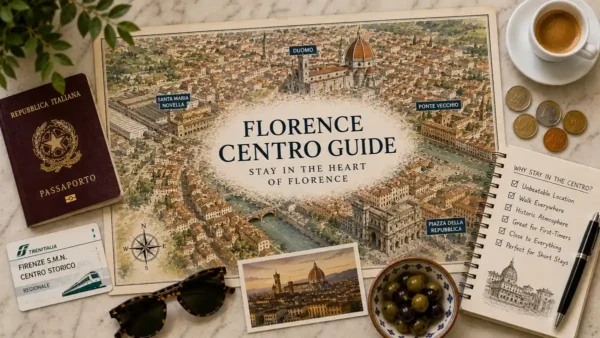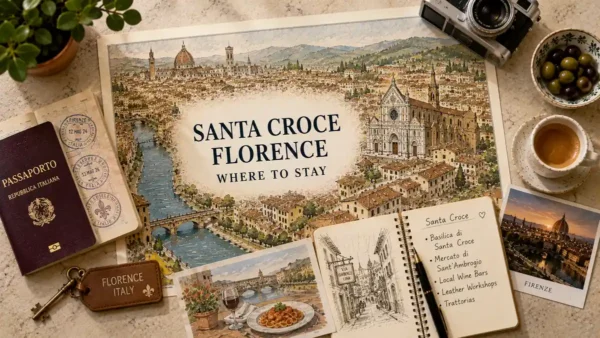
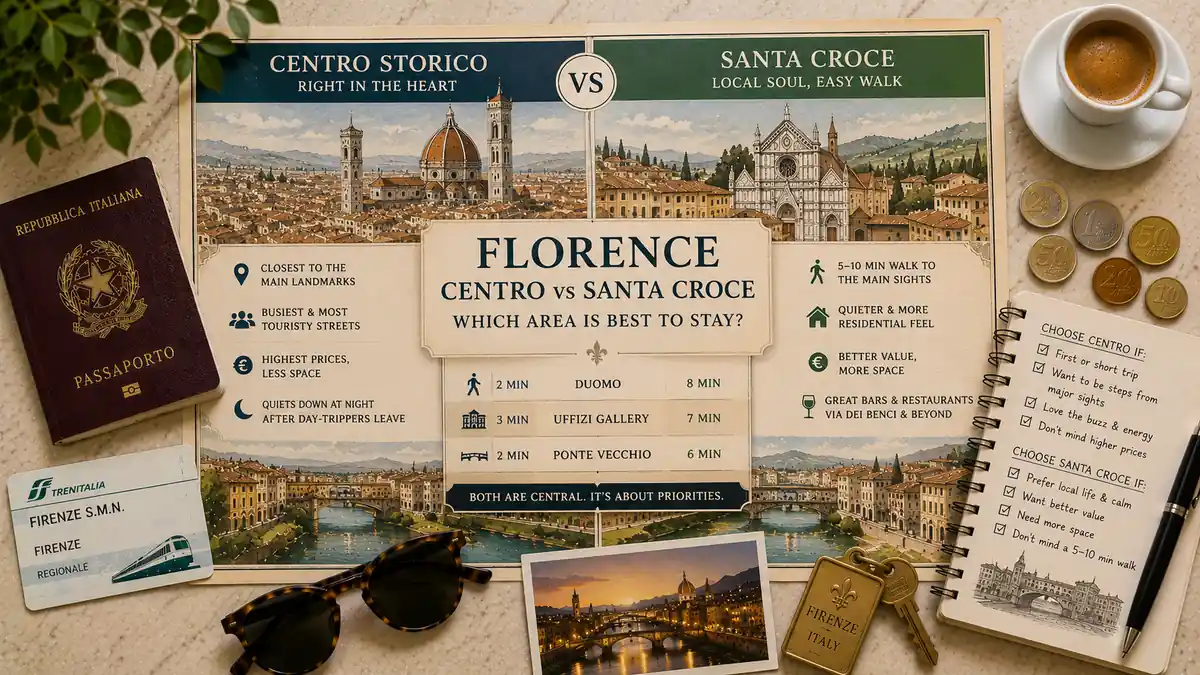
Centro Storico and Santa Croce are the two most-booked central bases in Florence, and they sit a short walk from each other. Both put the Duomo, the Uffizi, and Ponte Vecchio within easy reach on foot, so the decision is not really about being central — both are. It turns instead on a short set of trade-offs: how close you sleep to the monuments, how touristy or residential your street feels, how the nights sound, and how far your budget stretches. This guide arbitrates that head-to-head across each axis, names a winner per dimension, and closes with a clear choose-Centro-if or choose-Santa-Croce-if verdict plus who each base suits. If you want the full standalone write-up of either area, or a whole-city view of where to stay, those live on separate pages linked below.
Quick Answer
Choose Centro Storico to sleep beside the sights; choose Santa Croce for calmer, better-value local life. The split is proximity and buzz against residential calm and value, though both stay walkable to the Duomo and Uffizi. First-timers and short trips lean Centro; families, longer stays, and value-minded travelers lean Santa Croce.
Trust Layer
Tripstou comparison guide for travelers choosing between options. Covers tradeoffs, traveler fit, and decision logic.
Produced with AI assistance and reviewed by Alex Perrut, working in tourism since 2015, for the Tripstou editorial team. See our editorial process for details.
Last factual review: July 15, 2026.
Official sources consulted: Italia.it, ENIT.
Key Takeaways
- Choose Centro Storico for a first or short trip built around walking straight out onto the Duomo, Uffizi, and Ponte Vecchio.
- Choose Santa Croce for residential calm, more space per euro, and a short, easy walk to the same central sights.
- The proximity gap is measured in minutes, not access — Santa Croce still reaches every headline sight comfortably on foot.
- Santa Croce is the better-value base, and the Centro’s mid-range rooms punish budgets hardest for the location premium.
- Nightlife flips the areas: Santa Croce’s Via dei Benci runs loud and late, while the Centro quiets once day-trippers leave.
- Families and longer, value-minded stays suit Santa Croce; the common mistake is wrongly dismissing it as too far from the sights.
Table of Contents
Centro Storico wins on proximity to the sights
Centro Storico is the closer base to Florence’s headline sights. It contains the Duomo, the Uffizi, Piazza della Signoria, and Ponte Vecchio, so you step out of the door and into the monuments. Santa Croce sits just east of that core and stays an easy walk away.
The margin is decisive but not disqualifying. Staying in the Centro turns sightseeing into a walk downstairs, which matters most when your days are packed and your time is short. Santa Croce loses a few minutes of walking, not access — the basilica-side base still reaches the Uffizi and Ponte Vecchio comfortably on foot.
The proximity gap is measured in minutes, not neighborhoods: Santa Croce’s western edge sits closer to Piazza della Signoria than the far corners of the Centro itself. What flips the verdict is priority. Travelers who value a calm street over saved minutes will not miss the closer base. For the full standalone picture of each area, see the Centro Storico area guide and the Santa Croce area guide.
Santa Croce feels residential; Centro is the open-air museum
Santa Croce is the quieter, more residential choice by day; Centro is the open-air museum. Santa Croce keeps a working-neighborhood texture around the Sant’Ambrogio market, while the Centro fills with day-trippers around the Duomo and the Uffizi and only empties once they leave each evening.
The two areas run on different rhythms. The Centro peaks with tour groups from late morning to late afternoon, then thins. Santa Croce carries local life through the day — residents shopping the market, neighborhood cafes, a slower pace a couple of streets back from the basilica. If you want to feel like you live in Florence, Santa Croce delivers it. If you want to be surrounded by the monuments at all hours, the Centro is the immersion.
The calm ranking actually flips after dark. Once the last day-trip coaches pull out, the Centro’s monumental streets can feel emptier than a lively evening near Santa Croce’s bars. So “quieter” depends on the clock: Santa Croce by day, the Centro late at night.
Which area is better for nightlife — and for a quiet night?
Santa Croce is better for nightlife; Centro is better for a quiet night. Via dei Benci and the streets around the basilica carry Santa Croce’s late bar scene, while the Centro grows lively with sightseers by day and settles once the crowds thin after dark.
Match the area to how you plan to spend your evenings. Go-out travelers who want bars and buzz within stumbling distance belong in Santa Croce. Light sleepers and early risers do better in the Centro, where the noise is daytime foot traffic that fades at night. The tie-breaker is simple. Pick the area whose loudest hours match when you want to be awake.
Inside Santa Croce, the exact street matters more than the neighborhood. An apartment one block back from Via dei Benci gets you the nightlife without the late-night volume, because the loud radius is narrow. Ask where the windows face before you book. For a base chosen specifically around going out, compare options on the best areas for nightlife guide.
Santa Croce is the better-value base
Santa Croce is the better-value base. Its nightly rates generally run below the Centro’s for a comparable room, because the Centro charges a premium for putting you within a few minutes’ walk of the Duomo and the Uffizi. In Santa Croce, the same budget tends to buy more space and comfort.
Spend style changes how much that premium stings. At the budget end the gap is narrow, and a well-chosen room in either area can work — though the budget stay options stretch further in Santa Croce. The mid-range is where the Centro punishes you most: you pay location rates for a smaller room, while Santa Croce hands you more square meters for the money. At the high end the calculation changes again, since the premium buys a view or a landmark address you cannot get further out.
The tightest squeeze is a mid-range room in the Centro — you pay Centro prices for Santa Croce-sized space. Travelers set on a splurge should weigh the location premium deliberately; browse the luxury areas overview or the specific luxury hotels in Florence before paying top rates purely for the address.
Which area suits your kind of trip?
Centro suits first-time and short trips built around the sights; Santa Croce suits families and longer, value-minded stays. The right base follows your top priority: saved walking minutes and daytime buzz, or calm, space, and everyday texture. Match the base to the trip, not the map.
Each traveler type has a clearest fit. Below is the one-line verdict for the three most common trips, with a route to the fuller persona guide.
First-time visitors
First-time visitors are best based in Centro Storico. With limited days and a first-timer’s sight list, staying inside the monumental core makes every landmark a walk downstairs and wastes no time in transit. See the first-time stay guide for the full breakdown.
Couples
Couples get the most from Santa Croce when the trip leans on evenings out and local dining. It pairs romantic, walkable streets with neighborhood restaurants and better rates than the Centro, so you spend on the trip instead of the address. The couples stay guide goes deeper.
Families
Families are better based in Santa Croce. Larger apartments, the everyday rhythm of the Sant’Ambrogio market, and calmer streets suit traveling with kids far better than the Centro’s crowds and premium-priced small rooms. The family stay guide covers layouts and logistics.
How to choose between Centro and Santa Croce
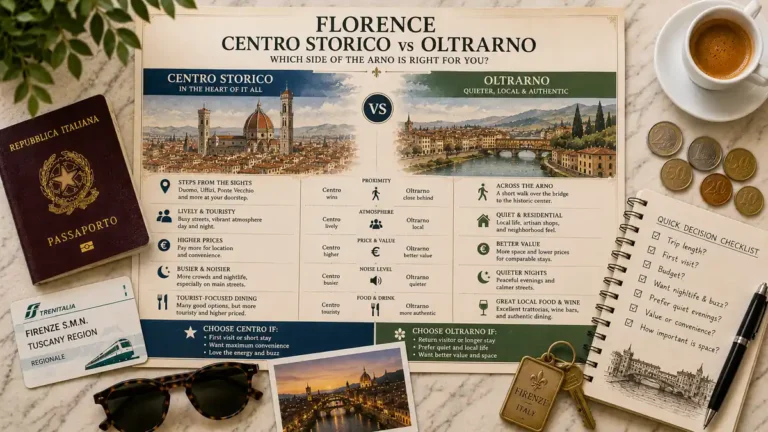
The choice comes down to one question: do the saved minutes to the sights outweigh calm, space, and value? Centro Storico is the base for sight-first short trips willing to pay for location; Santa Croce is the base for calmer, longer, better-value stays a short walk from the monuments.
| Decision dimension | Better base | Why it wins |
|---|---|---|
| Location and proximity | Centro Storico | Sits inside the monumental core, sights at the doorstep |
| Crowds and atmosphere | Depends on your priority | Centro for immersion, Santa Croce for residential calm |
| Noise and nightlife | Depends on your night | Santa Croce to go out, Centro to sleep quietly |
| Price and value | Santa Croce | Lower rates and more space for the money |
Use the scoreboard as a routing tool, then commit with the two lists below.
- Choose Centro if: it is your first trip or a short one, you want to walk out the door onto the sights, you will pay a premium for location, and you don’t mind crowds by day.
- Choose Santa Croce if: you want residential calm and local life, better value and more space, a family-friendly base, and you don’t mind a short walk to the monuments.
Florence has a third central option across the river, but this comparison stays between the two most-booked east-of-Arno bases. If you are still weighing the whole city instead of these two areas, step back to the where to stay in Florence hub before booking.
Hotels and places to stay
Compare hotels, apartments and stays for your dates in one search.
Search hotels and stays on hotels.com →
Tripstou may earn a commission if you book through this link, at no extra cost to you.
Frequently Asked Questions
Is Santa Croce safe at night?
Yes, Santa Croce is a safe area at night, on par with central Florence generally. The streets around Via dei Benci stay busy with bars and diners late, which keeps them lively rather than isolated. Use normal city awareness for pickpockets in crowds, and light sleepers should check which way apartment windows face.
How far is Santa Croce from the centro of Florence?
Santa Croce sits just east of Florence’s historic core, only a few minutes’ walk away. Its western edge borders Piazza della Signoria, so the basilica-side base reaches the Duomo, the Uffizi, and Ponte Vecchio comfortably on foot. The two areas effectively overlap; you cross from one to the other without noticing a real gap.
Is Santa Croce too far from the main sights?
No, Santa Croce is not too far from Florence’s main sights. Staying there costs a few minutes of walking, not access — the Duomo, the Uffizi, and Ponte Vecchio all remain an easy stroll. Travelers who assume Santa Croce is inconveniently distant are usually surprised by how central it actually feels.
Is Centro Storico too crowded to stay in?
No, Centro Storico is not too crowded to stay in, though the day-tripper crush is real around the Duomo and Uffizi. Crowds peak from late morning to late afternoon, then thin as tour groups leave, and the monumental streets grow quiet at night. Pick a side street if daytime density bothers you.
Is Centro Storico worth the higher price?
Centro Storico is worth the premium when proximity is your priority — first trips, short stays, or travelers who want every landmark at the doorstep. The location saves walking time you would otherwise spend in transit. It is not worth it if you value space, calm, or a bigger room, where Santa Croce delivers more.
Do Centro and Santa Croce book up far in advance?
Both areas are among Florence’s most-booked central bases, so rooms fill quickly for spring and early-autumn travel. The Centro’s prime addresses near the Duomo and Ponte Vecchio sell out first, given their limited supply. Reserve early for either area in peak season, especially if you want a specific type of room.
Related Guides
- Where to stay in Florence: the whole-city area guide
- Centro Storico: the full area profile
- Santa Croce: the full area profile
- Florence travel guide: city context and planning
- The best luxury hotels in Florence
- Where to stay in Florence for first-time visitors
Did this guide save you time or money? Tripstou is independent and reader-funded — if you'd like to give something back, you can support the site with a crypto contribution of any size.