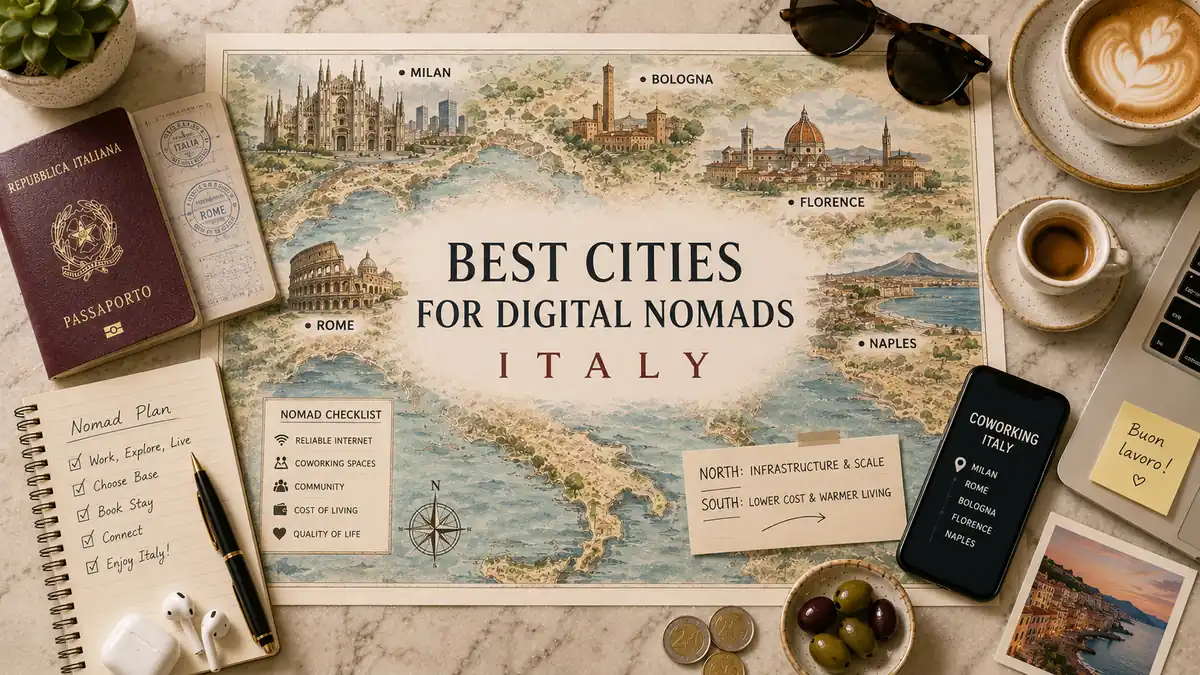
Choosing where to base yourself in Italy as a remote worker is a different problem from planning a trip. You are not picking sights — you are picking a city to live and work in for weeks or months, where connectivity, coworking, and monthly cost matter more than the skyline. Italy’s cities split sharply on those terms. The north offers the deepest infrastructure and the biggest professional scenes at the highest prices; the south offers cheaper, warmer living with thinner support for remote work. This guide scores five city hubs — plus a few southern budget picks — on one repeated lens: cost band, internet reliability, coworking density, and community. Read each capsule to self-select the base that fits how you work, then follow the north-vs-south trade-off that decides most choices. The aim is a shortlist you can act on, not inspiration.
Quick Answer
Milan is Italy’s strongest all-round nomad base for coworking and remote-work infrastructure. The choice hinges on north versus south, scored on cost, internet, coworking, and community: the north wins on scale and infrastructure, the south on lower cost. Choose Rome for scale and community, or Naples and the south for budget-first nomads.
Trust Layer
Tripstou selection guide for travelers choosing between multiple places. Covers selection criteria, traveler fit, and trip value.
Produced with AI assistance and reviewed by Alex Perrut, working in tourism since 2015, for the Tripstou editorial team. See our editorial process for details.
Last factual review: July 11, 2026.
Official sources consulted: italia.it, enit.it.
Key Takeaways
- Milan is the strongest all-round base, with Italy’s densest coworking network and most reliable connectivity, if you can absorb the highest cost.
- Rome fits nomads who want the largest international community on day one; Bologna is the central value pick without Milan’s prices.
- The core trade-off is north versus south: infrastructure and scale at higher cost, or cheaper, warmer living with thinner support.
- Naples is the budget gateway to the south, where Palermo, Bari, and Lecce push costs lower for independent, async workers.
- Florence rewards lifestyle-first solo workers who prize walkability and culture over a deep coworking scene or business network.
- Monthly cost depth and the “is Italy right for me” visa and tax decision live on the sibling and hub pages, not here.
Table of Contents
How Italy’s Nomad Cities Compare on Cost, Internet, and Coworking
Milan and Rome score highest for reliable remote-work infrastructure, with the deepest coworking supply and most consistent connectivity. Every city here is scored on the same four-criterion lens — cost band, internet reliability, coworking density, and community — so you can weigh bases on identical terms. Bologna and Naples lead on value; the north leads on infrastructure.
| City | Cost band | Internet | Coworking | Community |
|---|---|---|---|---|
| Rome | High, though below Milan’s | Reliable across central districts | Broad, varied supply citywide | Large international creative scene |
| Milan | Highest of the five cities | Most consistent, business-grade connectivity | Densest, most professional network | International, business and tech-led |
| Florence | Mid-to-high for its size | Reliable in the historic centre | Thinner than Milan or Rome | Small, lifestyle-led creative crowd |
| Bologna | Lower than Milan or Rome | Solid, well-connected central coverage | Growing, student-driven coworking supply | University energy, young crowd |
| Naples | Lowest of the five cities | Improving but less consistent | Limited, concentrated in centre | Vibrant, local, less international |
Read every band as a range, not a fixed number: rents, broadband speeds, and coworking rates shift by season, neighbourhood, and provider, so treat the table as relative ranking and verify current figures before you commit. For the monthly numbers behind each band, see our breakdown of the cost of living in Italy for nomads.
Coworking density decides more here than headline rent. A cheaper city with one unreliable space can cost you a missed client call, while Milan’s premium buys a workable backup on almost every block — which is why the value pick is rarely the cheapest city, but the cheapest city with real infrastructure.
Rome Is Italy’s Largest Remote-Work Base
Rome is Italy’s largest remote-work base, with broad coworking supply and the deepest international community. The capital’s scale means you are never far from a workspace, an English-speaking network, or a professional meetup, which makes it the easiest city to settle into quickly. The trade-offs are a higher cost band than Bologna or Naples and hot, draining summers.
What sets Rome apart from the other four is sheer volume: more coworking spaces, more meetups, and a larger pool of fellow remote workers than anywhere except Milan, but with a broader creative and international mix than Milan’s business-led scene. Cost sits high, though typically below Milan’s, and the July–August heat pushes many nomads out or indoors. It is the safest landing spot if you want community on day one.
Pick this if you want the biggest international community and the widest coworking choice, and can absorb a higher rent for it.
Milan Is the Best Pick for Infrastructure and Coworking
Milan is the best Italian base for infrastructure and coworking, at the country’s highest cost. It has the densest professional coworking network, the most consistent connectivity, and Italy’s most international business scene, so remote workers rarely hit friction. The catch is money: rent and daily costs run higher here than anywhere else on this shortlist.
Where Rome offers scale and creativity, Milan offers reliability and business gravity — it is the city where startups, agencies, and international companies cluster, which makes it strongest for networkers and those working corporate hours. Coworking depth and connectivity are the best in the country. The single downside is price, and it is a real one.
Milan’s high rent is really the price of redundancy. When one coworking space or connection drops, another sits a tram ride away — and for full-time remote workers whose income depends on being reachable, that reliability usually outweighs the saving on a cheaper base.
Pick this if reliable infrastructure and a business network matter more to you than saving money.
Florence Suits Lifestyle-First Nomads
Florence suits lifestyle-first nomads who value a walkable, beautiful base over deep coworking infrastructure. The city is compact, easy to live in on foot, and heavy on culture, which draws creative and lifestyle-led remote workers. Coworking runs thinner than Milan or Rome, and cost sits mid-to-high for a city this size, so it rewards independent workers more than networkers.
What makes Florence distinct is quality of daily life over professional depth: you trade the coworking density and connectivity scale of the northern hubs for walkability, art, and a slower rhythm. Internet in the centre is reliable, but the coworking scene is small, so it fits solo workers who don’t need a large network on tap. It is a lifestyle base first, a work base second.
Pick this if you want a walkable, beautiful base and don’t rely on a deep coworking scene.
Bologna Is the Value Pick for Central Italy
Bologna is the value pick for central Italy, pairing solid infrastructure with lower cost than Milan or Rome. Its university keeps the city young, affordable, and full of coworking that welcomes remote workers, and its rail hub puts most of Italy within reach. Coworking is growing but student-driven, so the scene skews younger and less corporate than Milan’s.
The case for Bologna is balance: it delivers most of the north’s connectivity and central access at a noticeably lower cost band, which is rare. Sitting on Italy’s main rail spine, it also makes weekend trips to Florence, Milan, or Venice easy, so it doubles as a hub for exploring. The trade-off is a scene that leans academic and young rather than corporate or international.
Pick this if you want central rail access and solid infrastructure without Milan’s price tag.
Naples Is the Budget Gateway to the South
Naples is the budget gateway to southern Italy, markedly cheaper and warmer than the northern bases. Living costs land below Milan or Bologna, the climate stays mild, and street life is vibrant, which appeals to budget-first nomads. Infrastructure is the trade-off: internet and coworking are thinner, so it rewards workers who don’t depend on flawless connectivity.
Against the northern hubs, Naples flips the equation — you gain cost savings, warmth, and energy, and give up coworking depth and consistent connectivity. The community is vibrant but more local and less internationally networked than Rome or Milan. It also works as a bridge to the deeper south, where the same trade-off sharpens: even cheaper living, even thinner infrastructure.
In Naples, part of what you save on rent goes into a backup plan — a second SIM, a coworking day pass, a decent router — and even after that, it still lands cheaper than the northern bases for most nomads.
Pick this if budget and warmth come first and you can work around patchier infrastructure.
North or South Italy: Which Suits Digital Nomads?
Weigh north against south by asking whether infrastructure or cost matters more to your work. The north — Milan, Bologna, Rome — wins on coworking density, connectivity, and scale, at a higher cost. The south trades that infrastructure for lower living costs, warmth, and a slower pace. Most nomads decide on which of the two they can least afford to lose.
The signals break down cleanly:
- Choose the north for coworking density, business networking, and the most reliable connectivity.
- Choose the south for lower rent, warmer weather, and a slower daily pace.
- Split the difference with Bologna or Florence as mid-cost central bases.
South of Naples, the budget picks worth naming are Palermo, Bari, and Lecce — cheaper still, warm year-round, and increasingly popular with cost-first nomads. Each has a growing but limited remote-work scene and less consistent infrastructure than the five main hubs, so treat them as options for independent workers rather than networkers, and verify connectivity for your specific stay before committing.
The north-south line isn’t really about temperature — it’s about how many working hours you can afford to lose to a bad connection. If your income depends on live calls, the north’s infrastructure pays for itself; if your work is asynchronous, the south’s savings win. Whether Italy is the right country for you at all — visa, taxes, and lifestyle fit — is a separate decision covered in our guide to whether Italy is right for you as a nomad.
Frequently Asked Questions
Which Italian city has the best digital nomad community?
Rome has Italy’s largest and most international nomad community, making it the easiest place to build a network fast. Milan’s scene is more business- and tech-led, ideal for professional networking, while Bologna’s university energy suits younger nomads. Your best fit depends on whether you want creative, corporate, or student-driven company.
Is southern Italy good for digital nomads?
Southern Italy suits budget-first, independent nomads more than networkers who need reliable infrastructure. Cities like Palermo, Bari, and Lecce offer low costs, warm weather year-round, and a slower pace, but coworking and connectivity stay thinner than the northern hubs. They work best for async workers who don’t depend on flawless video calls.
What is the cheapest Italian city for digital nomads?
Naples is the cheapest of the five main hub cities, with living costs clearly below Milan, Rome, or Bologna. Further south, Palermo, Bari, and Lecce can run cheaper still. Read these as relative rankings, not fixed figures—monthly totals shift by neighbourhood, season, and provider, so verify current costs before you commit.
Do smaller Italian cities have reliable Wi-Fi for video calls?
Connectivity in smaller Italian cities is usually workable but less consistent than in Milan, Rome, or Bologna. Central districts and dedicated coworking spaces are your safest bet for stable video calls, while older residential buildings can be patchier. If your income depends on live calls, verify the specific apartment’s connection and keep a mobile-data backup.
Is Milan or Rome the better base for a digital nomad?
Choose Milan for the deepest coworking network, most reliable connectivity, and business networking; choose Rome for a larger, more international creative community and slightly lower cost. Both are Italy’s top infrastructure bases. Milan rewards corporate and full-time remote workers, while Rome suits those who prioritise community and creative energy over pure reliability.
Which Italian city is best for a first-time digital nomad?
Rome is the easiest first base, thanks to its large English-speaking community, abundant coworking, and ready-made social scene. A newcomer steps into an existing network instead of building one from scratch. Bologna is a strong lower-cost alternative, with a young, welcoming crowd and central rail links that make early exploring simple.
Related Guides
- Living in Italy as a digital nomad — the hub decision: is Italy right for you, plus visa and tax routing.
- Cost of living in Italy for nomads — the monthly numbers behind every cost band above.
- Rome travel guide — full practical detail on Italy’s largest nomad base.
- Milan travel guide — the infrastructure and coworking capital in depth.
- Florence travel guide — the walkable, lifestyle-led base up close.
- Bologna travel guide — the central value pick in full.
- Naples travel guide — the budget gateway to the south in detail.
Did this guide save you time or money? Tripstou is independent and reader-funded — if you'd like to give something back, you can support the site with a crypto contribution of any size.