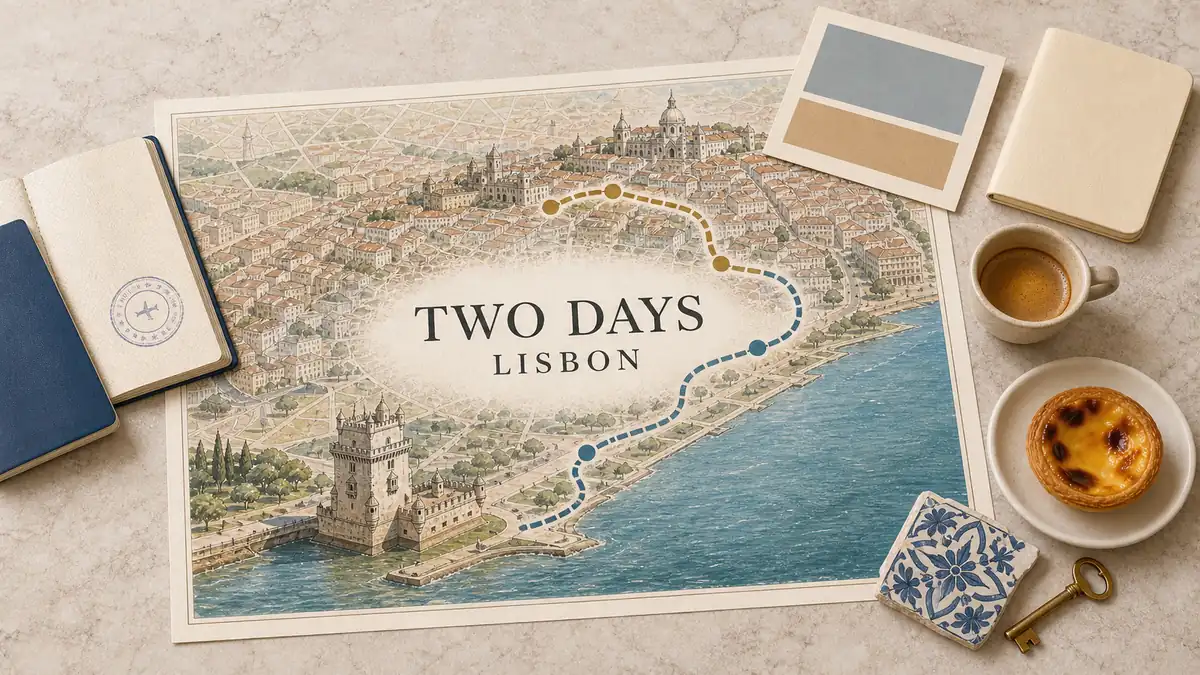
You have 48 hours in Lisbon, and the question is not what to see but in what order. A weekend or a stopover leaves no room for backtracking, and Lisbon punishes backtracking harder than most cities: its two great clusters of sights sit at opposite ends of the same riverfront.
This page commits to one route. Day 1 stays in the historic core — Alfama, the castle above it, then downhill through Baixa into Chiado and Bairro Alto. Day 2 goes west to Belém for the morning, comes back for a contemporary afternoon, and closes on the Tagus at sunset. Both days end at a viewpoint or on the water, which is the one piece of shape a short trip really needs.
It is also honest about the cuts. Two days holds the core and Belém, and very little else. Sintra in particular does not fit, and this plan says so before you build a day around it. Arrival logistics are handled elsewhere; the route starts on your first full morning.
Quick Answer
Spend Day 1 in Lisbon’s historic core — Alfama, Baixa and Chiado — and Day 2 in Belém. Geography drives the split: Belém sits west along the river and takes its own morning. The route suits first-timers based centrally; end each day at a miradouro or on the water, and leave Sintra for a longer trip.
Trust Layer
Tripstou itinerary guide for travelers planning a route. Covers pacing, stop count, stop order, base logic, and trip length.
Produced with AI assistance and reviewed by Alex Perrut, working in tourism since 2015, for the Tripstou editorial team. See our editorial process for details.
Last factual review: August 31, 2026.
Official sources consulted: Visit Portugal, Turismo de Portugal.
Key Takeaways
- Day 1 belongs to the historic core and Day 2 to Belém, because the two clusters sit at opposite ends of the riverfront.
- Belém is a morning, not a day; staying longer buys less than arriving before the mid-morning coach crowds.
- Gradient and polished calçada, not distance, are what push first-time visitors behind schedule across both days.
- Start each half-day high and walk downhill, using funiculars and trams to erase climbs instead of sightseeing.
- Ending both days at a miradouro or on the Tagus gives a short trip the shape it needs.
- Sintra does not fit into 48 hours; the Day 2 afternoon is the only block worth cutting.
Table of Contents
How This 2 Day Lisbon Itinerary Splits the City
Day 1 covers Lisbon’s historic core on foot; Day 2 takes the tram west to Belém. The split follows the map: the core and Belém sit at opposite ends of the same riverfront, roughly 6 km apart, so mixing them into both days spends your hours on the tram instead of the city.
- Day 1: Alfama–Baixa–Chiado — the historic core on foot.
- Day 2: Belém — monuments, pastéis, river sunset.
| Time of day | Day 1 — historic core | Day 2 — Belém and the river |
|---|---|---|
| Morning | Castelo de São Jorge, then down through Alfama to the Sé | Tram 15E west to Jerónimos and the Belém waterfront |
| Afternoon | Baixa’s flat grid to the river, then up into Chiado | LxFactory or the Museu Nacional de Arte Antiga |
| Evening | Sunset miradouro, then dinner in Bairro Alto | Sunset on the Tagus to close the trip |
The whole plan assumes you sleep somewhere central. From Baixa, Chiado or the streets just above them, Day 1 runs entirely on foot and Day 2 begins at a riverside tram stop a few minutes from your door. Base yourself further out and the route still works, but you spend the first and last half-hour of each day commuting into it.
That 6 km between Baixa and Belém is what quietly breaks most 48-hour plans. Travelers who spread Belém across both afternoons ride the same line twice for the same monuments, and the second trip buys them nothing the first did not already deliver.
Day 1 assumes a full morning, so arriving the night before is worth more than any single stop on this list — how long getting from Lisbon airport to the centre takes decides whether your first morning starts at the castle or at baggage reclaim. If you are still deciding how many days the city deserves in the first place, that question sits in our wider Lisbon travel guide, alongside the seasonal and orientation context this route takes for granted.
Day 1 in Lisbon: Alfama, Baixa and the Historic Core
Day 1 starts high at Castelo de São Jorge and ends downhill in Chiado and Bairro Alto. Between them you drop through Alfama to the Sé, cross Baixa’s flat grid to the river, then climb once into Chiado for a sunset miradouro. Gravity does most of the work.
Morning: Alfama and Castelo de São Jorge
Start at the castle, early. Castelo de São Jorge sits at the top of everything you will walk today, so taking it first means the only serious climb happens on fresh legs and before the mid-morning crowds. Book ahead where you can and arrive near opening.
From the castle gate the route is a descent through Alfama: narrow lanes, laundry, the occasional tram squeezing past, and the Sé cathedral at the bottom as your marker that the neighbourhood is done. Two viewpoints sit on the way down, Portas do Sol and Santa Luzia, and both are worth a pause without being destinations in themselves.
Alfama is the one leg where the map lies. Distances look trivial, but the lanes turn into staircases and double back on themselves, so a short gap on paper can take three times as long on the ground. Budget the whole morning for a walk that measures barely a kilometre.
When to Ride Tram 28 — and When to Walk Instead
Ride Tram 28 early in the day or after the evening peak, and walk it otherwise. The 28 runs the classic corridor from Martim Moniz across to Campo de Ourique, roughly 7 km of it, but the Alfama stretch is where it bunches, stalls and fills to standing. In the middle of the day you will often reach the next viewpoint faster on foot.
Treat the tram as a ride you take once, deliberately, for the experience — not as the transport backbone of your day. The uphill leg from Martim Moniz is the version worth queuing for; the downhill sections through Alfama are the ones you can walk in the same time while actually seeing the streets.
Packed trams are also the city’s most reliable pickpocket setting, and the 28 in particular. Keep bags in front of you and phones out of back pockets; our guide to staying safe in Lisbon covers where else that caution applies.
Afternoon: Baixa, Praça do Comércio and Chiado
The afternoon is flat, then briefly steep. From the Sé you walk into Baixa’s grid — the rebuilt, right-angled lower town — and follow it straight down to Praça do Comércio, which opens onto the Tagus and is the natural place to stop moving for twenty minutes.
From the square, turn back inland and climb into Chiado. It is one short ascent, and it delivers you into the café and bookshop quarter with the afternoon still in hand. Two anchors are enough here: the riverfront square itself, and the streets around Largo do Chiado where the day slows down before the evening.
Evening: Sunset Miradouro, Then Bairro Alto
End Day 1 at a miradouro and let the sunset set your dinner time. Lisbon’s viewpoints are the closest thing the city has to a scheduled event, and building the evening around one turns a tiring day into a clean finish. Miradouro de Santa Catarina is the pick on this route: it faces west over the river and sits a few minutes’ walk from both Chiado and Bairro Alto.
Senhora do Monte is the higher, wider panorama, but it lands you back on the Alfama side of the city — a long walk in the wrong direction after a day already spent walking. Take it only if you skipped the castle in the morning.
Bairro Alto follows on directly. The lanes are quiet until late and then fill quickly, so an early dinner is easier than a late one. If you want fado, book a house in advance and pick a later sitting: the rooms that take walk-ins at peak hours are rarely the rooms worth hearing.
Tours and activities
Book skip-the-line tickets, day trips and local tours with free cancellation on most activities.
You can also browse everything on getyourguide.com.
Tripstou may earn a commission if you book through this link, at no extra cost to you.
Day 2 in Lisbon: Belém in the Morning, River at Sunset
Belém takes Day 2’s morning, not the whole day. Tram 15E runs west along the river to Jerónimos, the waterfront monuments and the original pastel de nata, which is enough for one morning. The afternoon comes back east for LxFactory or a museum, and the trip closes on the Tagus at sunset.
Getting to Belém: Tram 15E from the Riverside
Take Tram 15E, not the 28. The 15E is the Belém line, picked up from the riverside stops around Praça do Comércio and Cais do Sodré, and it runs roughly 25–30 minutes west along the Tagus, longer when traffic is heavy. Go early: the same tram in the middle of the morning is a standing-room proposition.
Validate before you sit down and carry a rechargeable card instead of buying singles all day. Which card, how it loads and what a day’s travel involves are handled in our guide to getting around Lisbon.
Morning: Jerónimos, the Waterfront and the Pastel de Nata
Belém is a morning, not a day. Three things anchor it — the Mosteiro dos Jerónimos, the riverside walk west past the Padrão dos Descobrimentos, and a pastel de nata eaten at the pastelaria that has been making them here since long before they were a national export.
Book Jerónimos ahead and go early; the cloister is the part with the queue, and it is also the part worth the ticket. Torre de Belém is open, with timed-slot entry, so book a slot ahead if you want to climb it; otherwise it is a photograph from the promenade. The church beside the monastery is a shorter, quieter stop and an easy add to the same block.
Belém rewards arriving first, not staying long. The monuments, the pastelaria and the riverside path all peak together with the mid-morning coach arrivals — get there before them and you have already had the version of Belém worth having by the time the crowds land.
Afternoon: LxFactory or Museu Nacional de Arte Antiga
Take LxFactory on the way back unless art is the reason you travel. It sits under the bridge between Belém and the centre, which makes it a stop on the return rather than a detour, and its converted industrial yard of shops, bookshops and cafés absorbs a loose afternoon well.
Choose the Museu Nacional de Arte Antiga instead if you want one substantial interior on this trip. It holds Portugal’s national collection and it is also indoors, which matters more in January than in July. Either way this is a single stop, not a second sightseeing block — Day 2’s real work was finished in Belém.
Evening: A Tagus Sunset to End the Trip
Close the trip on the water. The Tagus is the reason Lisbon looks the way it does, and the last evening is the moment to be beside it: the docks at Cais do Sodré, the terraces along the riverfront, or a short sunset cruise if you book it a day or two ahead.
Fado works as an alternative close for the same slot. Reserve it, and reserve late — the early sittings tend to be the tourist-facing ones. Neither the cruise nor the fado house is essential to the route; both simply give the last evening a shape.
Two days in Lisbon usually lands softer on the wallet than travelers expect, largely because so much of this route is walking, viewpoints and one tram line. What the trip actually adds up to is broken down in our guide to what Lisbon costs.
Train and bus tickets
Compare routes, schedules and prices across rail and bus operators in one search, with mobile tickets on your phone.
New to Omio? Code NEW10 takes 10% off your first booking — or APPNEW10 if you book inside the Omio app. Both apply to bookings up to €80.
Search routes and compare prices on Omio →
Tripstou may earn a commission if you book through this link, at no extra cost to you.
Lisbon’s Hills Are the Real Pacing Risk
Gradient and calçada, not distance, are what make first-timers overrun this plan. Lisbon’s core covers a small area, but it stacks climbs and polished limestone pavement into every leg. The fix is planned descents, fewer ascents, grippy shoes and miradouro pauses built into the route instead of improvised.
Four habits keep the two days on schedule:
- Plan descents, not ascents — start each half-day at the high point and let the route fall towards the river.
- Wear shoes with grip — calçada portuguesa is polished limestone, and it turns slick the moment it rains.
- Use trams and lifts as hill-skippers — Lisbon’s trams and street lifts exist to erase a climb, and that is the best use of them on a short trip.
- Leave slack in both afternoons — the schedule that fails is the one with no gap between the museum and the sunset.
Wet calçada does more damage than the gradient ever will. The stone is genuinely slippery after rain, descents become the dangerous direction, and that is exactly when a tram or lift stops being a novelty and starts being the sensible move.
The smaller practicalities — tipping, water, card payments, what to do about a SIM — sit alongside this in our Lisbon travel tips, and none of them change the route.
How to Adapt This Route Without Rebuilding It
This route bends without breaking. When time shrinks, the Day 2 afternoon goes first; when it grows, a third day is the addition that changes what the trip can hold. Reversing the days, or losing one to rain, are one-line adjustments and not new itineraries.
- Cut first: the Day 2 afternoon — LxFactory or the museum. The Belém morning and the whole of Day 1 are the spine; that afternoon block is the only part not anchored to a specific hour of the day.
- Add first: a third day, which is the point at which Sintra finally becomes possible without gutting Lisbon — the version of the trip built in our 3 days in Lisbon itinerary.
- Reverse variant: run Belém first if your flight lands early enough to reach the tram before mid-morning.
- Rainy-day variant: pull the museum and the Belém interiors forward into the wettest half-day and push the miradouros to the clearer one.
Everything else on the plan resists cutting because it is load-bearing. Drop the castle and Day 1 loses its high starting point; drop Belém and Day 2 has no reason to exist. Cut the afternoon block instead, and the route keeps its shape at any length.
Frequently Asked Questions
Is 2 days enough in Lisbon?
Yes for the historic core and Belém — that is exactly what 48 hours holds. Two days covers Alfama, Baixa, Chiado, the castle and the Belém monuments at a walkable pace. What it cuts is day trips, second museums and any neighbourhood beyond the central spine.
Can you do Sintra as a day trip with only 2 days in Lisbon?
Not without losing half your Lisbon. Sintra absorbs a full day once you add the train, the hill and the palace queues, which means dropping either the historic core or Belém. Travelers who do it anyway accept that trade; the honest fix is a third day.
What is the best area to stay in Lisbon for a short trip?
Stay central — Baixa, Chiado or the streets just above them. A two-day route works on foot only if you start inside it, and those areas put Day 1 outside your door and Day 2’s tram a few minutes away. Our guide to where to stay in Lisbon compares the areas.
Is the Lisboa Card worth it for 2 days?
Only if you plan several paid interiors. This route runs mostly on walking, viewpoints and one tram line, so a card built around museum entry and transport rarely pays back across 48 hours. Count the ticketed sites you actually intend to enter, then decide.
What can you do in Lisbon if it rains for both days?
Lean on interiors and trams. A wet 48 hours still holds the Jerónimos church, the Museu Nacional de Arte Antiga, LxFactory’s converted warehouses and long café stops in Chiado. Swap the miradouro finishes for a riverside restaurant window, and take trams instead of slick descents.
Related Guides
Once the running order is settled, these guides cover the decisions around it:
- Lisbon travel guide — orientation, timing and how many days the city needs.
- 3 days in Lisbon itinerary — the longer version, and the one where Sintra fits.
- Lisbon trip cost — what a short stay in the city adds up to.
- Getting around Lisbon — trams, metro, funiculars and travel cards.
- Lisbon airport transport — how to reach the centre before Day 1 starts.
- Lisbon safety guide — pickpocket hotspots and the habits that avoid them.
- Lisbon travel tips — the practical habits worth having before Day 1.
Did this guide save you time or money? Tripstou is independent and reader-funded — if you'd like to give something back, you can support the site with a crypto contribution of any size.