You have likely booked, or are about to book, a trip to Malaga and want one thing settled before you go: is it safe? The honest answer is reassuring. Malaga is one of Spain’s calmer, more relaxed cities, and serious crime against tourists is rare. But “broadly safe” is not the same as “switch off completely,” and smart visitors still take a handful of specific precautions. This guide gives you the real risk profile — what the actual threat is and what it is not — names the exact streets and situations where pickpockets work, covers night, beach, solo and women travelers, and ends with concrete habits that remove almost all the risk. No scare stories, no vague reassurance: just what to watch and how to handle it.
Quick Answer
Yes — Malaga is one of Spain’s safer cities, with petty theft, not violent crime, the main concern. Risk concentrates in crowded tourist spots and a few outlying neighborhoods, mostly pickpocketing. Basic precautions — guard valuables in crowds, stay to well-lit central areas at night — keep nearly all visitors, including solo and women travelers, safe.
Trust Layer
Tripstou planning guide for travelers resolving one travel decision. Covers the main variable, traveler context, and practical tradeoffs.
Produced with AI assistance and reviewed by Alex Perrut, working in tourism since 2015, for the Tripstou editorial team. See our editorial process for details.
Last factual review: June 12, 2026.
Official sources consulted: travel-europe.europa.eu, european-union.europa.eu.
Key Takeaways
- Malaga ranks among Spain’s safer cities, where opportunistic petty theft, not violent crime, is the only realistic concern for visitors.
- Pickpockets work the crowds at Calle Larios, Muelle Uno, La Malagueta beach, and packed old-town streets, so stay alert there.
- Keep your phone and wallet in a front pocket or zipped bag, never a back pocket, in any crowd.
- Skip outlying areas like Palma-Palmilla after dark; they sit off the tourist path and warrant no detour.
- Solo travelers and women generally find central Malaga comfortable day and night, needing only standard big-city awareness.
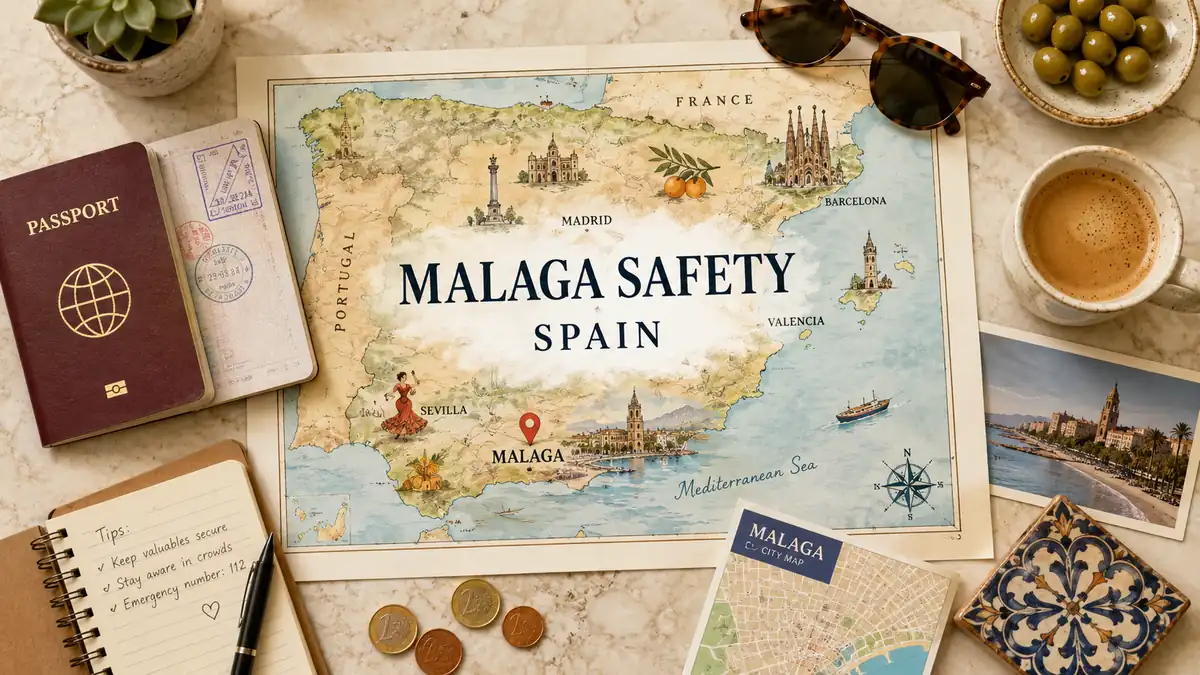
- Save 112 as Spain’s emergency number; English-speaking operators handle police, ambulance, and fire calls nationwide.
Table of Contents
Is Malaga safe for tourists?
Malaga is among Spain’s safer cities for tourists, and violent crime against visitors is rare. The real exposure is opportunistic theft — pickpocketing and bag snatching in crowds — not personal danger. Most travelers move through the city day and night without incident, provided they stay alert in busy areas.
The city’s tourist core is well-policed, busy, and used to international visitors, which keeps the day-to-day feel relaxed rather than tense. Families, couples, older travelers, and first-time visitors all tend to find Malaga easy and unintimidating to navigate.
The one tradeoff is that this relaxed feel can make it easy to drop your guard in crowds, which is exactly where opportunistic thieves operate. The risk is your wallet or phone, not your safety — so the right mindset is everyday awareness in busy spots, not anxiety about walking the streets.
What are the real safety risks in Malaga?
The dominant safety risk in Malaga is petty theft, not violence. Pickpocketing and bag snatching in tourist crowds account for nearly all incidents travelers face, while assaults and serious crime against visitors remain uncommon. Weigh your caution toward protecting valuables in busy places rather than fearing for your personal safety.
In practice, this means the threat is almost always about distraction and opportunity. Common situations include a crowded terrace where a phone is left on the table, a packed promenade where a bag hangs open, or a busy bar where a back pocket is easy to reach. None of these involve confrontation — the goal is to take something without you noticing.
Compared with Spain’s largest cities, Malaga generally feels calmer and less crowd-pressured than the busiest tourist zones of Madrid or Barcelona, though that is a qualitative impression rather than a hard ranking. The petty-theft pattern itself is similar; Malaga simply has fewer of the extreme high-density tourist chokepoints. For country-wide context on scams, common-sense laws, and broader precautions, see our guide to safety across Spain.
Where do pickpockets operate in Malaga?
Pickpockets in Malaga concentrate where crowds gather: Calle Larios, Muelle Uno, La Malagueta beach, and the busy old-town streets. Dense foot traffic lets thieves work unnoticed and slip away fast. The risk is opportunistic and predictable, so awareness in these specific hotspots removes most of the danger.
The recurring hotspots worth extra attention are:
- Calle Larios — the main pedestrian shopping street, busiest in the evenings and during events, where shoulder-to-shoulder crowds make pockets and open bags easy targets.
- Muelle Uno and the port promenade — a popular stroll where distracted, phone-in-hand walkers stand out.
- La Malagueta beach — unattended belongings on the sand are the classic target while you swim.
- Old-town squares and narrow streets — terraces and tight lanes around the cathedral and Plaza de la Constitución, especially when packed.
Be wary, too, of the common distraction tactics. Someone may press a sprig of rosemary into your hand or try to tie a bracelet on your wrist as a “free gift,” then demand payment or use the moment to reach for your bag. The simplest response is to keep your hands to yourself, decline firmly, and keep walking — engagement is what the tactic relies on.
Which areas should visitors be cautious in?
Most of central Malaga is safe day and night, so caution applies to only a few outlying areas. Palma-Palmilla, and parts of La Trinidad and Lagunillas after dark, see more local crime and little tourist traffic. These districts sit well off the standard visitor path, so few travelers ever pass through them.
It is worth being clear about what this does and does not mean. These are residential neighborhoods with their own local issues, not zones of danger aimed at tourists — and they hold nothing on a typical sightseeing route, so there is rarely any reason to be there at all. If you do find yourself nearby, normal city awareness after dark is enough; this is not a no-go warning, just a reason not to wander far from the center late at night.
This page is about safety, not where to base yourself, so we deliberately do not rank neighborhoods for stays here. For which central areas feel safe and convenient as a base, see our dedicated guide to where to stay in Malaga.
Is Malaga safe at night?
Central Malaga is lively and safe at night, with busy streets, restaurants, and nightlife well into the early hours. The main after-dark risk is petty theft in crowded bars and squares, not violence. Stick to well-lit central areas, keep valuables secure, and use common sense on the quieter edges.
The historic center, the port, and the main nightlife streets stay populated late, and a steady flow of people is itself a form of safety. The practical risks at night mirror the daytime ones: a phone left on a bar, a bag slung over a chair, or a back pocket in a packed venue. Keep cards and cash in a front pocket or zipped bag and you remove most of the exposure.
Getting home late is straightforward, whether on foot through busy central streets or by licensed taxi. Use official taxis or a recognized ride app rather than unmarked cars, and agree the method before getting in. For how the city’s transport network actually works and which options run late, see our guide to getting around Malaga.
Is Malaga safe for solo travelers and women?
Yes — Malaga is a comfortable, well-trafficked city for solo travelers and women. Busy central streets, an active café culture, and a steady tourist presence make moving around alone straightforward day and night. The same petty-theft caution applies as for everyone; serious harassment or danger toward visitors is uncommon.
Solo travelers tend to find Malaga an easy place to be independent: eating alone, walking the old town in the evening, and using public spaces all feel normal and unremarkable. Women travelers generally report feeling at ease in the center, including after dark on the main streets.
The sensible habits are the same ones that suit any city: favor well-lit, populated routes at night, keep an eye on belongings in crowds, and trust your instincts if a situation or a persistent stranger feels off. These are everyday precautions, not Malaga-specific warnings — the city does not call for an elevated sense of caution.
How to stay safe in Malaga: practical precautions
A short list of everyday habits removes almost all safety risk in Malaga. Secure valuables in crowds, stay central and well-lit at night, ignore unsolicited street “gifts,” and know the emergency number. None demands real effort, and together they cover the realistic scenarios any visitor is likely to encounter.
The precautions break down cleanly by situation:
In crowds
- Keep your phone and wallet in a front pocket or a zipped, closed bag, never a back pocket.
- Wear bags across your body and keep them in front of you on packed streets and terraces.
- Stay alert to anyone who crowds you or creates a distraction — that is when hands reach in.
At night
- Stick to well-lit, populated central streets and avoid wandering into quiet outlying areas late.
- Use licensed taxis or a recognized ride app rather than unmarked cars.
- Keep most of your cash and a backup card secured at your accommodation.
At the beach
- Never leave bags, phones, or valuables unattended on the sand while you swim.
- Bring only what you need to the beach and leave the rest behind.
If you do need help, the single number to remember is 112, the Spain-wide emergency line for police, ambulance, and fire, with English-speaking operators available. For broader etiquette, money, and day-to-day logistics that go beyond safety, see our Malaga travel tips.
| Scenario | Main risk | Precaution |
|---|---|---|
| Calle Larios in the evening | Pickpocketing in dense crowds | Valuables in a front pocket or zipped bag |
| La Malagueta beach | Theft of unattended belongings | Bring minimal items; never leave bags alone |
| Nightlife bars and squares | Distraction theft of phone or wallet | Keep items on you, not on tables or chairs |
| Getting home late | Unlicensed or unmarked vehicles | Use official taxis or a recognized ride app |
| Street “gift” approach | Bracelet or rosemary distraction | Decline firmly, keep hands free, walk on |
Frequently Asked Questions
Is Malaga safe to walk around at night?
Yes, walking around central Malaga at night is safe, as the historic center, port, and main streets stay busy late. Keep to well-lit, populated routes and secure your phone and wallet. The only real risk is opportunistic theft in crowds rather than any threat to your personal safety.
Is the old town of Malaga safe?
Malaga’s old town is safe and among the city’s most enjoyable areas to explore, day and night. The only meaningful risk is pickpocketing in its busiest squares and narrow lanes, especially around the cathedral and Plaza de la Constitución. Carry valuables securely in crowds and you will have no trouble.
Are Malaga’s beaches safe for valuables?
Malaga’s beaches are safe to enjoy, but valuables left on the sand are a classic theft target while you swim. Never leave bags, phones, or wallets unattended at La Malagueta or other beaches. Bring only what you need, and ask a companion to watch your things when you go in the water.
What areas of Malaga should tourists avoid?
There are no true no-go zones for tourists, but a few outlying residential districts — Palma-Palmilla, and parts of La Trinidad and Lagunillas after dark — see more local crime and hold nothing for visitors. They sit well off any sightseeing route, so simply staying near the center keeps you clear.
Is Malaga safe for families with kids?
Yes, Malaga is an easy, welcoming city for families with children. The compact center, pedestrian streets, calm beaches, and relaxed pace make it low-stress to navigate with kids day or night. The same petty-theft awareness applies as for any traveler, but there is no family-specific safety concern to plan around.
What is the emergency number in Malaga?
The emergency number in Malaga, as across Spain and the EU, is 112. It connects you to police, ambulance, and fire services, with English-speaking operators available. Save it before your trip so it is ready if you ever need urgent help, whether for theft, a medical issue, or any incident.
Related Guides
Once safety is settled, these guides resolve the next decisions for your Malaga trip:
- Malaga travel guide — the hub that frames the whole trip and routes every planning decision.
- 2 days in Malaga — a focused route for a short stay.
- 3 days in Malaga — a fuller plan with more of the city and surroundings.
- Where to stay in Malaga — which central areas suit your trip and feel convenient.
- Getting around Malaga — how the transport network works and which options run late.
- Malaga trip cost — what to budget across the main spending categories.
Did this guide save you time or money? Tripstou is independent and reader-funded — if you'd like to give something back, you can support the site with a crypto contribution of any size.