The real question for a remote worker eyeing Italy is not what a holiday costs, but what a month of ordinary life costs once the novelty wears off. Living in Italy is a residence budget, not a travel budget: you sign a lease, cook at home, buy a transit pass, and pay for coworking and insurance month after month. That total is driven by two levers above all others — the city you base in and the lifestyle tier you choose. This guide resolves the monthly number for a single nomad, breaks it into categories so you can see where the money actually goes, and compares the main Italian cities on cost alone. Everything below is expressed as sourced ranges, because there is no single figure — only a floor and a ceiling you decide between.
Quick Answer
A single digital nomad can live comfortably in Italy for roughly €1,600 to €2,600 per month. City choice and lifestyle tier swing that total most — northern hubs like Milan and Rome sit high, the south sits low. Smaller southern cities and outer neighborhoods land near the lean end; central Milan or Rome push the ceiling.
Trust Layer
Tripstou planning guide for travelers resolving one travel decision. Covers the main variable, traveler context, and practical tradeoffs.
Produced with AI assistance and reviewed by Alex Perrut, working in tourism since 2015, for the Tripstou editorial team. See our editorial process for details.
Last factual review: July 11, 2026.
Official sources consulted: Italia.it, ENIT.
Key Takeaways
- A single digital nomad can live in Italy for roughly €1,600 to €2,600 a month at a comfortable tier.
- City choice and lifestyle tier move the total more than anything else, swinging it by over a thousand euros.
- Rent is the dominant line, typically 40 to 60 percent of the monthly total; control it and the budget follows.
- Southern and smaller cities can cut your monthly total by a third versus Milan or Rome, almost entirely on rent.
- To spend less, attack rent first: pick a cheaper city, live one ring out, and sign an annual lease.
- These are gross living costs — your visa income floor and take-home after tax decide how comfortably they fit.
Table of Contents
How much does it cost to live in Italy per month as a digital nomad?
Most single digital nomads spend between €1,100 and €2,600 a month to live in Italy. The range is wide because two levers dominate: which city you base in and how you choose to live. A lean setup in the south sits near the floor; a comfortable life in a northern hub sits well above it.
That monthly figure is a residence cost, not a holiday cost, and the two behave differently. Tourists pay nightly hotel rates, restaurant markups, and attraction tickets; a resident nomad signs a lease, cooks at home, and buys a monthly transit pass. If you are pricing a two-week visit instead, the cost of a short trip to Italy runs on entirely different math. Whether Italy fits your remote-work life in the first place is the decision the living in Italy as a digital nomad guide resolves before you get to any budget.
Your fixed monthly base — rent, utilities, coworking, insurance — locks in most of your spending before daily life even begins. In Italy that base swings by hundreds of euros between a southern town and central Milan, which is exactly why “cost of living in Italy” has no single number. It has a floor and a ceiling, and you choose where between them you land.
Monthly budget by lifestyle tier: lean, comfortable, and higher-end
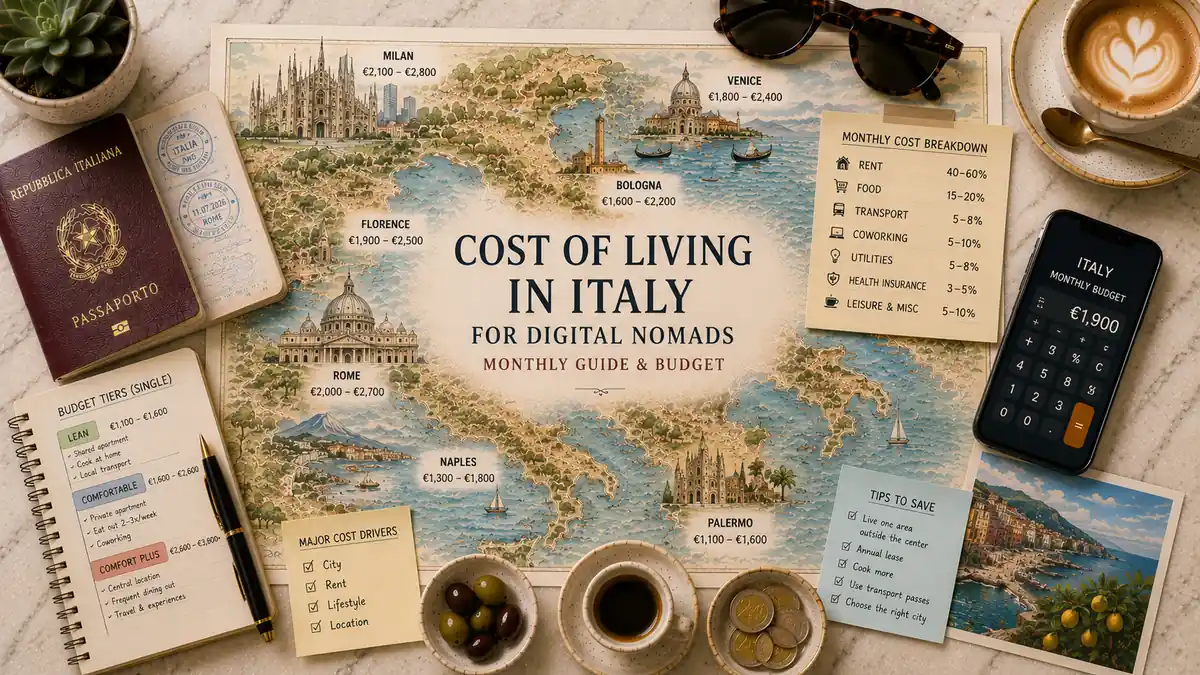
A comfortable monthly budget for a single nomad in Italy runs about €1,600 to €2,600. Lean living trims that to roughly €900–€1,500 by sharing housing and cooking at home; a higher-end lifestyle pushes it to €2,700–€4,200 with a central apartment and frequent dining out. Each tier buys a clearly different daily reality.
The tiers differ mostly in housing and comfort, not survival. A lean nomad shares a flat, cooks most meals, and works from cafés or a part-time desk. A comfortable nomad rents a private one-bedroom, eats out a few times a week, and keeps a proper coworking membership. A higher-end nomad takes a central apartment, a dedicated desk, and treats dining out as routine. The category table below shows how each line moves across the three tiers.
| Category | Lean | Comfortable | Higher-end |
|---|---|---|---|
| Rent | €450–€700, shared room or outer studio | €800–€1,300, private one-bedroom | €1,400–€2,200, central one-bedroom |
| Utilities and internet | €110–€160 including home internet | €150–€230 including home internet | €200–€300 including home internet |
| Food (groceries and dining) | €250–€350, mostly home cooking | €350–€550, some eating out | €550–€800, frequent restaurants |
| Transport | €30–€40 monthly transit pass | €40–€70 pass plus occasional rides | €70–€130 pass, taxis and rideshare |
| Coworking | €0–€100, cafés or part-time | €120–€220 hot-desk membership | €250–€400 dedicated private desk |
| Private health insurance | €40–€80 basic expat cover | €80–€150 mid-tier expat cover | €150–€250 comprehensive expat cover |
Moving up a tier in Italy is almost entirely a housing decision. Groceries and transport barely shift between lean and comfortable — the extra few hundred euros a month buys a private one-bedroom instead of a shared room, and a real desk instead of a café table. Keep in mind these are gross living costs. What actually stays in your pocket depends on how digital nomads are taxed in Italy, which sets your net income before any of this is spent.
Where your money goes: the monthly cost breakdown
Rent is the biggest line in an Italian nomad budget; everything else is secondary. Housing typically eats 40–60% of the monthly total, followed at a distance by food, utilities, coworking, health insurance, and transport. Internet is cheap and leisure is flexible. Control rent, and the rest of the budget falls into place around it.
Outside of rent, the smaller categories are fairly predictable across most of the country:
- Utilities (electricity, heating, water, gas): roughly €100–€200 a month, higher in winter.
- Home internet: around €25–€40 a month for fibre in most cities.
- Groceries: about €200–€350 a month for one person who cooks regularly.
- Public transport pass: roughly €30–€50 a month in most Italian cities.
- Leisure and dining out: highly flexible, commonly €150–€400 a month.
Treat every figure here as a range to verify before you commit, not a fixed price. Utilities in particular spike during the winter heating months and ease off in summer.
How much is rent per month for an apartment in Italy?
Rent for a one-bedroom apartment in Italy runs roughly €500 to €1,700 a month, depending on city and location. Central apartments in Milan and Rome anchor the top; one-bedrooms in Naples and smaller southern cities anchor the bottom. A room in a shared flat is cheaper still, commonly €400–€700 a month, which is how most lean nomads keep housing down.
Two factors move rent as much as the city itself: how central you live and how long you commit. Outer neighborhoods with a short metro or bus ride into the centre often cost 20–30% less than the historic core. Short-term furnished rentals aimed at tourists carry a heavy premium, while a standard annual lease is markedly cheaper for the same flat. Nomads who plan to stay several months almost always save by signing a longer contract.
How much does coworking cost per month in Italy?
A coworking membership in Italy costs roughly €100 to €350 a month. A flexible hot-desk plan sits at the lower end, around €100–€200, while a dedicated desk you keep permanently runs closer to €200–€350. Day passes exist for occasional use, and many nomads mix café work with a part-time plan to trim this line.
This is a cost-only picture. Which cities have the strongest coworking scenes, fastest internet, and best nomad communities is a separate question answered on the best-cities page — here it is purely a budget line.
How much is private health insurance per month for expats?
Private health insurance for expats in Italy typically costs €40 to €150 a month, depending on age and coverage level. Basic international plans sit at the lower end; comprehensive policies with wider coverage push higher. For most single nomads it is a modest but non-optional line in the monthly budget.
Insurance is also a visa requirement, not just a comfort. Italy’s digital nomad route obliges applicants to hold qualifying health coverage, so this line is effectively mandatory if you plan to live there legally. The exact coverage rules and income thresholds sit with the Italy digital nomad visa requirements — this page treats the premium only as a budget item.
Travel medical insurance
SafetyWing Nomad Insurance provides travel medical coverage designed for travelers and digital nomads, with flexible Monthly and Annual plans.
Check Nomad Insurance coverage and current pricing →
New Nomad Insurance Essential members can get 8 weeks of electronic theft coverage free with reward code TRIPSTOU8.
Apply the reward before creating your SafetyWing account by looking for the pink camera icon on the Nomad Insurance page.
Tripstou may earn a commission if you purchase through this link, at no extra cost to you.
Cost of living by city: Rome, Milan, Florence, Bologna, Naples, and the south
Milan and Rome are the most expensive cities to live in Italy; the south and smaller cities are the cheapest. Florence and Bologna sit in the middle — desirable but below the northern peaks. Naples and southern towns can cut your monthly total by a third or more, almost entirely through lower rent.
The table below compares typical one-bedroom rent against an estimated comfortable-tier monthly total, so the north-to-south spread is visible at a glance.
| City | Typical one-bed rent | Estimated monthly total |
|---|---|---|
| Milan | €1,100–€1,700 central one-bedroom | €2,200–€3,200 comfortable tier |
| Rome | €950–€1,500 central one-bedroom | €2,000–€2,900 comfortable tier |
| Florence | €850–€1,300 central one-bedroom | €1,800–€2,600 comfortable tier |
| Bologna | €800–€1,200 central one-bedroom | €1,700–€2,500 comfortable tier |
| Naples | €550–€950 central one-bedroom | €1,400–€2,100 comfortable tier |
| Southern and smaller cities | €400–€750 one-bedroom apartment | €1,100–€1,700 comfortable tier |
The city gap is almost pure rent. Groceries, a transit pass, and a coworking desk cost roughly the same in Naples as in Milan — it is housing that makes the north €600–€900 a month pricier, so picking a city is really a rent decision in disguise. Which city actually suits your work style, internet needs, and community is a different question, answered by the best cities in Italy for digital nomads guide. Here the comparison is on cost alone.
How can you lower your cost of living in Italy as a nomad?
Rent is the lever with the most give, so cut housing first. Choosing a smaller or southern city, living in an outer neighborhood, and signing an annual lease instead of paying short-term rates can each shave hundreds off the monthly total. Everyday spending — cooking over dining out — trims the rest.
The highest-leverage moves, in rough order of impact:
- Base yourself in a cheaper city. The north-to-south rent gap alone can reset your budget by a third.
- Live one ring out from the centre. A short commute in usually cuts rent 20–30% for the same flat size.
- Sign a longer lease. Annual contracts undercut tourist-priced furnished rentals substantially.
- Cook most meals and shop at local markets. Groceries cost a fraction of eating out.
- Mix café work with a part-time coworking plan instead of paying for a dedicated desk you barely use.
The cheapest move most nomads skip is timing the lease, not choosing the city. Italian landlords discount standard annual contracts heavily against short-term furnished rentals aimed at visitors — the same apartment can cost 30–40% less on a twelve-month lease than on a rolling monthly one. Commit to the stay, and housing, your largest line, drops before you touch anything else.
Frequently Asked Questions
Is southern Italy cheaper than the north to live in?
Yes, southern Italy is noticeably cheaper than the north, mainly on rent. Naples and smaller southern cities can run a third less than Milan or Rome for a comparable lifestyle. The trade-off is thinner coworking and international infrastructure, so you save on housing but may compromise on remote-work amenities.
What’s the cheapest city in Italy for digital nomads?
On cost alone, Naples and smaller southern cities are the cheapest places to base as a nomad. Rents there can sit well below half of central Milan’s, pulling the whole monthly total down. Cost is only one factor, though — which city actually suits your work and community is a separate decision covered by the best cities in Italy for digital nomads guide.
How much income do you need for the Italy digital nomad visa?
The Italy digital nomad visa requires a minimum income plus proof of health insurance. Treat that threshold as a budget floor sitting above your monthly living costs. The exact figure and qualifying criteria are set by the visa rules and change periodically, so confirm them on the Italy digital nomad visa requirements guide before applying.
Is living in Italy cheaper than a short holiday there?
Per day, yes — living in Italy is far cheaper than holidaying there. Residents pay monthly rent, cook at home, and buy transit passes, while tourists absorb nightly hotel rates and restaurant markups. A month of settled living can land near what one or two tourist weeks cost. For holiday budgeting, see the cost of a short trip to Italy.
How does Italian tax affect your take-home budget?
Tax determines how much of your gross income survives to fund daily life. Your real cost of living depends on take-home pay, not headline earnings, so the ranges here are gross and shrink after tax. How nomads are taxed in Italy is covered separately in the digital nomad taxes in Italy guide.
What monthly income should you aim for to live comfortably in Italy?
Aim for a net monthly income comfortably above €2,600 to live well as a single nomad in Italy. That leaves margin over the comfortable-tier ceiling for savings, travel, and irregular costs. In a cheaper southern city you can live comfortably on less; in central Milan or Rome, budget higher.
Related Guides
Once you have a monthly number, these guides resolve the decisions that sit around it:
- Living in Italy as a digital nomad — the parent decision on whether Italy is right for you as a remote worker.
- Best cities in Italy for digital nomads — choosing which city to actually base yourself in.
- Italy digital nomad visa requirements — the income threshold and insurance rules behind the budget.
- Digital nomad taxes in Italy — how tax shapes your net income and take-home budget.
- Cost of a short trip to Italy — budgeting a holiday instead of living there long term.
Did this guide save you time or money? Tripstou is independent and reader-funded — if you'd like to give something back, you can support the site with a crypto contribution of any size.