Living and working remotely from Italy can quietly turn you into an Italian taxpayer, and the moment it happens is not when you file — it is when you cross the residency line. This guide answers one question: does building your working life in Italy make you liable for Italian tax, and what must you actually do about it? The logic is simpler than the paperwork. Your residency status decides everything. Once Italy treats you as resident, your worldwide income enters its tax system, and self-employed remote workers face a chain of registrations and a regime choice on top. Every rate, ceiling, and deadline below is drawn from Agenzia delle Entrate, Italy’s tax authority, and framed as a range because these figures move. None of it replaces individual advice — a commercialista confirms how the rules land on your exact situation before you register or file.
Quick Answer
Spend more than roughly half the year in Italy and you likely become an Italian tax resident. Your worldwide income then becomes taxable there. Self-employed residents generally need a partita IVA and choose a tax regime — the forfettario flat tax or the ordinary regime. Confirm your status and regime with a commercialista before you act.
Trust Layer
Tripstou planning guide for travelers resolving one travel decision. Covers the main variable, traveler context, and practical tradeoffs.
Produced with AI assistance and reviewed by Alex Perrut, working in tourism since 2015, for the Tripstou editorial team. See our editorial process for details.
Last factual review: July 11, 2026.
Official sources consulted: italia.it, enit.it.
Key Takeaways
- Your tax residency status decides everything: cross Italy’s residency line and your worldwide income, not just Italian earnings, becomes taxable there.
- Residency turns on a four-part test — presence, domicile, home, and anagrafe registration — so the 183-day count is only one trigger.
- Self-employed residents generally must open a partita IVA, and its registration timing shapes which tax regime you can elect.
- The regime forfettario offers a low flat substitute tax but is gated by a revenue ceiling and strict eligibility conditions.
- Choose forfettario for simplicity, ordinary for deductions and no ceiling — but have a commercialista model both before you register or file.
Table of Contents
How are digital nomads taxed in Italy?
Whether Italy taxes you hinges on one thing: becoming a tax resident. Cross that line and Italy taxes your worldwide income; stay under it and only Italian-source income is generally in scope. Self-employed residents then open a partita IVA and pick a tax regime. Everything below follows from your residency status.
The whole system runs on a single sequence, and each step depends on the one before it:
- Establish whether you are tax resident — the residency test decides this.
- Get a codice fiscale, Italy’s tax identification number.
- If you are self-employed, open a partita IVA so you can invoice and be taxed correctly.
- Choose your tax regime — the forfettario flat tax or the ordinary regime.
- File and pay annually, with a commercialista confirming the details.
Employees kept on a foreign payroll and freelancers land in different places even at the same income. The residency trigger is shared, but only the self-employed carry the partita IVA and regime decision, so this page maps both paths.
The order matters more than any headline rate here: register your partita IVA before you understand your regime options and you can lock in the wrong setup for the tax year. If you are still weighing whether Italy suits you as a base at all, that go/no-go call sits in our Italy digital nomad guide; this page stays on the tax mechanics.
When do you become an Italian tax resident?
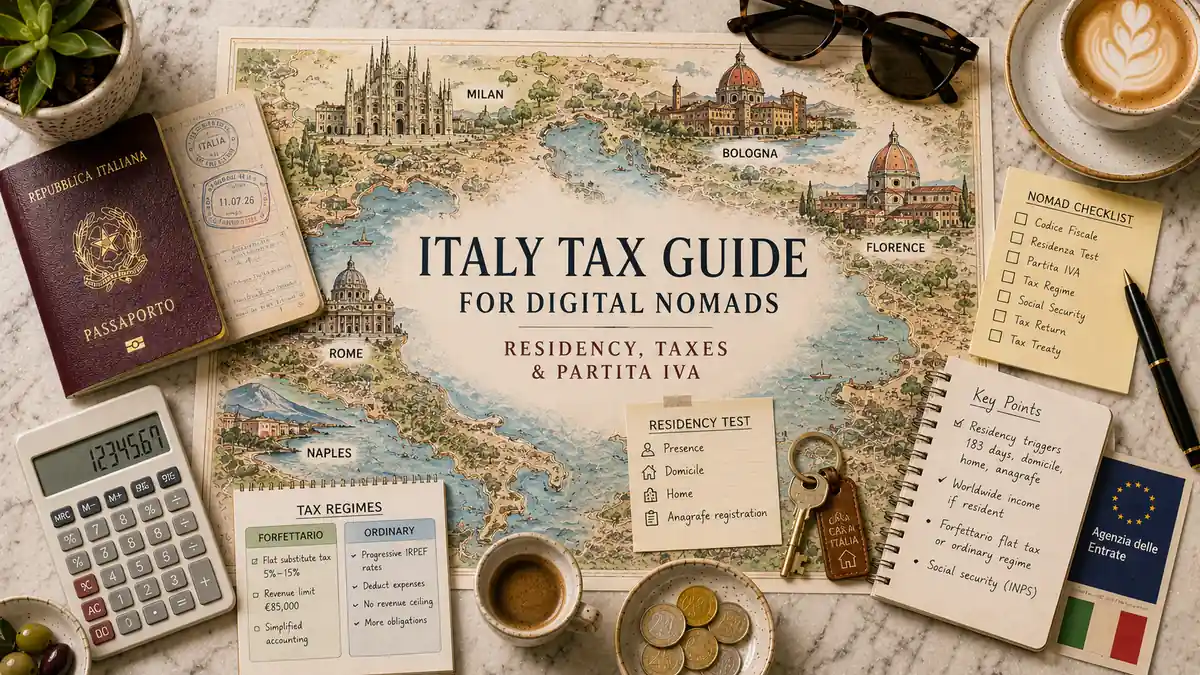
You become an Italian tax resident when you meet any single arm of Italy’s residency test. Agenzia delle Entrate applies a four-part test covering residence, domicile, physical presence, and registration in the anagrafe. Meet any one for most of the tax year and Italy treats you as resident. One arm alone is enough.
The four arms work independently, which is what catches remote workers off guard. Physical presence is the obvious one, but registering in the anagrafe (the local population register), keeping your main home in Italy, or centering your personal and economic life there can each pull you into residency even if you tried to stay under the day count. Agenzia delle Entrate recently reformed how these arms are read, so the wording matters. Because these tests turn on the specifics of your living situation, a commercialista is the right person to confirm which arm applies to you.
What is the 183-day rule?
The 183-day rule treats you as resident if you spend more than roughly half the tax year in Italy. Agenzia delle Entrate counts days of physical presence across the calendar year, and its reformed guidance — Circular 20/E — clarifies how partial days and the reworked residency arms are read. Treat 183 as an approximate threshold, not a precise figure to plan around, and verify the current day-counting method with Agenzia delle Entrate before you rely on it. A commercialista can tell you which days actually count in your case.
Does the digital nomad visa mean you owe Italian tax?
No — the digital nomad visa does not exempt you from Italian tax once you are resident. A visa grants the right to stay; it says nothing about what you owe. If your time in Italy makes you tax resident, worldwide-income liability follows regardless of which permit you hold. The eligibility rules, income requirement, and application steps live in our Italy digital nomad visa guide — this page stays on the tax consequences.
Do you pay Italian tax on your worldwide income?
Yes — Italian tax residents are taxed on their worldwide income. Once you cross the residency line, Italy taxes what you earn globally, not only what comes from Italian clients or Italian sources. Foreign salary, freelance invoices, and investment income all enter the Italian base. Double-taxation treaties can soften the overlap.
Italy runs a network of double-taxation treaties and allows foreign tax credits, so income already taxed abroad is not automatically taxed in full a second time. How much relief you get depends on your home country’s treaty with Italy and the type of income. This is qualitative by nature — the mechanics vary case by case, and Agenzia delle Entrate is the authority on how a given treaty applies.
Worldwide taxation is why your home-country tax bill rarely just disappears when you move. You often file in two places and lean on a credit or exemption to avoid paying twice — a coordination job that rewards professional help over guesswork.
Do you need a partita IVA to work remotely from Italy?
Yes — self-employed tax residents generally need a partita IVA to work legally from Italy. The partita IVA is your VAT and self-employment tax number; it lets you invoice clients and report income correctly. You also need a codice fiscale first. Employees on a foreign payroll may not need one, but freelancers and contractors almost always do.
The codice fiscale is the baseline tax ID that everyone dealing with Italian bureaucracy holds; the partita IVA is the extra registration that identifies you as a self-employed operator. Italy expects the partita IVA to be opened promptly once you start self-employed activity as a resident — commonly cited as within about 30 days of beginning work. Treat that window as approximate and confirm the current deadline with Agenzia delle Entrate, since registration timing feeds directly into which regime you can elect.
What is the regime forfettario, and who qualifies?
The regime forfettario is Italy’s flat-tax regime for eligible small freelancers and sole traders. It replaces the ordinary income tax, regional and municipal surtaxes, and VAT with a single reduced substitute tax. That simplicity is its draw. But it is gated by a revenue ceiling and several eligibility conditions, so not every remote worker can use it.
The regime is built around a substitute tax charged at a low flat rate, with a reduced startup rate available for a limited opening period before it steps up to the standard rate. The figures commonly cited — a revenue ceiling around €85,000, a startup rate near 5%, and a standard rate near 15% — are approximate and move over time, so verify each against Agenzia delle Entrate before you plan around them. Your taxable base is also set by an ATECO-code profitability coefficient rather than your real expenses, which is why the regime suits low-cost service work. Because the eligibility gates and coefficients are technical, confirm your fit with a commercialista instead of self-assessing.
The flat rate can quietly lose to the ordinary regime once your deductible costs climb. A heavily equipped or expense-heavy freelancer sometimes keeps more under ordinary rules despite the higher headline rate, because the forfettario ignores real expenses by design.
Who qualifies for the regime forfettario?
You qualify for the regime forfettario if your annual revenue stays under the ceiling and you meet the conditions Agenzia delle Entrate sets. The gates are qualitative here on purpose — the exact figures shift, so treat these as the shape of the rules, not final numbers:
- Annual revenue below the forfettario ceiling (commonly cited around €85,000 — verify current value).
- No disqualifying prior-residency or existing-employer relationships that the rules screen out.
- Activity that fits an eligible ATECO category with its own profitability coefficient.
- No controlling stake in businesses that would conflict with your registered activity.
Several of these conditions turn on your recent history and existing income, which is exactly where self-assessment goes wrong. Have a commercialista check your eligibility against the current Agenzia delle Entrate criteria.
Regime forfettario vs the ordinary regime — which should you choose?
Choose the forfettario for simplicity and a low flat rate; choose the ordinary regime for deductions and no revenue ceiling. The forfettario trades away expense deductions for a simple, low substitute tax, and it caps your revenue. The ordinary regime is more paperwork but lets high earners and expense-heavy businesses deduct real costs. Your margins decide.
Cells describe how each regime behaves in general; no rate or ceiling here is a fixed figure — verify current values with Agenzia delle Entrate.
| Factor | Regime forfettario | Ordinary regime |
|---|---|---|
| How tax is calculated | Low flat substitute tax on a coefficient base | Progressive IRPEF brackets plus regional and municipal surtaxes |
| Revenue ceiling | Capped; exceeding it forces a regime change | No revenue ceiling on eligibility |
| Expense deductions | Real expenses largely ignored by design | Actual business costs deductible against income |
| Paperwork and VAT | Simplified reporting; generally outside standard VAT | Fuller accounting and standard VAT obligations |
| Best suited to | Low-cost service freelancers under the ceiling | Higher earners or expense-heavy, growing businesses |
The ceiling behaves like a threshold, not a gentle slope. Cross the forfettario revenue limit and you move toward the ordinary regime, so freelancers working near the cap watch their turnover across the year deliberately — and verify the exact exit mechanics with Agenzia delle Entrate, because they are technical. What actually lands in your pocket after tax is a separate question from what you owe; for how far post-tax income stretches month to month, see the cost of living in Italy. Before you elect a regime, have a commercialista model both against your real numbers.
Should you hire a commercialista before acting?
Yes — engage a commercialista before you register, choose a regime, or file. Residency status, regime eligibility, and how your home-country treaty interacts with Italy are all individual, and small details change the answer. A commercialista — an Italian chartered accountant — confirms your setup, files correctly, and keeps you compliant.
The value is not just filing forms. A commercialista tells you which residency arm applies, whether the forfettario actually beats the ordinary regime at your income and cost level, how your home country’s treaty offsets Italian tax, and when your registrations are due. Getting any of those wrong is expensive to unwind. Against that risk, a professional fee is minor — and it is the one recommendation on this page that applies to every remote worker, regardless of income or setup.
Frequently Asked Questions
Do you need a codice fiscale as a remote worker in Italy?
Yes, a codice fiscale is the baseline tax identification number you need for almost any dealing with Italian authorities. You will use it to open a bank account, sign a lease, register a partita IVA, or file taxes. It is separate from, and required before, the self-employed partita IVA.
Do US citizens still pay US tax while living in Italy?
Yes, US citizens must keep filing US federal returns on worldwide income regardless of where they live, because the US taxes by citizenship. Mechanisms like the foreign earned income exclusion and foreign tax credits can reduce or offset double taxation, but they rarely remove the filing obligation. A cross-border tax professional is essential here.
What happens if you stay in Italy less than 183 days?
Staying under 183 days does not automatically keep you out of Italian tax residency. The residency test has other arms — your domicile, your main home, or anagrafe registration — and meeting any one can still make you resident. If none apply, only your Italian-source income is generally taxable. Confirm your status with a commercialista.
Do self-employed nomads pay social security contributions in Italy?
Yes, self-employed tax residents in Italy generally owe social security contributions on top of income tax, typically through INPS or a professional fund tied to your activity. These contributions are separate from your chosen tax regime and can be a significant cost. Ask a commercialista how they apply to your ATECO category.
What are the risks of registering your partita IVA late?
Registering late can expose you to penalties and interest, and it may complicate or delay electing the tax regime you want for the year. Italy expects the partita IVA to be opened soon after you begin self-employed activity as a resident. Confirm the current deadline with Agenzia delle Entrate and act through a commercialista.
How does a tax treaty stop you being taxed twice on the same income?
A double-taxation treaty assigns taxing rights between Italy and your home country and provides relief, usually through a foreign tax credit or an exemption. The exact method depends on the treaty and income type, so the same salary can be handled differently case by case. A commercialista or cross-border adviser confirms how yours applies.
Related Guides
- Italy digital nomad guide — whether Italy is the right base for you as a remote worker, and how the visa, taxes, and cost-of-living pieces fit together.
- Italy digital nomad visa — eligibility, income requirement, and the step-by-step application for Italy’s digital nomad visa.
- Cost of living in Italy — monthly budgets for remote workers and how far your post-tax income actually goes.
- Best cities in Italy for digital nomads — where to base yourself once the tax and visa questions are settled.
- Italy visa requirements — the short-stay entry rules that apply before any residency question arises.
Did this guide save you time or money? Tripstou is independent and reader-funded — if you'd like to give something back, you can support the site with a crypto contribution of any size.