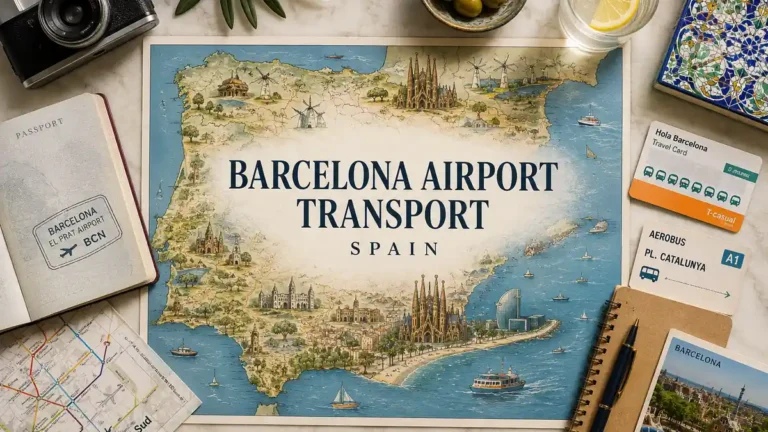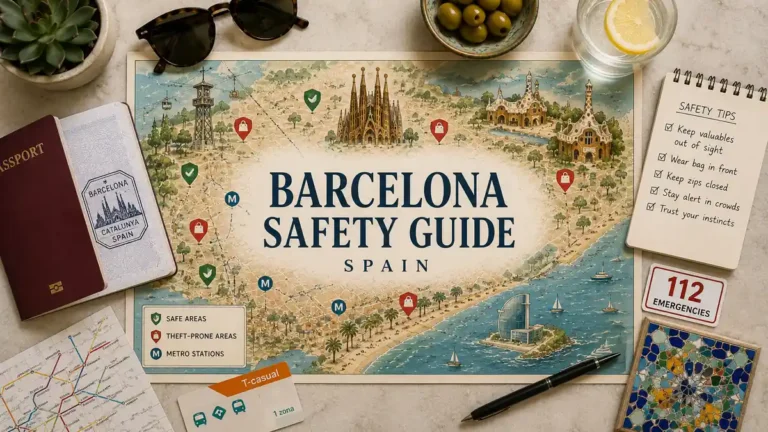
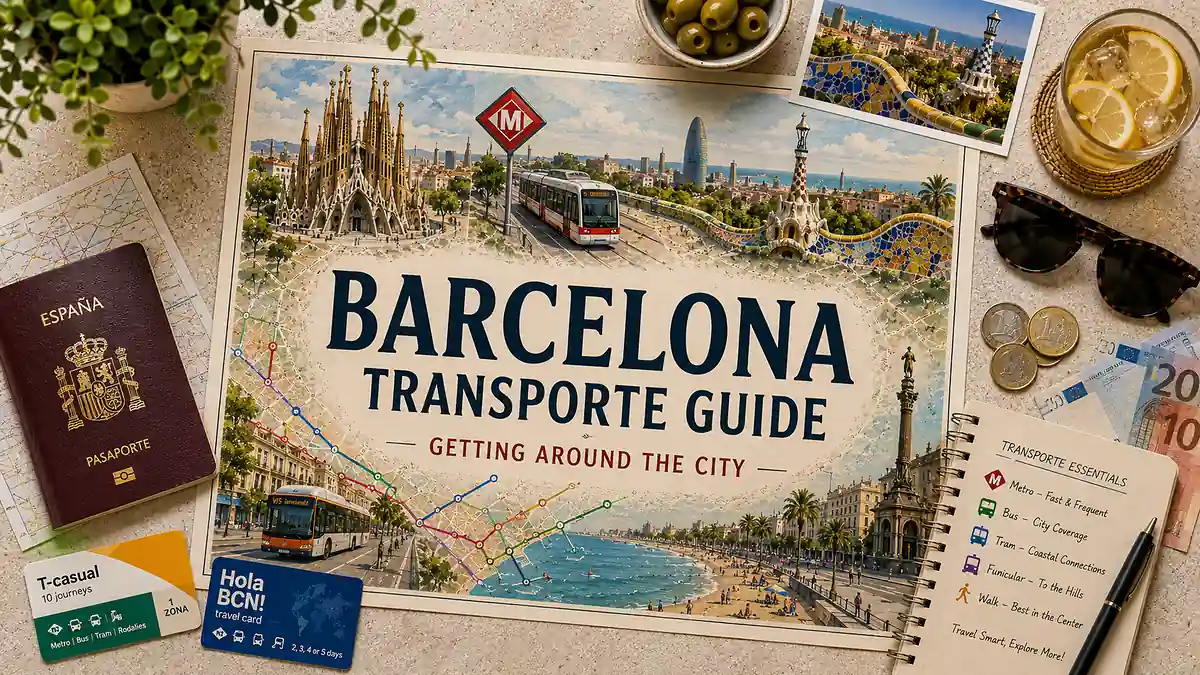
The real question for most Barcelona visitors is simple: what is the smartest way to move around the city, and which ticket should you actually buy? Barcelona has a dense, well-connected network, but you do not need to learn all of it to get around well. For a typical short stay, the answer comes down to two things — the metro plus walking as your backbone, and the right ticket for your trip length and group size. This guide resolves that decision fast, explains what each ticket covers, and flags the one gotcha that catches travelers off guard. Everything else, from the funicular to the regional trains, is useful context but rarely changes what you should do on a normal city break.
Quick Answer
Most visitors get around Barcelona best with the metro plus walking in the compact center. The right ticket depends on trip length and group size: a shareable T-casual 10-trip pack suits short stays, while a Hola BCN card suits longer solo trips. Buy a T-casual for a typical city break; choose Hola BCN for heavy daily riding.
Trust Layer
Tripstou planning guide for travelers resolving one travel decision. Covers the main variable, traveler context, and practical tradeoffs.
Produced with AI assistance and reviewed by Alex Perrut, working in tourism since 2015, for the Tripstou editorial team. See our editorial process for details.
Last factual review: June 3, 2026.
Official sources consulted: travel-europe.europa.eu, european-union.europa.eu.
Key Takeaways
- Metro plus walking is the default strategy for most short-stay visitors, since Barcelona’s center is compact and dense.
- The T-casual versus Hola BCN choice comes down to trip length multiplied by how many people are riding.
- A T-casual 10-trip pack can be shared across a couple on separate trips, often making it cheaper for short breaks.
- Hola BCN suits one person riding heavily over consecutive days, since it gives unlimited journeys within a set window.
- The airport metro is excluded from standard integrated tickets; only the Hola BCN card covers that line.
- Integrated tickets let you transfer between modes on one validated journey within a set transfer window.
Table of Contents
How Do You Get Around Barcelona?
You get around Barcelona mainly by metro and on foot, with a few specialist modes for specific trips. The core network is the metro, city buses, and trams run by TMB, plus FGC commuter lines and Rodalies regional trains. For most visitors, the metro plus walking covers nearly everything they need.
Here is how the realistic mode set breaks down for a visitor:
- Metro (TMB): the backbone — frequent, fast, and reaching every major neighborhood and most sights.
- Bus (TMB): useful for surface routes and slopes the metro misses, but slower in traffic.
- Tram (TMB): handy along a few outer corridors; rarely central to a tourist’s day.
- FGC: commuter rail that doubles as metro inside the city and reaches some uphill destinations.
- Rodalies: regional trains for trips beyond the city core and day excursions.
- Funicular and cable cars: the Montjuïc funicular and cable cars are scenic ways up the hill, more attraction than transport.
You do not need to master all of these to move confidently. The metro alone connects the Gothic Quarter, the Eixample, Gràcia, the beachfront, and the main stations, so it handles the vast majority of visitor journeys. The other modes fill specific gaps rather than forming part of a daily routine. For broader orientation on how the city’s districts fit together, our Barcelona travel guide sets the wider context, while this page stays focused on how to move and what to buy.
What’s the Smartest Way to Get Around for a Short Stay?
The smartest way to get around for a short stay is metro plus walking, full stop. Barcelona’s center is compact and dense, so most attractions sit within a short walk or one or two metro stops of each other. This combination is faster, cheaper, and simpler than mixing in taxis or learning every line.
The logic is straightforward: distances between central sights are short, and the metro covers the longer hops efficiently. A practical way to think about it by area:
- Gothic Quarter, El Born, El Raval: walk — these dense central districts are quicker on foot.
- Eixample (including Sagrada Família, Passeig de Gràcia): walk short hops, metro for the longer ones.
- Gràcia, Montjuïc, the beaches, Park Güell: metro or bus, since they sit further out or uphill.
- Day trips and outer destinations: add FGC or Rodalies as needed.
Add a bus only when a route saves a steep climb or a long detour, and reach for FGC when your destination sits on one of its lines. Where you base yourself shapes how much you ride: a central stay means more walking and fewer tickets, while an outer base leans more on the metro. Our guide to where to stay in Barcelona covers that area-to-transit tradeoff in full, so you can match your base to how you plan to move.
Which Barcelona Transport Card Should You Buy?
Buy a T-casual for most short trips and a Hola BCN card for longer or heavy-use solo stays. The single deciding variable is trip length combined with group size: the T-casual is a 10-journey pack you can share, while Hola BCN is an unlimited time-based card for one person. Match the card to how often and how many.
The three options most visitors weigh are the single ticket, the T-casual, and the Hola BCN. The single ticket only makes sense for a one-off ride. For everything else, the choice is between the shareable 10-trip pack and the unlimited time card.
| Ticket | What it is | Shareable? | Best for |
|---|---|---|---|
| Single ticket | One integrated journey within the zone | No — one rider, one trip | A single one-off ride |
| T-casual | A 10-journey pack within the zone | No — one person per pack, but buy several | Short or light-use city breaks |
| Hola BCN | Unlimited travel for a set time window | No — personal to one rider | Longer solo stays with heavy riding |
One important nuance: the T-casual is a single-person card on each tap, but a 10-journey pack can be used up across a couple of light-riding travelers sharing the same physical card on separate trips, which often makes it the cheaper choice for a couple on a short break. Hola BCN, sold in fixed windows from 48 hours upward, wins when one person rides many times a day over several days. Prices and exact validity windows change, so confirm current figures before you buy; to see how the ticket cost fits your wider budget, check our breakdown of Barcelona trip cost.
Train and bus tickets
Compare routes, schedules and prices across rail and bus operators in one search, with mobile tickets on your phone.
New to Omio? Code NEW10 takes 10% off your first booking — or APPNEW10 if you book inside the Omio app. Both apply to bookings up to €80.
Search routes and compare prices on Omio →
Tripstou may earn a commission if you book through this link, at no extra cost to you.
T-casual vs Hola BCN: How to Choose
Choose the T-casual when you ride lightly or want to share trips across people, and Hola BCN when one person rides heavily over consecutive days. The T-casual is a fixed pack of 10 journeys with no time limit; Hola BCN is unlimited journeys within a set time window. The breakpoint is rides per day multiplied by number of travelers.
Two simple scenarios make the decision clear:
- Couple on a 2–3 day break, mostly walking: a T-casual usually wins — you make only a handful of metro trips, and the 10-journey pack stretches across both of you.
- Solo visitor on a 4–5 day stay riding often: Hola BCN usually wins — unlimited rides over the window cost less than buying journey after journey.
The mental test is whether your total rides will exceed what a few T-casual packs cover within your time on the ground. If you walk most of the center and dip into the metro a few times a day, the journey pack is hard to beat. If the metro is your default for nearly every move and you are alone, the time-based card pays off. Because the exact prices shift, run the comparison against current figures rather than a fixed number.
What Do Barcelona Transport Tickets Cover (and Not Cover)?
Standard integrated tickets cover the metro, TMB buses, tram, FGC, and Rodalies within the validity zone as one linked journey. The headline gotcha: the airport metro is not included in standard integrated tickets — only the Hola BCN card covers it. Plan for that exception before you arrive.
Within the zone, the integrated system treats a connected trip across modes as a single journey, so switching from metro to bus or FGC mid-trip does not always cost a second fare. The practical points to remember:
- Single and T-casual tickets work across metro, bus, tram, FGC, and Rodalies inside the covered zone.
- Zone limits apply — trips beyond the standard zone need different validity, which matters mainly for excursions.
- The airport metro line is the key exclusion from standard tickets; Hola BCN is the card that includes it.
Airport arrival options sit outside this guide — that is a separate decision with its own routes and fares — so here it is enough to know the standard ticket you buy for the city will not cover the airport metro unless you choose Hola BCN. Confirm current zone definitions when you buy, since they can change.
How Do You Tap In and Transfer in Barcelona?
You tap or scan your ticket at the gate or validator each time you start a journey, and the integrated system lets you transfer between modes on one validated journey within a set time window. That means a metro-to-bus or metro-to-FGC connection can count as one trip rather than two, as long as you stay inside the transfer window.
In practice, validate at the metro turnstile, on board the bus, or at the FGC and Rodalies gates, depending on the mode. The integrated-transfer concept is the part worth understanding: a single fare can carry you across a connected chain of modes, so a journey with one change is usually one charge, not two. The transfer window has a fixed time limit, so a smooth connection counts as one trip while a long pause or a return leg starts a new one — check the current minute figure when you travel, as it can be adjusted. For broader first-timer practicalities around using the system day to day, see our Barcelona travel tips.
When Should You Just Walk Instead?
You should just walk whenever your destination is within the compact historic center, because short central hops are often faster on foot than underground. Walking down to a station, waiting for a train, and walking back up frequently takes longer than the direct surface route between two nearby central sights.
The center’s density is the reason: many of Barcelona’s headline sights cluster close enough that the metro’s station-walk-plus-wait overhead outweighs its speed. Reserve the metro for longer crossings — beachfront to the upper Eixample, or the center out to Park Güell or Montjuïc — and walk the short links between neighboring attractions. This shapes how you build a day: clustering nearby sights on foot and saving metro rides for the big jumps keeps your itinerary efficient. Our 2-day Barcelona itinerary and 3-day Barcelona itinerary show how that walk-versus-ride balance plays out across a real day plan.
Frequently Asked Questions
Is the metro the best way to get around Barcelona?
Yes, the metro is the best single mode for most visitors, paired with walking. It is frequent, fast, and reaches every major neighborhood and most sights without dealing with traffic. For short central hops, though, walking often beats the metro, since you skip the station descent, the wait, and the climb back up.
How much does a T-casual cost in Barcelona?
A T-casual is a 10-journey pack priced in fixed tiers by travel zone, with the standard one-zone version covering nearly all visitor trips. Because fares are set by the transport authority and adjusted periodically, check the current price before you buy rather than relying on a fixed figure, especially for two-zone travel.
Does the Hola BCN card include the airport metro?
Yes, the Hola BCN card includes the airport metro line, which is its main advantage over standard tickets. The single ticket and T-casual do not cover the airport metro, so travelers relying on those need a separate fare for that trip. If airport metro matters to you, Hola BCN handles it in one card.
Can two people share one transport card in Barcelona?
Yes, two people can share a single T-casual on separate trips, since the 10-journey pack is not personal to one rider. Each tap uses one journey, so a couple making a few metro trips can split one pack. The Hola BCN card, by contrast, is personal and cannot be shared between riders.
How late does the Barcelona metro run?
The Barcelona metro runs late into the night, with extended or all-night service on certain days such as Saturdays. Exact opening and closing times vary by day of the week and can change, so confirm the current operating hours for your travel dates rather than assuming a fixed schedule, particularly for early mornings.
Do you need a car in Barcelona?
No, you do not need a car in Barcelona for a typical city visit. The metro plus walking covers the compact center and main sights efficiently, while parking is scarce and central driving is restricted. A car only makes sense for day trips beyond reach of regional trains, which most short stays avoid.
Related Guides
Use these guides to plan the rest of your Barcelona trip around how you move:
- Barcelona travel guide — broad city orientation and how the districts fit together.
- Where to stay in Barcelona — match your base to how you plan to get around.
- 2-day Barcelona itinerary — a tight route for a short break.
- 3-day Barcelona itinerary — a fuller plan with room to roam.
- Barcelona trip cost — see how transport fits your overall budget.
- Barcelona travel tips — first-timer practicalities for the city.
Did this guide save you time or money? Tripstou is independent and reader-funded — if you'd like to give something back, you can support the site with a crypto contribution of any size.